
经济弱复苏

Search documents
东兴证券晨报-20260331
Dongxing Securities· 2026-03-31 07:09
Core Insights - The report highlights a rebound in China's economic indicators, with the manufacturing PMI at 50.4%, non-manufacturing PMI at 50.1%, and composite PMI at 50.5%, indicating a recovery in economic sentiment [2] - The ongoing geopolitical tensions, particularly the conflict involving Iran, are expected to sustain high oil prices, impacting global supply chains and market sentiment [7][8] - The report suggests a potential shift in market dynamics towards value and defensive stocks due to the uncertainty surrounding the conflict, with a possible return to growth stocks if negotiations progress positively [9] Economic Indicators - In March, China's manufacturing PMI rose by 1.4 percentage points, non-manufacturing PMI by 0.6 percentage points, and composite PMI by 1.0 percentage points, indicating a return to expansion [2] - The People's Bank of China reported that M2 money supply reached 349.22 trillion yuan, growing by 9% year-on-year, while the social financing scale increased by 8.2% [2] Company Insights - China Bank reported a revenue of 659.87 billion yuan for 2025, a 4.28% increase year-on-year, with a net profit of 243.02 billion yuan, up 2.18% [3] - ZTE Corporation's computing business saw a 150% revenue increase, contributing nearly 25% to overall revenue, with significant growth in server and storage sales [3] - Huayu Automotive achieved a revenue of 183.99 billion yuan in 2025, an 8.49% increase, with a net profit of 7.21 billion yuan, up 7.51% [4] - Mengniu Dairy reported a revenue of 82.25 billion yuan, with a net profit of 1.55 billion yuan, marking a 1379% increase year-on-year [4] Industry Trends - The new energy storage industry is experiencing steady growth, with the Ministry of Industry and Information Technology focusing on top-level design and regulatory measures to enhance industry standards and prevent low-level competition [3] - The logistics and express delivery sector is seeing a recovery in market share for Zhongtong Express, with a business volume of 38.52 billion pieces in 2025, a 13.3% increase [15][16] - The airline industry is facing short-term challenges due to rising fuel prices, with China National Airlines reporting a significant loss attributed to increased tax expenses [11][12][14]
国债周报:债期各期限走势分化-20260323
Guo Mao Qi Huo· 2026-03-23 05:56
1. Report Industry Investment Rating - No information provided in the report 2. Core Viewpoints of the Report - The overall trend of Treasury bond futures this week showed a pattern of oscillating decline, with the adjustment amplitude of long - term varieties greater than that of short - term ones. The 30 - year Treasury bond futures performed the weakest, hitting a new low for the year at one point. The trading logic in the financial market has shifted from the initial support of risk - aversion sentiment to concerns about imported inflation. The soaring oil price has strengthened the global "re - inflation" expectation, causing major central banks to turn cautious in their monetary policies. The market has postponed the expectation of the interest - rate cut time to after the second quarter. For the Chinese bond market, the core contradiction of the trading logic is that the long - term risk of geopolitical conflicts has pushed up international energy prices, which may be transmitted to the domestic market through PPI, improve corporate profitability, and start a positive cycle of "PPI recovery - corporate profit improvement - enhanced credit demand", thus continuously suppressing the bond market, especially the long - term varieties sensitive to interest rates. The central bank's reduction of repurchase operations and factors such as tax periods, new share subscriptions on the Beijing Stock Exchange, and government bond payments have brought pressure on the capital side. Although the central bank will continue to implement a moderately loose monetary policy, the signal of support for the stock market may intensify the pressure on bond trends [4]. - China is expected to replicate its role during the epidemic, becoming the "stabilizer" of global production with its complete industrial chain. The domestic fundamentals are likely to have an independent cycle. In the short term, the bond market faces adjustment pressure due to external inflation and the marginal convergence of internal capital, especially the long - term bonds. In the medium term, it is expected to fluctuate within a range, and there is unlikely to be a trending unilateral market. For trading positions, it is advisable to adopt a band - trading strategy, entering and exiting quickly; for allocation positions, one can wait for the negative factors to subside and moderately participate during the adjustment [6]. 3. Summary According to Relevant Catalogs 3.1 Main Viewpoints - This week, Treasury bond futures showed an oscillating decline, with long - term varieties adjusting more than short - term ones. The 30 - year Treasury bond futures were the weakest. The trading logic in the financial market has shifted to concerns about imported inflation. The soaring oil price has strengthened the "re - inflation" expectation, and major central banks have maintained interest rates. The market has postponed the expectation of interest - rate cuts. For the Chinese bond market, geopolitical conflicts may push up energy prices, which may be transmitted through PPI, affecting bond prices. The central bank's reduction of repurchase operations and other factors have pressured the capital side, but the central bank will continue a moderately loose monetary policy. The signal of support for the stock market may increase bond pressure [4]. - China is expected to become the global production "stabilizer", and the domestic fundamentals may have an independent cycle. The bond market faces short - term adjustment pressure, especially for long - term bonds. In the medium term, it will likely oscillate within a range. Trading positions should use a band - trading strategy, and allocation positions can wait for negative factors to subside [6]. 3.2 Liquidity Tracking - Multiple charts are presented to show various aspects of liquidity, including open - market operations (currency投放, currency回笼, and net currency投放), medium - term lending facility (amount and price), reverse repurchase rates, inter - bank bond repurchase rates, deposit - type pledge - style repurchase rates, Shanghai Stock Exchange pledge - style repurchase rates, and loan market quotation rates, etc. [10][11][13] 3.3 Treasury Bond Futures Arbitrage Indicator Tracking - Charts are provided to show the basis, net basis, implied repo rate (IRR), and implied interest rate of 2 - year, 5 - year, 10 - year, and 30 - year Treasury bond futures [48][58][67][75]
构建商品牛市轮动框架-下一个或是化工
2026-03-01 17:23
Summary of Conference Call Records Industry Overview - The focus is on the commodity market, particularly the chemical sector, within the context of a potential commodity bull market rotation framework [1][2][3]. Key Points and Arguments - **Commodity Bull Market Rotation Framework**: Historical patterns show a rotation sequence of "precious metals → industrial metals → energy and chemicals → agricultural products" during commodity bull markets, typically triggered by liquidity easing and economic recovery [1][2]. - **Current Economic Context**: The U.S. economy is in a phase of monetary easing, weak recovery, and moderate inflation, which usually favors both stocks and commodities. Precious metals are expected to transition to industrial metals, with CPI steepening and significant potential for natural gas, energy, and chemicals to rise [1][6]. - **Chemical Sector Dynamics**: Chemical stocks often lead futures and spot prices, but concerns about "chemical stocks running ahead of fundamentals" need to be contextualized. Some chemical products have not shown universal fundamental support for their price increases [1][7]. - **PPI Analysis**: The Producer Price Index (PPI) is influenced by base effects, and understanding price direction requires a breakdown of PPI's internal structure to identify products with price increase potential. A negative growth convergence of -2% to 0% is anticipated for PPI in 2026 [1][8]. - **Investment Opportunities**: The chemical sector is positioned for potential profit expansion due to a combination of demand-side recovery and supply-side natural clearing, with capital expenditure growth at historically low levels [3][9][11]. Additional Important Insights - **Historical Comparisons**: Past commodity cycles, such as those in 2005 and 2009, exhibited similar patterns of price increases and rotation structures, emphasizing the role of precious and industrial metals in the early stages of recovery [5]. - **Supply-Side Dynamics**: The chemical sector is among those experiencing supply contraction, which is crucial for future price stability and potential profit growth. This is part of a broader trend affecting various industries, including energy metals and general machinery [9][10][11]. - **Policy Impact**: The current policy environment is more moderate compared to previous years, with a focus on natural clearing mechanisms rather than aggressive interventions. This includes capital expenditure reductions and industry consolidation [3][9]. Conclusion - The chemical sector is expected to gain increased attention from capital markets as it aligns with both demand recovery and supply-side constraints. The current economic phase suggests a favorable outlook for commodities, particularly chemicals, as they transition into a more prominent role in the commodity bull market cycle [11].
1月PMI数据点评:价格指数回升,结构亮点突出
Yong Xing Zheng Quan· 2026-02-09 08:33
1. Report's Industry Investment Rating No information provided about the industry investment rating in the report. 2. Core Viewpoints - Seasonal effects dragged down manufacturing production and demand, and the foundation for economic recovery needs to be consolidated. In January, the manufacturing PMI was 49.30%, down 0.8 percentage points from the previous value, falling below the boom - bust line. The new orders index on the demand side dropped 1.60 percentage points to 49.20%, and the production index on the supply side dropped 1.10 percentage points to 50.60% [1]. - Changes in the international trade environment disrupted the growth of external demand. In January, the new export orders index was 47.80%, down 1.20 percentage points from the previous value, while the import index was 47.30%, up 0.30 percentage points from the previous value. Although the manufacturing PMIs in the US and the Eurozone rebounded, changes in import policies or rules in some international markets expanded the impact on China's product exports [1]. - Driven by the rise in commodity prices, the price side of the manufacturing industry continued to recover. The raw material purchase price index remained in the expansion range, and the ex - factory price index rose above the boom - bust line, with the spread between the two widening by 1.3 percentage points to 5.50 pct [2]. - Non - manufacturing business slowed down, and the service industry was relatively stable. In January, the official non - manufacturing PMI was 49.40%, down 0.80 percentage points from the previous value. The service industry PMI was 49.50%, down 0.2 percentage points. The construction industry's business climate declined due to weather and holiday factors [2]. 3. Summary by Relevant Catalogs 3.1 PMI Presents Structural Highlights - The manufacturing PMI in January was 49.30%, down 0.8 percentage points from the previous value, falling below the boom - bust line. The new orders index on the demand side and the production index on the supply side both declined. The slowdown in demand due to the approaching Spring Festival and the pre - placement of some production capacity led to a seasonal contraction in manufacturing production and demand [12]. - Among different industries, the high - tech manufacturing PMI was 52.0%, remaining at a relatively high level for two consecutive months; the equipment manufacturing PMI was 50.1%, staying in the expansion range; the consumer goods industry and high - energy - consuming industries had PMIs of 48.3% and 47.9% respectively [12]. 3.2 External Environment Disturbance - In January, the new export orders index dropped, while the import index rebounded. Although the manufacturing PMIs in the US and the Eurozone improved, changes in international market import policies or rules increased the impact on China's exports, and the probability of export disturbances and uncertainties remained [19]. 3.3 Price - end Recovery - Driven by rising commodity prices, the manufacturing price - end continued to recover. The raw material purchase price index remained in the expansion range, and the ex - factory price index rose above the boom - bust line, with a wider spread. The current price recovery may be due to rising global commodity prices and previous policies to rectify "involution - style" competition, which may also be reflected in the next stage of PPI data. However, if raw material prices rise much faster than finished - product prices, it may put pressure on corporate profits [27][29]. 3.4 Attention to Corporate Business Vitality - In January, the PMIs of large, medium, and small enterprises all declined. Against the backdrop of rapidly rising raw material prices and uncertain external demand, improving corporate prosperity is a key link for continuous economic recovery, which helps promote the upstream - downstream transmission of prices and stabilize and expand domestic demand [31]. 3.5 Non - manufacturing Business Climate Decline - The non - manufacturing business slowed down in January, with the non - manufacturing PMI at 49.40%, down 0.80 percentage points from the previous value. The service industry PMI was 49.50%, down 0.2 percentage points. Some industries in the service sector, such as monetary and financial services, capital market services, and insurance, had high market activity, while the real estate industry was weak. The service industry's business activity expectation index increased, indicating enhanced confidence [34]. - The construction industry was still in the contraction range. Affected by weather and holiday factors, the construction industry's business climate declined, with the business activity index dropping 4.00 percentage points from the previous value. The business activity index and new orders index both decreased significantly, and the business activity expectation index fell below the critical point, showing cautious expectations from construction enterprises [35]. 3.6 Investment Suggestions - The domestic PMI data in January showed structural highlights. Although the manufacturing PMI, non - manufacturing PMI, and composite PMI output index declined from the previous values, indicating a short - term slowdown in economic prosperity during the traditional off - season, there were still highlights such as the expansion of the production side, the leading role of new - energy industries, and positive expectations in the service industry [3][40]. - The recovery of the price index was another feature of the manufacturing PMI in January. Affected by rising commodity prices, the main raw material purchase price index and ex - factory price index both increased, which was conducive to improving corporate revenue and profit margins [3][40]. - Looking forward to February 2026, manufacturing production may continue to slow down due to the Spring Festival, but it will gradually recover after the holiday. The service industry in the non - manufacturing sector is expected to benefit from Spring Festival consumption, and its business climate is likely to continue to improve. Overall, the economy will maintain a weak recovery trend, and the bond market will continue to show a slightly stronger oscillatory trend [3][40].
宏观政策维持宽松基调 为“十五五”开局奠定基础
Sou Hu Cai Jing· 2025-12-07 16:53
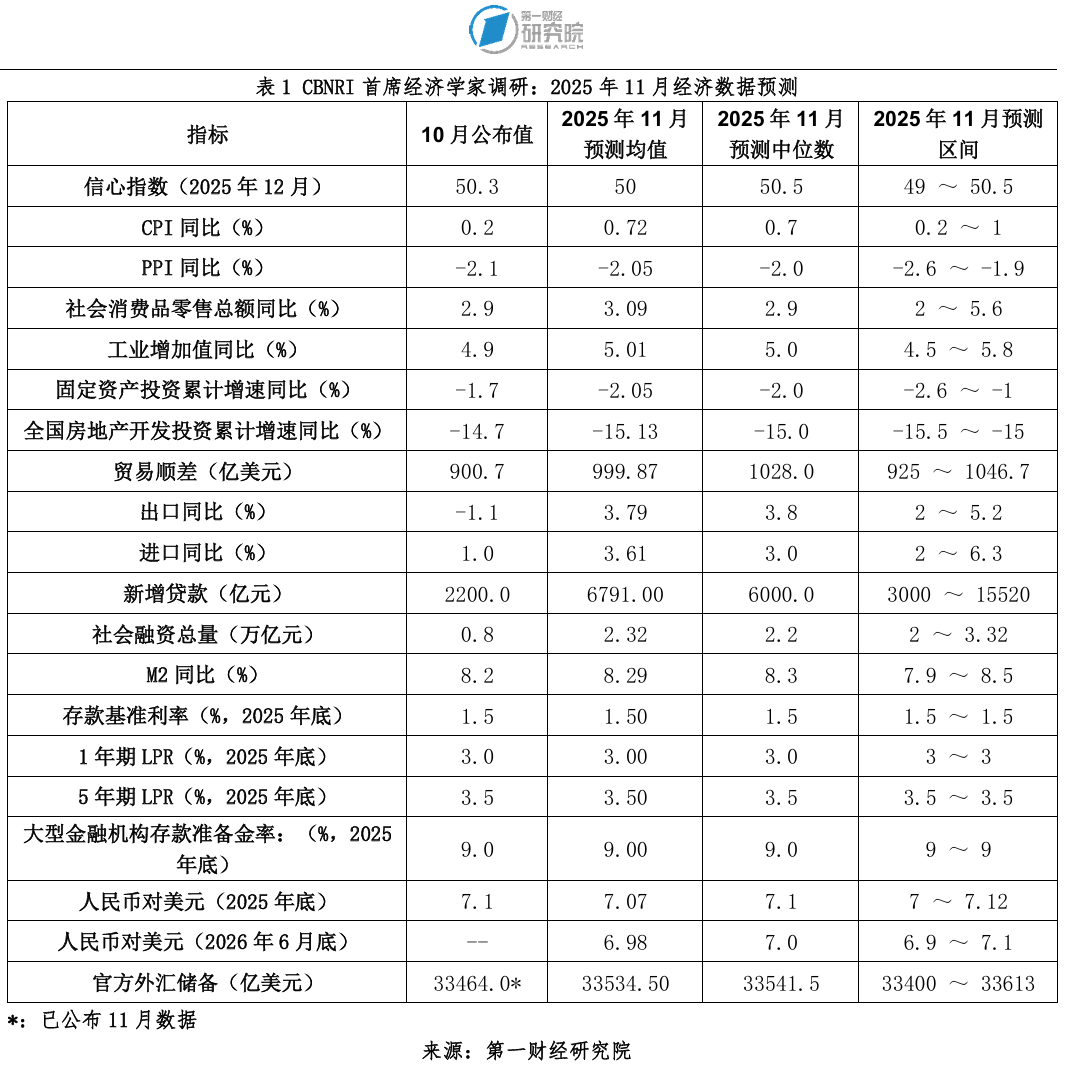
Group 1: Economic Outlook - The core viewpoint indicates that the macroeconomic policy for the fourth quarter maintains strategic consistency, focusing on precise efforts to stabilize economic growth while preparing for the "14th Five-Year Plan" [1][2] - The Chief Economist Confidence Index for December 2025 is reported at 50, indicating a weak recovery in the economy, with expectations for continued loose macro policies to support the upcoming "14th Five-Year Plan" [2][3] Group 2: Consumer and Investment Trends - The predicted growth rate for social retail sales in November is 3.09%, slightly higher than the previous month's 2.9%, driven by the "Double 11" shopping festival and a recovery in dining trends [5] - The forecast for fixed asset investment growth in November is -2.1%, indicating continued pressure from the real estate market and a decline in construction investment [7][8] Group 3: Industrial and Trade Performance - The predicted growth rate for industrial added value in November is 5.0%, showing a slight increase from the previous month's 4.9%, with improvements in manufacturing PMI indices [6] - The forecast for November's trade surplus is $999.87 billion, higher than the previous month's $900.7 billion, with expectations for both imports and exports to show positive growth [10] Group 4: Monetary and Fiscal Policy - The average prediction for new loans in November is 6,791 billion yuan, a significant increase from the previous month's 2,200 billion yuan, indicating a potential easing in credit conditions [11][12] - The monetary policy is expected to remain moderately loose, with potential for further interest rate cuts and structural tools to support economic growth [15][20] Group 5: Inflation and Price Trends - The predicted Consumer Price Index (CPI) growth for November is 0.72%, while the Producer Price Index (PPI) is forecasted at -2.05%, reflecting ongoing price pressures in the economy [3][4]
一财首席经济学家调研:宏观政策维持宽松基调,为“十五五”开局奠定基础
Di Yi Cai Jing· 2025-12-07 12:10
Core Viewpoint - The "First Financial Chief Economist Confidence Index" for December 2025 is at 50, slightly lower than the previous month, indicating a weak recovery in China's economy, with macro policies expected to maintain a loose tone to support the start of the "14th Five-Year Plan" [1][5][24]. Economic Indicators - The predicted Consumer Price Index (CPI) for November is 0.72%, up from 0.2% in the previous month, while the Producer Price Index (PPI) is expected to be -2.05%, slightly better than the previous month's -2.1% [7][8]. - The forecast for total retail sales of consumer goods in November is a year-on-year growth of 3.09%, an increase from 2.9% in October, driven by the "Double 11" shopping festival and a recovery in dining trends [8][9]. - Industrial added value is predicted to grow by 5.0% year-on-year in November, up from 4.9% in October, reflecting a slight recovery in manufacturing activity [9][10]. - Fixed asset investment is expected to decline by 2.1% year-on-year in November, worsening from the previous month's -1.7%, with pressures from the real estate market and manufacturing sector [10][11]. - Real estate development investment is forecasted to decrease by 15.1% year-on-year in November, indicating ongoing challenges in the sector [11][12]. Trade and Financial Data - The trade surplus for November is projected to be $999.87 billion, an increase from $900.7 billion in October, with both imports and exports expected to rise [14][15]. - New loans for November are anticipated to rebound to 6,791 billion yuan, significantly higher than the previous month's 2,200 billion yuan [15][16]. - The total social financing amount is expected to reach 2.32 trillion yuan in November, up from 0.81 trillion yuan in October [16][17]. - The M2 money supply growth rate is forecasted at 8.29%, slightly above the previous month's 8.2% [17][18]. Monetary Policy and Exchange Rates - Economists predict little change in the LPR and reserve requirement ratios in the near term, with a focus on maintaining liquidity in the market [18][19]. - The expected exchange rate for the Chinese yuan against the US dollar by the end of November is 7.07, with a potential adjustment to 6.98 by mid-next year [19][20]. Foreign Exchange Reserves - As of the end of November, China's foreign exchange reserves are reported at $33,464 billion, a slight increase from the previous month [20][21]. Policy Outlook - Future fiscal policies are expected to be more proactive, with an emphasis on increasing investment in infrastructure and social sectors to stimulate economic growth [22][24]. - The upcoming Central Economic Work Conference is anticipated to focus on the strategic significance of 2026 as the start of the "14th Five-Year Plan," emphasizing high-quality development and domestic demand [24][26].

2025年中美宏观经济与资产配置展望
Sou Hu Cai Jing· 2025-11-30 03:09
Group 1: US Economic Outlook - The US economy is experiencing short-term "stagflation," with GDP growth expected to slow from 2.8% in 2024 to 1.7% in 2025, and inflation pressures may rebound, with PCE inflation projected to rise to 2.8% in Q3 and 2.9% in Q4 of 2025 [2][24] - The real estate market continues to show signs of stagnation, with high interest rates leading to historically low purchasing power and sales, while many homeowners are reluctant to move due to locked-in low mortgage rates, resulting in tight inventory [2][29] - Corporate earnings growth has been downgraded, particularly in industries sensitive to trade wars and economic cycles, such as industrials, energy, and materials [3] Group 2: Federal Reserve and Monetary Policy - The Federal Reserve is expected to cut interest rates twice between September and December 2025, with a potential further two cuts in 2026, bringing the policy rate down to a range of 3.25%-3.5% [4] - However, due to potential increased influence from the White House on the Federal Reserve, market inflation expectations remain unstable, and rising government debt may keep Treasury yields elevated [5] Group 3: Investment Recommendations - Short-term investment focus should be on sectors such as healthcare, consumer staples, communication services, materials, and industrials [7] - Overall, the US stock market is in the late stages of a bull market, suitable for long-term dollar-cost averaging, with asset allocation recommendations to overweight commodities, standard allocation to stocks and cash, and underweight bonds, while being bearish on the US dollar and bullish on the euro, pound, and emerging market currencies [8] Group 4: China Economic Outlook - China's economy is entering a phase of weak recovery, with Q1 2025 GDP growth peaking at 5.4% but expected to decline to 4.7% in Q4 due to base effects and diminishing policy impacts [9] - The real estate market is stabilizing, with a recovery in second-hand home sales in first-tier cities and gradual inventory digestion, leading to expectations of price stabilization in the second half of 2025 [10] - Deflationary pressures are bottoming out, and corporate profits are expected to rebound, supported by a continuation of accommodative policies, including a potential 10 basis point rate cut in Q4 2025 [11][12] Group 5: Currency and Asset Allocation - The Chinese yuan is expected to appreciate moderately, potentially reaching 7.1 by the end of 2025 and 7.05 by the end of 2026 [15] - Asset allocation recommendations for China include overweighting stocks, standard allocation to commodities and bonds, and underweighting cash [16] - The stock market is entering the second phase of a bull market, with accelerated sector rotation, and short-term optimism is noted for AI hardware and applications, internet, healthcare, chemicals, machinery, and consumer staples [17]

2025年8月图说债市月报:美联储降息渐行渐近,弱复苏下信用债投资进入“冷静期”-20250923
Zhong Cheng Xin Guo Ji· 2025-09-23 07:21
Key Insights - The expectation of a Federal Reserve interest rate cut has significantly increased, with market predictions exceeding 90% probability, driven by weak economic data, particularly in the labor market [8][9] - The credit bond market is experiencing a cooling trend, with issuance down to 13,127.58 billion yuan in August, a decrease of 1,349.78 billion yuan from the previous month, and net financing dropping to 543.99 billion yuan [10][49] - The monthly rolling default rate in the bond market is at 0.17%, with one new defaulting entity, Shenzhen Zhongzhuang, indicating ongoing credit risks [21][24] Market Review - The manufacturing PMI in August slightly improved to 49.4, indicating a weak recovery in the economy, while liquidity remains generally ample with the central bank injecting 1,466 billion yuan [10][36] - The average issuance rate for credit bonds has mostly increased, with the 3-year AAA corporate bond rate rising by 16 basis points, reflecting higher borrowing costs across various sectors [49][50] - The secondary market saw most bond yields rise, with the 10-year government bond yield increasing by 13 basis points to 1.84% [12][30] Credit Risk and Regulatory Environment - The ongoing high-pressure regulatory environment for implicit debt emphasizes the need to prevent "disposal risk" [11][12] - Five entities, including those in the real estate sector, have extended their bonds due to operational performance declines and cash flow issues, highlighting the challenges faced by these industries [24][25] - Credit spreads for short-term notes have generally widened, with most sectors experiencing increased issuance costs [30][51]
纯债基金上周收益率环比提升 市场仍在酝酿修复
Mei Ri Jing Ji Xin Wen· 2025-09-22 14:09
Group 1 - The market anticipates the People's Bank of China (PBOC) to restart government bond trading operations, leading to a rise in the 10-year government bond yield [1][3] - The yield on the 10-year government bond increased from 1.7895% to 1.795%, reflecting market volatility [3] - The PBOC has conducted a net purchase of 1 trillion yuan in government bonds from August to December 2024, providing crucial support for market liquidity [3] Group 2 - Economic data from August showed weaker-than-expected performance, particularly in infrastructure investment, indicating ongoing issues with domestic demand [4][5] - The bond market is expected to remain under pressure due to weak institutional sentiment, despite the potential for a recovery in the future [6] - Short-term market conditions may continue to exhibit volatility, with a cautious approach recommended for bond market participation [7]
国债期货日报:资金面收紧,国债期货全线收跌-20250919
Hua Tai Qi Huo· 2025-09-19 03:00
Report Industry Investment Rating No relevant content provided. Core View of the Report The bond market is under pressure due to the strong stock market, rising risk appetite, increased expectations of the Fed cutting interest rates before the end of the year, and rising global trade uncertainties. Overall, the bond market oscillates between the expectations of stabilizing growth and monetary easing. Short - term attention should be paid to policy signals at the end of the month [3]. Summary According to the Directory I. Interest Rate Pricing Tracking Indicators - Price indicators show that China's CPI (monthly) has a 0.00% month - on - month change and a - 0.40% year - on - year change, while China's PPI (monthly) has a 0.00% month - on - month change and a - 2.90% year - on - year change [9]. - Economic indicators (monthly update) include a social financing scale of 433.66 trillion yuan, an increase of 2.40 trillion yuan month - on - month (+0.56%), an M2 year - on - year growth of 8.80% with no month - on - month change, and a manufacturing PMI of 49.40%, up 0.10% month - on - month (+0.20%) [10]. - Economic indicators (daily update) cover various aspects such as the US dollar index, the US dollar against the offshore RMB, SHIBOR 7 - day, DR007, R007, and others, with corresponding numerical values and changes [11]. II. Overview of the Treasury Bond and Treasury Bond Futures Market No specific content other than referring to figures about the closing price trend, price change rate, precipitation funds trend, position ratio, net position ratio, long - short position ratio, spread between national development bonds and treasury bonds, and treasury bond issuance situation of treasury bond futures is provided [15][16][20][26]. III. Overview of the Money Market Liquidity The money market is mainly reflected through figures on the Shibor interest rate trend, the maturity yield trend of inter - bank certificates of deposit (AAA), the transaction statistics of inter - bank pledged repurchase, and local government bond issuance [29][35]. IV. Spread Overview The spread overview is presented through figures on the inter - period spread trend of treasury bond futures and the term spread of spot bonds and cross - variety spreads of futures [33][37][38]. V. Two - year Treasury Bond Futures The two - year treasury bond futures are analyzed through figures on the implied interest rate of the main contract and the treasury bond maturity yield, the IRR of the TS main contract and the funding rate, and the three - year basis and net basis trends of the TS main contract [40][43][50]. VI. Five - year Treasury Bond Futures The five - year treasury bond futures are analyzed through figures on the implied interest rate of the main contract and the treasury bond maturity yield, the IRR of the TF main contract and the funding rate, and the three - year basis and net basis trends of the TF main contract [52][56]. VII. Ten - year Treasury Bond Futures The ten - year treasury bond futures are analyzed through figures on the implied yield of the main contract and the treasury bond maturity yield, the IRR of the T main contract and the funding rate, and the three - year basis and net basis trends of the T main contract [59][61]. VIII. Thirty - year Treasury Bond Futures The thirty - year treasury bond futures are analyzed through figures on the implied yield of the main contract and the treasury bond maturity yield, the IRR of the TL main contract and the funding rate, and the three - year basis and net basis trends of the TL main contract [66][72]. Market Analysis - **Macro - level**: In July, the Politburo meeting proposed a series of policy guidelines. On August 1, 2025, the Ministry of Finance and the State Taxation Administration announced that starting from August 8, 2025, VAT will be levied on the interest income of newly issued treasury bonds, local government bonds, and financial bonds. The China - US joint statement on the Stockholm economic and trade talks suspended the implementation of a 24% tariff for 90 days starting from August 12, 2025. The Ninth Plenary Session of the State Council emphasized measures to stabilize the real estate market. In August, the CPI decreased by 0.4% year - on - year [1]. - **Funding - level**: At the end of August, M2 increased by 8.8% year - on - year, M1 rebounded to 6% year - on - year, and the gap between them narrowed continuously. In the first eight months, RMB loans increased by 13.46 trillion yuan, and the cumulative social financing increment was 26.56 trillion yuan. The government bond financing ratio was high, and the deposit increased by 8.6% year - on - year. On September 18, 2025, the central bank conducted a 487 - billion - yuan 7 - day reverse repurchase operation at a fixed rate of 1.4%. The main term repurchase rates have recently rebounded [2]. - **Market - level**: On September 18, 2025, the closing prices of TS, TF, T, and TL were 102.41 yuan, 105.82 yuan, 108.08 yuan, and 115.62 yuan respectively, with price changes of - 0.04%, - 0.05%, - 0.05%, and - 0.17% respectively. The average net basis of TS, TF, T, and TL was 0.011 yuan, 0.027 yuan, - 0.047 yuan, and 0.138 yuan respectively [2]. Strategy - **Single - side trading**: As the repurchase rate rebounds, the price of treasury bond futures oscillates [4]. - **Arbitrage**: Pay attention to the decline of the 2512 basis [4]. - **Hedging**: There is medium - term adjustment pressure, and short - position traders can use far - month contracts for appropriate hedging [4].