制造业

Search documents
天海防务:已生效对外担保金额折合人民币约为40.15亿元
Mei Ri Jing Ji Xin Wen· 2025-12-17 09:38
每经头条(nbdtoutiao)——"太空快递"来了?全国首个民营飞船成功"上天"!背后公司创始人:正积 极开发"中型货运飞船"低成本产品 每经AI快讯,天海防务(SZ 300008,收盘价:7.56元)12月17日晚间发布公告称,截至本公告日,公 司累计对下属各子(孙)公司提供已生效的美元担保金额约为1.42亿美元,已生效的欧元担保金额为 10231.8万欧元,已生效的人民币担保金额约为21.62亿元,总计已生效对外担保金额折合人民币约为 40.15亿元(以2025年12月17日汇率第4页折算,不包含本次担保),占公司最近一期(2024年12月31 日)经审计的净资产的191.77%。本次担保合同生效后,总计对子公司已生效对外担保金额折合人民币 约为41.67亿元,占公司最近一期(2024年12月31日)经审计净资产的199.03%。 (记者 曾健辉) 2025年1至6月份,天海防务的营业收入构成为:制造业占比93.9%,服务业占比2.82%,批发零售业占 比1.8%,其他业务占比1.48%。 截至发稿,天海防务市值为131亿元。 ...

正业科技:12月17日召开董事会会议
Mei Ri Jing Ji Xin Wen· 2025-12-17 09:31
每经AI快讯,正业科技(SZ 300410,收盘价:8.2元)12月17日晚间发布公告称,公司第六届第十次董 事会会议于2025年12月17日在公司三楼会议室以现场及通讯表决的方式召开。会议审议了《关于召开 2026年第一次临时股东会的议案》等文件。 每经头条(nbdtoutiao)——"太空快递"来了?全国首个民营飞船成功"上天"!背后公司创始人:正积 极开发"中型货运飞船"低成本产品 2024年1至12月份,正业科技的营业收入构成为:制造业占比100.0%。 (记者 张明双) 截至发稿,正业科技市值为30亿元。 ...

1至11月云南省规模以上工业增加值同比增长4.5%
Zhong Guo Xin Wen Wang· 2025-12-17 08:56
Core Viewpoint - Yunnan Province's industrial added value increased by 4.5% year-on-year from January to November, showing a 0.9 percentage point acceleration compared to the previous period [1] Group 1: Industrial Performance - The mining industry saw an added value growth of 9.5%, while the manufacturing sector grew by 4.7%, and the electricity, heat, gas, and water production and supply industry increased by 2.2% [1] - High-end manufacturing performed well, with equipment manufacturing and high-tech manufacturing added value growing by 17% and 16.9% respectively, surpassing the overall industrial growth rate by 12.5 and 12.4 percentage points [1] Group 2: Consumption and Investment - The total retail sales of social consumer goods reached 11,646.20 billion yuan, marking a 3% year-on-year increase [1] - Fixed asset investment decreased by 4% year-on-year, with the primary industry investment growing by 2.4%, while the secondary and tertiary industries saw declines of 2.5% and 5.5% respectively [1] Group 3: Key Industry Investments - Infrastructure investment grew by 2% year-on-year, accounting for 47.7% of total investment, contributing 0.9 percentage points to overall investment growth, with transportation investment increasing by 2.4% [2] - Energy industry investment rose by 12.8%, continuing its rapid growth trend, contributing 1.9 percentage points to total investment growth, while tourism investment increased by 8.5%, adding 0.5 percentage points [2] Group 4: Economic Indicators - From January to October, the service industry in Yunnan achieved operating income of 3,154.73 billion yuan, reflecting a year-on-year growth of 6.8% [2] - In November, the Consumer Price Index (CPI) rose by 0.4% year-on-year, while the Producer Price Index (PPI) decreased by 0.7% [2]
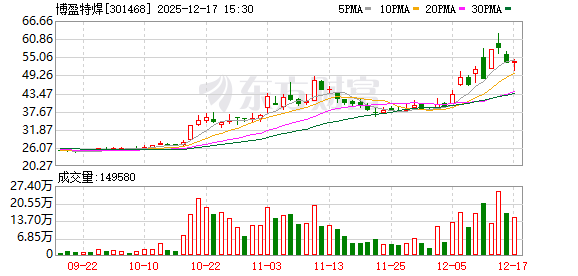
博盈特焊:越南生产基地一期共有4条HRSG生产线
Zheng Quan Ri Bao Zhi Sheng· 2025-12-17 07:45
Core Viewpoint - The company is expanding its production capacity in Vietnam, with plans to establish a total of 12 HRSG production lines to meet market demand [1] Group 1: Production Capacity - The first phase of the Vietnam production base includes 4 HRSG production lines [1] - The second phase of the Vietnam production base is progressing steadily and is expected to commence production in the second quarter of next year [1] - The company has adjusted its capacity planning for the Vietnam production base based on current market demand [1] Group 2: Domestic Operations - The company has laid out 2 HRSG production lines at its domestic Diao production base, primarily serving customers outside of North America [1]
博盈特焊:公司大部分采用“FOB”贸易模式(Free On Board)交易
Zheng Quan Ri Bao· 2025-12-17 07:41
Group 1 - The company primarily adopts the "FOB" (Free On Board) trading model for revenue recognition, confirming revenue after completing production, export customs procedures, and loading goods onto the ship, with shipping costs borne by the buyer [2]

美国11月非农喜忧参半,失业率持续抬升
Dong Zheng Qi Huo· 2025-12-17 06:14
1. Report Industry Investment Rating - The走势评级for the US dollar is "oscillation" [1] 2. Core Viewpoints of the Report - The US employment market continues to cool down, with the unemployment rate rising for five consecutive months and wage growth slowing, which may further weaken consumption momentum. However, the resilience of new employment is maintained, and short - term market concerns about economic downward pressure are limited. More data is needed to verify the pace of the weakening employment market. Future interest rate cuts remain the baseline scenario, but the timing depends on the future weakening speed of the employment market, with room for debate. Currently, the probability of a rate cut in January has slightly increased to 25%, and the market expects 1 - 2 rate cuts next year [2][36] 3. Summary by Relevant Catalogs 3.1 US November Non - farm Employment Situation - **Overall Data**: The US added 64,000 non - farm jobs in November, exceeding the market expectation of 50,000. In October, there was a decrease of 105,000 jobs, mainly due to government lay - offs. The average monthly increase in the past 12 months was 78,000, indicating labor market resilience. However, the unemployment rate rose to 4.6%, higher than the market expectation and the previous value. The labor participation rate slightly rebounded to 62.5%. The month - on - month hourly wage growth rate was 0.1%, lower than the expected 0.3% and the previous value. The year - on - year growth rate was 3.5%, lower than the expected and the previous value. After the data release, the US dollar index and the 10 - year Treasury yield oscillated downward, gold oscillated at a high level, and the US stock market rose first and then fell [1][8] - **Industry - specific Data** - **Service Industry**: Private service employment added 50,000 jobs, slightly down from the previous value. The main sources of new employment were education and healthcare (65,000), professional and business services (12,000), and retail (6,200). The transportation and warehousing industry laid off 18,000 employees, and the leisure and hospitality industry, which was previously a major source of new employment, also significantly laid off 12,000 employees. In November, the government sector employment decreased by 5,000, with the federal government employment continuing to decline by 6,000 [18] - **Production Sector**: The production sector reversed the consecutive lay - off trend and added 19,000 jobs in November. Construction added 28,000 jobs, while the mining industry laid off 4,000 and the manufacturing industry laid off 5,000. The ISM manufacturing PMI in October was 48.2, and the employment sub - item weakened to 44. The rebound in construction employment may be mainly due to the accelerated construction of data centers and power infrastructure [25] - **Job Vacancy Data**: In October, the number of job vacancies rebounded to 7.67 million, higher than the expected and the previous value. The number of job vacancies in the service industry slightly rebounded, with increases in wholesale, retail, and education and healthcare industries. The number of job vacancies in the production sector also slightly rebounded, with the construction job vacancies remaining at a low level and the labor demand in the manufacturing sector showing marginal improvement [29] - **Wage and Working Hours Data**: In November, wage growth further declined, with the month - on - month growth rate falling to 0.1% and the year - on - year growth rate dropping to 3.5%. Only the financial, leisure and hospitality, and other service industries saw a slight increase in wage growth, while the wage growth in the rest of the industries continued to cool down. The average weekly working hours were 34.3 hours, slightly higher than the expected and the previous value. Most industries saw an increase in working hours, except for the mining and logging industry [34][35] 3.2 Investment Recommendations - After the December interest rate meeting, the Federal Reserve has cut interest rates by a cumulative 75bp this year. With increasing internal differences among the Fed members, the threshold for further rate cuts is higher. The November non - farm data did not significantly boost the probability of rate cuts. Coupled with the upcoming announcement of the new Fed chairman, the market's debate on the long - term rate cut path has intensified. Short - term market volatility remains difficult to reduce. Gold will oscillate at a high level, the US Treasury yield curve will steepen, the US dollar will oscillate weakly, and the US stock market will continue to oscillate weakly due to concerns about over - investment in AI [3][40]
【环球财经】调查:经济学家大幅上调2025年新加坡经济增长预期至4.1%
Xin Hua Cai Jing· 2025-12-17 06:07
Group 1 - The latest survey by the Monetary Authority of Singapore (MAS) indicates a significant upward revision in the GDP growth forecast for Singapore in 2025, with the median forecast rising to 4.1% from 2.4% in September [1] - The strong performance of the economy in the third quarter of 2025, with a year-on-year growth of 4.2%, has contributed to this upward revision, surpassing the previous forecast of 0.9% [1] - Growth expectations have been raised across major industries, with manufacturing seeing the most significant increase from 0.8% to 5.4%, while financial services, construction, and wholesale and retail trade also experienced upward adjustments [1] Group 2 - For 2026, the expected economic growth rate is projected to slow down to 2.3%, with inflation pressures anticipated to rise, forecasting overall inflation at 1.5% and core inflation at 1.3% [2] - Geopolitical tensions, including trade conflicts and wars, are viewed as the largest downside risk, with 100% of respondents highlighting this concern [2] - On the upside, 76.5% of respondents believe that the ongoing global tech cycle will be a major driver of Singapore's economic growth, alongside resilience in global growth and easing trade tensions [2]
2025年11月经济数据点评:多数经济指标延续走弱态势
Hua Yuan Zheng Quan· 2025-12-17 05:57
Report Overview - Report Date: December 17, 2025 - Report Title: Economic Data Review for November 2025 1. Industry Investment Rating - The document does not provide an industry investment rating. 2. Core Viewpoints - Most economic indicators continued to weaken in November. Consumption and investment faced significant pressure, and the GDP growth rate in Q4 might slow down compared to Q3. The core contradiction in the current economic operation is the co - existence of the drag from the adjustment of old driving forces and the growth of new driving forces. Real - estate downturn and cautious consumer behavior are short - term constraints, while policy support and industrial upgrading are key supports [2]. - In December, social retail sales still face a high - base pressure from the +3.7% year - on - year growth in December 2024, and the effect of the withdrawal of national subsidies may continue to show. In terms of fixed - asset investment, the decline in real - estate investment has widened, infrastructure investment may be under great fiscal constraint pressure, and only manufacturing upgrading provides support [2]. - The 2025 Central Economic Work Conference emphasized the role of domestic demand, strengthened the main position of enterprise innovation, and added the statement of "increasing counter - cyclical and cross - cyclical adjustment" in macro - policies. Attention should be paid to the implementation effect of growth - stabilization policies and the supporting role of high - quality development and new productive forces on the economy [2]. - In 2026, the bond market may perform better than expected. Since the second half of the year, the bond market has often deviated from the fundamentals and is dominated by institutional behavior. It is expected that the policy interest rate will be cut by about 20BP in 2026, with a 10BP cut likely in Q1. In the long - term, the 30 - year treasury bond yield is expected to fall below 2% [3]. 3. Summary by Category Consumption - In November, the growth rate of social retail sales continued to decline. The total retail sales of consumer goods in November was 4.4 trillion yuan, a year - on - year increase of 1.3%, 1.6 percentage points lower than the previous month. The year - on - year growth rate has declined for six consecutive months, reaching the lowest single - month level since 2023. From January to November, the total retail sales of consumer goods increased by 4.0% year - on - year, 0.3 percentage points lower than from January to October [2]. - The policy to expand service consumption continued to be implemented, and service retail sales continued to grow rapidly. From January to November, the retail sales of cultural, sports, and leisure services continued to grow at a double - digit rate. The national box office revenue increased by 19.5% year - on - year, and the number of moviegoers increased by 20.3% year - on - year [2]. - The year - on - year growth rate of most retail sales of national - subsidy - related categories continued to slow down. In November, the year - on - year growth rate of retail sales of above - quota household appliances and audio - visual equipment dropped significantly to - 19.4%, 4.8 percentage points lower than in October. The year - on - year retail sales of above - quota furniture decreased by 3.8%, 13.4 percentage points lower than in October [2]. Fixed - Asset Investment - The pressure on fixed - asset investment continued to increase. The cumulative year - on - year growth rate of fixed - asset investment has been weakening for eight consecutive months, with negative growth for three consecutive months and an accelerating decline. The decline in real - estate development investment has widened for nine consecutive months. From January to November, fixed - asset investment decreased by 2.6% year - on - year [2]. - From January to November, infrastructure investment, manufacturing investment, and real - estate development investment decreased by 1.1%, increased by 1.9%, and decreased by 15.9% year - on - year respectively, 1.0, 0.8, and 1.2 percentage points lower than the previous period. Infrastructure investment has had negative cumulative year - on - year growth for two consecutive months [2]. - Private investment has had negative cumulative year - on - year growth for six consecutive months. From January to November, the year - on - year decline widened to - 5.3%, 0.8 percentage points lower than from January to October [2]. Foreign Trade - The overall growth rate of imports and exports rebounded significantly. In November, the total value of imports and exports was 3.9 trillion yuan, a year - on - year increase of 4.1%, a significant increase of 4 percentage points from 0.1% in October. Exports were 2.3 trillion yuan, a year - on - year increase of 5.7%, rebounding from - 0.8% in October. Imports were 1.6 trillion yuan, maintaining growth for six consecutive months [3]. - Trade with the EU and Africa rebounded significantly, while the decline in exports to the US continued to widen. In November, the total trade value with ASEAN increased by 3.3% year - on - year, and exports to ASEAN increased by 8.2%. The total trade value with the EU increased by 10.25% year - on - year, 8.3 percentage points higher than the previous period. Exports to the EU increased by 14.8% year - on - year, a significant rebound of 13.9 percentage points from October [3]. - High - end manufacturing became the core driving force for the rebound. In November, exports of mechanical and electrical products increased by 9.65% year - on - year in US dollars, 8.4 percentage points higher than the previous month, and exports of high - tech products increased by 7.68% year - on - year, 5.9 percentage points higher than the previous month [3]. Industrial and Service Sectors - From January to November, the added value of industrial enterprises above the designated size increased by 6.0% year - on - year, 0.1 percentage points lower than from January to October. In November, it increased by 4.8% year - on - year, 0.1 percentage points lower than in October [3]. - In November, the added value of high - tech manufacturing and equipment manufacturing above the designated size increased by 8.4% and 7.7% year - on - year respectively, maintaining a growth rate of over 7% in each month since 2025 [3]. - In November, the service production index increased by 4.2% year - on - year, 0.4 percentage points lower than the previous month and 1.9 percentage points lower than in November last year [3]. Economic Outlook and Recommendations - The economy still faces certain pressure. On the consumption side, although there is growth in durable goods and service consumption supported by policies, the decline in the retail sales of above - quota durable goods reflects that the overall consumer willingness still needs to be boosted. On the investment side, the drag of infrastructure and real - estate on the economy may continue [3]. - The probability of the introduction of growth - stabilization policies such as reserve requirement ratio cuts and interest rate cuts increases. The bond market in 2026 may perform better than expected, and it is recommended to focus on the allocation value of 5 - year bank capital bonds and ultra - long - term interest - rate bonds [3]
【环球财经】就业数据疲弱 纽约股市三大股指16日涨跌不一
Xin Hua Cai Jing· 2025-12-17 05:32
美国商务部16日上午发布的数据显示,美国10月份零售与食品服务业零售金额分别为7326亿美元,环比 持平,同比增加3.5%,环比涨幅低于市场预期的0.2%,9月份环比涨幅从0.2%修订为0.1%。 标普全球在当日上午发布的初步数据显示,美国12月制造业和服务业产出综合指数为53,低于11月的 54.2,为6个月以来的低点。其中,12月份服务业采购经理人商业活动指数为52.9,低于11月的54.1,为 6个月以来的低点;当月制造业采购经理人指数为51.8,低于11月的52.2,为5个月以来的低点。 截至当天收盘,道琼斯工业平均指数比前一交易日下跌302.30点,收于48114.26点,跌幅为0.62%;标 准普尔500种股票指数下跌16.25点,收于6800.26点,跌幅为0.24%;纳斯达克综合指数上涨54.049点, 收于23111.462点,涨幅为0.23%。 板块方面,标普500指数十一大板块八跌三涨。能源板块和医疗板块分别以2.98%和1.28%跌幅领跌,科 技板块和非必需消费品板块分别以0.32%和0.31%涨幅领涨。 美国劳工部16日公布的数据显示,今年11月美国失业率升至4.6%,为2021年1 ...
上市门槛高不可攀?这条“曲线”正被更多中国企业选择
Sou Hu Cai Jing· 2025-12-17 05:27
Core Viewpoint - The tightening IPO window on major global exchanges has led many small and medium-sized enterprises to consider the OTCQB market as a viable alternative for public listing, offering a pathway with lower costs and regulatory hurdles compared to traditional IPOs [1]. Group 1: Redefining OTCQB - The OTCQB is not a final destination but a crucial intermediate step for growth-oriented companies transitioning from private to publicly regulated entities [2]. Group 2: Strategic Value of OTCQB - Low-cost trial: Companies can obtain a public trading code at a fraction of the cost and time of traditional IPOs, establishing international governance and financial disclosure systems [3]. - Market valuation: Although initial liquidity may be limited, companies gain a public market price that serves as a benchmark for future financing, acquisitions, and equity incentives [4]. - Paving the way for uplisting: OTCQB serves as a controlled-risk, cost-effective starting point for companies aiming to eventually list on major exchanges [5]. Group 3: Five-Step Ladder to Listing - Step 1: Foundation building (approximately 1-2 months) involves establishing a compliant offshore holding company and a clear international governance structure [7]. - Step 2: Financial translation (approximately 1 month) requires auditing by a PCAOB-recognized firm and converting financial statements to meet U.S. regulatory standards [8]. - Step 3: Regulatory dialogue (approximately 1 month) includes submitting a complete application to FINRA to obtain a unique ticker symbol and qualify for public quotation [9]. - Step 4: Public offering and trading (approximately 1-1.5 months) involves completing an initial public offering under flexible conditions, followed by trading on the OTCQB [10]. - Step 5: Value cultivation and uplisting preparation (1-2 years) focuses on optimizing business operations, attracting analyst attention, maintaining investor relations, and improving metrics to align with major exchange standards [11][12]. Group 4: Uplisting to Major Exchanges - Transitioning from OTCQB to Nasdaq is based on clear, publicly available registration procedures, requiring companies to meet specific financial thresholds, thus reducing uncertainty associated with traditional IPOs [14]. Group 5: Case Studies of Successful Transitions - Case A: Technology company WETG listed on OTCQB in 2020, improved disclosure and investor base, and successfully uplisted to Nasdaq in 2022, significantly enhancing liquidity and market attention [16]. - Case B: Manufacturing company RLEA established credit on the international capital market through OTCQB, secured initial financing, and has applied for Nasdaq uplisting in 2024, demonstrating the pathway's applicability to real economy enterprises [17].