
美国非农就业数据

Search documents
2月非农大幅走弱:趋势与扰动并存
HTSC· 2026-03-08 00:45
Employment Data - In February 2026, the U.S. non-farm payrolls decreased by 92,000, significantly below Bloomberg's consensus estimate of 55,000, with the previous two months revised down by 69,000[1] - The unemployment rate rose by 0.1 percentage points to 4.4%, exceeding the expected 4.3%[1] - The labor force participation rate fell by 0.1 percentage points to 62.0%, below the expected 62.5%[1] Wage and Hours - Hourly wage growth remained steady at 0.4% month-on-month, with a year-on-year increase of 3.8%, up by 0.1 percentage points from the previous month[1] - Average weekly hours worked remained unchanged at 34.3 hours[1] Sector Performance - Employment in the healthcare sector dropped by 135,000 to -19,000, while construction jobs fell by 59,000 to -11,000, indicating a negative correlation with the previous month's strong performance[5] - The decline in non-farm employment was attributed to statistical disturbances, strikes in the healthcare sector, and adverse weather conditions[2][3] Market Reactions - Following the employment data release, U.S. Treasury yields initially fell before rising again, and the dollar index showed mixed movements[1] - Market pricing for cumulative interest rate cuts in 2026 increased by 6 basis points to 44 basis points, while the 10-year Treasury yield rose by 2 basis points to 4.18%[1] Risk Factors - The report highlights risks associated with a potential acceleration in the weakening of the U.S. labor market and tighter financial conditions[4]
未知机构:弘则FICC宏观美国1月非农就业数据点评医疗社保托底美国就业表强-20260213
未知机构· 2026-02-13 02:50
Summary of Key Points from the Conference Call Industry Overview - The analysis focuses on the U.S. labor market, specifically the non-farm payroll data for January, highlighting trends in employment and economic indicators related to various sectors, particularly healthcare and social services [1][2]. Core Insights and Arguments 1. **Employment Growth**: The U.S. non-farm payroll increased by 130,000 jobs in January, significantly exceeding market expectations of 70,000 jobs. The unemployment rate slightly decreased by 0.1% to 4.3%, with improvements noted in hours worked, wages, and labor participation rates, indicating a demand-driven decline in unemployment [1]. 2. **Revisions to Previous Data**: Employment figures for November and December 2025 were revised down by a total of 17,000 jobs. Additionally, the QCEW benchmark for 2025 was significantly adjusted downward by 862,000 jobs, leading to a reduction in the average monthly non-farm job growth for 2025 from 49,000 to 15,000 [1]. 3. **Sector-Specific Employment**: The majority of new jobs in January were concentrated in the healthcare and social services sectors, contributing approximately 120,000 jobs. In contrast, government employment continued to show negative growth, indicating structural disparities in the job market recovery [2]. 4. **Market Reactions**: Following the employment data release, both the U.S. dollar and Treasury yields rose, leading to a cooling of market expectations regarding Federal Reserve interest rate cuts. The implied number of rate cuts for 2026 decreased from 2.4 to 2 [2]. 5. **Commodity and Equity Market Response**: Precious metals and base metals, which are sensitive to interest rates, exhibited a V-shaped price movement but showed little overall change. Meanwhile, U.S. equities continued to display a risk-on sentiment, largely ignoring the rise in interest rates [2]. 6. **Concerns Over Data Reliability**: The reliability of non-farm payroll data has come under scrutiny due to significant downward revisions over the past two years. The concentration of job growth in specific sectors raises concerns about the overall breadth of the recovery [2]. Additional Important Content - The overall market volatility remained subdued despite the strong employment data, attributed to concerns over the high concentration of job growth and the quality of non-farm data. The market's reaction was seen as a correction to previous pricing adjustments based on weaker non-farm expectations [2].
美国1月非农就业数据超市场预期
Qi Huo Ri Bao· 2026-02-12 10:51
Core Viewpoint - The U.S. labor market showed stronger-than-expected performance in January, with non-farm payrolls increasing by 130,000 and the unemployment rate dropping to 4.3%, impacting market expectations for Federal Reserve interest rate decisions [1]. Group 1: Employment Data - The U.S. added 130,000 non-farm jobs in January, significantly exceeding market expectations [1]. - The unemployment rate fell to 4.3%, indicating a tightening labor market [1]. Group 2: Federal Reserve Expectations - The CME FedWatch Tool indicates a 94.6% probability that the Federal Reserve will keep interest rates unchanged in March [1]. - Market expectations for future rate cuts have shifted from June to July following the strong employment data [1]. - Federal Reserve officials have signaled a cautious approach to further rate cuts, with a preference for patience in assessing economic conditions [1]. Group 3: Economic Commentary - Cleveland Fed President Loretta Mester expressed a preference for maintaining current rates while evaluating the impact of recent rate cuts [1]. - Kansas City Fed President Esther George emphasized the need to keep rates in a "slightly restrictive" range due to inflation remaining above target levels [1]. - Moody's Chief Economist Mark Zandi warned that despite the strong employment report, the job market remains fragile and susceptible to shocks [2].
——1月美国非农就业数据点评:就业反弹推迟降息窗口
Huafu Securities· 2026-02-12 04:16
Employment Data - In January, non-farm employment increased significantly by 130,000, surpassing the expected 65,000, marking the largest increase since January 2025[7] - Private sector employment added 172,000 jobs in January, with a three-month average of 103,000 and a fourth-quarter average of 50,000[7] - The education and healthcare sectors contributed the majority of the employment increase, adding 137,000 jobs[8] Unemployment and Labor Participation - The unemployment rate fell by 0.1 percentage points to 4.3%, driven by improved job demand[9] - The labor participation rate rebounded by 0.1 percentage points to 62.5%, primarily due to increases in the 20-54 age group[13] Wage Growth - Average hourly earnings increased by 0.4% month-on-month, exceeding the expected 0.3%[19] - Year-on-year wage growth decreased slightly to 3.7%, remaining stable within the 3.7%-3.9% range since the second half of 2025[19] Market Expectations - Following the strong employment data, the probability of a Federal Reserve rate cut in March dropped from 21.7% to 7.9%, and the probability of a cut before June decreased from 75% to 59.8%[2] - U.S. stock indices rose, the dollar strengthened, and U.S. Treasury yields increased, with the 10-year yield reaching a high of 4.2% before retreating[2]
欧洲股市延续涨势 受美国非农就业数据超预期提振
Xin Lang Cai Jing· 2026-02-11 14:12
Core Viewpoint - European stock markets reached intraday highs following data showing that U.S. job growth in January exceeded expectations and the unemployment rate unexpectedly declined [1] Group 1: Market Performance - The Stoxx 600 index increased by 0.3%, indicating a positive market sentiment [1] - Energy and mining stocks were the standout performers in the market [1]
黄金直线跳水,美元油价急升,美联储降息概率有变
2 1 Shi Ji Jing Ji Bao Dao· 2026-02-11 13:59
Group 1 - The core point of the article is the release of the U.S. January non-farm payroll report, which shows an increase of 130,000 jobs, surpassing the forecast of 65,000 and the previous value of 50,000 [1] - The U.S. unemployment rate for January is reported at 4.3%, the lowest since August 2025, compared to the forecast of 4.4% and the previous value of 4.4% [2] - The December non-farm payroll figures were revised to an increase of 48,000, and November's figures were revised to an increase of 41,000 [3] Group 2 - The annual benchmark revision indicates a downward adjustment of 862,000 jobs, compared to the forecast reduction of 825,000 [4] - Following the data release, traders reduced bets on a Federal Reserve rate cut, with full pricing now indicating a cut in July rather than June [4] - U.S. stock index futures rose after the report, with the Nasdaq futures up 0.35%, S&P 500 futures up 0.31%, and Dow futures up 0.24% [4] Group 3 - The U.S. Treasury yields rose sharply, with the 10-year Treasury yield increasing by 4 basis points to 4.192% [4] - The U.S. dollar index (DXY) initially surged by 50 points to 97.14 before quickly retreating [4] - Non-U.S. currencies experienced a decline, with the euro dropping over 60 points against the dollar, the pound falling over 70 points, and the yen seeing a near 100-point increase against the dollar [4] Group 4 - Spot gold prices fell nearly $40, with the current price at $5,054.46 per ounce, after reaching a high of $5,100 [5] - Both WTI and Brent crude oil prices increased by over 2% amid geopolitical tensions involving Iran and Israel [7]

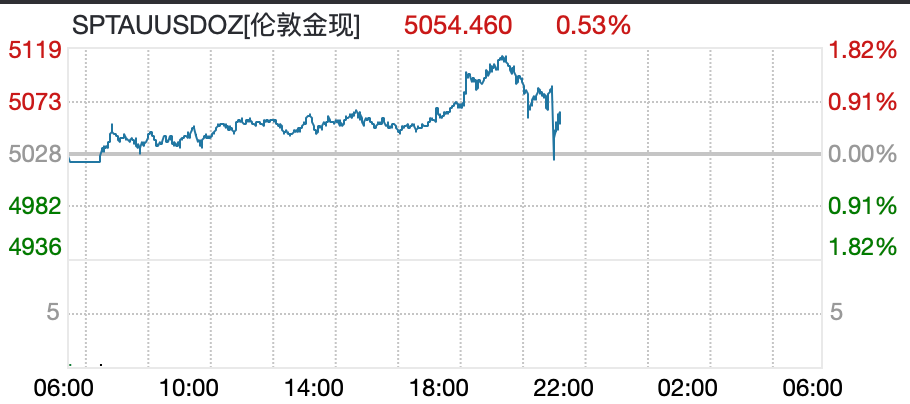
现货黄金站上5100美元,白银急涨6%
2 1 Shi Ji Jing Ji Bao Dao· 2026-02-11 13:21
Core Viewpoint - The article highlights the recent surge in gold and silver prices, driven by market anticipation of the upcoming U.S. non-farm payroll data, which is expected to influence Federal Reserve interest rate policies [1] Group 1: Gold Market - Spot gold has reached $5,100 per ounce, marking the first time since January 30, with a daily increase of 1.54% [1] - The market is closely watching the non-farm payroll report, as a significantly weak data release could strengthen bets on an earlier rate cut by the Federal Reserve, leading to a weaker dollar and higher gold prices [1] Group 2: Silver Market - Spot silver experienced a substantial increase of 6%, reaching $85.57 per ounce [1] - The rise in silver prices is also linked to the anticipation surrounding the non-farm payroll data and its potential impact on monetary policy [1] Group 3: Economic Indicators - The upcoming non-farm payroll report is seen as a critical indicator that could either support or pressure gold prices depending on its performance relative to market expectations [1] - A strong report could reinforce expectations for prolonged interest rates, thereby boosting the dollar and applying downward pressure on gold prices [1]
IC外汇平台:新西兰元兑美元汇率升至0.6065,创近两周新高
Sou Hu Cai Jing· 2026-02-11 05:08
Core Viewpoint - The New Zealand dollar (NZD) has recently shown a rebound against the US dollar (USD), reaching a near two-week high at around 0.6065, influenced by a weaker USD and upcoming US non-farm payroll data that may guide short-term exchange rate direction [1][3]. Group 1: Currency Movements - The NZD is supported by a weaker USD, while market focus is on the forthcoming US employment data, which is crucial for expectations regarding the Federal Reserve's monetary policy [1][3]. - A strong performance in US employment data could reinforce expectations for the Federal Reserve to maintain a relatively tight policy, thereby supporting the USD; conversely, weaker data may lead to speculation about a policy shift, putting pressure on the USD [3]. Group 2: Global Market Sentiment - Improved global market risk sentiment has reduced the safe-haven demand for the USD, benefiting currencies like the NZD that are closely tied to economic growth [3]. - Recent Chinese inflation data showing a slowdown in consumer price growth and continued contraction in producer prices indicates a need for stronger domestic demand, which may prompt supportive policies to stabilize the economy, positively influencing sentiment in the Asia-Pacific region [3]. Group 3: Domestic Factors in New Zealand - Recent labor market data from New Zealand indicates a rise in the unemployment rate, which may weaken market expectations for further interest rate hikes by the Reserve Bank of New Zealand, thus limiting the NZD's upside potential [3]. - The NZD's movement is influenced by a balance of factors: the overall weakness of the USD and improved global sentiment provide support, while moderate domestic economic data and cautious sentiment ahead of significant external risk events act as constraints [3].

加元关口拉锯战 贸易争端退居二线
Jin Tou Wang· 2026-02-11 04:48
Group 1 - The USD/CAD exchange rate is stabilizing around 1.3550, with market participants focused on upcoming U.S. non-farm payroll data to break the current stalemate [1] - The trade dispute surrounding the Detroit-Windsor border bridge project has become a focal point, but Canadian Prime Minister's commitment to manage differences with the Trump administration has alleviated concerns about deteriorating trade relations [1] - The fundamental support for the Canadian dollar is linked to oil price movements and monetary policy divergence, as Canada, being a major oil exporter, has its economy closely tied to international oil prices [1] Group 2 - Recent Canadian economic data shows a surprising contrast, with a decrease in employment numbers but a significant drop in the unemployment rate to 6.5%, the lowest in 16 months, indicating structural resilience in the labor market [2] - The Bank of Canada has maintained its benchmark interest rate at 2.25%, with the governor emphasizing that the current rate is "appropriate," reinforcing a hawkish stance that supports the attractiveness of Canadian dollar assets [2] - Despite the strengthening fundamentals for the Canadian dollar, upward movement faces pressure from a weak U.S. dollar index and mixed signals from Federal Reserve officials regarding interest rate policies [2] Group 3 - If the U.S. non-farm payroll data exceeds expectations, it could strengthen the Federal Reserve's stance on maintaining high interest rates, potentially pushing the USD/CAD exchange rate above 1.36 [3] - Conversely, if the data is weak, it may ignite further rate cut expectations, putting downward pressure on the USD and possibly breaking below the 1.3550 support level [3] - The technical analysis indicates a typical oscillating structure for the USD/CAD exchange rate, with key support at 1.3479 and resistance around 1.3680, suggesting a cautious trading strategy ahead of the non-farm payroll report [3]
美非农就业数据推迟至2月11日发布 就业人数或下修91.1万人
Sou Hu Cai Jing· 2026-02-11 02:50
Core Viewpoint - The market is focused on the upcoming U.S. non-farm payroll data for January, with expectations of a slowdown in employment growth and a potential impact on Federal Reserve policy [1] Group 1: Employment Data - The U.S. non-farm payroll report, originally scheduled for February 6, has been delayed to February 11 due to a government shutdown [1] - The report is expected to show an addition of 69,000 jobs for January, with the unemployment rate remaining at 4.4% [1] - There is an anticipated downward revision of 911,000 jobs in the annual employment data up to March 2025 [1] Group 2: Federal Reserve Policy - The Federal Reserve initiated interest rate cuts at the end of 2025, influenced by signs of weakness in the labor market [1] - The market currently estimates a 78.4% probability that the Federal Reserve will maintain interest rates in March, but this expectation has decreased to 57.3% for April, down from 70% a week prior [1]