装备制造业

Search documents
4月制造业PMI为49%,但这一产业延续高景气
券商中国· 2025-04-30 09:55
重要数据披露! 4月30日,国家统计局服务业调查中心和中国物流与采购联合会发布了4月份中国采购经理指数。其中,制造业采购 经理指数(制造业PMI)为49.0%,比上月下降1.5个百分点。 分析认为,4月份外贸环境的变化给我国制造业带来一定的扰动,市场需求和企业生产短期有所放缓,原材料采购、 市场价格等方面也有所波动,但国内需求稳定释放,缓解了出口订单下行的压力,新动能和消费品生产继续稳中有 增。 新出口订单指数环比走低 4月份,制造业PMI比上月下降1.5个百分点,至49.0%,降至临界点以下。 国家统计局服务业调查中心高级统计师赵庆河表示,这是受前期制造业较快增长形成较高基数叠加外部环境急剧变 化等因素影响。 从13个分项指数来看,同上月相比,生产指数、新订单指数、新出口订单指数积压订单指数、产成品库存指数、采 购量指数、进口指数、购进价格指数、出厂价格指数、原材料库存指数、从业人员指数、供应商配送时间指数和生 产经营活动预期指数均下降,指数降幅在0.1至5.5个百分点之间。 中国人民大学统计学院教授、中国调查与数据中心副主任吴翌琳对记者表示,4月中国制造业PMI景气度环比走低主 要是受外需收缩和政策效应递 ...
重磅数据出炉!
证券时报· 2025-04-30 09:32
4月30日,国家统计局服务业调查中心和中国物流与采购联合会发布了4月份中国采购经理指数。 其中,制造业采购经理指数(制造业PMI)为49.0%,比上月下降1.5个百分点。分析认为,4月份外贸环境的变化给我国制造业带来一定的扰动,市场需求和企业 生产短期有所放缓,原材料采购、市场价格等方面也有所波动,但国内需求稳定释放,缓解了出口订单下行的压力,新动能和消费品生产继续稳中有增。 新出口订单指数环比走低 4月份,制造业PMI比上月下降1.5个百分点,至49.0%,降至临界点以下。 国家统计局服务业调查中心高级统计师赵庆河表示,这是受前期制造业较快增长形成较高基数叠加外部环境急剧变化等因素影响。 从13个分项指数来看,同上月相比,生产指数、新订单指数、新出口订单指数、积压订单指数、产成品库存指数、采购量指数、进口指数、购进价格指数、出厂价 格指数、原材料库存指数、从业人员指数、供应商配送时间指数和生产经营活动预期指数均下降,指数降幅在0.1至5.5个百分点之间。 中国人民大学统计学院教授,中国调查与数据中心副主任吴翌琳对记者表示,4月中国制造业PMI景气度环比走低主要是受外需收缩和政策效应递减以及大宗商品价 格波动 ...
如何更全面评估4月PMI数据?五个维度盘点外部冲击的影响
Sou Hu Cai Jing· 2025-04-30 06:25
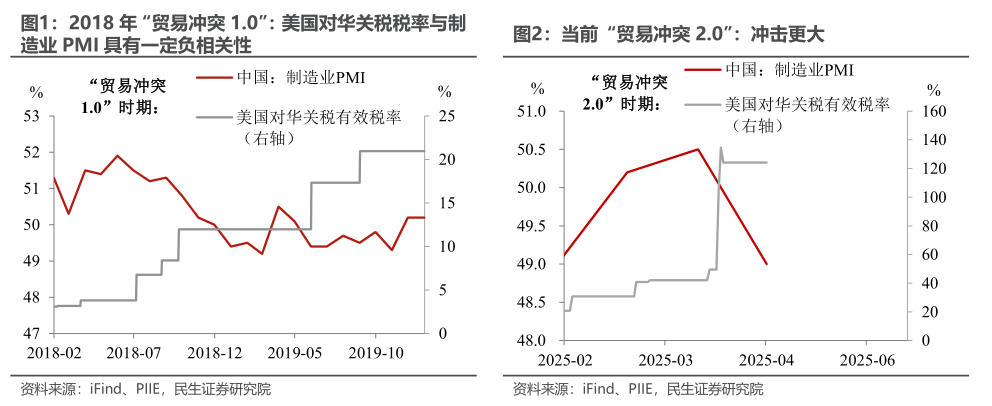
Core Viewpoint - The April PMI data reflects the impact of tariff shocks, indicating that the previous "export rush" has come to an end, with significant declines in both manufacturing PMI and new export orders, surpassing the declines seen in 2018 [1] Dimension 1: Direct Impact - The new export orders index for April PMI dropped by 4.3 percentage points to 44.7%, marking a decline much steeper than the -2.7 percentage points seen during the lowest growth rates between 2018-2019 [5] - High-frequency data also shows a clear decline in export container freight rates to regions such as the U.S. West Coast, East Coast, and South America in April, signaling the end of the "export rush" [5] Dimension 2: Indirect Impact - The PMI new orders index, representing domestic demand, fell to 49.2% (down 2.6 percentage points), while the PMI production index dropped to 49.8% (down 2.8 percentage points), both falling below the growth threshold and contributing to the overall decline in manufacturing PMI [11] Dimension 3: Corporate Behavior Impact - As demand weakens, companies are more inclined to reduce prices to clear inventory, with the PMI finished goods inventory index decreasing by 0.7 percentage points to 47.3% and the PMI production expectations index falling by 1.7 percentage points [13] - The PMI ex-factory price index also declined by 3.1 percentage points to 44.8%, indicating ongoing downward pressure on inflation [13] Dimension 4: Employment and Expectations Impact - The negative impact of U.S. tariffs on the PMI employment index and production expectations index may be more significant and longer-lasting than the direct effects on exports [16] - The PMI employment index fell by 0.3 percentage points to 47.9%, aligning with the political bureau's emphasis on "stabilizing employment," "stabilizing enterprises," and "stabilizing expectations" [16] Dimension 5: Impact by Enterprise Type - In April, the PMIs for large, medium, and small enterprises were 49.2%, 48.8%, and 48.7% respectively, with declines of 2.0 percentage points, 1.1 percentage points, and 0.9 percentage points, indicating a downturn in business sentiment across all sizes, particularly among small enterprises [17] Non-Manufacturing Sector - The non-manufacturing sector also experienced a decline, with the construction PMI at 51.9% (down 1.5 percentage points) and the services PMI at 50.1% (down 0.2 percentage points), both at historically low levels [20] Policy Implications - The tariff shocks reflected in the PMI data suggest that policy measures may need to prioritize "stabilizing livelihoods" over "total countermeasures," with a focus on targeted structural policies for affected enterprises expected to be accelerated [22]

重要数据发布:49%
天天基金网· 2025-04-30 06:08
制造业PMI有所回落 4月制造业PMI比3月下降1.5个百分点,分项数据显示,制造业市场需求有所放缓。4月,新出口订单指 数为44.7%,较3月下降4.3个百分点;新订单指数为49.2%,较3月下降2.6个百分点。 中国物流信息中心分析师文韬表示,国外需求短期收紧拖累了我国制造业整体市场需求。 国家统计局服务业调查中心高级统计师赵庆河表示,从全球范围看,受贸易环境不确定性增大影响,主 要经济体制造业景气度普遍位于收缩区间,美国供应管理协会发布的3月份美国制造业PMI为49.0%,有 关机构发布的4月份欧元区、英国、日本制造业PMI初值均低于临界点。 制造业PMI中生产指数和价格指数也有所下降。4月,制造业生产指数为49.8%,比3月下降2.8个百分 点。主要原材料购进价格指数和出厂价格指数分别为47.0%和44.8%,比3月下降2.8和3.1个百分点,制 造业市场价格总体水平有所下降。 "制造业价格指数有所下降,主要受到市场需求不足和近期部分大宗商品价格持续下行等因素影响。"赵 庆河表示。 国家统计局服务业调查中心和中国物流与采购联合会4月30日发布数据显示,4月,制造业PMI为49%, 比3月下降1.5个百 ...
4月PMI:盘点冲击信号
Minsheng Securities· 2025-04-30 06:04
2025 年 4 月 PMI 点评 4 月 PMI:盘点冲击信号 2025 年 04 月 30 日 邮箱:taochuan@mszq.com 邮箱:zhongyumei@mszq.com 与此同时,4 月进口也受到较大冲击。4 月 PMI 进口指数环比降幅达 4.1pct,这 一降幅为 2020 年 5 月以来的最大降幅,同时也超过了"贸易冲突 1.0"时期 2.6pct 的最大降幅。 ➢ 维度二(间接影响):供需两端同步放缓。4 月代表内需的 PMI 新订单指数 为 49.2%(环比-2.6pct),代表生产的 PMI 生产指数为 49.8%(环比-2.8pct)。 两个指标同时降至荣枯线之下,成为 4 月制造业 PMI 的两大拖累项,外部风险 的加剧对国内产需也造成一定负面影响。 ➢ 维度三(企业行为影响):主动去库后的价格下跌。随着需求的走弱,企业 面对未来不确定性,更倾向于通过降价等方式加快对库存的"清理",4 月 PMI 产成品库存指数下降 0.7pct 至 47.3%、同时 PMI 生产经营预期指数下降 1.7pct 均佐证了这一点。外部冲击下企业的主动去库行为导致 4 月 PMI 出厂价格指数 ...
国家统计局:制造业PMI有所回落
Guo Jia Tong Ji Ju· 2025-04-30 01:37
Group 1: Manufacturing PMI Insights - The manufacturing purchasing managers' index (PMI) decreased to 49.0% in April, down 1.5 percentage points from the previous month, falling below the critical point [2][6] - Both production index and new orders index showed a decline, recorded at 49.8% and 49.2% respectively, down 2.8 and 2.6 percentage points from last month, indicating a slowdown in manufacturing production and market demand [2][3] - High-tech manufacturing PMI remained strong at 51.5%, significantly above the overall manufacturing level, with both production and new orders indices above 52.0% [3] Group 2: Non-Manufacturing PMI Insights - The non-manufacturing business activity index stood at 50.4%, a decrease of 0.4 percentage points from the previous month, but still indicating expansion [4][6] - The service sector's business activity index was 50.1%, down 0.2 percentage points, with certain industries like air transport and telecommunications showing strong growth [4] - The construction sector maintained expansion with a business activity index of 51.9%, despite a decline of 1.5 percentage points, and civil engineering construction saw an increase to 60.9% [4] Group 3: Comprehensive PMI Insights - The comprehensive PMI output index was recorded at 50.2%, down 1.2 percentage points from the previous month, yet still above the critical point, indicating overall expansion in production activities [5][6] - The manufacturing production index and non-manufacturing business activity index contributed to the comprehensive PMI, at 49.8% and 50.4% respectively [6] - The overall economic output has been expanding since January 2023, despite external environmental changes impacting the manufacturing PMI [6]
国家统计局服务业调查中心高级统计师赵庆河解读2025年4月中国采购经理指数
Guo Jia Tong Ji Ju· 2025-04-30 01:35
(二)高技术制造业持续向好。从重点行业看,高技术制造业PMI为51.5%,明显高于制造业总体水平, 其生产指数和新订单指数均位于52.0%及以上,高技术制造业延续较好发展态势。装备制造业、消费品 行业和高耗能行业PMI分别为49.6%、49.4%和47.7%,比上月下降2.4、0.6和1.6个百分点,景气水平不 同程度回落。 (三)价格指数有所下降。受市场需求不足和近期部分大宗商品价格持续下行等因素影响,主要原材料购 进价格指数和出厂价格指数分别为47.0%和44.8%,比上月下降2.8和3.1个百分点,制造业市场价格总体 水平有所下降。 4月份制造业采购经理指数有所回落 非制造业商务活动指数继续保持扩张 ——国家统计局服务业调查中心高级统计师赵庆河解读2025年4月中国采购经理指数 2025年4月30日国家统计局服务业调查中心和中国物流与采购联合会发布了中国采购经理指数。对此, 国家统计局服务业调查中心高级统计师赵庆河进行了解读。 4月份,制造业采购经理指数为49.0%,比上月下降1.5个百分点;非制造业商务活动指数和综合PMI产 出指数分别为50.4%和50.2%,继续保持在扩张区间。 一、制造业采购经理 ...
受前期制造业较快增长形成较高基数叠加外部环境急剧变化等因素影响,制造业PMI为回落至临界点以下
news flash· 2025-04-30 01:33
金十数据4月30日讯,国家统计局服务业调查中心高级统计师赵庆河解读2025年4月中国采购经理指数。 4月份,受前期制造业较快增长形成较高基数叠加外部环境急剧变化等因素影响,制造业PMI为49.0%, 回落至临界点以下。从重点行业看,高技术制造业PMI为51.5%,明显高于制造业总体水平,其生产指 数和新订单指数均位于52.0%及以上,高技术制造业延续较好发展态势。装备制造业、消费品行业和高 耗能行业PMI分别为49.6%、49.4%和47.7%,比上月下降2.4、0.6和1.6个百分点,景气水平不同程度回 落。 受前期制造业较快增长形成较高基数叠加外部环境急剧变化等因素影响,制造业PMI为回落至临界点以 下 相关链接 ...
安徽领跑长三角一季报,做对了什么?
2 1 Shi Ji Jing Ji Bao Dao· 2025-04-29 09:09
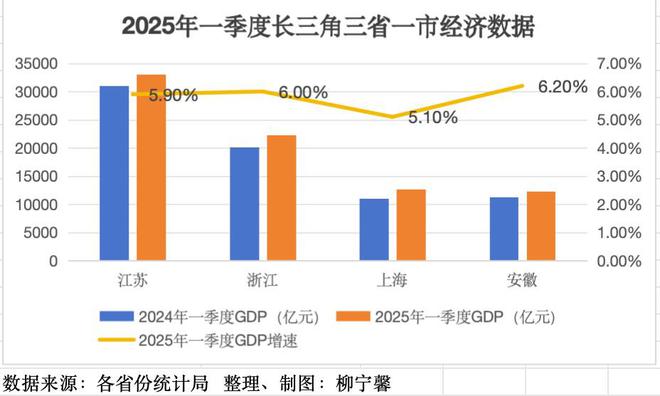
Economic Overview - The Yangtze River Delta (YRD) region achieved a GDP of 80,388.66 billion yuan in Q1, accounting for 25.22% of the national GDP, with an increase of 6,839.2 billion yuan compared to the same period last year [1] - By province, Jiangsu's GDP was 33,088.6 billion yuan (5.9% growth), Zhejiang's was 22,300 billion yuan (6.0% growth), Shanghai's was 12,735.06 billion yuan (5.1% growth), and Anhui's was 12,265 billion yuan (6.2% growth) [1] Industrial Growth - High-tech manufacturing is a key driver of economic growth in the YRD, with Anhui leading in industrial value-added growth at 9.2%, followed by Zhejiang (8.9%), Jiangsu (8.2%), and Shanghai (3.7%) [5] - In Q1, the high-tech manufacturing sector in Jiangsu saw a significant increase, with high-tech industries accounting for 51.4% of the province's industrial output [6] - Anhui's high-tech manufacturing value-added grew by 20.1%, with notable growth in the automotive sector, particularly in new energy vehicles [8] Foreign Trade Performance - The YRD's total import and export volume reached 38.7 trillion yuan in Q1, representing 37.6% of the national total, with Zhejiang contributing 12.9 trillion yuan and a growth rate of 7.3% [4] - Export growth rates for Anhui, Shanghai, Zhejiang, and Jiangsu were 17.3%, 12.6%, 11.1%, and 9.6%, respectively [4] Consumption Trends - Consumption growth varied across provinces, with Anhui (5.8%) and Jiangsu (5.6%) showing positive growth, while Shanghai experienced a decline of 1.1% in retail sales [10] - The YRD is focusing on boosting consumption in Q2, with various provinces implementing specific measures to stimulate consumer spending [12][13] Strategic Development - Experts suggest that the YRD should leverage its integrated development strategy to enhance regional cooperation and optimize the industrial structure, particularly in high-tech sectors [3][7] - There is a call for strengthening links with RCEP countries and enhancing the domestic unified market to drive further economic growth [3]
一季度杭州GDP达5715亿元 同比增长5.2%
Zhong Guo Xin Wen Wang· 2025-04-28 17:43
Economic Overview - Hangzhou's GDP reached 571.5 billion yuan in Q1, with a year-on-year growth of 5.2% [1] - The primary industry added value was 5.3 billion yuan, growing by 2.5%; the secondary industry added value was 129.1 billion yuan, growing by 5.8%; the tertiary industry added value was 437.1 billion yuan, growing by 5.0% [1] Industrial Performance - The industrial output value above designated size in Hangzhou was 107.3 billion yuan, with a year-on-year increase of 7.0%, accelerating by 3.0 percentage points compared to the previous year [3] - High-tech industries, strategic emerging industries, and equipment manufacturing saw added values grow by 9.0%, 9.4%, and 11.6% respectively, surpassing the overall industrial growth by 2.0, 2.4, and 4.6 percentage points [3] Consumer Market - The total retail sales of consumer goods in Hangzhou reached 207.5 billion yuan, with a year-on-year growth of 6.3%, accelerating by 3.5 percentage points compared to the previous year [3] - Retail sales of automobiles reached 29.8 billion yuan, growing by 16.8%, with new energy vehicles increasing by 69.6%; communication equipment retail sales grew by 134.1%; home appliances and audio-visual equipment retail sales grew by 48.1% [3] Trade and Investment - The total import and export value in Hangzhou was 210.3 billion yuan, with a year-on-year growth of 10.8%, accelerating by 4.4 percentage points compared to the previous year [4] - Private enterprises exported 111.5 billion yuan worth of goods, growing by 19.3%, accounting for 75.8% of total exports; exports of electromechanical products and high-tech products grew by 17.3% and 13.2% respectively [4] - Industrial investment in Hangzhou grew by 14.6% in Q1, with manufacturing investment increasing by 12.9%; key manufacturing sectors such as general equipment manufacturing, electrical machinery, and automotive manufacturing saw investments grow by 38.6%, 45.2%, and 30.1% respectively [4]