
电力设备

Search documents
业绩大幅预增股抢先看!
Zheng Quan Shi Bao Wang· 2026-01-05 03:47
Group 1 - Major market indices opened higher on the first trading day of 2026, with electronics and media sectors rising over 2%, while pharmaceuticals and non-bank financials also showed strong gains [1] - The brain-computer interface (BCI) concept surged, with the index rising over 10%, leading to a wave of stock price increases, including a 30% limit up for BeiYikang and 20% limit ups for Sanbo Brain Science, Meihao Medical, and Aipeng Medical [2] - Elon Musk announced that his BCI company Neuralink will start large-scale BCI output in 2026, planning to shift towards nearly fully automated surgeries [3] Group 2 - Open Source Securities reported that Neuralink's expectations for scaled production and automated surgical solutions signify a transition from clinical validation to commercial scalability for brain-computer interfaces [4] - Companies with positive earnings forecasts for 2025 have performed well, with C Strong rising over 10% and Salt Lake Shares and Ocean Biological both increasing over 7%. Over 40 companies have released earnings forecasts, with many expecting profit increases, including Transfar Zhilian, Baiao Saitu, and Tianci Materials, all projecting profit growth exceeding 100% [5] - Ocean Biological expects a net profit growth of 50.6% to 72.56 million for 2025 [5] Group 3 - Two new stocks are available for subscription this week, including Zhixin Co., which specializes in automotive welding parts and has become a primary supplier for major automotive manufacturers [7] - Kema Materials focuses on the research, production, and sales of dry friction plates and wet paper-based friction plates, aiming to develop new friction materials [8] Group 4 - As of December 31, 2025, the market's financing balance totaled 2.52 trillion, a decrease of 143.69 billion from the previous trading day [9] - 349 stocks received net financing purchases exceeding 10 million, with 34 stocks having net purchases over 1 billion [10] - China Satellite topped the list with a net purchase of 1.194 billion, followed by Xinwei Communication and Aerospace Electronics with net purchases of 525 million and 499 million, respectively [11]




港股速报|港股早盘小幅高开 快手涨超10%
Mei Ri Jing Ji Xin Wen· 2026-01-05 02:49
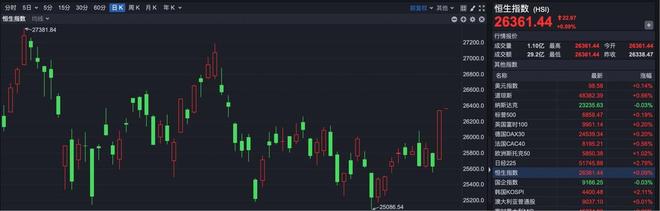
Market Overview - The Hong Kong stock market opened slightly higher on January 5, with the Hang Seng Index at 26,361.44 points, up 22.97 points, a gain of 0.09% [2] - The Hang Seng Tech Index reached 5,755.28 points, increasing by 18.84 points, or 0.33% [4] Company Focus - Kuaishou-W (HK01024) saw a significant early morning rise, exceeding 10% [6] - From December 15 to 30, 2025, Kuaishou repurchased a total of 9.9627 million shares for a total amount of 643 million HKD, despite a cumulative drop of 4.37% during that period [7] - In the tech sector, Alibaba rose over 2%, and Bilibili increased by more than 3% [7] - New stock Wan'an Robotics (HK06600), listed on December 30, 2022, continued to attract investment, rising over 20% in early trading and more than 50% from its issue price [7] Sector Performance - Oil and gas equipment and services stocks opened higher, with Shandong Molong rising over 13% [7] - Gold stocks were active, with Zijin Mining International increasing by over 1% [7] - Power equipment stocks opened lower, with Goldwind Technology dropping over 6% [7] - Chinese brokerage stocks generally fell, with China Merchants Securities down over 1% [7] - China Aluminum rose over 6%, and new consumption stocks rebounded, with Pop Mart up over 2% and Chow Tai Fook up over 5% [7] Market Outlook - Huatai Securities believes that the current market sentiment and liquidity environment are better than in November, increasing the likelihood of successful investments in Hong Kong stocks [9] - The firm suggests continuing to allocate to technology chains with performance expectations, as liquidity may catalyze significant growth in the next quarter [9] - The report highlights that in 2026, stock selection will focus more on fundamentals, industry conditions, and profitability, particularly in the power chain and travel sectors [9] - GF Securities' Liu Chenming team is optimistic about the Hong Kong market's rebound, noting a shift from traditional economic cycles to hard technology sectors like AI applications and new energy [9]

中信证券裘翔:2026年A股公司盈利增速将呈现前低后高态势
Zheng Quan Shi Bao Wang· 2026-01-05 01:37
Core Viewpoint - The chief A-share strategist at CITIC Securities, Qiu Xiang, predicts that the profit growth rate of A-share companies will exhibit a pattern of low growth followed by high growth in 2026 [1] Group 1: Market Phases - The market trend is expected to be influenced by the US-China trade agreement and the US midterm elections, divided into three phases: 1. From now until the trade agreement is finalized, the market's upward slope is expected to slow down 2. From the agreement's implementation to the end of the midterm elections, A-shares are likely to experience sustained growth in a stable external environment 3. After the midterm elections, uncertainties from external disturbances may increase sharply, prompting investors to refocus on domestic factors [1] Group 2: Investment Opportunities and Sector Allocation - Four major themes are highlighted for investment opportunities: 1. The manufacturing sector's competition for global pricing power, with a focus on industries such as non-ferrous metals, chemicals, and new energy, which can convert market share advantages into pricing power and profit margin increases 2. The globalization of Chinese enterprises, significantly expanding market capitalization and profit growth potential, with key industries including machinery, innovative pharmaceuticals, electric equipment, and military industry 3. The continuation of the technology trend, particularly in AI, which is expected to further expand its commercial applications and enhance the competitive advantages of Chinese companies, focusing on sectors like semiconductors, computing power, edge hardware, and AI applications 4. The potential for unexpected recovery in domestic demand, where although the outlook for domestic demand-related sectors is generally moderate, there exists significant room for recovery and valuation elasticity [2]

港股开盘:恒指涨0.09%,恒生科指涨0.33%,快手涨近6%,黄金股、油气设备与服务股高开
Jin Rong Jie· 2026-01-05 01:33
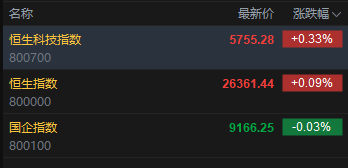
Market Performance - The Hang Seng Index opened up 0.09% at 26,361.44 points, while the Hang Seng Tech Index rose 0.33% to 5,755.28 points. The National Enterprises Index fell 0.03% to 9,166.25 points, and the Red Chip Index decreased by 0.22% to 4,074.78 points [1] - Major tech stocks showed mixed performance: Alibaba-W increased by 1.41%, Tencent Holdings rose by 0.16%, JD.com-SW fell by 0.26%, Xiaomi Group-W gained 0.79%, NetEase-S dropped 0.26%, Meituan-W decreased by 0.38%, Kuaishou-W surged by 5.89%, and Bilibili-W rose by 0.85% [1] - The three major indices in Hong Kong experienced a "New Year rally" on the last trading day, with the Hang Seng Index up 2.76% to 26,338.47 points, the Tech Index up 4% to 5,736.44 points, and the National Enterprises Index up 2.86% to 9,168.99 points [1] Investment Insights - CICC analyzed that the recent surge is likely not due to significant capital inflow or major policy changes, but rather driven by industry factors such as the listing of semiconductor leaders and the end of overseas holidays prompting investors to reposition for 2026 [2] - Huatai Securities recommends continuing to allocate to tech chains with performance expectations, while also considering a balanced allocation to cash flow assets due to changing driving factors and funding attributes [2] - Key sectors to watch in Q1 include strong cyclical industries with external demand catalysts, such as copper, aluminum, chemicals, and engineering machinery, alongside technology as a main focus [2] Company News - BYD is projected to achieve total sales of 4.602 million new energy vehicles in 2025, with pure electric vehicle sales expected to reach approximately 2.257 million units, marking a year-on-year increase of 27.86% [6] - Semiconductor industry developments are highlighted by the increase in the shareholding of the National Integrated Circuit Industry Investment Fund in SMIC from 4.79% to 9.25% [10] - The China Securities Regulatory Commission has revised regulations to lower public fund sales costs, which is expected to save investors approximately 51 billion yuan annually, reducing the comprehensive fee rate by about 20% [9]

AI注能变革,内外需求共振
Zhong Guo Neng Yuan Wang· 2026-01-05 00:55
Core Viewpoint - The report from Guojin Securities indicates that the domestic power grid equipment market is expected to exceed 2 trillion yuan by 2026, with a year-on-year growth of 15%, driven by significant changes in industry dynamics, particularly in domestic and international markets [1][2]. Market Size and Growth - The estimated total market size for domestic power grid equipment enterprises in 2026 is over 2 trillion yuan, with a year-on-year increase of 15% [2]. - Breakdown of market segments includes: - Domestic grid (approximately 823 billion yuan, yoy +9%) [2]. - External grid (approximately 580 billion yuan, yoy +19%) [2]. - International market (approximately 665 billion yuan, yoy +20%) [2]. Industry Dynamics - The industry is entering a new phase characterized by stable growth and structural differentiation, with a focus on international expansion and main grid development as key drivers [2]. - The report highlights ten segments to track and assess market conditions, indicating a global upcycle in power equipment [2]. Segment Analysis - Main grid (high growth maintained): In 2026, the bidding for transmission and transformation equipment is expected to reach 91.9 billion yuan, a year-on-year increase of 26% [3]. - Ultra-high voltage (bottoming out): Approval for new projects is expected to accelerate post-Q4 2025, with five new direct current lines anticipated in 2026 [3]. - Distribution network (upward turning point): Material bidding from January to November showed a year-on-year decrease of 4%, but prices for the second batch of regional joint procurement equipment have increased by 10% to 30% [3]. - Smart meters (downward trend slowing): Bidding for smart meters in 2025 is approximately 15 billion yuan, a year-on-year decrease of 40%, but new standards in 2026 are expected to lead to price increases [3]. - Digitalization of the grid (bottoming out): Bidding for digital equipment in 2025 is expected to reach 4.2 billion yuan, a year-on-year increase of 70% [3]. - Export opportunities for transformers and switchgear remain strong, with significant year-on-year growth in exports [3]. Investment Recommendations - Focus on the transformer segment, which is expected to benefit from technological innovation and increased demand [4]. - Solid-state transformers (SST) are highlighted as a disruptive technology with significant commercial potential, expected to see validation in 2026 and commercialization in 2027 [5]. - Attention is drawn to the anticipated recovery in domestic investments under the "14th Five-Year Plan," particularly in ultra-high voltage policies and new smart meter standards [5].
上市公司套保进入精耕细作时代
Qi Huo Ri Bao Wang· 2026-01-05 00:54
Core Insights - The number of A-share listed companies using derivatives continues to grow, with 1,782 companies publishing hedging-related announcements in the first 11 months of 2025, an increase of 279 companies or 18.6% year-on-year, reflecting the survival wisdom of Chinese enterprises in a complex international environment [1] Group 1: Hedging Trends - Since 2020, factors such as the pandemic, geopolitical conflicts, and supply chain restructuring have driven an increase in the hedging participation rate among listed companies in China, which stands at 35%, compared to the 70%-80% maturity level in Europe and the U.S. [2] - The demand for hedging in emerging sectors has surged, with industries such as electronics, basic chemicals, power equipment, machinery, and pharmaceuticals becoming the main players in hedging activities, aligning with the direction of China's manufacturing transformation [2] Group 2: Risk Management Strategies - Exchange rate risk is the primary concern for companies, with 1,311 companies publishing currency hedging announcements in the first 11 months of 2025, a 13% increase year-on-year, significantly outpacing other risk types [4] - Approximately 78% of companies use foreign exchange forward contracts for hedging, while 22% opt for foreign exchange options for dual protection [4] - The reform of the RMB exchange rate formation mechanism is reshaping market expectations, prompting companies to establish dynamic adjustment mechanisms for hedging strategies [4] Group 3: Commodity-Specific Hedging - Copper is the most popular commodity for hedging, with 80% of listed companies mentioning copper futures hedging in the first 11 months of 2025, due to its extensive application in various industries [6] - Different segments of the copper industry employ distinct hedging strategies, with upstream mining companies typically using sell hedges to lock in sales prices, while downstream processing companies adjust positions based on order conditions [7] Group 4: Evolving Hedging Practices - Companies are increasingly adopting refined risk management models, such as converting fixed price negotiations into basis trading to mitigate default risks and attract foreign partners [5] - The use of hedging tools is evolving from a simplistic approach to a more sophisticated operation, enhancing the resilience of the real economy against risks [7]
从估值重估走向业绩驱动 2026年中国股市将延续涨势
Shang Hai Zheng Quan Bao· 2026-01-05 00:45
Group 1 - The core viewpoint of the articles indicates a positive outlook for the Chinese stock market in 2026, driven by factors such as AI innovation, supportive policies for private enterprises, and improved corporate earnings [1][4][5] - The Shanghai Composite Index achieved an 18.41% increase in 2025, marking its best annual performance since 2020, with the Shenzhen Component Index and ChiNext Index rising by 29.87% and 49.57% respectively [1] - Domestic and foreign institutions are increasingly optimistic about Chinese assets, particularly in the technology sector, which is expected to be a key growth driver in 2026 [2][4][6] Group 2 - Domestic securities firms, such as CITIC Securities, emphasize a shift from valuation-driven gains to performance-driven earnings, suggesting that investors should focus on companies' earnings rather than expecting further valuation increases [2][3] - International investment banks, including UBS and Morgan Stanley, predict a favorable environment for Chinese stocks, citing ongoing support for innovation and the resilience of corporate earnings in a complex trade environment [4][5] - The AI sector is highlighted as a critical area for investment, with expectations for new applications and growth in related industries such as semiconductors and advanced manufacturing [6][7] Group 3 - The overall sentiment among foreign institutions is that structural improvements in the Chinese market will support a broader upward trend, with predictions of significant earnings growth for Chinese companies in 2026 and 2027 [4][5] - The focus on AI and technology is expected to enhance the profitability of the Chinese stock market, with a notable increase in R&D investments driving the digital economy's contribution to GDP [6][7] - Asset allocation strategies suggest an overweight position in Chinese stocks and gold, with a cautious approach to gold due to its current high valuation [7]

A股1月逾2800亿元解禁,百利天恒、海博思创解禁规模居前
Bei Jing Ri Bao Ke Hu Duan· 2026-01-05 00:33
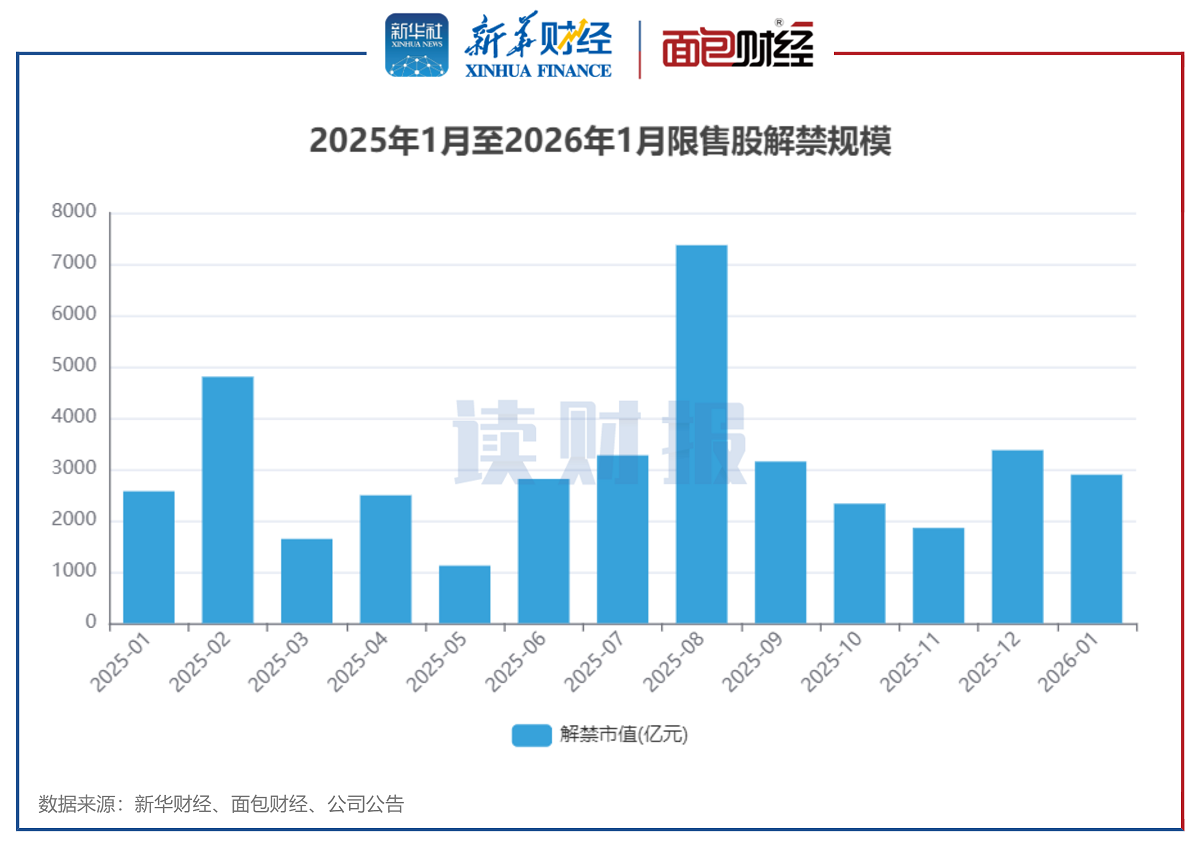
Group 1 - In January 2026, a total of 117 companies will have their restricted shares unlocked, amounting to approximately 10.202 billion shares and a total market value of 289.587 billion yuan, which is a decrease of about 14.13% month-on-month and an increase of approximately 12.57% year-on-year [1][2][4] - The company with the largest unlock scale is Baili Tianheng, with a market value exceeding 90 billion yuan [1][4] - The top three industries by unlock market value are pharmaceuticals and biotechnology, electrical equipment, and automotive [1][9] Group 2 - In January, 12 companies will have their anniversary unlocks, totaling approximately 1.028 billion shares and a market value of 54.824 billion yuan, including companies like Haibo Sichuang, Xingtou Measurement and Control, and Saifen Technology [1][11] - The second largest unlock scale is for Haibo Sichuang, with 9.464 million shares and a market value of approximately 23.937 billion yuan, accounting for about 52.55% of its total share capital [4][8] - Guolian Minsheng ranks third in unlock market value, with 1.771 billion shares, representing 31.17% of its total share capital and a market value of approximately 18.132 billion yuan [8]

读财报A股1月逾2800亿元解禁 百利天恒、海博思创解禁规模居前
Zhong Guo Jin Rong Xin Xi Wang· 2026-01-05 00:06
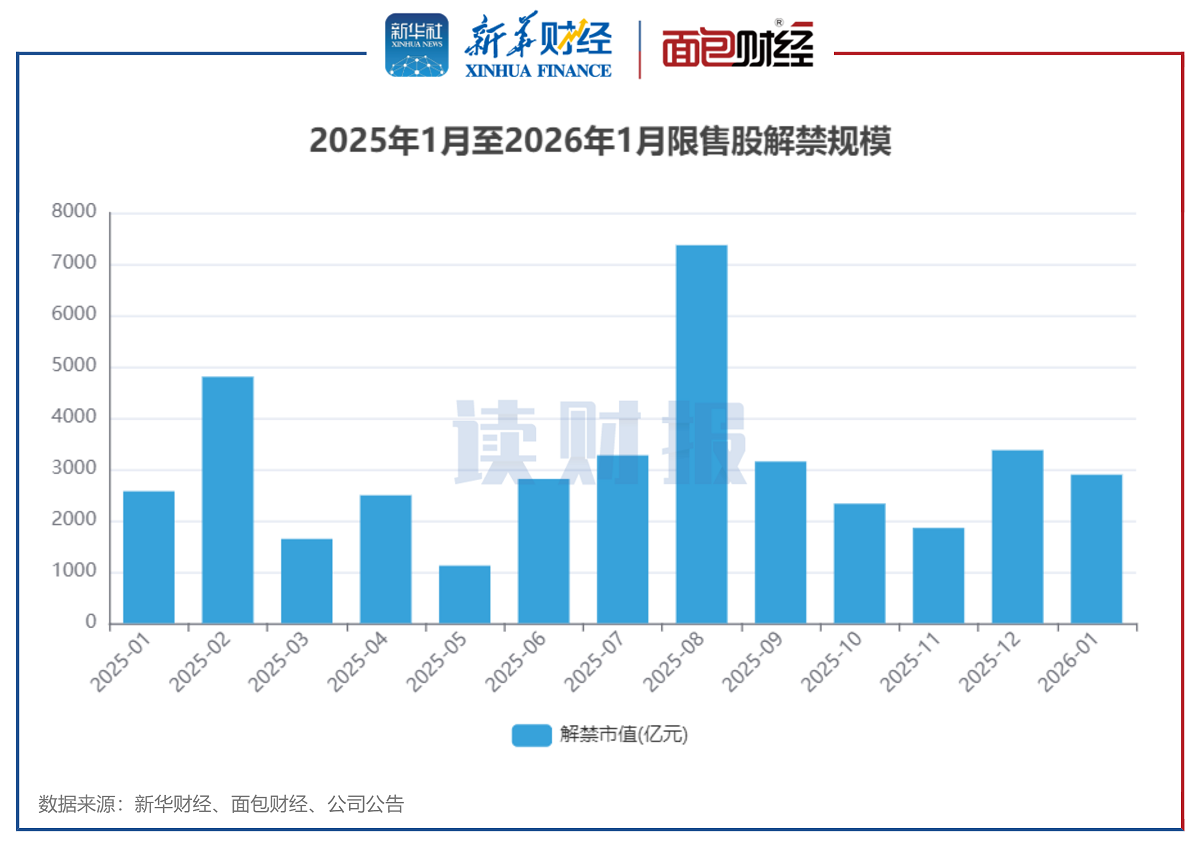
Group 1 - In January 2026, a total of 117 companies will have their restricted shares unlocked, amounting to approximately 10.202 billion shares and a total market value of 289.587 billion yuan, which is a decrease of about 14.13% month-on-month but an increase of about 12.57% year-on-year [1][3][7] - The company with the largest unlock scale is Baili Tianheng, with a market value exceeding 90 billion yuan, accounting for 72.2% of its total share capital [3][4] - The top three industries by unlock market value are pharmaceuticals and biotechnology, electrical equipment, and automotive [1][8] Group 2 - In January, 12 companies will have their anniversary unlocks, totaling approximately 1.028 billion shares and a market value of 54.824 billion yuan, including companies like Haibo Sichuang and Xingtou Measurement Control [1][10] - Haibo Sichuang will have 9.464 million shares unlocked, with a market value of approximately 23.937 billion yuan, accounting for 52.55% of its total share capital [6][11] - Guolian Minsheng will have 1.771 billion shares unlocked, representing 31.17% of its total share capital, with a market value of about 18.132 billion yuan [7]
A股市场大势研判:创业板指2025年全年大涨近50%
Dongguan Securities· 2026-01-04 23:30
Market Overview - The A-share market showed mixed performance with the Shanghai Composite Index closing at 3968.84, up by 0.09%, while the Shenzhen Component Index fell by 0.58% to 13525.02 [2] - The ChiNext Index experienced a significant increase of nearly 50% throughout 2025, indicating strong growth in the market [1][4] Sector Performance - The top-performing sectors included Defense and Military with a gain of 2.13%, Media at 1.54%, and Real Estate at 1.13%, while sectors like Communication and Agriculture showed declines of -1.35% and -1.10% respectively [3] - Notable concept stocks included the Xiaohongshu concept and Kuaishou concept, which rose by 2.88% and 2.49% respectively, while sectors like Silicon Energy and Organic Silicon faced declines [3] Future Outlook - The report anticipates that the overall market will maintain some upward potential before the Spring Festival, with any short-term adjustments viewed as opportunities for low-cost positioning [6] - The manufacturing sector is showing signs of recovery, with the Purchasing Managers' Index (PMI) for December at 50.1%, indicating expansion in manufacturing activity [5][6] Investment Recommendations - It is suggested to focus on sectors such as dividends, TMT (Technology, Media, and Telecommunications), and consumer goods for potential investment opportunities [6]