
银行

Search documents
【金融服务】工商银行上海市分行成功举办第34届华交会采购对接会-东南亚专场
Xin Lang Cai Jing· 2026-03-03 10:03
Core Viewpoint - The 34th East China Import and Export Commodity Fair (referred to as "HuaJiaoHui") will be held from March 1 to 4, 2026, at the Shanghai New International Expo Center, with the Industrial and Commercial Bank of China (ICBC) Shanghai Branch actively supporting the event to promote Chinese brands internationally and contribute to the Belt and Road Initiative [1][3]. Group 1: Cross-Border Trade Facilitation - The procurement matchmaking event successfully connected nearly 30 overseas professional buyers with over 50 domestic foreign trade enterprises through both online and offline methods, facilitating deep cooperation and achieving multiple intended transaction results across various sectors such as consumer goods, daily necessities, and electronics [1][4]. Group 2: Tailored Services for Overseas Buyers - ICBC Shanghai Branch provided one-on-one exclusive guidance for overseas buyers, assisting them in identifying product needs and potential exhibitors, while also offering multilingual support for real-time translation during the event [2][5]. Group 3: Comprehensive Financial Services for Foreign Trade Enterprises - ICBC Shanghai Branch offered a range of financial services including international settlement, trade financing, and foreign exchange risk management, promoting policies for cross-border trade facilitation and new financial products to support Chinese foreign trade enterprises in the international market [3][7]. - The bank plans to enhance its cross-border financial service capabilities through strategic cooperation with government agencies, industry associations, and domestic and foreign enterprises, aiming to contribute to stabilizing foreign trade and promoting openness [7].

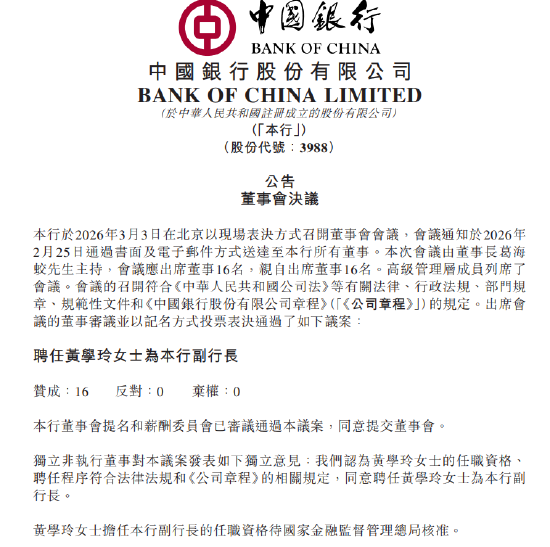
中国银行:聘任黄学玲为副行长
Xin Lang Cai Jing· 2026-03-03 09:57
3月3日金融一线消息,中国银行发布公告称,董事会会议同意聘任黄学玲为该行副行长,任职资格待国 家金融监督管理总局核准。 简历显示,黄学玲出生于1977年,2026年加入中国银行。2025年7月至2026年2月任中央汇金投资有限责 任公司股权管理二部主任。2020年4月至2025年7月任中央汇金投资有限责任公司资本运营部主任,兼中 央汇金资产管理有限责任公司董事长、总经理。此前曾任中央汇金投资有限责任公司综合管理部副主 任,中央汇金资产管理有限责任公司执行董事,中国出口信用保险公司董事,中央汇金公司综合合管理 部/银行机构管理二部改革规划处主任等职务。获北京大学经济学硕士学位。 责任编辑:王馨茹 3月3日金融一线消息,中国银行发布公告称,董事会会议同意聘任黄学玲为该行副行长,任职资格待国 家金融监督管理总局核准。 简历显示,黄学玲出生于1977年,2026年加入中国银行。2025年7月至2026年2月任中央汇金投资有限责 任公司股权管理二部主任。2020年4月至2025年7月任中央汇金投资有限责任公司资本运营部主任,兼中 央汇金资产管理有限责任公司董事长、总经理。此前曾任中央汇金投资有限责任公司综合管理部副主 ...


——3月信用债策略月报:利差压缩空间有限,以稳为主、逢高配置-20260303
Huachuang Securities· 2026-03-03 09:45
Group 1 - The report indicates that the credit spread is currently at a low level, with limited compression potential, suggesting a focus on stability and high-yield opportunities in the market [2][24][28] - In March, the bond market is expected to experience a seasonal slow decline in yields, with credit spreads likely to widen, thus presenting opportunities for strategic allocation at high points [3][15][24] - The report highlights that the demand for credit bonds typically strengthens in the second quarter, despite the current low value for credit spreads, which may pose risks if spreads widen significantly [2][3][24] Group 2 - The strategy for credit bonds suggests that within the 3-year maturity range, there is a high demand for funds and wealth management products, with yields expected to fluctuate between 1.65% and 2.05% [3][28] - For 4-5 year maturity bonds, the report notes that the compression space is limited, and investors should consider strategic allocations at high points during the month [3][28] - Long-term bonds (over 5 years) are still seen as having some value, particularly for insurance and long-term liabilities, with a recommendation for active trading and quick exits to capitalize on market movements [3][28] Group 3 - The report emphasizes the importance of sector strategies, particularly in urban investment bonds, real estate bonds, coal bonds, and steel bonds, each with specific recommendations based on current market conditions [4][11][28] - Urban investment bonds are highlighted for their ticket value in lower-grade varieties, while real estate bonds are suggested for their potential recovery in valuation, especially for high-quality entities [4][11] - The coal and steel sectors are advised for short-term investments, with specific focus on high-grade bonds and the potential for yield improvements based on market conditions [4][11]
汇丰控股:维持“增持”评级,目标价165港元-20260303
摩根大通· 2026-03-03 09:45
Investment Rating - The report maintains an "Overweight" rating for HSBC Holdings with a target price of HKD 165 [1] Core Insights - HSBC's Q4 2025 performance and mid-term tangible return on equity (ROTE) guidance exceeded expectations [1] - The earnings briefing conveyed positive messages, with management clearly outlining revenue growth trajectories from 2026 to 2028, drivers of net interest income growth, and a roadmap for achieving business synergies [1] - Management's explanation regarding costs alleviates market concerns about insufficient investments in key areas such as technology and artificial intelligence [1] - A strong currency is anticipated to persist, with the next catalyst being the investor day scheduled for May [1]

中金:港股资金面透视
中金点睛· 2026-03-03 09:33
Core Viewpoint - The Hong Kong stock market, particularly the Hang Seng Technology Index, has underperformed since February, with the Hang Seng Index down 2.8% and the Hang Seng Technology Index down 10.1% as of February 28, 2026, indicating a significant decline compared to other indices [2][6]. Group 1: Market Performance - The Hang Seng Technology Index has seen a 20% decline since its peak in October, breaking through multiple technical support levels [2]. - The underperformance is attributed to a negative sentiment in the equity risk premium, which has dragged down the index by 14.7 percentage points [2][6]. - The top five weighted stocks in the index contributed to a 6.0 percentage point decline [3]. Group 2: Credit Cycle and Market Sentiment - The overall credit cycle is expected to experience fluctuations, with a potential recovery from the bottom in 2025 leading to a slowdown in 2026 [6]. - The market's focus on specific sectors, particularly in the context of AI narratives, has led to a divergence between "leaders and laggards" [6]. - The liquidity environment has amplified market volatility, influenced by macroeconomic factors such as the appointment of a hawkish Federal Reserve chair [7]. Group 3: Future Outlook for 2026 - The liquidity environment in Hong Kong is unlikely to surpass that of 2025, with projected net inflows of 1.4 trillion HKD in 2025 compared to 807.9 billion HKD in 2024 [8]. - The anticipated IPO and refinancing activities in 2026 could reach 1.1 trillion HKD, significantly exceeding the 600 billion HKD expected in 2025 [38][41]. - The potential inflow from foreign capital, particularly long-term foreign investments, could amount to 500-550 billion HKD if active foreign capital returns to benchmark levels [9][23]. Group 4: Sector Analysis - The sectors likely to benefit from foreign capital inflows include banking, e-commerce, and technology hardware, as these areas are currently underrepresented in foreign investment portfolios [23]. - The unique characteristics of Hong Kong's market, such as high dividend yields and specific tech and consumer sectors, continue to attract southbound capital despite overall market weakness [37]. Group 5: Investment Strategy - The investment strategy should focus on sectors aligned with credit expansion, particularly AI technology, cyclical stocks, and consumer goods [46]. - Short-term recommendations include prioritizing investments in internet, technology hardware, and new consumption sectors, while maintaining a watchful eye on financial and biotech sectors for potential long-term opportunities [49].

瀑布杀 | 谈股论金
水皮More· 2026-03-03 09:24
Market Overview - The A-share market experienced a collective decline, with the Shanghai Composite Index falling by 1.43% to 4122.68 points, the Shenzhen Component down by 3.07% to 14022.39 points, and the ChiNext Index decreasing by 2.57% to 3209.48 points [3] - The total trading volume in the Shanghai and Shenzhen markets reached 3.16 trillion yuan, an increase of 111.8 billion yuan compared to the previous day [3] Market Risks - The primary risk facing the market is that the indices are at relatively high levels after reaching new highs, which makes them vulnerable to significant declines if external markets experience sharp downturns [4] - Ongoing tensions between the U.S. and Iran have not eased, with the potential for prolonged conflict, which could negatively impact the global economy, particularly if the Strait of Hormuz is blocked, leading to uncontrolled oil prices [5] Sector Performance - The A-share market saw limited upward movement, primarily in sectors related to oil, coal, and related industries, while the banking and insurance sectors provided some support [6] - A significant number of stocks declined, with 4675 stocks falling and only 559 rising, indicating a broad market sell-off [6] - The financial sector, particularly banks and insurance, showed resilience due to prior adjustments and relatively low valuations, which allowed them to act as a stabilizing force [7] Investment Trends - The market is witnessing a shift in investment focus, with a notable rotation from previously overhyped sectors like aerospace, military electronics, and semiconductors to undervalued core sectors such as banking and utilities [7] - The trend of capital inflow from northbound trading into Hong Kong stocks continues, with approximately 6 billion Hong Kong dollars flowing into the market, indicating some investors are positioning themselves ahead of potential market movements [8] Conclusion - The current market environment reflects a challenging landscape with significant external risks and sectoral shifts, emphasizing the need for careful analysis and strategic positioning in investment decisions [9]

暴涨120%!三大板块,逆市爆发
证券时报· 2026-03-03 09:16
Core Viewpoint - The oil, gas, and shipping sectors have experienced significant gains despite a broader market downturn, driven by geopolitical tensions and supply chain concerns [12][13]. Group 1: Market Performance - On March 3, major Asia-Pacific stock indices fell sharply, with the Nikkei 225 down over 3% and the Korean Composite Index down 7.24%, marking its largest single-day drop since August 5, 2024 [1]. - The A-share market also declined, with the Shanghai Composite Index dropping 1.43% to 4122.68 points, and the ChiNext Index falling 2.57% [2]. - Despite the overall market weakness, the oil, gas, and shipping sectors saw substantial gains, with major companies like China National Petroleum, China National Offshore Oil, and Sinopec hitting consecutive daily limits [2][5]. Group 2: Sector Highlights - In the oil sector, companies such as Keli Co. and Tongyuan Petroleum reached their daily limits, with Keli Co. up 30% and Tongyuan Petroleum up 20% [6][7]. - The gas sector also showed strength, with Kaiti Gas hitting a 30% limit and several other companies like Shenzhen Gas and Meino Energy seeing gains of over 20% [8][9]. - The shipping sector saw continuous gains, with companies like China Merchants Energy and China Merchants Shipping achieving daily limits [10]. Group 3: Geopolitical Impact - Reports indicate that the Strait of Hormuz has been closed by Iranian forces, raising concerns about global oil supply disruptions, as approximately 20% of the world's oil transport passes through this strait [12]. - The escalation of tensions in the Middle East is expected to significantly increase global shipping prices, benefiting various shipping segments [13]. Group 4: Banking and Insurance Performance - The banking sector showed resilience, with Agricultural Bank of China rising nearly 4% and other major banks like Industrial and Commercial Bank of China and China Construction Bank increasing over 2% [15][16]. - The insurance sector also saw gains, with companies like New China Life and China Life Insurance rising over 1% [17]. Group 5: Semiconductor Sector Decline - The semiconductor sector faced a sharp decline, with companies like Zhenlei Technology and Canxin Technology dropping over 10% [19][20]. - Despite the current downturn, institutions remain optimistic about long-term investment opportunities in semiconductor-related sectors due to ongoing demand for AI infrastructure [21][22].






渣打集团3月2日斥资1402.23万英镑回购80.9万股
Zhi Tong Cai Jing· 2026-03-03 09:06
渣打集团(02888)发布公告,于2026年3月2日斥资1402.23万英镑回购80.9万股。 ...
投资于人:构建双轮驱动的新增长范式|宏观经济
清华金融评论· 2026-03-03 09:06
Core Viewpoint - The article emphasizes the need for increased investment in human capital in China, shifting from a traditional focus on material capital to a more balanced approach that includes education, healthcare, and social services [2][3]. Group 1: Investment in Human Capital - China's fiscal spending has historically favored material investments over human capital, necessitating a shift to prioritize education, healthcare, and other human development areas [2]. - Recent government initiatives across various ministries focus on "people-centered" development, aligning with the emphasis on combining investments in material and human capital [3]. - The transition from a material capital-driven growth model to one that enhances overall productivity through human capital investment is crucial for sustainable economic development [3]. Group 2: Differences in Investment Approaches - Investment in human capital focuses on intangible assets such as knowledge, skills, and health, contrasting with traditional investments in tangible assets like land and equipment [5]. - The growth logic differs: traditional investments can lead to overproduction if demand does not rise, while human capital investment fosters innovation and sustainable growth by enhancing labor productivity and effective demand [5][6]. - Human capital investments generate broad, long-lasting positive externalities that are difficult to quantify, unlike traditional investments that yield more immediate and measurable returns [6]. Group 3: Supporting High-Quality Development - Investment in human capital is essential for addressing labor supply constraints and enhancing the quality of the workforce, which is vital for technological innovation and economic growth [8]. - By improving basic social services, such as education and healthcare, human capital investment can stabilize consumer expectations and release consumption potential, which is critical for high-quality economic development [9]. - Focusing on human capital can also address structural challenges, such as an aging population, by enhancing services in sectors like elderly care and vocational training, thus creating new economic growth points [9]. Group 4: Government Role and Public Investment Priorities - The government should act as a supplement to market failures in education and public health, guiding social capital into sectors like healthcare and elderly care [11]. - Public investment should prioritize basic social services, strategic research, and addressing gaps in development-oriented services to ensure equitable and efficient resource allocation [12][13]. - Strengthening the social safety net and enhancing public services are essential for stabilizing development expectations and releasing consumer potential [13]. Group 5: Corporate Investment Challenges and Incentives - Companies face challenges in investing in human capital due to high talent turnover risks and the uncertainty of returns on such investments [15][16]. - To encourage corporate investment in human capital, a dual incentive mechanism involving both corporate initiatives and government support is necessary [17]. - Companies should enhance their incentive systems, focusing on employee retention and targeted training aligned with business strategies to improve the effectiveness of human capital investments [18]. Group 6: International Experiences and Lessons - China can learn from international experiences in human capital investment, particularly in establishing comprehensive social security systems and encouraging private sector participation in public services [21][22]. - Adopting market-oriented mechanisms and ensuring that welfare systems align with economic capabilities are crucial for sustainable development [23].
全国政协委员、交通银行董事长任德奇:今年很有信心保持息差稳定
Xin Lang Cai Jing· 2026-03-03 08:24
Group 1 - The core viewpoint is that the chairman of the Bank of Communications, Ren Deqi, expressed confidence in maintaining stable interest margins this year, indicating that current policies are aligned with this expectation [1]
