
风电

Search documents
午后 A股拉升!多股强势涨停!
Zheng Quan Shi Bao· 2025-11-05 09:51
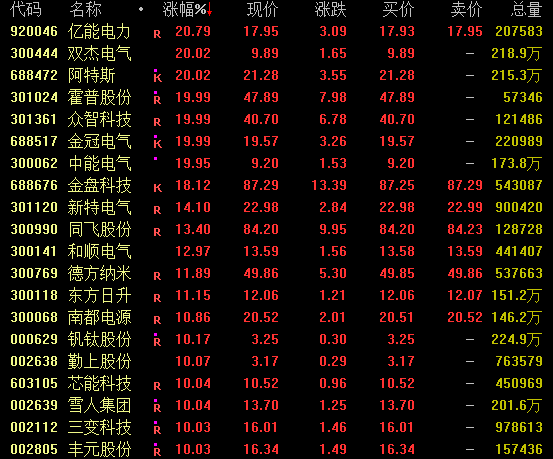
Market Overview - A-shares experienced a strong afternoon rally with the ChiNext Index rising over 1%, while Hong Kong stocks gradually stopped falling, with the Hang Seng Index briefly turning positive [1] - The Shanghai Composite Index closed up 0.23% at 3969.25 points, the Shenzhen Component Index rose 0.37% to 13223.56 points, and the ChiNext Index increased by 1.03% to 3166.23 points [1] - Total trading volume in the Shanghai and Shenzhen markets was 189.45 billion yuan, a decrease of approximately 44 billion yuan from the previous day, remaining below 200 billion yuan for two consecutive days [1] New Energy Sector - The new energy sector saw a collective surge, with companies like YN Power rising over 20%, and several others including Shuangjie Electric, Canadian Solar, and Zhongzhi Technology hitting the 20% limit up [3] - Sunshine Power, with a market capitalization exceeding 400 billion yuan, rose over 7% with a total trading volume of 233.7 billion yuan, leading the A-share market in trading volume [3] - The global demand for energy storage is expected to explode due to increased penetration of new energy and declining costs of storage systems, with Europe showing accelerated growth in large-scale storage [4][5] Hainan Free Trade Zone - The Hainan Free Trade Zone concept was active, with stocks like Intercontinental Oil and Gas, Caesar Travel, and Hainan Development hitting the limit up [7] - The construction of the Hainan Free Trade Port is reaching a significant milestone, with the full island closure operation expected by 2025, marking a shift in investment focus from B2C consumption to B2B industrial upgrades and high-value-added services [8] Coal Sector - The coal sector saw strong gains, with Antai Group hitting the limit up for three consecutive days, and other companies like Baotailong and Daya Energy also rising significantly [10] - The domestic coal production growth rate is gradually slowing due to safety regulations and overproduction checks, with winter storage demand expected to increase due to early cold weather in northern regions [11] - Expectations for the fourth quarter include a potential increase in port thermal coal prices by over 15%, with prices possibly exceeding 850 yuan per ton, and coking coal prices also expected to remain high [12]

狼来了?| 谈股论金
水皮More· 2025-11-05 09:36
Market Overview - The A-share market saw all three major indices rise today, with the Shanghai Composite Index up 0.23% closing at 3969.25 points, the Shenzhen Component Index up 0.37% at 13223.56 points, and the ChiNext Index up 1.03% at 3166.23 points. The total trading volume in the Shanghai and Shenzhen markets was 1.8723 trillion yuan, a decrease of 43.4 billion yuan compared to the previous day [3]. Market Sentiment - The current market sentiment is under scrutiny, with discussions on whether the bulls or bears are "crazy." Notably, Michael Burry, a well-known short-seller, has begun shorting Nvidia and Palantir, causing significant concern on Wall Street. His previous successful prediction of the 2008 financial crisis adds weight to his current actions, which have led to a notable decline in major U.S. indices, including a 2% drop in the Nasdaq [4][5]. A-share Market Reaction - The A-share market opened significantly lower, with the Shanghai Composite Index down nearly 1% and the Shenzhen Component Index down about 1.5%. However, a typical market behavior of "low open, high rise" was observed as main funds initiated self-rescue efforts, leading to a recovery [5][6]. Sector Performance - The performance of sectors today showed a clear divide, with TMT (Technology, Media, and Telecommunications) sectors, including software development, semiconductors, and internet services, experiencing declines. Conversely, energy sectors such as wind, water, electricity, coal, and oil saw strong performance. This indicates a demand for recovery in previously lagging sectors while retaining some bullish sentiment [7]. Technology Sector Concerns - The technology sector is currently under pressure, with concerns about the commercial viability of the artificial intelligence industry, particularly in the consumer market. The lack of clear profit models and the high capital expenditure in areas like data centers are seen as potential risks. The Nasdaq's recent performance, having adjusted for five consecutive trading days, suggests that the technology sector may need to consolidate [8][9].






龙净环保:公司巴彦淖尔70MW自发自用风电项目,已于11月1日顺利投运
Mei Ri Jing Ji Xin Wen· 2025-11-05 09:12
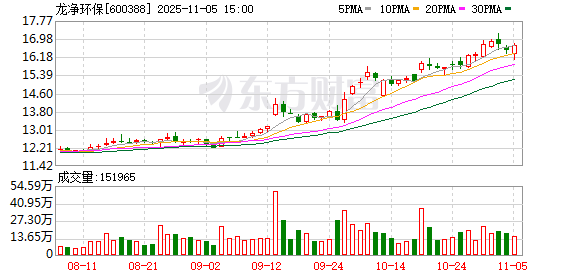
龙净环保(600388.SH)11月5日在投资者互动平台表示,尊敬的投资者,您好。公司巴彦淖尔70MW自 发自用风电项目,已于2025年11月1日顺利投运。感谢您的关注! (文章来源:每日经济新闻) 每经AI快讯,有投资者在投资者互动平台提问:巴彦淖尔风电项目进展如何? ...

前8月我国能源投资保持较快增长
Zhong Guo Hua Gong Bao· 2025-11-05 07:47
Core Insights - The National Energy Administration reported a significant increase in energy investment in China, with key projects completing investments of 1.97 trillion yuan in the first eight months of the year, representing an 18.2% year-on-year growth [1] Group 1: Investment Growth Characteristics - Nuclear power, power grids, new energy storage, and coal power are major contributors to the growth in energy project investments [1] - New energy storage projects in Xinjiang, Guangdong, Yunnan, Shandong, and Inner Mongolia saw investment growth rates exceeding 100% year-on-year [1] Group 2: Rapid Growth in Specific Sectors - Wind power, modern coal chemical industry, oil and gas reserve facilities, charging and swapping infrastructure, and hydrogen energy investments are experiencing rapid growth [1] - Ongoing projects in Xinjiang and Inner Mongolia for coal-to-oil and coal-to-olefins are progressing steadily, while the Daan green hydrogen ammonia integration demonstration project in Jilin has been completed [1] Group 3: Steady Growth in Other Energy Investments - Solar power generation, integrated source-grid-load-storage projects, oil and gas exploration and development, and pumped storage investments are also growing steadily [1] - Several integrated source-grid-load-storage projects are advancing in Shandong, Shanxi, Gansu, and Guangxi, while major oil fields are steadily increasing reserves and production [1]
电网设备集体爆发 保变电气5分钟拉涨停 灿能电力30cm涨停
2 1 Shi Ji Jing Ji Bao Dao· 2025-11-05 04:42
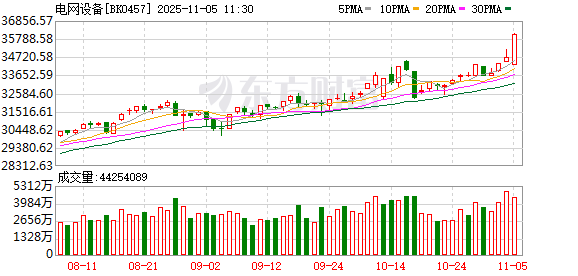
Core Insights - The electric grid equipment sector experienced significant stock price increases, with several companies reaching their daily price limits, indicating strong market interest and potential investment opportunities [2][5][6] Group 1: Market Movements - Companies such as Baobian Electric (保变电气) and Caneng Electric (灿能电力) saw their stock prices surge, with Baobian Electric hitting the daily limit and Caneng Electric increasing by 30% [2][5] - Other notable performers included Zhongzhi Technology (众智科技) and Zhongneng Electric (中能电气), both achieving 20% increases, while several other stocks rose over 10% [2][6] Group 2: Industry Developments - Microsoft CEO Satya Nadella highlighted a critical issue in the AI industry, stating that the lack of sufficient power to support GPU operations is a significant challenge, which may drive demand for electric power solutions [2] - The East Asia Summit Clean Energy Forum revealed that China and ASEAN have established 16 cross-border power transmission lines, with over 190 cooperative projects and a total investment exceeding $92 billion [3] - The ASEAN Energy Cooperation Action Plan aims to increase the share of renewable energy equipment to 45% by 2030, indicating substantial growth potential in renewable energy installations [3] Group 3: Future Outlook - Huatai Securities emphasized the importance of building a new energy system and integrating renewable energy with storage solutions to ensure system stability and carbon reduction [4] - The global energy storage market is expected to grow significantly, with Sunshine Power projecting a 40-50% increase in demand by 2026, suggesting a favorable environment for storage companies [3][4]


“强需求+反内卷+新技术”主线共振——三季报看,新能源如何布局?
Mei Ri Jing Ji Xin Wen· 2025-11-05 03:37
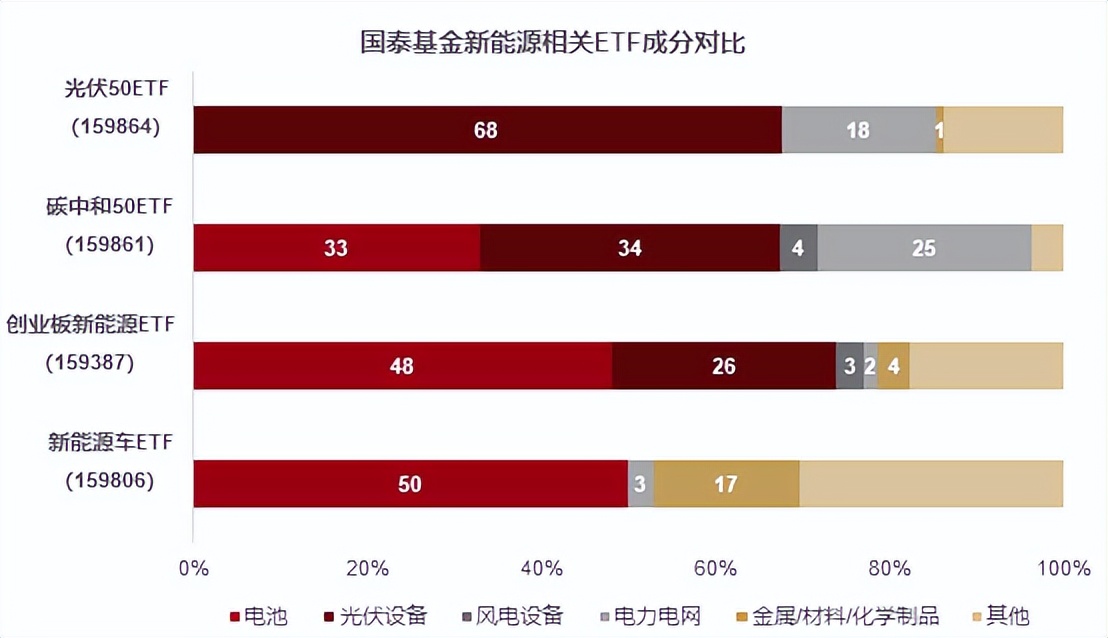
Lithium Battery - SW Battery (801737.SI) achieved revenue of 901.9 billion yuan in the first three quarters of 2025, a year-on-year increase of 13%, and a net profit of 70.2 billion yuan, up 34% year-on-year [1] - In Q3 2025, revenue reached 333.1 billion yuan, a 19% year-on-year increase and a 10% quarter-on-quarter increase, with a net profit of 28.1 billion yuan, up 58% year-on-year and 23% quarter-on-quarter [1] - The improvement in performance is driven by strong domestic passenger car sales, heavy truck replacements, and the resumption of electric vehicle subsidies in Europe [1] - Resource prices for lithium, nickel, cobalt, and manganese have been rising due to demand expectations and supply policies, with significant price increases expected in Q4 2025 and 2026 [1] Solar Energy - SW Photovoltaic Equipment (801735.SI) reported revenue of 625.2 billion yuan in the first three quarters of 2025, a decline of 11%, and a net loss of 6.9 billion yuan, which has widened [3] - In Q3 2025, revenue was 216.6 billion yuan, down 8% year-on-year and 4% quarter-on-quarter, but net profit turned positive at 1.1 billion yuan [3] - The improvement in profitability is attributed to rising prices of silicon materials and the positive impact of inverter companies benefiting from strong downstream storage demand [3] - Prices for photovoltaic materials showed mixed trends, with silicon materials and wafers increasing, while battery and module prices are stabilizing [3] Wind Power - SW Wind Power Equipment (801736.SI) achieved revenue of 171.0 billion yuan in the first three quarters of 2025, a year-on-year increase of 38%, and a net profit of 5.7 billion yuan, up 13% [5] - In Q3 2025, revenue was 66.2 billion yuan, a 27% year-on-year increase, with net profit of 1.4 billion yuan, reflecting stable performance [5] - The growth is driven by accelerated project construction and a recovery in bidding prices, leading to increased orders and revenue [5] Market Outlook - The lithium battery industry is expected to maintain high prosperity in Q4 2025 and 2026, driven by strong demand in energy storage and commercial vehicles, as well as a new car cycle in Europe [2] - The solar energy sector is anticipated to recover due to policy support, market clearing, and technological iterations, with a focus on the ongoing "anti-involution" efforts [4] - The wind power sector is poised for a new upward cycle, with significant growth potential in offshore wind projects and positive market sentiment for onshore wind installations [5] Investment Opportunities - Key investment themes include strong demand in energy storage, the ongoing "anti-involution" in the solar sector, and breakthroughs in new technologies such as solid-state batteries and advanced photovoltaic materials [6] - Investors interested in lithium battery demand and solid-state battery advancements may consider the New Energy Vehicle ETF (159806), which covers the entire lithium battery supply chain [7] - For a comprehensive exposure to lithium, energy storage, solar, and wind power, investors can look at the 20cm ChiNext New Energy ETF (159387) and the Carbon Neutrality 50 ETF (159861) [7]
新能源基本面依旧持续向好,关注创业板新能源ETF(159387)
Mei Ri Jing Ji Xin Wen· 2025-11-05 02:13
Core Viewpoint - The new energy sector experienced significant pullbacks on November 4, with various ETFs showing declines due to a shift in market sentiment [1] Group 1: Performance Analysis - The lithium battery sector showed notable improvement in revenue and profit, driven by strong domestic passenger car sales, heavy truck replacements, and renewed electric vehicle subsidies in Europe [1] - The photovoltaic sector continued to see a decline in performance for the first three quarters, but there was a marginal improvement in Q3 2025, attributed to the effectiveness of anti-involution policies and rising prices of silicon materials [1] - The wind power sector reported increased revenue and profit, benefiting from accelerated project construction and a self-regulatory mechanism that improved bidding prices, leading to a rise in both volume and price [1] Group 2: Future Outlook - The fundamentals of the new energy sector remain positive, with three key investment themes to watch: strong demand in energy storage, progress in anti-involution policies in photovoltaics, and advancements in new technologies such as solid-state batteries and BC cells [2] - Investors are encouraged to consider specific ETFs that align with these themes, including the entrepreneurial board new energy ETF (159387) and the carbon neutrality 50 ETF (159861) [2]

前8月我国能源投资保持较快增长
Zhong Guo Hua Gong Bao· 2025-11-05 02:09
Core Insights - The National Energy Administration reported a significant increase in energy investment in China, with a total investment of 1.97 trillion yuan in key energy projects in the first eight months of the year, representing an 18.2% year-on-year growth [1] Group 1: Investment Growth Characteristics - Nuclear power, power grids, new energy storage, and coal power are key drivers of investment growth in energy projects [1] - In the first eight months, key energy storage projects in Xinjiang, Guangdong, Yunnan, Shandong, and Inner Mongolia saw investment growth rates exceeding 100% [1] Group 2: Rapid Growth in Specific Sectors - Wind power, modern coal chemical industry, oil and gas reserve facilities, charging and swapping infrastructure, and hydrogen energy investments are experiencing rapid growth [1] - Ongoing projects in Xinjiang and Inner Mongolia for coal-to-oil and coal-to-olefins are progressing steadily, while the Daan green hydrogen ammonia integration demonstration project in Jilin has been completed [1] Group 3: Steady Growth in Other Energy Investments - Investments in solar power generation, integrated source-grid-load-storage systems, oil and gas exploration and development, and pumped storage are steadily increasing [1] - Several integrated source-grid-load-storage projects are being advanced in Shandong, Shanxi, Gansu, and Guangxi, while major oil fields are steadily increasing reserves and production [1]
联合国环境署:形势依然严峻
中国能源报· 2025-11-05 01:49
Core Viewpoint - The United Nations Environment Programme's report indicates that global warming remains a severe issue, with current climate commitments under the Paris Agreement only slightly alleviating the trend of rising global temperatures, leading to increased climate risks and damages [1]. Group 1: Climate Goals and Emission Reduction - The Paris Agreement aims to limit the increase in global average temperature to within 2 degrees Celsius above pre-industrial levels, with efforts to keep it within 1.5 degrees Celsius [1]. - To achieve these temperature goals, global greenhouse gas emissions need to be reduced by 35% and 55% from 2019 levels by 2035 [1]. - The report suggests that without significant emission reductions, global warming could exceed 1.5 degrees Celsius within the next decade [1]. Group 2: Expected Temperature Increases - If countries fully implement their Nationally Determined Contributions (NDCs), global warming is projected to reach between 2.3 to 2.5 degrees Celsius this century, while current policies could lead to a rise of 2.8 degrees Celsius [1]. - These projections show slight improvements compared to last year's report, but emphasize the need for faster and more substantial greenhouse gas reductions to mitigate climate risks [1]. Group 3: Technological Capabilities - The report highlights that since the adoption of the Paris Agreement, the necessary low-carbon technologies for significant emission reductions are available, with the wind and solar industries driving down application costs [2]. - This indicates that the international community has the capability to accelerate climate action if there is a collective commitment [2].

复苏拐点渐明,二次成长正兴 - 电新行业2025年三季报综述
2025-11-05 01:29
Summary of Key Points from the Conference Call Records Industry Overview - **Energy Storage Market**: The domestic energy storage market demand has significantly increased due to market-oriented policies, with lithium battery production rising over 30% year-on-year in September due to bidding activities in Inner Mongolia [1][2] - **Lithium and Cobalt Prices**: Prices for lithium carbonate and cobalt rebounded in Q3, while lithium hexafluorophosphate faced price pressures. Overall industry revenue grew by 12% year-on-year and 6% quarter-on-quarter, with non-recurring profits increasing by approximately 20% [1][2] - **Wind Power Industry**: The wind power sector saw accelerated performance in Q3 2025, particularly in component production, with significant profit margin improvements in towers, castings, and bearings, despite a slight profit decline in wind turbines due to project transfers [1][4] - **Power Grid Industry**: The power grid sector experienced high demand in high-voltage lines, overseas projects, and data center-related businesses, while facing pressure in distribution and electricity usage segments [1][5][6] Core Insights and Arguments - **Lithium Battery Industry Performance**: The lithium battery sector performed well in Q3 2025, with domestic new energy vehicle sales up by about 23% and European market growth at 41%. The overall revenue growth of 12% year-on-year was driven by strong demand in the energy storage market [2] - **Wind Power Sector Growth**: The wind power industry achieved significant revenue growth across various segments, with component manufacturers seeing profits double year-on-year. However, the overall gross margin structure declined due to an increase in low-margin wind turbine sales [4] - **Power Grid Sector Dynamics**: High-voltage line projects and data center demands drove revenue growth over 10%, while traditional distribution and electricity usage faced challenges due to intense competition and cost control issues [5][6] - **Data Center Growth**: The data center sector showed strong performance, driven by accelerated domestic construction and increased demand related to AI, providing substantial opportunities for domestic companies [10] Additional Important Insights - **Future Outlook for High-Voltage and Data Center Markets**: The high-voltage export and data center markets are expected to maintain strong growth, supported by the rapid development of AI in North America, which will drive demand for transformers and data center technology [11][12] - **Solar Industry Financial Performance**: The solar industry showed signs of recovery in Q3, with improved net profits and positive cash flow across most companies. The upstream sector, particularly polysilicon, saw a significant recovery in profitability [13] - **Energy Storage Sector Trends**: The energy storage sector continued to show good growth in revenue and net profit, particularly in large-scale storage, while household storage faced fluctuations due to various external factors [14] - **Investment Recommendations**: The report recommends focusing on sectors like solar and energy storage, particularly companies like Sungrow, Canadian Solar, and Trina Solar, which are expected to benefit from ongoing market trends [15]