
护肤品

Search documents
百植萃CEO离职
Bei Jing Shang Bao· 2025-09-10 13:58
Core Insights - The CEO of Baizhicui, Sun Hui (Nancy), announced her departure from the brand after a seven-year association [1] - Baizhicui was founded in 2012 by renowned dermatologist Li Yuanhong and Sun Hui joined the company in 2018, becoming CEO in 2019 [1] - In June of this year, Orange Group announced the acquisition of Baizhicui, marking the brand's entry into external capital [1]
薇诺娜、可复美等主打功效型的国货护肤品,护城河在哪?
Ge Long Hui· 2025-09-10 11:35
Core Viewpoint - The domestic functional skincare brands in China are facing challenges despite achieving significant sales during promotional events like Double 11, with concerns over product quality and market positioning becoming increasingly prominent [1][2][3]. Group 1: Market Overview - The Chinese skincare market has evolved over the past fifty years, starting from local brands like Meijiajing and Yumeijing in the 70s and 80s to the dominance of international brands such as Estée Lauder and L'Oréal, which now hold over 60% market share [2]. - As consumer expectations have shifted towards products that address specific skin issues, domestic brands struggle to compete against established international labels that have ingrained safety and efficacy perceptions in consumers' minds [2]. Group 2: Brand Strategies - Brands like Winona and Yuze have focused on soothing sensitive skin and barrier repair, capitalizing on a market trend that prioritizes these attributes over traditional Japanese skincare concepts [3][4]. - The success of domestic brands is heavily reliant on online sales channels, with companies like Betaini (Winona's parent company) reporting that 82.34% of their sales came from online platforms in 2021 [5]. Group 3: Financial Metrics - Domestic brands face high customer acquisition costs, with sales expense ratios for Betaini, Giant Biological, and Shanghai Jahwa at approximately 46%, 22%, and 40% respectively, compared to international brands like L'Oréal and Estée Lauder at around 30% and 25% [7]. - Research and development (R&D) expenditure remains low for many domestic brands, with Betaini's R&D rate at 2.99% and Giant Biological at 1.6%, significantly lower than international competitors like Shiseido at 4.3% [7]. Group 4: Future Challenges - Despite positive sales trends, the core competitiveness of domestic skincare brands hinges on their R&D capabilities, which need to improve to compete with international brands that showcase advanced technologies at events like the China International Import Expo [8][9]. - The overall market for domestic skincare is entering a new cycle, with uncertainty about which brands will successfully navigate the challenges ahead [10].
避开三个“洗脸误区” 一文了解洁面的正确打开方式→
Yang Shi Xin Wen· 2025-09-07 02:06
Core Viewpoint - The article discusses common misconceptions about facial cleansing and emphasizes the importance of proper cleansing methods for maintaining skin health [1] Misconceptions about Cleansing - Misconception 1: Deep cleansing is necessary for facial skin. In reality, the skin's surface does not require "deep cleansing," as the skin barrier only allows for the removal of surface dirt and oil [3] - Misconception 2: Amino acid cleansers must contain amino acids. The term "amino acid cleanser" should refer to those containing amino acid-based surfactants, not just any product labeled as such [10] - Misconception 3: More foam indicates better cleansing. The actual cleansing power depends on the formulation's surfactants, not the amount of foam produced [13] Identifying Cleansing Ingredients - To identify soap-based cleansers, look for fatty acids and strong alkalis in the ingredient list, such as sodium or potassium salts of fatty acids [4][5][6] - SLS (Sodium Lauryl Sulfate) and SLES (Sodium Laureth Sulfate) are strong surfactants that can lead to increased moisture loss and skin barrier damage, making them unsuitable for sensitive skin types [7][8] - Amino acid surfactants can be identified by their naming convention, typically including a fatty acid, an amino acid, and sodium or potassium [12] Recommended Cleansing Practices - According to the "Chinese Skin Cleansing Guidelines," it is recommended to cleanse the face twice daily, using appropriate products based on individual skin conditions [16] - The water temperature for cleansing should be warm to avoid damaging the skin barrier, and post-cleansing care should include moisturizers tailored to skin type [17]

中美关税交锋惨烈,潜伏在我国多年的美国货,却靠中国人大赚特赚
Sou Hu Cai Jing· 2025-09-05 15:11
Core Viewpoint - The article discusses how certain brands perceived as domestic in China are actually owned by American companies, highlighting the impact of U.S. tariffs and the complexities of global capitalism in consumer perception [2][26]. Group 1: Brand Analysis - Shuanghui, once a true Chinese brand, was acquired by Goldman Sachs in 2006 for $2 billion, and later its parent company, WH Group, purchased Smithfield Foods, marking its transition to a global food giant [4][6]. - Despite the U.S.-China trade war, Shuanghui remains unaffected due to its localized production and supply chain, with 2024 sales exceeding 60 billion yuan [8]. - The brand continues to market itself as a "national brand," misleading consumers into believing it is still a purely domestic enterprise [8]. Group 2: Dabo Brand Case - Dabo SOD Honey, a well-known skincare product, was acquired by Johnson & Johnson for 2.3 billion yuan in 2008, altering its brand identity while maintaining its market presence [10][12]. - Post-acquisition, Dabo retained its original packaging and pricing strategy, allowing it to continue appealing to middle and lower-income consumers [12]. - The brand's production is fully localized, making it resilient to tariff impacts and positioning it as a cost-effective alternative to imported skincare products [12][14]. Group 3: Harbin Beer - Harbin Beer, originally founded by Russian merchants, was acquired by Anheuser-Busch in 2004, and its control eventually passed to European capital [16][18]. - The brand employs a marketing strategy that emphasizes "Chinese elements," misleading consumers into thinking it remains a domestic brand [18]. - Harbin Beer has successfully avoided tariff impacts due to its local production and sourcing, with sales exceeding 1.8 million tons in the previous year [20]. Group 4: Little Sheep - Little Sheep, a popular hot pot chain, was privatized by Yum Brands in 2012 for nearly 4.6 billion Hong Kong dollars, leading to a reduction in store numbers from over 700 to less than 300 by 2024 [22][24]. - Despite the decrease in store count, the brand's profitability remained stable due to integration into Yum's supply chain, which standardized production and maintained flavor consistency [24]. - Little Sheep's marketing emphasizes its "grassland genes" and "Chinese cuisine," reinforcing its image as a domestic brand [24]. Group 5: Consumer Awareness - The article emphasizes the blurred lines of brand nationality in a globalized economy, where profits are the primary focus, and consumers may unknowingly support foreign-owned brands [26]. - It calls for consumers to be more discerning and informed about the ownership of the products they purchase, rather than relying solely on emotional marketing [26].

2025年中国功能性护肤品行业技术发展现状分析 三大赛道品牌商核心技术各异【组图】
Qian Zhan Wang· 2025-09-05 04:08
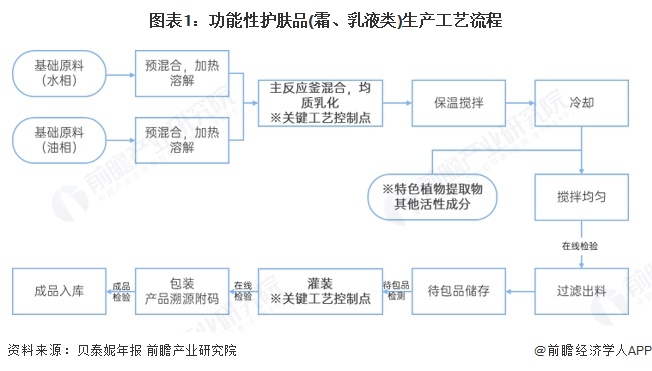
Core Insights - The article focuses on the research and development (R&D) investments of listed companies in China's functional skincare industry, highlighting the importance of R&D intensity relative to revenue [1][10]. R&D Investment Overview - The leading company in R&D investment is Huaxi Biological, with a projected investment of 466 million yuan in 2024, representing 8.68% of its revenue [10]. - Other companies like Chuang'er Biological also show significant R&D investment intensity, indicating a competitive landscape in innovation [10]. Key Companies and Their R&D Focus - **Betaini**: Focuses on the R&D of Yunnan specialty plants to address various skin issues and enhance product lines [11]. - **Huaxi Biological**: Concentrates on active ingredient delivery control and efficacy extension projects [10][11]. - **Chuang'er Biological**: Specializes in collagen protein project development [10][11]. - **Fuerjia**: Aims to expand its product line, including Class III medical devices and sunscreen products [10][11]. Production Processes - Functional skincare products include creams, lotions, masks, serums, and emulsions, each with distinct production processes. For instance, Betaini's cream and lotion production involves several key steps, with homogenization and filling being critical control points [1]. Competitive Landscape - The article outlines various brands and their core technologies, such as Vichy and La Roche-Posay from France, which emphasize thermal spring water, and Curel from Japan, which focuses on ceramide care [6][7].
全方位进阶,敷尔佳清痘面膜迎重磅升级
Jin Tou Wang· 2025-09-05 03:30
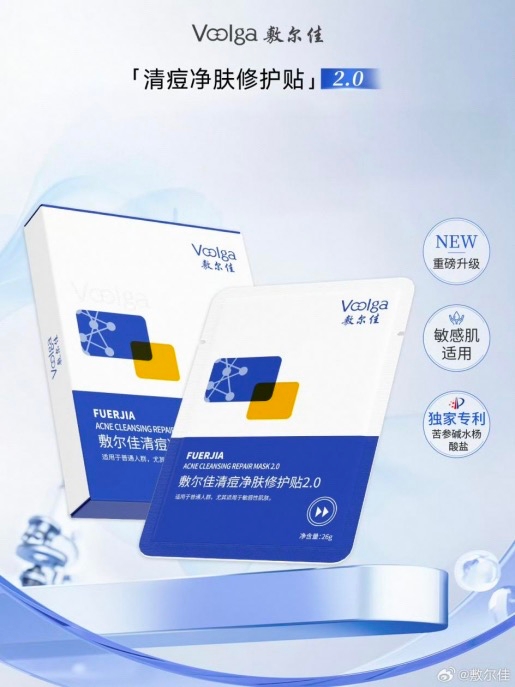
Core Insights - The increasing prevalence of acne-prone skin is attributed to fast-paced lifestyles, irregular schedules, and environmental pollution, leading to a shift in acne care from a niche to a core segment within the booming "beauty economy" [1] - The launch of the second-generation acne treatment mask, "Clearing Acne Skin Repair Patch 2.0" by the company, introduces technological breakthroughs and multiple patented formulations, offering a "gentle yet effective" new experience for acne care [1] Product Features - The key ingredient in the "Clearing Acne Skin Repair Patch 2.0" is "Sophora Flavescens Alkaloid Salicylate," which utilizes supramolecular technology to enhance skin penetration by 3-5 times compared to traditional salicylic acid, achieving a 6.08 times higher penetration within 48 hours and a 4.04 times higher retention in the skin [3] - The product addresses core acne issues through a comprehensive solution that includes oil control, acne removal, and redness reduction, effectively alleviating discomfort associated with various types of acne [3][4] Market Trends - According to data from Euromonitor, the online acne care market in China is expected to exceed 24 billion yuan in 2024, with a year-on-year growth of over 15%, significantly outpacing the overall skincare market [4] - The sales of "acne management" products, which focus on oil control, stabilization, and prevention, are twice that of "emergency acne" products, indicating a strong consumer demand for long-term care solutions [4] Strategic Positioning - The upgrade of the acne mask product aligns well with the trend towards more refined and systematic acne care, showcasing the company's competitive advantage in functional skincare while demonstrating a deep understanding of Chinese consumers' skin issues [4] - With the continuous expansion of the acne care market and the deepening of user needs, the company is well-positioned to lead the industry into a more professional new phase through innovative products [4]
郁美净儿童霜,盘皮包的神
半佛仙人· 2025-09-04 04:15
Core Viewpoint - The article explores the unconventional use of a children's cream, specifically "Yumeijing," as a maintenance product for leather goods, highlighting its effectiveness and the absurdity of societal norms regarding product usage [3][8][10]. Group 1: Product Analysis - "Yumeijing" children's cream contains ingredients that are beneficial for both skin and leather, such as moisturizing agents and emulsifiers, making it a versatile product [10][11]. - The cream's formulation has been established for decades, indicating its reliability and effectiveness over time, with a history dating back to significant cultural events [10][11]. - The article suggests that the cream can effectively eliminate odors from leather goods, which is often a concern for consumers [9][10]. Group 2: Societal Commentary - The narrative critiques societal expectations and norms regarding product usage, questioning why a product designed for children cannot also serve other purposes [8][9]. - It reflects on the absurdity of consumer behavior, where individuals are more concerned about the appropriateness of a product rather than its effectiveness [8][9]. - The author uses humor and irony to convey the message that sometimes the best solutions come from unexpected places, challenging conventional wisdom [3][8].

业绩连降后触底?华熙生物反击“玻尿酸过气论”
阿尔法工场研究院· 2025-09-04 00:06
Core Viewpoint - The competition between Huaxi Biological and Juzhi Biological in the skincare industry has intensified, with Huaxi experiencing a significant decline in performance while Juzhi shows robust growth, indicating a shift in market dynamics and consumer preferences [2][3][4]. Financial Performance Comparison - Huaxi Biological reported revenue of 2.261 billion, net profit of 221 million, and gross profit of 1.605 billion for the first half of 2025, with year-on-year declines of 19.57%, 35.38%, and 23.35% respectively [4]. - In contrast, Juzhi Biological achieved revenue of 3.113 billion, net profit of 1.182 billion, and gross profit of 2.542 billion, with all metrics showing over 20% year-on-year growth [4]. - From 2022 to 2024, Juzhi's revenue growth averaged around 50%, while Huaxi's revenue growth has been declining since 2022, with significant reductions continuing into 2023 and 2024 [4]. Brand Performance and Market Dynamics - Huaxi's skincare business, led by the "Runbaiyan" brand, generated 4.607 billion in functional skincare revenue in 2022, accounting for over 70% of total revenue, but is projected to decline to 2.569 billion by 2024, a drop of over 44% [8][10]. - Juzhi's functional skincare revenue, primarily from the "Kefumei" brand, is expected to rise from 1.562 billion in 2022 to 4.3 billion in 2024, marking an increase of over 175% [10]. - The competition reflects a shift in the narrative of effective skincare from "hyaluronic acid hydration" to "recombinant collagen + medical aesthetics synergy" [14]. Marketing and Strategic Responses - Huaxi Biological has initiated a "three-pronged attack" in response to market challenges, including public statements against perceived misinformation regarding its products and the efficacy of hyaluronic acid [15][21]. - The company has faced criticism for its reliance on hyaluronic acid, with analysts noting that its product lines exhibit significant overlap and homogeneity, which may dilute brand differentiation [25][27]. - Juzhi Biological's heavy reliance on its flagship product, "Kefumei," poses risks, as any quality issues could severely impact overall performance [11][13]. Future Outlook and Strategic Recommendations - Huaxi's path to recovery lies in rebuilding its growth mechanisms, focusing on channel efficiency, pricing discipline, and new product positioning [28]. - The market's evolving preferences indicate that simply reiterating the benefits of hyaluronic acid may not suffice; a more diversified and innovative approach is necessary to regain market share [27][28].


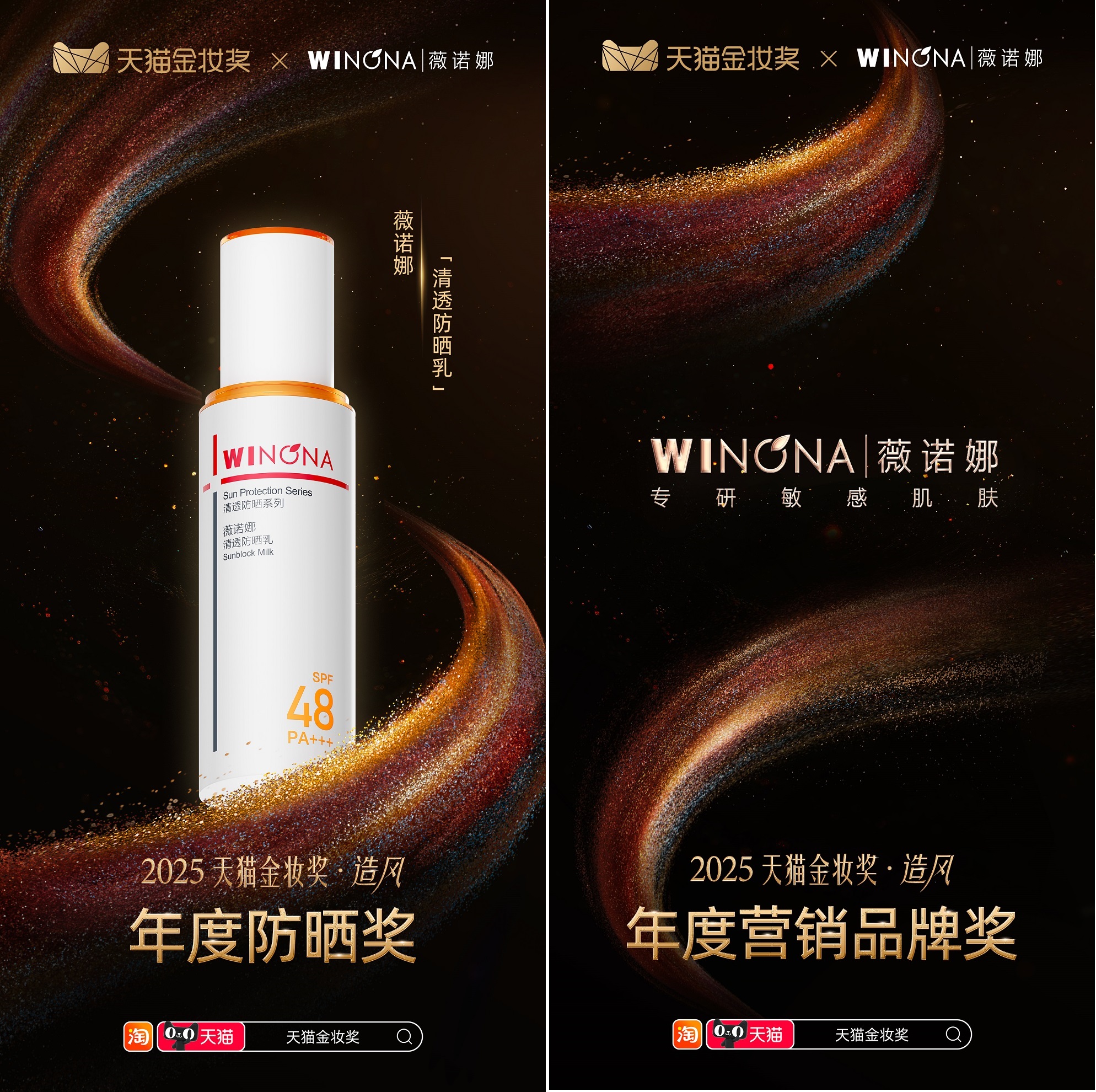
连续八年斩获“天猫金妆奖”,薇诺娜以医研实力铸就国货护肤标杆
Jiang Nan Shi Bao· 2025-09-01 12:45
Core Insights - Winona, a leading brand in sensitive skin care, won the annual sunscreen award and marketing brand award at the 2025 Tmall Golden Makeup Awards, reflecting its strong market presence and consumer trust [1][4] - Winona has achieved the highest sales in the sensitive skin care category in China for five consecutive years from 2020 to 2024, showcasing its deep commitment to dermatological research and clinical validation [5] - The brand's unique approach combines pharmaceutical principles with skincare, collaborating with 63 top-tier hospitals for product safety and efficacy testing, thus establishing a strong professional barrier [9] Product Development and Innovation - Winona has developed a new generation of effective skincare products based on the "NUTE principle," focusing on clinical needs, unique mechanisms, technology empowerment, and evidence-based validation [9] - The brand's flagship product, the second-generation Winona Special Care Cream, represents a significant upgrade after 14 years of development, utilizing breakthrough technology for enhanced skin sensitivity repair [10][11] - Winona has expanded its product line to include various items like special care essence, cleansers, and masks, addressing the diverse needs of sensitive skin consumers [11] Market Leadership and Strategy - Winona's "Sensitive Skin PLUS" strategy aims to deepen its focus on niche market demands, establishing a comprehensive solution that includes core products for repair, sun protection, whitening, and anti-aging [12][13] - The brand's Clear Sunscreen has been recognized for its effectiveness, with 98% of testers agreeing on its gentleness and non-irritating properties, and it has received multiple awards for sales leadership in the sensitive skin sunscreen category [14] Social Responsibility and Brand Evolution - Winona has been actively involved in the "We Smile Sunshine Plan" since 2016, providing skin health education and resources to communities affected by high-altitude sun damage, thus elevating public awareness of sun protection as a health issue [16] - The brand's commitment to long-termism and scientific innovation positions it as a trusted name in the skincare industry, capable of adapting to market changes while maintaining consumer loyalty [16][17]
巨子生物(02367.HK):上半年业绩稳定增长20% 持续推进多品类多渠道战略
Ge Long Hui· 2025-08-31 10:47
Core Insights - The company reported stable growth in its performance for the first half of 2025, achieving revenue of 3.113 billion with a year-on-year increase of 22.5% and a net profit attributable to shareholders of 1.182 billion, up 20.2% year-on-year [1] - The company maintains its full-year guidance, expecting a revenue growth rate of 25%-28% and a net profit of 2.5 billion to 2.55 billion, representing a year-on-year increase of 21%-24% [1] Brand Performance - The brand "可复美" generated revenue of 2.542 billion, a year-on-year increase of 22.7%, accounting for 81.7% of total revenue, with disposable products expected to represent 30% and dressings 25% of sales [1] - The brand "可丽金" achieved revenue of 503 million, up 26.9% year-on-year, although there was a slight decline in offline sales due to distributor impacts [1] Product Category Performance - Functional skincare products generated revenue of 2.410 billion, a year-on-year increase of 24.2%, while medical dressings brought in 693 million, up 17.0% year-on-year [1] - The growth in functional skincare revenue is attributed to refined operations across all channels, enhanced brand influence, and the successful launch of key products [1] Channel Performance - Direct sales channels generated revenue of 2.325 billion, a year-on-year increase of 26.5%, with online direct sales particularly strong at 391 million, up 133.6% due to targeted operations on e-commerce platforms [2] - Offline direct sales also saw significant growth, reaching 118 million, up 74.3%, driven by the accelerated layout of brand specialty stores [2] - The DTC store direct sales revenue was 1.816 billion, a year-on-year increase of 13.3%, while the distribution channel revenue was 787 million, up 12.1% [2] Profitability and Cost Structure - The company's gross margin and net margin for the first half of 2025 were 81.7% and 38.0%, respectively, reflecting a year-on-year decrease of 0.7 percentage points and 0.6 percentage points [2] - The decline in gross margin is primarily due to the increased proportion of lower-margin functional skincare products [2] - The sales, management, and R&D expense ratios were 34.0%, 2.7%, and 1.3%, showing a decrease in sales expense ratio due to refined operational management and changes in channel structure [2] Investment Outlook - The company shows a robust growth trend in its mid-year report, with core brands continuing to drive significant growth through the launch of new products and expansion in both online and offline channels [3] - The projected net profits for 2025-2027 are 2.549 billion, 3.092 billion, and 3.673 billion, corresponding to PE ratios of 20, 17, and 14 times, respectively, maintaining an "outperform" rating [3]