有机硅

Search documents
中原证券晨会聚焦-20251202
Zhongyuan Securities· 2025-12-02 02:12
Core Insights - The report highlights a gradual recovery in various industries, with a focus on investment opportunities arising from supply and demand dynamics [6][14][16] - The AI sector is experiencing rapid growth, with significant advancements in technology and applications, particularly in China [16][17] - The chemical industry is expected to see a marginal recovery in profitability due to improved demand and reduced investment pressures [13][14] Domestic Market Performance - The A-share market has shown a slight upward trend, with the Shanghai Composite Index closing at 3,914.01, reflecting a 0.65% increase [3] - The average P/E ratios for the Shanghai Composite and ChiNext indices are 15.95 and 48.16, respectively, indicating a favorable long-term investment environment [8][9] International Market Performance - Major international indices, such as the Dow Jones and S&P 500, experienced slight declines, with the Dow Jones closing at 30,772.79, down 0.67% [4] Industry Strategies - The chemical industry is entering a phase of improved stability, with a focus on supply-side constraints and demand recovery, particularly in agricultural chemicals and fluorochemicals [13][14] - The AI industry is projected to benefit from increased domestic demand and government support, with a focus on integrated circuits and software [16][17] - The food and beverage sector is facing challenges with declining revenue growth, but opportunities exist in the snack and beverage markets, which are expected to grow significantly [20][21] Investment Recommendations - The report suggests focusing on leading companies in the chemical sector, such as Wanhua Chemical and Satellite Chemical, as well as opportunities in the AI and semiconductor industries [15][16] - In the food and beverage sector, companies like Baoli Food and Dongpeng Beverage are recommended due to their growth potential in the snack and soft drink markets [21] Key Data Updates - The semiconductor industry continues to show strong growth, with global sales reaching $69.47 billion, a 25.1% year-on-year increase [36] - The photovoltaic industry is experiencing a supply-demand imbalance, with a focus on capacity reduction and optimization of the competitive landscape [25][23]
中原证券:化工行业逐步进入景气阶段 从供给与需求两端寻找投资机会
智通财经网· 2025-12-02 01:44
Core Viewpoint - The chemical industry is expected to see a marginal recovery in overall profitability due to the continuous improvement of China's macro economy and consumer stimulus policies, despite a slowdown in fixed asset investment [1][2]. Group 1: Industry Demand and Supply - The gradual recovery of downstream demand and the slowdown in new production capacity are contributing to a stabilization in chemical industry profits, with sectors like agrochemicals, fluorochemicals, and new energy experiencing rapid revenue and profit growth [2]. - The chemical industry has seen a decline in fixed asset investment growth in 2023, with further reductions expected from 2025, alleviating the pressure of overcapacity in the future [2]. - The demand from sectors such as automotive, home appliances, and textiles is expected to recover moderately starting in 2024, driven by both supply and demand factors [2]. Group 2: Regulatory Environment and Industry Structure - The ongoing implementation of anti-involution policies is expected to strengthen supply-side constraints in the chemical industry through administrative regulation and industry self-discipline [2]. - The decline in fixed asset investment is anticipated to gradually reverse the overcapacity situation in the industry, promoting a gradual recovery in industry prosperity [2]. - Enhanced regulatory requirements regarding environmental protection, safety supervision, and emissions reduction are expected to optimize the industry structure and promote high-quality development [2]. Group 3: Investment Strategy - Investment strategies should focus on sectors with orderly supply-demand dynamics and good self-discipline foundations, such as organic silicon and polyester filament industries [3]. - Attention should also be given to the phosphate chemical industry, which is benefiting from rapid growth in downstream energy storage demand, indicating a positive outlook for industry prosperity [3]. - The biofuel industry, which is supported by national policies and the dual carbon policy, is also recommended for investment [3]. - Key integrated leading companies to watch include Wanhua Chemical, Satellite Chemical, and Baofeng Energy, along with opportunities in organic silicon, polyester filament, phosphate chemicals, and biofuels [3].

工业硅:驱动不足下的亦步亦趋
Wu Kuang Qi Huo· 2025-12-02 01:38
Report Summary 1. Report Industry Investment Rating No information provided. 2. Core Viewpoints - In the situation where neither supply nor demand can provide strong drivers, the price trend of industrial silicon shows a pattern of "stable spot prices and fluctuating futures prices." The futures price fluctuations mainly come from cost change expectations, capital sentiment, and event disturbances. Limited supply reduction, insufficient demand, and high inventory are important constraints on price breakthroughs, while cost is an important support at the lower end. The futures price may experience short - term pulse - type increases but lacks a sustainable trend. In the short term, the industrial silicon price is likely to remain range - bound. To achieve a trending market, new drivers are needed [1][30]. 3. Summary by Related Contents Supply - side Situation - In the southwest region, after entering the dry season, due to rising electricity prices and increased costs, the operating rates of some factories in Yunnan and Sichuan have significantly decreased. The weekly output has dropped by about 50% from the annual high, which is in line with seasonal characteristics. In the northwest region, production remains strong. Due to the advantage of coal - power costs and the ability to use hedging tools, enterprises can maintain a relatively high operating rate. As a result, the weekly national total output has decreased by less than 10% from the annual high. It is estimated that there is still some room for production decline in the southwest region. According to statistics, the production cost in Xinjiang is about 8,500 yuan/ton, significantly lower than that in the southwest region. If the northwest region maintains its operation, the overall production contraction is expected to be limited, and the impact of weather on production in the northwest needs to be monitored [6]. Demand - side Situation - **Polysilicon**: The polysilicon futures market focuses on warehouse receipts and the establishment of platform companies, with the near - month prices showing strength. However, from the perspective of the industrial chain supply - demand, the marginal change is not optimistic. In December, the production schedule of the downstream silicon wafer segment is 45.7GW, a decrease of about 16% compared to November's 54.37GW. The production schedule of the silicon material segment is 11.35 tons, with a limited month - on - month decline. The polysilicon inventory of silicon enterprises has reached 28 tons, and the pressure of inventory accumulation before the Spring Festival is increasing. Although the silicon material price is temporarily stable, with N - type material quoted at 50,000 - 52,000 yuan/ton, it is mainly a strategic price - holding behavior. If the platform company is established, the industry operating rate is expected to remain controlled, and the actual demand for industrial silicon will be insufficient [17]. - **Organic silicon**: The organic silicon industry has a greater impact on the industrial silicon market in terms of sentiment and expectations. After facing profit pressure and weak prices, the industry held a meeting, established a coordination mechanism, and planned to implement a production - reduction plan in early December, while also raising the spot price. Before December, the production of organic silicon DMC showed a slight increase, and the subsequent production - reduction plan is expected to have a relatively limited impact on the demand for industrial silicon. After the downstream profit is restored, the willingness to suppress the price of upstream raw materials may decrease, which will improve the price expectation of industrial silicon to some extent. However, if the production - reduction plan is fully implemented, the procurement of industrial silicon will be difficult to increase in a certain period [22]. - **Silicon - aluminum alloy and exports**: Driven by the industrial manufacturing and automotive industries, the operating rate of aluminum alloy has recently increased. After the end of the export rush, the export of industrial silicon decreased significantly in October, which cannot change the overall weak demand pattern [29].
港口集装箱吞吐量明显反弹——每周经济观察第48期
一瑜中的· 2025-12-01 12:04
Economic Outlook - The macroeconomic WEI index has declined to 4.62% as of November 23, down from 5.42% the previous week, indicating a downward trend since late September [8][9] - Retail sales of passenger cars have seen a slight narrowing in decline, with a year-on-year decrease of 7% as of November 23, compared to 9% previously [2][13] - The real estate market continues to struggle, with residential sales dropping by 35% year-on-year in 67 cities as of November 29 [3][13] Trade and Exports - Port container throughput has rebounded significantly, with a 5.4% increase week-on-week as of November 23, and a year-on-year increase of 10% [22][23] - New export orders in China's manufacturing PMI rose to 47.6%, reflecting a notable increase of 1.7 percentage points from the previous month [24] Prices and Commodities - Prices of precious metals and agricultural products have risen, with COMEX gold reaching $4223.9 per ounce, up 3.4%, and LME copper at $10,985 per ton, up 2.7% [2][40] - Domestic agricultural prices have generally increased, with vegetable prices up 1.9% and egg prices up 1.2%, while pork prices fell by 0.4% [41][42] Infrastructure and Production - Infrastructure data remains weak, with cement dispatch rates at 33.4%, unchanged from the previous week and down from 36.5% year-on-year [15] - The asphalt plant operating rate has increased to 28%, up 3 percentage points from the previous week, but still down 4.7 percentage points year-on-year [15] Interest Rates and Debt - Interest rates remain relatively stable, with 1-year, 5-year, and 10-year government bond yields reported at 1.4017%, 1.6183%, and 1.8412%, respectively [55] - The issuance of special bonds to support infrastructure projects has been significant, with plans for 1.5 trillion yuan in long-term bonds to support nearly 3,000 projects [45]

基础化工行业年度策略:行业逐步进入景气阶段,从供给与需求两端寻找投资机会
Zhongyuan Securities· 2025-12-01 08:51
Core Insights - The basic chemical industry is gradually entering a prosperous phase, with investment opportunities identified from both supply and demand sides [1][7] - The industry is expected to see a marginal recovery in profitability due to the gradual rebound in downstream demand and a slowdown in new capacity releases [7][11] - The report maintains a "market perform" rating for the industry, suggesting a focus on integrated leading companies such as Wanhua Chemical, Satellite Chemical, and Baofeng Energy [7][8] Industry Overview - The chemical industry has shown signs of bottoming out, with profitability stabilizing after a decline in 2023 [11][15] - In the first three quarters of 2025, the chemical raw materials and chemical products manufacturing industry achieved a revenue of CNY 67,246.8 billion, a year-on-year increase of 1.0%, while total profits fell by 4.4% [13][17] - The chemical product price index has seen a cumulative decline of 10.29% since the beginning of 2025, indicating ongoing price pressures [13][14] Sub-Industry Performance - Among 33 sub-industries, 18 reported revenue growth, with significant increases in carbon fiber (49.12%), synthetic resin (33.63%), and lithium battery chemicals (21.31%) [17][18] - Conversely, industries such as organic silicon and soda ash experienced substantial revenue declines of 17.37% and 15.75%, respectively [18][21] - Profitability varied widely, with pesticide, polyester, and fluorochemical sectors showing strong profit growth, while organic silicon and rubber products faced severe profit declines [18][22] Investment Strategy - The report suggests focusing on sectors with improving supply-demand dynamics, such as organic silicon and polyester filament, as well as those benefiting from rapid growth in downstream energy storage demand, like phosphate chemicals [7][8] - The biobased fuel industry is highlighted as having significant growth potential due to national policy support and the dual carbon policy [7][8] - The overall investment strategy emphasizes structural opportunities within the industry, driven by regulatory changes and demand recovery [7][8]
兴发集团20251128
2025-12-01 00:49
Summary of Xingfa Group Conference Call Company Overview - Xingfa Group is a comprehensive company primarily based on phosphate mining, expanding into downstream products in new energy and new materials. The phosphate business contributes approximately 1.2 to 1.4 billion yuan in profit annually, accounting for about 50% of total profits. The company operates six mines, five of which are classified as national green mines. [3][4] Phosphate Mining Capacity Expansion - The company plans to double its phosphate mining capacity from 5.85 million tons to 10 million tons over the next five years. New phosphate projects are expected to start production in 2026 with an initial capacity utilization rate of 80%. [2][3] - The company anticipates an increase of 500,000 tons in capacity from Yian Mining, with expansions at Qiaogou and Xingshun mines expected to be completed by 2028. [5] - Phosphate demand is projected to grow steadily, with a net increase of 30 to 40 million tons expected over the next five years, although slow approval processes may limit short-term supply-demand balance impacts. [6] Organic Silicon Market Outlook - The organic silicon industry plans to reduce production rates to around 70%, with prices currently at 13,000 yuan/ton and expected to rise to 14,000-15,000 yuan/ton, achieving a profit margin of about 10%. Demand is growing at an annual rate of 15%-20%, indicating a positive market outlook. [7][19] Glyphosate Market Situation - Glyphosate prices have risen significantly in the second half of 2025, currently at 26,500 yuan/ton, supported by seasonal demand in South America and Africa, as well as rising raw material costs during dry seasons. [8] Impact of Sulfur Prices - Sulfur prices have more than doubled since the beginning of the year, significantly impacting the fertilizer segment. The company has managed to procure sulfur slightly below market prices, but costs for wet-process sulfuric acid have exceeded those for thermal-process sulfuric acid. [9] New Energy Sector Developments - The new energy sector includes products such as iron phosphate, lithium iron phosphate, and dihydrolithium, with total capacity expected to reach 250,000 tons/year by 2026. The current operating rate is around 80%. [12] - The new energy segment is currently experiencing slight losses but has shown profitability since July 2025, with expectations of overall profitability by 2026. [13] New Materials Product Progress - The company has introduced new materials such as DMSO, which has seen a price drop from 29,000 yuan to 21,000 yuan due to new competitors entering the market. The company is working on upstream raw material improvements and expanding downstream derivatives. [15] - The "Xinfang" series products are in various stages of production, with high profit margins expected from products like Xinfang A, which is used in mining reagents. [16] Phosphate Fertilizer Export and Pricing - The export quota for phosphate fertilizer for 2025 has been fully utilized, leading to lower net profits in the fertilizer segment. Domestic prices are currently around 3,850 yuan, with expectations to rise to 4,150 yuan. [17][18] Future Plans and Dividend Considerations - The company maintains a positive attitude towards dividends, with annual cash inflows of about 4 billion yuan. The specific dividend amount will be decided by the board. [21] Conclusion - Xingfa Group is strategically positioned for growth in the phosphate, organic silicon, and new energy sectors, with plans for capacity expansion and product diversification. The company is navigating challenges such as rising raw material costs and market competition while maintaining a focus on profitability and shareholder returns.

如何看大化工的投资机会?
2025-12-01 00:49
Summary of Conference Call on Chemical Industry Investment Opportunities Industry Overview - The chemical industry is currently experiencing historically low gross margins per ton due to rapid domestic capacity expansion leading to oversupply, while demand has not significantly decreased, indicating potential improvement in supply-demand dynamics in the future [1][2][3] - Companies are proactively reducing capital expenditures, with expectations of continued negative growth in capital expenditures for chemical listed companies from 2024 to 2026 [1][2] Supply and Demand Dynamics - Both domestic and international supply sides are showing signs of contraction. Domestically, companies are reducing capital expenditures due to poor profitability, while internationally, the Russia-Ukraine conflict has increased energy costs in Europe and led to operational difficulties for global chemical leaders, accelerating the shutdown of production lines [1][3] - The demand side is expected to recover, with the U.S. entering a rate-cutting cycle, followed by China and the UK, which may lead to a resonance in demand between China and the U.S. [1][3] Emerging Opportunities - New industries such as renewable energy, energy storage, photovoltaics, and AI are expected to drive incremental demand for chemical products, with the industry projected to enter an upward cycle from 2026 to 2027 [1][3] - Recommended sectors include: - **Bottom Elastic Products**: Organic silicon and industrial silicon benefiting from high energy consumption characteristics and energy-saving trends (e.g., Hengsheng Silicon, Xin'an Chemical, Xingfa Group) [1][4] - **Soda Ash**: Benefiting from anti-dumping policies despite expansion (e.g., Boyuan Chemical) [1][4] - **PTA and Polyester Filament**: Stable growth in end-user demand (e.g., Tongkun, Xinfengming) [1][4] Investment Recommendations - Focus on quality stocks with bottom valuations and potential volume growth, such as Wanhua Chemical, Hualu Hengsheng, Longbai Group, and Huahong New Materials [2][4][7] - Growth companies in tires and new materials are also worth attention, such as Sailun Tire, Xin Nuobang, and Shengquan Group, which benefit from AI, new energy development, and domestic substitution [5] Strategic Outlook for 2026 - The strategy for the petrochemical industry in 2026 will adopt a top-down framework due to prolonged low margins (10%-20%) and the completion of capital expenditures in 2023 and 2024 [6][7] - Anticipation of three rate cuts by the Federal Reserve in 2026, reducing rates to around 3%, is expected to support a soft landing for the global economy [6] Key Focus Areas in Petrochemical Sector - The PTA sector is highlighted as a key area of focus, with optimism regarding market corrections and support from national policies [7][8] - Attention should also be given to cyclical sectors, including private refining companies like Satellite Chemical, Baofeng Energy, and Hengli Petrochemical, which are expected to experience reversals [8] Additional Investment Opportunities - Other notable investment opportunities include the POE market and Xinjiang coal chemical stocks, which are expected to perform well due to stable operations and significant profit margin potential [11] - Companies like Aerospace Engineering and 3D Chemical are highlighted for their safety margins and potential valuation recovery due to supportive policies [11]
量化数据揭秘:牛市中80%人亏钱真相
Sou Hu Cai Jing· 2025-11-30 12:19
Group 1 - The core viewpoint of the article highlights the volatility and potential pitfalls in the market, particularly in the context of the silicon industry and stock price movements [1][2][3] - The article discusses the recent price surge in the silicon sector, driven by supply constraints and increased demand, but warns that this may not be sustainable as institutional investors may be offloading shares while retail investors rush in [2][4] - It emphasizes the discrepancy between index performance and individual stock movements, suggesting that a rising index does not necessarily indicate broad market strength, as evidenced by the decline in the percentage of stocks rising alongside the index [2][3] Group 2 - The article presents a cautionary tale about the dangers of following market trends blindly, particularly when media coverage is overwhelmingly positive, indicating a potential market peak [5][6] - It advises investors to be wary of unusual market behaviors, such as a rising index accompanied by falling individual stock prices, which could signal underlying weaknesses [5][6] - The importance of utilizing quantitative tools to track real capital flows and identify genuine market trends is stressed, as this can provide a competitive edge in an information-asymmetric environment [5][6]
基础化工行业周报:万华上调东南亚及南亚地区MDI价格,韩国提高对华PET薄膜反倾销税-20251130
Huafu Securities· 2025-11-30 12:13
Investment Rating - The report does not explicitly state an investment rating for the industry Core Views - The chemical sector has shown positive performance with the Shanghai Composite Index rising by 1.4%, the ChiNext Index by 4.54%, and the CSI 300 by 1.64% during the week. The CITIC Basic Chemical Index increased by 3.49%, and the Shenwan Chemical Index rose by 2.98% [2][14] - Key sub-industries within the chemical sector have experienced varied performance, with membrane materials leading at 7.48% growth, followed by titanium dioxide at 5.85% and chlor-alkali at 4.57% [2][17] Summary by Sections Industry Dynamics - Wanhua Chemical announced a price increase of $200/ton for MDI products in Southeast Asia and South Asia starting December 1, 2025, due to market conditions and supply stability [3] - South Korea raised anti-dumping duties on PET film imports from China, significantly increasing the tax rate on Tianjin Wanhua's products from 3.84% to 36.98% [3] Investment Themes - **Tire Sector**: Domestic tire companies are becoming increasingly competitive, with a focus on scarce growth targets. Recommended companies include Sailun Tire, Senqcia, General Motors, and Linglong Tire [4] - **Consumer Electronics**: A gradual recovery in consumer electronics is anticipated, benefiting upstream material companies. Key players in the panel supply chain include Dongcai Technology, Stik, Light Optoelectronics, and Ruile New Materials [4] - **Phosphate Chemicals**: Supply constraints due to environmental policies and increasing demand from the new energy sector are tightening the supply-demand balance. Recommended companies include Yuntianhua, Chuanheng Co., Xingfa Group, and Batian Co. [5] - **Fluorochemicals**: The reduction of production quotas for second-generation refrigerants is stabilizing profitability, with a focus on companies like Jinshi Resources and Juhua Co. [5] - **Economic Recovery**: As the economy improves, leading chemical companies are expected to benefit significantly from price and demand recovery. Recommended companies include Wanhua Chemical, Hualu Hengsheng, and Baofeng Energy [9] - **Vitamin Supply Disruptions**: BASF's supply issues with vitamins A and E are expected to create market imbalances, with companies like Zhejiang Medicine and New Hecheng recommended for attention [9] Sub-Industry Reviews - **Polyurethane**: Pure MDI prices in East China rose to 19,700 RMB/ton, a 1.55% increase week-on-week, with operating rates stable at 68% [30] - **Tire Industry**: Full steel tire operating rates increased to 63.91%, while semi-steel tire rates decreased to 72.37% [54] - **Fertilizers**: Urea prices rose to 1,679.1 RMB/ton, with operating rates for urea at 86.4% [67][68] - **Vitamins**: Vitamin A prices remained stable at 63 RMB/kg, while Vitamin E prices fell by 2.88% to 50.5 RMB/kg [86][87] - **Fluorochemicals**: Fluorspar prices decreased to 3,350 RMB/ton, with a decline in operating rates to 34.12% [91]

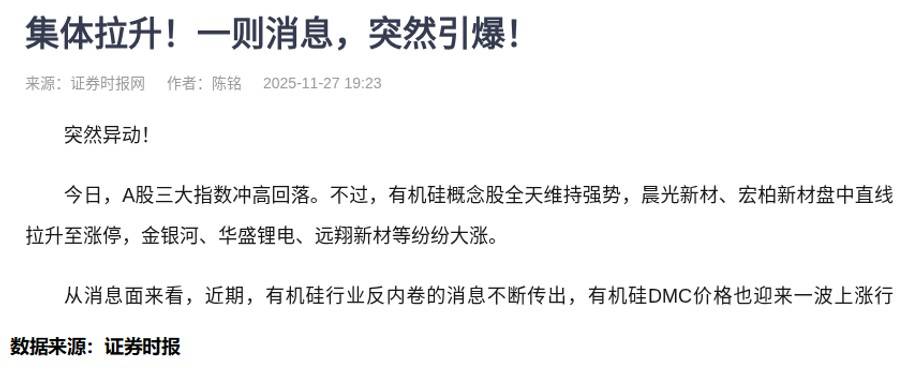
【金牌纪要库】有机硅企业联合减产30%,“反内卷”加速行业拐点来临,这些企业产能规模较大
财联社· 2025-11-28 15:28
Group 1 - The organic silicon companies have united to reduce production by 30%, accelerating the industry's turning point, with a potential price gap recovery of 50% based on the cycle experience from 2016 to 2018, as these companies have large production capacities [1] - Overseas giants like Dow Chemical are gradually exiting the market, with a further reduction expected to 600,000 to 700,000 tons by 2026-2027, indicating that this company's business structure is pure and its performance is highly correlated with DMC prices, providing higher potential elasticity [1] - The electronics industry is becoming the main consumer market, with thermal silicone grease, phase change materials, and electronic potting adhesives widely used in servers, base stations, and smart devices, allowing this company to avoid the saturated construction adhesive market and enter high-barrier fields [1]