
有色金属

Search documents
ETF收评 | A股午后大涨,中韩半导体ETF大涨8%
Ge Long Hui· 2026-02-03 10:07
Market Performance - The three major A-share indices collectively rose, with the Shanghai Composite Index increasing by 1.29%, the Shenzhen Component Index by 2.19%, and the ChiNext Index by 1.86%. The North Star 50 Index saw a significant rise of 3.27% [1] - The total trading volume in the Shanghai, Shenzhen, and Beijing markets reached 25,656 billion yuan, a decrease of 410 billion yuan compared to the previous day, with over 4,800 stocks rising across the three markets [1] Sector Performance - Leading sectors included photovoltaic equipment, CPO, commercial aerospace, engineering machinery, rare earth permanent magnets, cloud gaming, storage chips, cultivated diamonds, and epoxy propylene, all showing significant gains [1] - The banking, insurance, and agricultural products sectors lagged behind in performance [1] ETF Performance - The storage chip sector experienced a major surge, with the Huatai-PB Fund's China-Korea Semiconductor ETF rising by 8% [1] - The photovoltaic sector rebounded strongly, with the Guotai and Fuguo Fund's Sci-Tech Innovation Board New Energy ETF increasing by 7.42% and 6.84%, respectively [1] - The non-ferrous metals sector also saw a rebound, with the Southern Fund's Non-Ferrous Metals ETF rising by 6.84% [1] - The engineering machinery sector saw afternoon gains, with the GF Fund's Engineering Machinery ETF and the Dachen Engineering Machinery ETF increasing by 6.6% and 6.51%, respectively [1] - The New Economy ETF from Yinhua fell by 6.9%, while the Hong Kong stock market weakened, with the Hong Kong Stock Connect Technology ETF from Ping An declining by 1% [1] - Banking stocks fell, with the Banking ETF and the Huatai Banking ETF decreasing by 1% and 0.88%, respectively [1]
大和:料中资股去年业绩呈结构性复苏 2026年中国股票盈利动能延续
Zhi Tong Cai Jing· 2026-02-03 09:12
该行指,与市场一致预期相比,料536家有数据的A股公司中,23%将交出"盈利超预期"(2024年为 16%),而54%则属"盈利不及预期"(2024年为57%)。虽然过去一年基本面逐步改善,但分析员对复苏速 度的预期显然过高。 大和发布研报称,中资股2025年业绩作出前瞻,料呈结构性复苏,但惊喜有限。该行料A股市场在2025 年暂时扭转了2022年至2024年的盈利恶化趋势。截至2026年1月30日,逾2,500家公布业绩预告的公司 中,有40.3%录得盈利改善(由亏转盈、盈利增长或持续盈利),高于2024年的33.5%,但低于2025年上半 年43.8%。然而,大部分公司仍属负面业绩(持续亏损、盈利下滑或由盈转亏)。 受惠于全球金属行情及中国股市走强,料钢铁、有色金属及多元金融在2025年领跑,逾七成成份股盈利 改善。尽管地产持续低迷,房企及建材股盈利改善比例亦分别由约20%,各升至35%及53.7%。低基数 效应及政策反内卷措施是主要推动力。大和表示进入2026年以来,中国股票盈利动能延续:有色金属、 交通运输及电子板块录得最强盈利上调,而下游行业则遭下调。 ...
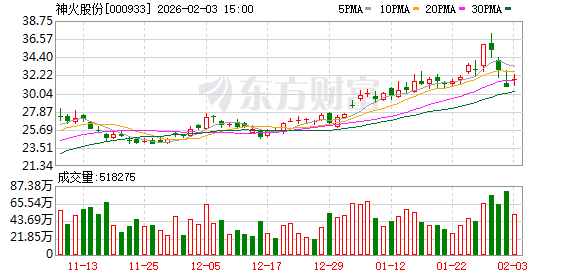
神火股份:截至2026年1月底股东人数为6.83万户
Zheng Quan Ri Bao· 2026-02-03 09:06
Group 1 - The core point of the article is that Shenhuo Co., Ltd. reported a total of 68,300 shareholders as of the end of January 2026 [2]


港股收盘 | 恒指收涨0.22% 加税传闻扰动科网股 商业航天、有色金属强势反弹
Zhi Tong Cai Jing· 2026-02-03 08:54
Market Overview - The Hong Kong stock market experienced volatility, with the Hang Seng Index closing up 0.22% at 26,834.77 points, while the Hang Seng Tech Index fell 1.07% to 5,467.26 points, reflecting a mixed performance across sectors [1] - Huatai Securities noted that the recent "Wash Trade" led to a global risk-off sentiment, causing liquidity pressure and a decline in commodities and Asian markets, but they believe the adjustment is more technical and emotional, with a positive medium-term outlook for Chinese assets [1] Blue-Chip Stocks Performance - Tencent (00700) saw a significant drop of 2.92%, closing at 581 HKD, contributing to a decline in the Hang Seng Index by 59.56 points, influenced by rumors regarding potential tax adjustments on high-margin sectors like financial services and internet value-added services [2][7] - Other notable blue-chip movements included a rise of 8.09% for CSPC Pharmaceutical Group (01093) and a decline of 2.42% for both Semiconductor Manufacturing International Corporation (00981) and China Unicom (00762) [2] Sector Highlights - The technology sector faced pressure due to tax rumors, with Tencent dropping over 6% at one point, while gold and silver prices rebounded significantly, with gold rising over 5% to 4,916.6 USD/oz [3][4] - The commercial aerospace sector gained attention with SpaceX's acquisition of xAI, valued at approximately 1.25 trillion USD, which is expected to benefit the domestic space photovoltaic industry [5] - The engineering machinery sector showed resilience, with a reported 13.2% year-on-year increase in export trade, driven by strong demand for excavators [7] Notable Stock Movements - Ying Si Intelligent (03696) reached a new high, closing up 14.52% at 69 HKD, following milestone payments related to its clinical trial project [8] - CIMC Group (000039) also performed strongly, closing up 14.98% at 9.98 HKD, with significant deliveries in data center business and a robust order book in the marine engineering sector [9] - The AI model companies, MINIMAX (00100) and Zhizhu (02513), saw increases of 10.98% and 8.28% respectively, following the release of new models [9]

金属行业2月投资策略展望:资金情绪逐步回落,关注节后需求验证
BOHAI SECURITIES· 2026-02-03 08:12
Industry Overview - The report indicates that the steel industry is expected to continue its weak performance in February due to the impact of the Spring Festival holiday, with demand likely to remain subdued and production to contract, leading to slight fluctuations in steel prices [2][17][18] - In the copper sector, production activities on both supply and demand sides are anticipated to be affected by the Spring Festival, resulting in continued inventory accumulation. Attention should be paid to post-holiday demand verification and geopolitical developments [2][32] - The aluminum industry is facing a slight contraction in production, with sufficient supply of bauxite from Guinea. Post-holiday production recovery in alumina and electrolytic aluminum plants may support alumina prices [3][41] - Gold prices are expected to experience increased volatility in the short term, influenced by geopolitical risks and domestic political uncertainties in the U.S. [3][51] Steel Sector - The steel PMI index for January 2026 is reported at 49.9%, indicating continued contraction but a slowdown in the rate of decline, with steel prices showing slight fluctuations [17] - In December 2025, the average daily transaction volume of construction steel was 98,600 tons, down 1.81% month-on-month and 10.95% year-on-year [18] - The total crude steel production for December 2025 was 960.81 million tons, a year-on-year decrease of 4.40% [19] Copper Sector - China's electrolytic copper production in January increased by 0.10% month-on-month and 16.32% year-on-year, with a total production of 1.326 million tons in December 2025 [32][33] - The LME copper inventory rose by 18.69% to 175,000 tons, while SHFE copper inventory increased by 91.81% to 156,900 tons during the same period [33][40] Aluminum Sector - The production of metallurgical-grade alumina in January 2026 decreased by 1.78% month-on-month and 2.6% year-on-year, with total production at 8.011 million tons in December 2025 [41][42] - The domestic electrolytic aluminum production in December 2025 was 3.874 million tons, reflecting a year-on-year increase of 2.87% [42] Precious Metals - Gold prices increased by 13.28% to $4,907.50 per ounce from December 31, 2025, to January 30, 2026, while silver prices rose by 20.10% to $85.25 per ounce during the same period [51][52] Lithium and Cobalt - The price of battery-grade lithium carbonate increased by 32.08% to 158,500 yuan per ton, while the price of battery-grade lithium hydroxide rose by 64.58% to 158,000 yuan per ton [53] - The average price of 1 cobalt decreased by 4.99% to 447,000 yuan per ton during the reporting period [65] Rare Earths - The report notes a recovery in the supply of praseodymium and neodymium oxides, with prices for praseodymium-neodymium oxide increasing by 23.41% to 748,500 yuan per ton [73]





中加基金固收周报|银行配置行情推动债市震荡走强
Xin Lang Cai Jing· 2026-02-03 07:41
Market Overview and Analysis - The issuance scale of government bonds, local bonds, and policy financial bonds in the primary market last week was 0 billion, 439.3 billion, and 185 billion respectively, with net financing amounts of -113.3 billion, 310.9 billion, and 183 billion [1] - Financial bonds (excluding policy financial bonds) had a total issuance scale of 71.8 billion, with a net financing amount of 52.6 billion. Non-financial credit bonds had a total issuance scale of 294.5 billion, with a net financing amount of 149.8 billion [1] Secondary Market Review - The sentiment in the bond market continues to recover, with the yield on 10-year government bonds approaching 1.8%. Key influencing factors include institutional behavior, real estate policies, and stock market volatility [2] - The liquidity situation is tightening due to accelerated local bond issuance and month-end disturbances, with R001 and R007 rising by 4.3 basis points and 10.4 basis points respectively compared to the previous week [2][8] Policy and Fundamentals - The manufacturing PMI for January recorded 49.3, indicating a further decline in economic sentiment. High-frequency data shows stable performance on the production side at the beginning of the year, slight improvement in real estate demand, and price differentiation in food and a pullback in the prices of non-ferrous metals [3][9] Overseas Market - President Trump announced the nomination of hawkish member Kevin Walsh for the next Federal Reserve Chair. The yield on 10-year U.S. Treasury bonds closed at 4.26%, up 2 basis points from the previous week [4][10] Equity Market - Last week, A-shares experienced a pullback after reaching a peak, with the total A-share index down by 1.59%. There was sector divergence, with military, automotive, and computer sectors leading the decline, while the non-ferrous sector fell sharply after extreme trading conditions. The average daily trading volume increased to 3.06 trillion, up by 264.3 billion from the previous week. As of January 29, 2026, the total financing balance for all A-shares was 27,221.87 billion, an increase of 14.679 billion from January 22 [5][11] Bond Market Strategy Outlook - In February, the short-term downward space for bond market yields may be limited as the 10-year government bond approaches the lower range of 1.8-1.9%. There is expected to be an increase in profit-taking demand. The supply-demand dynamics in the bond market are anticipated to change, with local bond issuance accelerating again. Seasonal tightening pressure on liquidity before the Spring Festival remains a concern. Overall, the bond market's supply-demand performance at the beginning of 2026 is better than previously expected, with insufficient social credit demand and a slowdown in government bond supply growth. The banking sector's stabilization supports high demand for bond allocation, particularly in the long end, which is under less pressure than previously judged at the end of last year. The bond market is expected to show high certainty in the short and medium term, with long-end fluctuations. Potential directional changes should focus on external inflation transmission and real estate stabilization. There are slightly positive signals in real estate in January, but sustainability remains to be observed in the spring. The PPI for non-ferrous and energy prices shows a trend of rapid recovery [6][12]
【债券日报】:转债市场日度跟踪20260202-20260203
Huachuang Securities· 2026-02-03 07:31
1. Report Industry Investment Rating No information about the report industry investment rating is provided in the given content. 2. Core Viewpoints - On February 2, most industries in the convertible bond market experienced corrections, and valuations compressed on a month - on - month basis. The trading sentiment in the convertible bond market weakened, and multiple market indices declined [1]. - The convertible bond price center decreased, and the proportion of high - priced bonds dropped. Valuations also compressed, with different types of convertible bonds showing various price and valuation changes [2]. - The underlying stocks in most industries fell in the A - share and convertible bond markets. Only a few industries such as food and beverage, and banking in the A - share market, and the light manufacturing industry in the convertible bond market rose [3]. 3. Summary by Relevant Catalogs I. Market Main Index Performance - Multiple market indices declined on February 2. The CSI Convertible Bond Index decreased by 2.39% month - on - month, the Shanghai Composite Index by 2.48%, the Shenzhen Component Index by 2.69%, the ChiNext Index by 2.46%, the SSE 50 Index by 2.07%, and the CSI 1000 Index by 3.39%. In terms of market styles, large - cap value stocks were relatively dominant [1][7]. II. Market Fund Performance - The trading volume in the convertible bond market decreased. The trading volume of the convertible bond market was 76.16 billion yuan, a 7.15% month - on - month decrease; the total trading volume of the Wind All - A was 2606.638 billion yuan, an 8.94% month - on - month decrease. The net outflow of main funds from the Shanghai and Shenzhen stock markets was 53.977 billion yuan, and the yield of the 10 - year Treasury bond rose by 0.88bp to 1.82% [1]. III. Convertible Bond Price and Valuation - Convertible Bond Price: The weighted average closing price of convertible bonds was 137.99 yuan, a 2.14% month - on - month decrease. The closing price of equity - biased convertible bonds was 218.00 yuan, a 5.16% month - on - month increase; that of bond - biased convertible bonds was 120.49 yuan, a 1.84% month - on - month decrease; and that of balanced convertible bonds was 132.26 yuan, a 0.27% month - on - month decrease. The proportion of high - priced bonds above 130 yuan was 69.76%, a 5.04pct month - on - month decrease [2]. - Convertible Bond Valuation: The fitted conversion premium rate of 100 - yuan par value was 35.71%, a 1.40pct month - on - month decrease; the overall weighted par value was 101.95 yuan, a 2.78% month - on - month decrease. The premium rate of equity - biased convertible bonds was 19.84%, a 0.23pct month - on - month increase; that of bond - biased convertible bonds was 88.47%, a 5.59pct month - on - month decrease; and that of balanced convertible bonds was 28.94%, a 0.33pct month - on - month decrease [2]. IV. Industry Performance - A - share Market: 28 industries fell, with the top three decliners being non - ferrous metals (-7.62%), steel (-5.93%), and basic chemicals (-5.69%); only two industries rose, namely food and beverage (+1.11%) and banking (+0.17%) [3]. - Convertible Bond Market: 27 industries fell, with the top three decliners being non - ferrous metals (-4.62%), automobiles (-4.57%), and media (-4.13%); the only rising industry was light manufacturing (+10.53%) [3]. - Different Industry Indicators: In terms of closing prices, large - cycle decreased by 2.73%, manufacturing by 0.25%, technology by 3.07%, large - consumption by 1.67%, and large - finance by 1.47%. In terms of conversion premium rates, large - cycle increased by 2.0pct, manufacturing decreased by 0.6pct, technology increased by 0.29pct, large - consumption decreased by 0.28pct, and large - finance increased by 1.3pct. In terms of conversion values, large - cycle decreased by 4.06%, manufacturing increased by 1.65%, technology decreased by 3.03%, large - consumption decreased by 2.02%, and large - finance decreased by 2.55%. In terms of pure bond premium rates, large - cycle decreased by 4.0pct, manufacturing decreased by 0.96pct, technology decreased by 5.7pct, large - consumption decreased by 2.2pct, and large - finance decreased by 1.7pct [3]. V. Industry Rotation - Only the food and beverage and banking industries rose. The food and beverage industry had a daily increase of 1.11% in the underlying stocks and - 1.67% in convertible bonds; the banking industry had a daily increase of 0.17% in the underlying stocks and - 0.15% in convertible bonds. Other industries mostly declined [58].
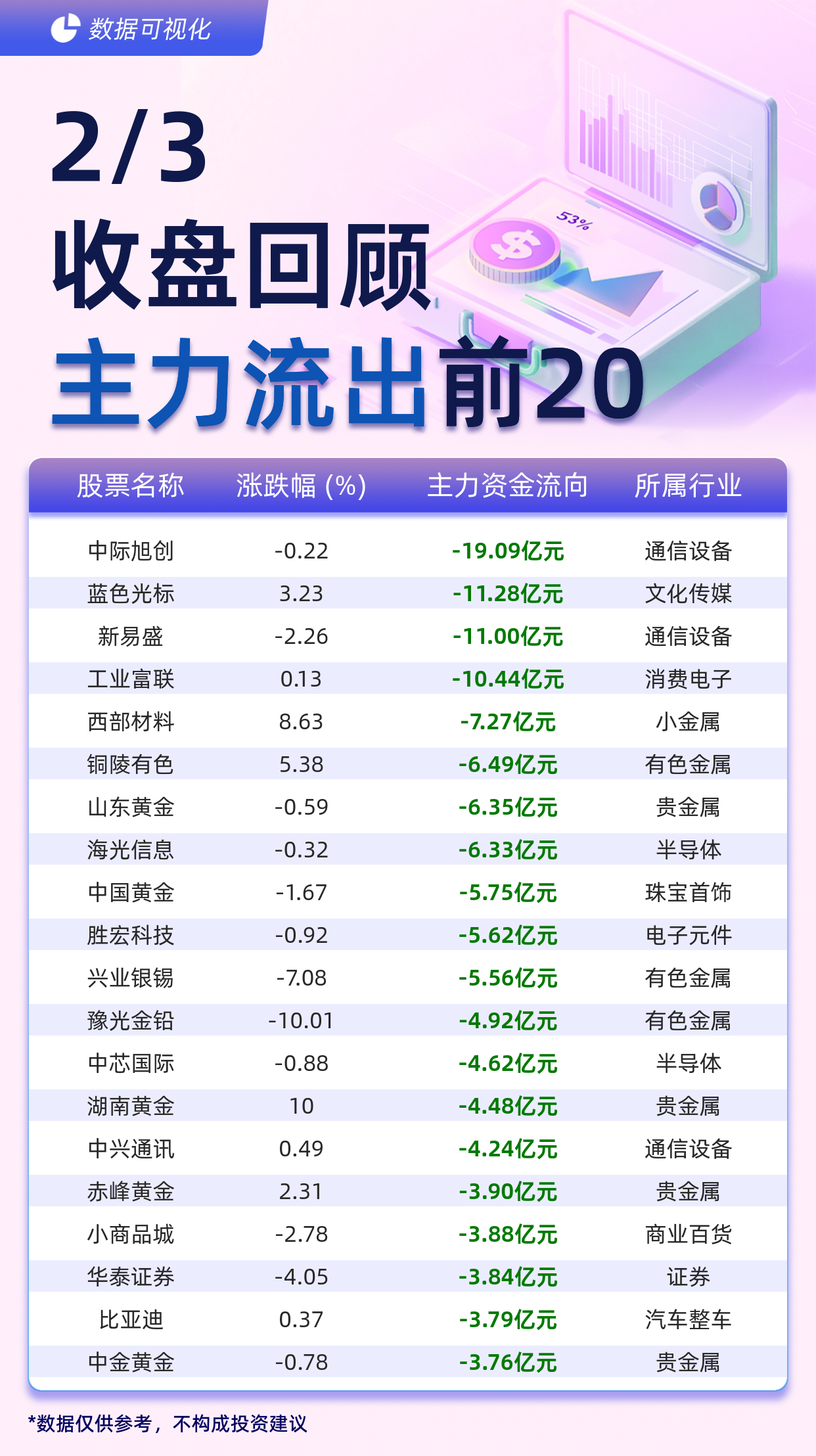
主力个股资金流出前20:中际旭创流出19.09亿元、蓝色光标流出11.28亿元
Jin Rong Jie· 2026-02-03 07:14
Group 1 - The main stocks with significant capital outflows include Zhongji Xuchuang (-1.91 billion), BlueFocus (-1.13 billion), and Xinye Sheng (-1.10 billion) [1] - Zhongji Xuchuang experienced a slight decline of 0.22%, while BlueFocus saw an increase of 3.23% despite the capital outflow [2] - Other notable stocks with capital outflows include Industrial Fulian (-1.04 billion), Western Materials (-0.73 billion), and Tongling Nonferrous Metals (-0.65 billion) [1][3] Group 2 - The sectors affected by capital outflows include communication equipment, cultural media, and precious metals [2][3] - Stocks like Western Materials and Tongling Nonferrous Metals showed positive price movements of 8.63% and 5.38% respectively, despite significant capital outflows [2][3] - The overall trend indicates a mixed performance among the top stocks, with some experiencing price increases while others faced declines [1][2]



有色ETF鹏华(159880)涨超6.6%,将完善铜资源储备体系建设
Xin Lang Cai Jing· 2026-02-03 07:07
截至2026年2月3日 14:40,国证有色金属行业指数(399395)强势上涨3.57%,成分股东阳光上涨10.02%, 湖南黄金上涨10.00%,中稀有色上涨8.93%,盛和资源,盛屯矿业等个股跟涨。有色ETF鹏华(159880) 上涨6.68%,最新价报2.28元。 有色ETF鹏华(159880),场外联接(A:021296;C:021297;I:022886)。 有色ETF鹏华紧密跟踪国证有色金属行业指数,国证有色金属行业指数参照国证行业分类标准,选取归 属于有色金属行业的规模和流动性突出的50只证券作为样本,反映了沪深北交易所有色金属行业上市公 司的整体收益表现,向市场提供细分行业的指数化投资标的。 数据显示,截至2026年1月30日,国证有色金属行业指数(399395)前十大权重股分别为紫金矿业、洛阳 钼业、北方稀土、中国铝业、华友钴业、中金黄金、山东黄金、兴业银锡、赣锋锂业、云铝股份,前十 大权重股合计占比49.87%。 有色金属强势反弹,消息面上,中国有色金属工业协会相关负责人表示,完善铜资源储备体系建设,一 方面扩大国家铜战略储备规模,另一方面探索进行商业储备机制,通过财政贴息等方式选择国有 ...
工业有色ETF鹏华(159162)涨超5.4%,机构看好铜价格上行
Xin Lang Cai Jing· 2026-02-03 07:02
Group 1 - The China Nonferrous Metals Industry Association is working on improving the copper resource reserve system, which includes expanding the national copper strategic reserve and exploring commercial reserve mechanisms through financial subsidies for state-owned enterprises [1] - Huaxin Securities indicates that the copper downstream operating rate is recovering, leading to a domestic destocking trend, with prices expected to remain strong [1] - The aluminum supply side continues to see production increases in domestic and Indonesian electrolytic aluminum, while demand shows a mixed picture, with construction material demand declining [1] Group 2 - As of February 3, 2026, the CSI Industrial Nonferrous Metals Theme Index (H11059) rose by 3.04%, with significant gains in constituent stocks such as Dongyang Sunshine (up 10.02%) and Shenghe Resources (up 7.31%) [1] - The CSI Industrial Nonferrous Metals Theme Index tracks 30 large-cap companies involved in copper, aluminum, lead-zinc, and rare metals, reflecting the overall performance of the sector [2] - As of January 30, 2026, the top ten weighted stocks in the CSI Industrial Nonferrous Metals Theme Index account for 55.71% of the index, including companies like Luoyang Molybdenum and Northern Rare Earth [2]