
纺织服装

Search documents
华宝基金胡一江:「红利轮动」在即?“低估值+小市值+高股息”空间可观
Xin Lang Ji Jin· 2025-08-01 08:44
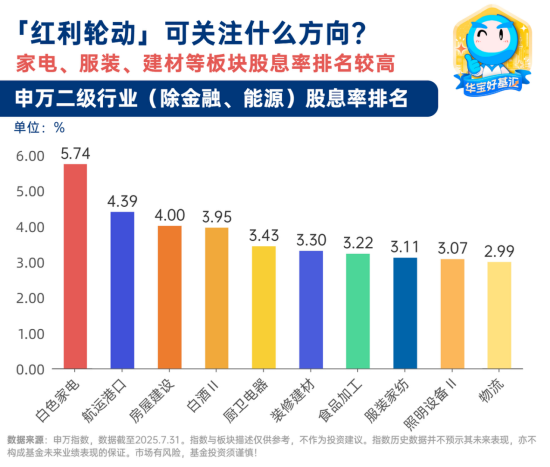
Group 1 - The core viewpoint emphasizes the rising interest in high dividend assets due to a declining risk-free interest rate and increased dividend payouts by listed companies, driven by policy changes and long-term investment demands [1][3] - Investors are encouraged to consider the value of dividend assets from two perspectives: the high trading volume and liquidity in the A-share market, suggesting a focus on undervalued assets and small-cap companies with characteristics of "high dividend," "low valuation," and "small market capitalization" [1] - Following the rise of traditional high dividend sectors such as banking, coal, and insurance, investors are advised to explore the switching opportunities within high dividend assets, particularly in sectors like local state-owned enterprises, traditional consumer goods, and quality private companies with lower market capitalization [3] Group 2 - The ETFs mentioned primarily invest in the constituent stocks of their respective indices, with the S&P China A-Share Dividend Opportunities Index and the CSI 800 Dividend Low Volatility Index as benchmarks [4] - The historical performance of these indices does not guarantee future results, and adjustments to the index constituents are made according to the index compilation rules [4]

超3300家个股上涨
第一财经· 2025-08-01 08:38
Market Overview - A-shares experienced a volatile trading day with the Shanghai Composite Index down 0.37%, Shenzhen Component down 0.17%, and ChiNext down 0.24% [3][4] - The total trading volume in the Shanghai and Shenzhen markets was 1.6 trillion yuan, a decrease of 337.7 billion yuan compared to the previous trading day [4] Sector Performance - The military, oil and gas, civil explosives, rare earth permanent magnets, and PCB sectors saw the largest declines [7] - Conversely, the traditional Chinese medicine sector surged, with AI applications also showing strength, while solar energy, BC batteries, education, logistics, and paper sectors performed well [7] Notable Stocks - The solar energy sector rebounded significantly, with stocks like Jiejia Weichuang and Shuangliang Energy hitting the daily limit, and Haiyou New Materials rising over 12% [7] - The traditional Chinese medicine sector saw multiple stocks hitting the daily limit, including Qizheng Tibetan Medicine and Weikang Pharmaceutical [8] Capital Flow - Main capital inflows were observed in the banking, solar equipment, and traditional Chinese medicine sectors, while textile and clothing, electric grid equipment, and gas sectors experienced net outflows [10] - Specific stocks with significant net inflows included Jiejia Weichuang (5.42 billion yuan), Beiqi Blue Valley (4.95 billion yuan), and Shuangliang Energy (4.55 billion yuan) [10] Market Sentiment and Outlook - Analysts noted that the A-share index has shown strong characteristics with three consecutive monthly gains, but August may see profit-taking and technical pressure above 3600 points [11] - Despite recent adjustments, the overall market trend remains upward, with high trading volumes providing more room for error [11] - The market is entering a medium to long-term slow bull phase, with reduced volatility and healthy rotation of market hotspots [11]





银河证券每日晨报-20250801
Yin He Zheng Quan· 2025-08-01 05:21
Macro Overview - The manufacturing PMI for July is reported at 49.3%, a decrease of 0.4 percentage points from the previous month, indicating a slight decline in manufacturing activity [2] - The production index stands at 50.5%, while the new order index has dropped to 49.4%, reflecting a contraction in new orders [3] - Extreme weather conditions in July, including heavy rainfall and high temperatures, have negatively impacted production intensity [3] - The price indices for factory output and raw material purchases have increased, indicating rising costs for manufacturers [4] - Inventory levels are still low, with both finished goods and raw materials inventory indices declining [5] Industry Insights Technology Sector - The report emphasizes the importance of technology innovation in driving new productive forces, with a focus on cultivating internationally competitive emerging pillar industries [20] - Investment recommendations include focusing on artificial intelligence, particularly in three main areas: core infrastructure, overseas leaders, and AI application leaders [23] Banking Sector - The banking sector is expected to benefit from continued supportive macro policies, with an emphasis on stabilizing employment and economic expectations [25] - The government has issued 15.8 trillion yuan in bonds this year, with 5.2 trillion yuan being special bonds, which will support infrastructure and related financing needs [25] - The report suggests that retail banking and technology finance are likely to benefit from policies aimed at expanding domestic demand [26] Textile and Apparel Sector - The report highlights the government's focus on expanding domestic demand and service consumption, which is expected to benefit the textile and apparel industry [30] - The textile export figures show a slight increase, but the sector faces uncertainties due to ongoing U.S.-China tariff disputes [31] - The use of new materials in textiles is becoming more widespread, driving industry transformation and upgrades [32] Communication Sector - The communication industry is positioned for growth, driven by technology innovation and the development of new productive forces [35] - The report identifies key areas of focus, including operators, artificial intelligence, and space computing, which are expected to enhance the industry's growth potential [38]
25%关税今日生效 印度官员:采取一切必要措施维护国家利益
Sou Hu Cai Jing· 2025-08-01 02:44
Core Points - The U.S. government has threatened to impose a 25% tariff on Indian goods starting August 1, which has prompted a strong response from the Indian government [1][3] - Indian officials emphasize the importance of protecting the interests of farmers, workers, entrepreneurs, exporters, and small and medium enterprises [1] - The Indian textile industry is expected to face significant challenges due to the U.S. tariff increase, which is viewed as a violation of international trade rules [3][5] Group 1 - The U.S. President announced a 25% tariff on Indian imports, which is described as a punitive measure [3] - The Indian government is actively assessing the impact of this tariff and is committed to taking necessary actions to safeguard national interests [3] - The Secretary General of the Indian Apparel Export Promotion Council stated that the tariff will adversely affect the textile sector and criticized the U.S. for its unilateral tariff imposition [3] Group 2 - The concept of "reciprocal tariffs" proposed by the U.S. is deemed illegal by Indian officials, as it contradicts World Trade Organization (WTO) agreements regarding tariff limits [5] - The Indian government is focused on ensuring the welfare of various stakeholders in the economy amidst these trade tensions [1]
浙江森马服饰股份有限公司8月1日新增投诉,消费者要求赔偿损失,补足商品数量
Jin Rong Jie· 2025-08-01 02:32
Group 1 - Zhejiang Semir Garment Co., Ltd. has received a new consumer complaint regarding a contract dispute related to an online purchase made on June 15, 2025 [1] - The complaint was filed by a consumer who reported that the company refused to fulfill the contractual agreement, seeking compensation for losses and to make up the product quantity [1] - As of August 1, 2025, no mediation agreement has been reached regarding the complaint, with the handling department being the Wenzhou Ouhai District Market Supervision Administration [2] Group 2 - Zhejiang Semir Garment Co., Ltd. was established on February 5, 2002, and is located in the Ouhai District of Wenzhou [2] - The company primarily engages in the textile and apparel industry, with a registered capital of 2,694.09 million RMB [2] - The legal representative of the company is Qiu Jianqiang [2]

际华集团上涨5.68%,报4.28元/股
Jin Rong Jie· 2025-08-01 02:20
Core Viewpoint - On August 1, Jihua Group's stock price increased by 5.68%, reaching 4.28 CNY per share, with a trading volume of 352 million CNY and a turnover rate of 1.96%, resulting in a total market capitalization of 18.796 billion CNY [1] Company Overview - Jihua Group Co., Ltd. is a significant producer of military supplies, police uniforms, workwear, and related products in China, responsible for approximately 50% of the production tasks for military and police equipment [1] - The company has an annual production capacity of 56 million sets of various clothing, 28 million pieces of apparel, 75 million pairs of shoes, 178 million tons of various yarns, 57 million meters of grey fabric, and 74 million meters of dyed fabric [1] - Jihua Group operates over 50 wholly-owned and controlled subsidiaries across 23 provinces, municipalities, autonomous regions, Hong Kong, and Europe, with total assets exceeding 31 billion CNY [1] Financial Performance - As of March 31, Jihua Group had 109,300 shareholders, with an average of 40,200 circulating shares per shareholder [1] - For the first quarter of 2025, the company reported a revenue of 1.631 billion CNY, a year-on-year decrease of 37.35%, while the net profit attributable to shareholders was 7.3961 million CNY, reflecting a year-on-year increase of 128.02% [1]

广东传统产业谋变:强化人工智能赋能新型工业化
Sou Hu Cai Jing· 2025-08-01 02:03
Core Viewpoint - Traditional industries are crucial for Guangdong's economic structure, serving as a foundation for overall manufacturing growth and requiring transformation towards high-end technology and intelligent development to remain competitive globally [1][2][3]. Group 1: Importance of Traditional Industries - Traditional industries account for over 70% of the added value in large-scale manufacturing in Guangdong, contributing 65% of tax revenue and employing 75% of the workforce [2]. - Guangdong leads the nation in the production of over 160 industrial products, with significant contributions from traditional sectors such as textiles, apparel, and home appliances [2][4]. - The textile and apparel industry cluster in Guangdong has reached a scale of 2.86 trillion yuan, with an annual clothing production exceeding 4 billion pieces [2]. Group 2: Challenges and Transformation - The transformation of traditional industries is complex due to the predominance of small and medium-sized enterprises, which face difficulties in upgrading and transitioning [1][6]. - Issues such as lack of technology, talent, and experience hinder the transformation process, with many enterprises still reluctant or unable to adapt [6][7]. - The global economic environment poses additional challenges, including shrinking demand and declining global trade, which exacerbate existing issues in traditional industries [5][6]. Group 3: Policy and Innovation Support - Guangdong has implemented various supportive measures, including legislation for high-quality manufacturing and digital economy promotion, to facilitate the transformation of traditional industries [3][4]. - The province aims to enhance policy supply and project support, focusing on technological innovation and green development to drive the transformation of traditional industries [10]. - The integration of artificial intelligence and innovation is emphasized as a key driver for upgrading traditional industries, with examples of successful applications in companies like Feiya [7][9].
广东传统产业“三化”融合发展调研:优势凸显仍需破局,多策并举促转型
Nan Fang Nong Cun Bao· 2025-08-01 01:34
Core Viewpoint - The research highlights the significant potential and challenges faced by Guangdong's traditional industries in their transformation towards high-end, intelligent, and green development, referred to as the "three integrations" [2][5]. Group 1: Current Status of Traditional Industries - Guangdong's traditional industries are described as the "ballast stone" for building a modern industrial system, with over 400 major industrial products and more than 160 products ranking first in national output [8][10]. - Key sectors such as food and beverage, textiles, and home appliances show strong performance, with the textile and apparel industry cluster reaching a scale of 2.86 trillion yuan and an annual output exceeding 4 billion garments [12][14]. - The automotive and petrochemical industries are also progressing, with automotive production reaching 1.3134 million units in the first half of 2025, including 431,000 new energy vehicles [15][16]. Group 2: Transformation Progress - Over 44,000 industrial enterprises in Guangdong have completed digital transformation, accounting for nearly 60%, with a digital management penetration rate of 88.2% [18]. - The adoption of artificial intelligence is highlighted, with examples such as Guangzhou Zhijing Technology's "Find Fabric God" reducing fabric search time from two days to two minutes [20][21]. - Guangdong leads in the number of green manufacturing demonstration units, indicating a clear low-carbon development path [21]. Group 3: Challenges in Transformation - The research identifies several challenges, including insufficient motivation for transformation among enterprises, particularly small and medium-sized enterprises facing a "four deficiencies" problem: lack of technology, talent, experience, and trial-and-error capability [28]. - The service ecosystem for transformation is not well-developed, with a shortage of industry-savvy service providers and insufficient collaboration within the industrial chain [30][32]. - There is a need for optimization in industrial structure, as some sectors face overcapacity in low-end production while lacking high-end materials and products [35]. Group 4: Policy Recommendations - The research group proposes seven strategies to facilitate the transition from passive to active upgrades in traditional industries, including optimizing the development environment and enhancing policy frameworks [39][41]. - Emphasis is placed on strengthening innovation-driven initiatives, supporting new technology and process development, and improving intellectual property protection [43]. - Recommendations also include enhancing the service ecosystem, providing customized transformation solutions, and promoting collaborative development through leading enterprises [46][48].

公告精选︱正丹股份:上半年净利润同比上升120.35% 拟10股派3元;禾望电气:目前公司尚无HVDC产品
Ge Long Hui· 2025-08-01 01:07
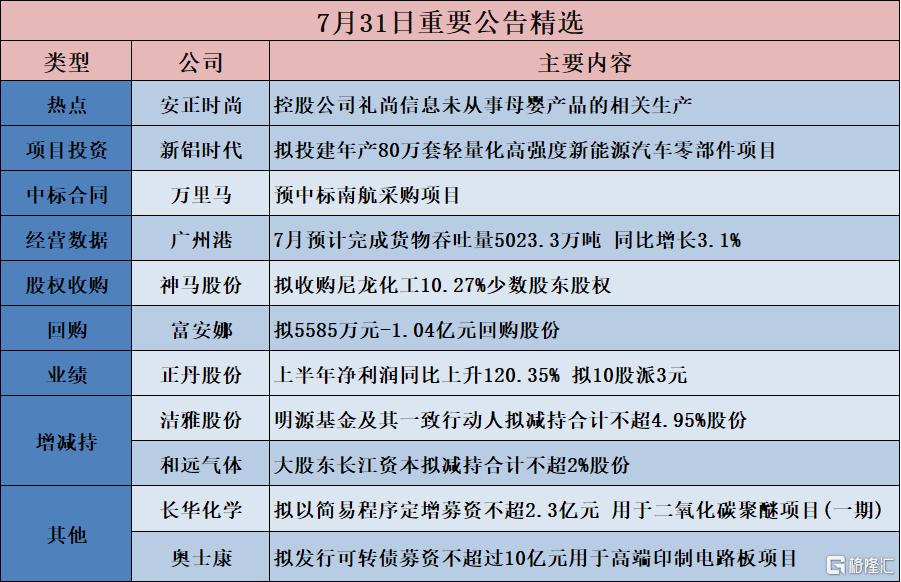
Key Points - The article highlights significant announcements from various companies, including investment projects, performance data, and share buybacks [1][2] Company Announcements - Anzheng Fashion's controlling company, Lishang Information, has not engaged in the production of maternal and infant products [1] - New Aluminum Era plans to invest in a project to produce 800,000 sets of lightweight, high-strength auto parts annually [1] - Wanlima is expected to win a procurement project from China Southern Airlines [1] - Guangzhou Port anticipates a cargo throughput of 50.233 million tons in July, reflecting a year-on-year increase of 3.1% [1] - Shenma Co. intends to acquire a 10.27% minority stake in Nylon Chemical [1] - Fuanna plans to repurchase shares worth between 55.85 million to 104 million yuan [1] - Zhengdan Co. reported a 120.35% year-on-year increase in net profit for the first half of the year and plans to distribute 3 yuan per 10 shares [1] - Jieya Co. and Heyuan Gas's major shareholders plan to reduce their stakes by up to 4.95% and 2%, respectively [1][2] - Changhua Chemical aims to raise no more than 230 million yuan through a simplified procedure for a carbon dioxide polyether project [1] - Aoshikang plans to issue convertible bonds to raise no more than 1 billion yuan for a high-end printed circuit board project [1] Performance Data - Zhengdan Co. expects a significant increase in net profit for the first half of the year, with a proposed dividend distribution [2] - Jiejia Weichuang anticipates a net profit increase of 38.65% to 59.85% for the half-year [2] - Sinopec forecasts a 39.5% to 43.7% decline in net profit for the first half of the year [2]





东莞市菲特威尔服饰有限公司成立,注册资本200万人民币
Sou Hu Cai Jing· 2025-07-31 13:16
天眼查App显示,近日,东莞市菲特威尔服饰有限公司成立,法定代表人为李橄榄,注册资本200万人 民币,东莞市舍予智能科技有限公司、东莞市逸达网络科技有限公司持股。 序号股东名称持股比例1东莞市舍予智能科技有限公司60%2东莞市逸达网络科技有限公司40% 经营范围含服饰制造;服装制造;服装服饰批发;服装服饰零售;鞋帽零售;鞋帽批发;母婴用品销 售;鞋制造;针纺织品及原料销售;日用品销售;日用品批发;家居用品销售;家居用品制造;工艺美 术品及礼仪用品销售(象牙及其制品除外);工艺美术品及礼仪用品制造(象牙及其制品除外);玩具 销售;玩具制造;箱包制造;箱包销售;产业用纺织制成品销售;产业用纺织制成品制造;互联网销售 (除销售需要许可的商品);货物进出口;技术进出口。(除依法须经批准的项目外,凭营业执照依法 自主开展经营活动) 企业名称东莞市菲特威尔服饰有限公司法定代表人李橄榄注册资本200万人民币国标行业制造业>纺织 服装、服饰业>服饰制造地址广东省东莞市石排镇石排中心路491号402室企业类型其他有限责任公司营 业期限2025-7-30至无固定期限登记机关东莞市市场监督管理局 来源:金融界 ...