
金融

Search documents
京东(09618):始终看好在香港发展 将围绕供应链持续投资
智通财经网· 2025-12-10 02:10
Core Viewpoint - JD.com continues to invest in Hong Kong, enhancing its supply chain capabilities and local presence through strategic acquisitions and infrastructure development [1][2][3] Group 1: Company Developments - JD.com has acquired Surearn Profits Limited, which owns office space in the China Construction Bank Tower in Central Hong Kong, with the transaction pending regulatory approval [1] - The company has established a logistics and e-commerce presence in Hong Kong since 2015, with a significant increase in daily package collection volume, growing over 50 times in the past two years [2] - JD.com has completed several strategic investments in Hong Kong, including the acquisition of local supermarket chain Jia Bao and the establishment of a joint laboratory with Hong Kong University of Science and Technology [1][2] Group 2: Community Engagement - Following a recent fire incident in Tai Po, JD.com’s Jia Bao supermarket was the first to deliver emergency supplies, demonstrating the company's commitment to community support [3] - JD.com announced a donation of 30 million RMB in cash and supplies for disaster relief and recovery efforts in response to the fire [3] Group 3: Future Outlook - JD.com plans to continue expanding its logistics infrastructure in Hong Kong, with the upcoming listing of JD Industrial in December marking the fourth company from JD's ecosystem to go public in Hong Kong [1][2]

信达国际控股港股晨报-20251210
Xin Da Guo Ji Kong Gu· 2025-12-10 01:58
Market Overview - The Hang Seng Index has short-term support at the 25,000 point level, with recent hawkish signals from the Federal Reserve indicating limited rate cut space in 2026. Economic conditions in mainland China are cooling, and corporate earnings in Hong Kong are unlikely to improve significantly in the short term [2][3] - The Hang Seng Index closed at 25,434, down 1.29% year-to-date, with a cumulative increase of 26.79% [5] Sector Focus - The AI sector is gaining attention with the launch of AI glasses and smartphones, benefiting related stocks [7] - The biopharmaceutical sector is expected to thrive due to rising flu cases and favorable financing conditions [7] - The insurance sector is seeing improved investment returns driven by strong A-share performance [7] Corporate News - Vanke (2202) is reportedly willing to pay some interest to bondholders to facilitate debt extension negotiations [10] - Xiaomi (1810) is undergoing personnel adjustments in China and plans to close unprofitable stores [10] - Longi Green Energy (6869) is raising over HKD 2.2 billion through a nearly 15% discounted share placement [10] - SenseTime (0020) reports double-digit growth in domestic chip computing power and plans to launch a new generation of AI models in spring [10] - Novartis (NVS) has reached a USD 1.7 billion drug target collaboration agreement with UK biotech company Relation [10] - Midea (0300) has completed its share repurchase plan, buying back 135 million A-shares for approximately CNY 10 billion [10] Economic Indicators - The U.S. job openings reached 7.67 million in October, the highest in five months, alleviating concerns about labor market deterioration [8] - China's urban rail transit completed a passenger volume of 2.83 billion in November, showing a 4.4% year-on-year increase [8] - The Chinese express delivery development index for November was 478.1, up 3% year-on-year, indicating a positive trend in the industry [8] Investment Sentiment - Approximately half of the surveyed companies in Hong Kong are optimistic about the economic outlook for next year, a significant increase from 18% last year [9] - The Hong Kong government is planning to implement an automatic exchange of tax information related to cryptocurrency transactions starting in 2028 [9]

上海前10月经济指标呈现韧性定力
Sou Hu Cai Jing· 2025-12-10 01:52
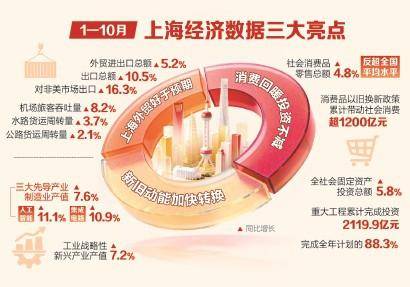
Core Viewpoint - Shanghai's economy demonstrates strong resilience amid complex external conditions, achieving a notable GDP growth of 5.5% in the first three quarters of the year [2]. Group 1: Trade and Transportation - Shanghai's foreign trade performance has exceeded expectations, with total import and export volume increasing by 5.2% year-on-year from January to October, and exports rising by 10.5%, particularly with a 16.3% increase in exports to non-US markets, showcasing the competitive edge of Chinese and Shanghai enterprises [3]. - Passenger throughput at airports has seen a significant increase of 8.2% during the same period, while waterway and road freight turnover grew by 3.7% and 2.1%, respectively [3]. - The financial sector also showed positive trends, with major financial markets in Shanghai recording a total transaction volume of 29.678 trillion yuan, a year-on-year increase of 12.7% [3]. Group 2: Economic Structure and Growth Drivers - The structural transformation of Shanghai's economy is accelerating, with the output of the three leading industries in manufacturing growing by 7.6% from January to October, including integrated circuits and artificial intelligence, which grew by 10.9% and 11.1%, respectively [5]. - The output of strategic emerging industries in the industrial sector increased by 7.2%, indicating the continuous strengthening of new productive forces [5][6]. Group 3: Consumer and Investment Trends - The total retail sales of consumer goods in Shanghai increased by 4.8% year-on-year, surpassing the national average for the first time, with the "old for new" consumption policy driving over 120 billion yuan in social consumption [8]. - Fixed asset investment in Shanghai grew by 5.8% year-on-year, with significant projects completing investments of 211.99 billion yuan, achieving 88.3% of the annual target [8]. - Urban renewal projects are accelerating, with the completion of various housing renovations and the initiation of 25 "urban village" transformation projects [8].

港交所首推科技100指数,涵盖AI、机器人等六大创新领域
Huan Qiu Wang· 2025-12-10 01:24
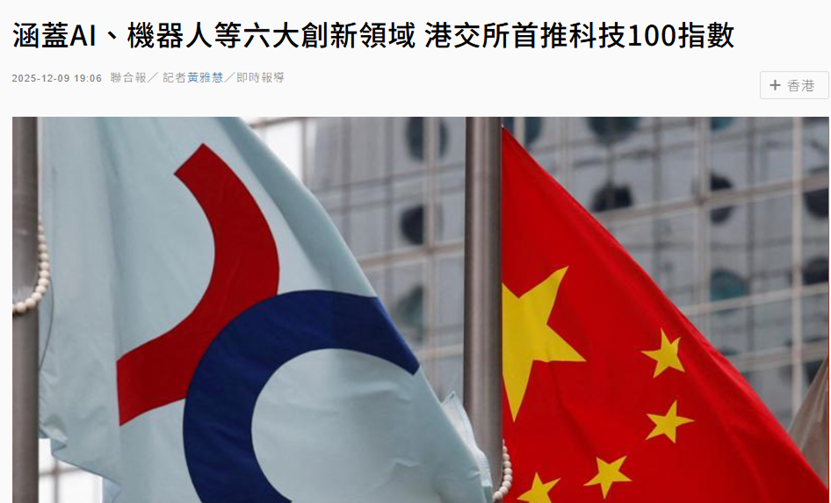
Core Viewpoint - The Hong Kong Stock Exchange (HKEX) has launched its first stock index, the HKEX Technology 100, which includes companies from various technology sectors such as artificial intelligence, biotechnology, electric vehicles, and robotics [1][4] Group 1: Index Characteristics - The HKEX Technology 100 index has four main characteristics: broad market capitalization coverage, listing time requirements with a rapid inclusion mechanism, eligibility for Stock Connect trading, and a diverse range of technology sectors [1] - The index selection criteria include: a minimum listing period of six months, a fundamental requirement where R&D expenditure must account for at least 3% of revenue or revenue must grow by at least 5% year-on-year, and a liquidity requirement with an average daily trading volume exceeding 20 million HKD over the past six months [4] Group 2: Strategic Importance - The CEO of HKEX, Charles Li, stated that this index represents a significant milestone in the development of the group's index and data business, highlighting Hong Kong's critical role in promoting the growth of emerging industries [4] - The index provides investors with an effective and comprehensive investment tool to capitalize on opportunities in technology and emerging sectors [4]


山西证监局:凝聚合力深化转型 抓住资本市场发展新机遇
Sou Hu Cai Jing· 2025-12-10 00:23
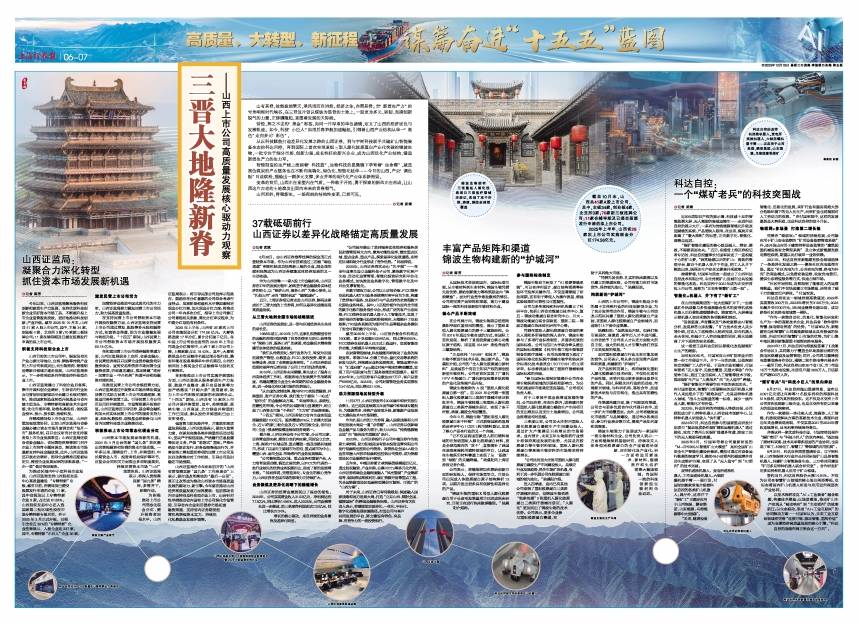
今年以来,山西证监局聚焦服务科技创新和新质生产力发展,支持优质科技创新企业用好资本市场工具,不断提升拟上市 企业监管服务质效,更好地推动科技创新、产业升级。截至2025年10月末,山西共41家A股上市公司,其中,主板34家, 创业板4家,北交所3家;70家新三板挂牌公司;11家在辅导期及已提交股票发行申请的拟上市公司。 今年以来,山西证监局聚焦服务科技创新和新质生产力发展,支持优质科技创新企业用好资本市场工具,不断提升拟上市 企业监管服务质效,更好地推动科技创新、产业升级。截至2025年10月末,山西共41家A股上市公司,其中,主板34家, 创业板4家,北交所3家;70家新三板挂牌公司;11家在辅导期及已提交股票发行申请的拟上市公司。 积极支持科技型企业上市 山西目前的上市公司中,煤炭及相关产业占据主导地位,白酒、钢铁等传统产业的上市公司表现突出,而生物医药、智能 制造等新兴领域正逐步发展。山西证监局表示,下一步将采取系列举措支持科技型企业上市。 山西证监局建立了科创企业后备库,集中开展科创企业调研,引导省内行业协会与晋创谷创新驱动平台建立长效对接机 制,推动国家制造业转型升级基金与省内链主型龙头、专精特新和 ...
主城向新,润州城市经济向“立体”发展
Xin Hua Ri Bao· 2025-12-09 23:34
Group 1: Urban Development and Economic Growth - The international retail brand Aldi is set to establish a presence in the Ruzhou District of Zhenjiang, confirming its location in the Wanda business circle, which signifies an enhancement in the city's commercial capabilities and highlights Ruzhou's attractiveness as a hub for modern service industries [1] - Ruzhou is focusing on maximizing economic potential through innovative urban space utilization, emphasizing the importance of building economy, organic urban renewal, and creating exceptional consumer experiences in a district where service industries account for over 80% of the economy [1] - The Ruzhou District Business and Financial Services Cluster, covering only 1.45 square kilometers, is a provincial-level demonstration area for productive service industries, attracting major enterprises and fostering a collaborative "industrial forest" through various functional sectors [2] Group 2: Digital Economy and Technological Innovation - The Guantang Innovation Community is dedicated to establishing Zhenjiang as a leader in the digital economy, focusing on core industries such as cloud computing, big data, and artificial intelligence, with significant investments in infrastructure like the Dongyun Supercomputing Center [3] - Jiangsu Ruixiang Technology Group, recognized in the "2025 China Industry Digitalization Top 100," is leveraging Ruzhou's location and talent advantages to provide digital transformation services to over 300,000 enterprises, positioning itself as a leader in the digital welfare sector [2] Group 3: Cultural and Community Engagement - Ruzhou is revitalizing old streets through "micro-renovations" that enhance cultural aesthetics without large-scale demolitions, resulting in significant tourist engagement, with over 230,000 visitors during the recent National Day and Mid-Autumn Festival [4] - A community-driven approach has been established, where local businesses and residents collaborate to enhance the neighborhood's vibrancy, creating a cycle of mutual benefit and community engagement [5] Group 4: Events and Consumer Engagement - Large-scale cultural and sports events are being utilized to drive consumer activity, with notable events like concerts and sports competitions generating significant economic impact, such as over 10 million yuan in direct spending from a single concert [7] - Ruzhou is implementing year-round promotional activities under the theme "Enjoy Ruzhou," linking events to consumer incentives, thereby creating a continuous cycle of engagement and spending [8]
【早报】大涨超4%!银价再创历史新高;海光信息、中科曙光终止重组
财联社· 2025-12-09 23:08
Macroeconomic News - China and the U.S. should continuously expand their cooperation list to open new avenues for economic relations, as stated by Vice Premier He Lifeng during a meeting with a senior advisor from the Cohen Group [1] - Due to diplomatic disputes, China's export of rare earths to Japan has faced delays, with the Chinese Foreign Ministry confirming that relevant issues are being handled according to laws and regulations [1] - The U.S. plans to approve the sale of NVIDIA H200 AI chips to China, with the Chinese Foreign Ministry emphasizing the importance of cooperation for mutual benefit [1] - The White House's National Economic Council Director, Kevin Hassett, indicated that the Federal Reserve has "ample room for rate cuts," suggesting potential cuts exceeding 25 basis points [1] - Ukrainian President Zelensky announced readiness for elections and requested assistance from the U.S. and European partners to ensure election security, with preparations expected to be completed within 60 to 90 days [1] Industry News - A new company named Beijing Guanghe Qiancheng Technology Co., Ltd. has been registered with a capital of 30 billion, focusing on exploring strategic cooperation opportunities in the polysilicon sector [2] - The National Retail Innovation Development Conference highlighted the need for improvements in retail layout, supply-demand matching, and online-offline balance, with a focus on tapping into lower-tier markets [2] - The State Administration for Market Regulation has approved two mandatory national standards for civil unmanned aerial vehicles, set to take effect on May 1, 2026 [2] Company News - Haiguang Information announced the termination of its major asset restructuring with Zhongke Shuguang [5] - Zhongke Shuguang also announced the termination of its stock swap absorption merger with Haiguang Information [5] - HoloV announced a significant increase in orders for satellite testing systems, primarily from commercial aerospace satellite manufacturers and testing service providers [6] - Daye Co. reported that its Jiangbei company is engaged in the research and production of aerospace power systems and antennas, currently with a small net profit scale [6] - Huayun Cable stated in a conference call that it covers 70%-80% of the market for supporting Long March and Shenzhou series rockets [7] - Zhongtian Rocket confirmed its role as a supplier for Lingkong Tianxing [7] Global Market - U.S. stock indices closed mixed, with the Dow down 0.37%, Nasdaq up 0.13%, and S&P 500 down 0.09%. The Nasdaq Golden Dragon China Index fell 1.37%, with most popular Chinese concept stocks declining [8] - Spot silver rose 4.31% to $60.641 per ounce, continuing to set historical highs. COMEX gold futures increased by 0.45% to $4236.6 per ounce, while COMEX silver futures rose 4.72% to $61.16 per ounce [8] Investment Opportunities - UBS reports that the traditional DRAM market is experiencing a tightening supply, with demand remaining robust, leading to enhanced pricing power. By Q2 2026, Micron's traditional DRAM gross margin is expected to reach 67%, surpassing HBM for the first time [12] - Media reports indicate that memory prices are rising rapidly, with a 64GB DDR5 memory kit exceeding 4000 yuan, outpacing all financial products. Wanlian Securities suggests that the storage chip market is poised for a new boom driven by AI [13] - TrendForce forecasts that global demand for optical transceiver modules above 800G will reach nearly 63 million units by 2026, marking a growth of 2.6 times, indicating a sustained increase in the optical module industry's demand [14]



中信证券徐广鸿: 估值修复与结构重塑共振 2026年港股锚定四大核心赛道
Zhong Guo Zheng Quan Bao· 2025-12-09 20:46
Core Viewpoint - The Hong Kong stock market is entering a phase of valuation repair and structural reshaping, characterized by undervaluation, capital misalignment, and performance differentiation, with a significant influx of southbound capital and a shift in foreign investment reshaping the funding landscape [1][2]. Valuation and Market Dynamics - The Hang Seng Index has experienced a cumulative decline of over 50% from the post-Lunar New Year of 2021 to January 2024, leading to a significant valuation gap [2]. - As of December 9, 2023, the Hang Seng Index, Hang Seng China Enterprises Index, and Hang Seng Technology Index have recorded cumulative gains of 49.20%, 22.59%, and 24.32%, respectively [2]. - By the end of 2025, the expected EPS growth rate for the Hang Seng Index in 2026 is projected to be 8%, with a dynamic P/E ratio of only 12 times, indicating a notable valuation gap compared to major global markets [2]. Capital Flow and Investment Preferences - Southbound capital has seen a record net inflow of nearly 1.4 trillion HKD by the end of November, marking a new high since the launch of the mutual market access mechanism [3]. - The capital structure shows a clear differentiation, with institutional investors favoring themes like non-bank ETFs and personal investors focusing on growth sectors such as automotive, pharmaceuticals, and consumer goods [3]. - Foreign capital, while still experiencing outflows, has shown signs of recovery since August, with long-term foreign capital seeing its first phase of inflow since September 2022, particularly favoring the information technology sector [3]. Sector Performance and Outlook - The technology sector is expected to see significant profit growth in 2025, contrasting sharply with traditional sectors like finance and real estate [4]. - The Hang Seng Technology Index has shown volatility but continues to strengthen its core competitiveness, with the sector benefiting from advancements in AI and related technologies [4]. - The long-term trend of recovery in the Hong Kong stock market is expected to continue, driven by policy dividends and external risk dynamics [5][6]. Investment Directions - Key investment opportunities for 2026 are identified in four main sectors: technology, pharmaceuticals, resource products, and essential consumer goods, focusing on "earnings certainty + valuation elasticity" [8][9]. - The technology sector, particularly the AI industry chain, is anticipated to benefit from a virtuous cycle of investment and revenue growth, with a focus on leading companies and quality players in the computing power supply chain [8]. - The pharmaceuticals sector is entering a phase of certain growth, supported by policy and industry developments, with a focus on innovative companies and those benefiting from domestic market reforms [8]. - The resource products sector is supported by supply-demand mismatches and liquidity drivers, with expectations of rising commodity prices benefiting related stocks [9]. - The essential consumer goods sector is poised for valuation recovery, supported by domestic policies aimed at boosting consumption and improving income expectations [9].

2026年开始,个人存款超100万,大概率要面对这5大难题!
Sou Hu Cai Jing· 2025-12-09 15:07
Core Viewpoint - The increasing trend of household savings in China is driven by the need to prepare for unexpected events and future expenses, with a significant rise in deposit balances noted in recent years [1] Group 1: Household Savings Trends - As of June, the household deposit balance reached 162.02 trillion yuan, with an increase of 10.77 trillion yuan in the first half of the year [1] - The average savings per person, based on a population of 1.4 billion, amounts to 115,000 yuan [1] Group 2: Challenges for High Deposit Holders - Starting in 2026, individuals with deposits exceeding 1 million yuan are expected to face five major challenges [3] - The first challenge is a significant reduction in interest income from savings, with the one-year deposit rate dropping from 2.25% to 1.35%, resulting in a loss of approximately 9,000 yuan in interest income for a 1 million yuan deposit [5] - The second challenge is that deposit interest rates are unable to keep pace with inflation, leading to a decrease in the purchasing power of savings over time [8] Group 3: Investment Risks - Many depositors are turning to investments in stocks, funds, and bank wealth management products, but these investments often result in losses. For instance, only 18.9% of retail investors in A-shares were profitable in the first eight months of 2025, with an average loss of about 21,000 yuan [10] - Public funds have also seen significant losses, with many funds experiencing declines of 20-30% last year, undermining the credibility of financial advisors [10] - The risks associated with bank wealth management products have increased, particularly after the breaking of the rigid repayment mechanism, leading to losses in lower-rated products [10] Group 4: Entrepreneurial Challenges - Individuals with over 1 million yuan in savings are also attempting to invest in entrepreneurship, but the success rate is low. A case is highlighted where a significant investment in a restaurant led to failure and substantial debt [13] Group 5: Social Pressure from Lending - Those with substantial savings often face pressure from friends and family seeking loans for various reasons, creating a dilemma between maintaining relationships and financial prudence [16]
(机遇香港)香港外来直接投资总存量大幅上升
Sou Hu Cai Jing· 2025-12-09 14:17
Core Insights - The total stock of foreign direct investment (FDI) in Hong Kong is projected to increase by 9.1% year-on-year, reaching HKD 20,049.6 billion by the end of 2024, which is equivalent to 631% of the local GDP for that year [1] - The total stock of outward direct investment from Hong Kong is expected to rise by 6.7% year-on-year to HKD 18,890 billion, representing 595% of the local GDP for 2024 [1] - The net inflow of direct investment for 2024 is estimated at HKD 353.2 billion, with total direct investment inflows at HKD 982.4 billion and outflows at HKD 629.2 billion [1] Investment Landscape - Hong Kong continues to affirm its status as a major international financial and business hub, serving as a preferred location for multinational corporations, reflecting global investors' confidence in the economic outlook of Hong Kong [1] - The FDI from and to mainland China is highlighted as a significant aspect of Hong Kong's investment activities, emphasizing its role as a "super connector" and "super value creator" in the region [1] Government Initiatives - The Hong Kong Special Administrative Region (HKSAR) government plans to leverage the unique advantages of Hong Kong to enhance its role in connecting domestic and international markets, aiming to deepen international ties [1] - The government is committed to implementing supportive policies to attract more strategic enterprises to establish a presence in Hong Kong, promoting high-quality development [1]