
电池

Search documents
全球第三的失守与进攻丨年度观察
起点锂电· 2025-12-26 10:05
Core Viewpoint - 2025 marks the beginning of a new growth cycle for lithium batteries and a global showdown, with Korean battery companies intensifying their counterattacks [3] Group 1: Market Dynamics - LG Energy Solution, once a leading competitor to CATL, is currently navigating between losing ground and making offensive moves [4] - The global demand for electric vehicles (EVs) is slowing down, impacting LG Energy's market position. For instance, LG Energy's battery installation volume from January to October 2025 was 86.5GWh, a year-on-year increase of only 12.8%, significantly lower than the industry average of 35% [8][9] - LG Energy's market share has dropped below 10%, now standing at 9.3%, while CATL and BYD hold 38.1% and 16.9% respectively [8][9] Group 2: Financial Performance - LG Energy's financial performance is under pressure, with revenue declining. In Q1 2025, revenue was 6.3 trillion KRW, down 2.9% quarter-on-quarter, while Q2 revenue fell to 5.6 trillion KRW, a decrease of 11.2% [11] - Despite a rise in profits, LG Energy's reliance on subsidies and tax credits is evident, with significant portions of profits attributed to these incentives [11][12] Group 3: Strategic Shifts - LG Energy is focusing on lithium iron phosphate (LFP) batteries, aiming to strengthen its position in the energy storage system (ESS) market. The company has secured over 300 billion KRW in LFP battery orders from Tesla, effective from August 2027 [15] - The company plans to increase its ESS battery production capacity from 30GWh this year to over 50GWh next year, reflecting a strategic pivot towards energy storage [15][16] - A recent organizational restructuring aims to unify production across different product lines, enhancing flexibility in response to market demands [16] Group 4: Future Outlook - The transition to energy storage may take 2-3 years to yield significant results for LG Energy, as the company faces challenges in balancing costs and profits within the LFP battery supply chain [18]




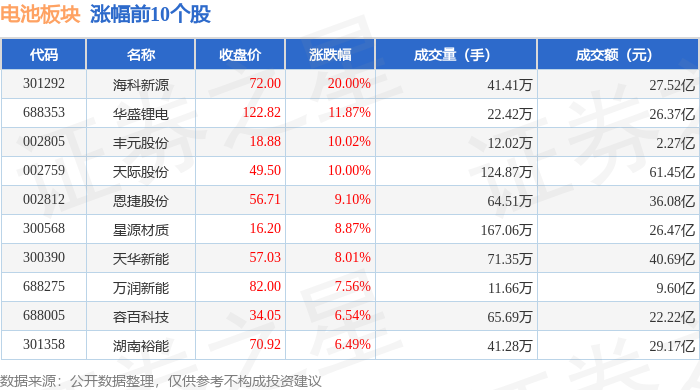
电池板块12月26日涨1.24%,海科新源领涨,主力资金净流入53.4亿元
Zheng Xing Xing Ye Ri Bao· 2025-12-26 09:07
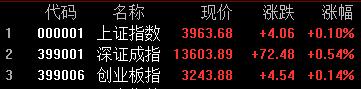
Market Overview - The battery sector increased by 1.24% compared to the previous trading day, with Haike Xinyuan leading the gains [1] - The Shanghai Composite Index closed at 3963.68, up 0.1%, while the Shenzhen Component Index closed at 13603.89, up 0.54% [1] Top Gainers in the Battery Sector - Haike Xinyuan (301292) closed at 72.00, up 20.00%, with a trading volume of 414,100 shares and a transaction value of 2.752 billion [1] - Baosheng Lithium Battery (688353) closed at 122.82, up 11.87%, with a trading volume of 224,200 shares and a transaction value of 2.637 billion [1] - Fengyuan Co., Ltd. (002805) closed at 18.88, up 10.02%, with a trading volume of 120,200 shares and a transaction value of 227 million [1] - Tianji Co., Ltd. (002759) closed at 49.50, up 10.00%, with a trading volume of 1,248,700 shares and a transaction value of 6.145 billion [1] - Enjie Co., Ltd. (002812) closed at 56.71, up 9.10%, with a trading volume of 645,100 shares and a transaction value of 3.608 billion [1] Market Capital Flow - The battery sector saw a net inflow of 5.34 billion from main funds, while retail funds experienced a net outflow of 2.488 billion and 2.852 billion respectively [2][3] - The top stocks with significant main fund inflows include: - Tianji Co., Ltd. (002759) with a net inflow of 1.024 billion, accounting for 16.66% of the total [3] - Enjie Co., Ltd. (002812) with a net inflow of 604 million, accounting for 16.73% of the total [3] - Hunan YN (301358) with a net inflow of 485 million, accounting for 16.62% of the total [3]



【公募基金】华宝基金汤慧:以产业趋势为纲,以赔率空间为目
华宝财富魔方· 2025-12-26 09:03
Core Viewpoint - The article analyzes the investment capabilities of Tang Hui, the manager of Huabao Growth Strategy Fund, highlighting her dynamic investment system based on industry trends and stock odds, which has led to superior performance compared to peers [2][3][31]. Fund Manager Information - Tang Hui has a background as a senior strategy analyst at Haitong Securities and joined Huabao Fund in June 2015, currently managing three products [4][30]. - Since taking over the Huabao Growth Strategy Fund on May 9, 2020, it has achieved a total scale of 146 million yuan by September 30, 2025, outperforming 97% of similar funds [6][30]. Performance Analysis - The Huabao Growth Strategy Fund has recorded a cumulative excess return of 83.04% since Tang Hui's tenure, significantly surpassing its performance benchmark [7][8]. - The fund's performance was particularly strong in years other than 2023, where it faced challenges due to market downturns, but is expected to show aggressive performance as the market recovers in 2025 [8][30]. Investment Framework - Tang Hui's investment framework combines a top-down approach focusing on macro trends with a bottom-up stock selection based on valuation and odds, allowing her to identify key positions within industry chains [14][16]. - The investment strategy emphasizes a combination of beta (60%-70%) and alpha (30%-40%) to balance risk and return, focusing on sectors with high growth potential [14][34]. Stock Selection and Portfolio Management - The portfolio management strategy involves dynamic adjustments based on market conditions, with a high turnover rate reflecting active tracking of industry trends and stock valuations [27][29]. - The fund's holdings are diversified across key positions in industry chains, ensuring exposure to multiple growth opportunities while managing risk through strategic stock selection [24][20]. Operational Characteristics - Tang Hui maintains a relatively high stock position and focuses on industry allocation and stock selection for excess returns, with a disciplined approach to portfolio adjustments based on market signals [27][29]. - The fund's operations are characterized by a responsive decision-making process, allowing for quick adjustments in response to changes in market conditions and stock valuations [29][30].

韩国综合指数收涨0.5% 三星电子创纪录新高
Xin Lang Cai Jing· 2025-12-26 07:43
Group 1 - The South Korean stock market rose on Friday, with the KOSPI index closing up 0.51% at 4,129.68 points, driven by strong foreign inflows and a rebound in semiconductor manufacturers, particularly Samsung Electronics, which reached an all-time high [1][3] - Foreign investors purchased a net 17,785.87 billion KRW in the KOSPI, indicating strong demand for semiconductor stocks due to rising advanced chip prices and optimistic expectations for Samsung's upcoming earnings report [1][3] - The South Korean won appreciated against the US dollar, closing at 1,440.3 KRW, a 0.37% increase from the previous day's closing price of 1,445.7 KRW, with an intraday high of 1,429.5 KRW, the strongest level since November 3 [1][3] Group 2 - The National Pension Service (NPS) of South Korea has resumed strategic foreign exchange hedging operations to stabilize the won, extending its currency swap agreement and temporary strategic hedging mechanism for another year [2][4] - The NPS provides KRW to the Bank of Korea in exchange for USD, alleviating demand pressure in the foreign exchange market, and has become a net seller of USD, which supports the won [2][4] - Following warnings from policymakers about the recent weakness of the won, the currency rebounded, with the onshore market seeing a 1.2% increase to 1,429.85 KRW, and a 2.3% rise earlier in the week [2][4]
A股收评:8连红!沪指收涨0.1%,海南板块再度爆发!
Ge Long Hui· 2025-12-26 07:22
Market Performance - The A-share market indices continued to rise, with the Shanghai Composite Index recording an 8-day increase, while the Shenzhen Component Index and the ChiNext Index saw a 6-day increase [1] - As of the market close, the Shanghai Composite Index rose by 0.1% to 3563 points, the Shenzhen Component Index increased by 0.54%, and the ChiNext Index gained 0.14% [1] Trading Volume - The total market turnover reached 2.18 trillion yuan, an increase of 237.2 billion yuan compared to the previous trading day, with over 3400 stocks declining [1] Sector Performance - The Hainan sector surged, with significant gains in stocks such as Hainan Mining and Hainan Airlines, which hit the daily limit [4] - The industrial metals sector also saw a rise, with Jiangxi Copper hitting the daily limit [4] - The commercial aerospace, small metals, titanium dioxide, and fluorochemical sectors experienced notable increases [4] Notable Stocks - Hainan sector stocks such as Intercontinental Oil and Gas, Hainan Mining, and Jun Da Co. all reached their daily limit [5] - Jiangxi Copper announced a formal offer to acquire SolGold plc for 28 pence per share, targeting the Cascabel project in Ecuador, a significant undeveloped copper-gold deposit [6][7] Battery Sector - The battery sector saw gains, with Haike New Energy hitting the daily limit and Huasheng Lithium gaining over 11% [9] - Haike New Energy signed a strategic cooperation agreement for 270,000 tons of lithium battery materials, following previous agreements totaling nearly 800,000 tons [9] Paper Sector - The paper sector experienced a pullback, with companies like Jiang Tian Technology and Anni Co. seeing declines of over 12% and 3% respectively [12] - Suzano announced a global price increase for hardwood pulp starting January 2026, which may impact the sector [11] Rubber Products and Small Appliances - The rubber products sector declined, with Tian Tie Technology dropping over 13% due to the criminal detention of its controlling shareholder [13][14] - The small appliances sector also faced losses, with Beili Cong falling over 14% amid an investigation into information disclosure violations [15][16] Market Outlook - According to the chief economist of Debon Securities, the A-share market is expected to continue a "slow bull" trend in 2026, supported by stable indices and a focus on technology growth, particularly in AI and computing sectors [16]
华宝基金汤慧:以产业趋势为纲,以赔率空间为目
HWABAO SECURITIES· 2025-12-26 07:02
1. Report Industry Investment Rating There is no information about the report industry investment rating in the provided content. 2. Core Viewpoints of the Report - Since taking charge of Huabao Growth Strategy in May 2020, Tang Hui has achieved excellent returns, outperforming 97% of similar funds, with relatively good drawdown control [4][14][40]. - Tang Hui has an investment system centered on "industry trends + stock odds", a portfolio management concept of "beta (60%-70%) + alpha (30%-40%)", and an operation style of dynamic adjustment and disciplined execution [3][18][41]. 3. Summary by Relevant Catalogs 3.1 Fund Manager Information 3.1.1 Fund Manager Introduction - Tang Hui was a senior strategy analyst at Haitong Securities Research Institute and joined Huabao Fund in June 2015. She currently manages 3 products and is the fund manager of Huabao Growth Strategy since May 2020, Huabao Baokang Flexible since January 2021, and Huabao Baokang Consumer Goods since December 2021 [4][9][37]. 3.1.2 Management Product Introduction 3.1.2.1 Representative Product - Tang Hui manages three public - offering funds. Huabao Growth Strategy is used as the representative product for analysis. As of September 30, 2025, its scale is 146 million yuan [10]. 3.1.2.2 Representative Product Net Value Performance - As of November 25, 2025, after excluding the 3 - month establishment period, Huabao Growth Strategy significantly outperformed the benchmark, with a cumulative positive excess return of 83.04%. It outperformed 97% of similar funds, and its drawdown control is in the upper - middle level. It had a weak performance in 2023 but was excellent in other years, especially in 2025 [11][14][40]. 3.2 Fund Manager Investment Ability Analysis 3.2.1 Investment Framework - Guided by Industry Trends and Focused on Odds Space - Tang Hui's investment system combines understanding of industry trends and control of stock odds. She selects high - growth and long - logic tracks from a top - down perspective, captures inflection points of industry prosperity "second - order derivatives", and then conducts bottom - up stock selection based on odds [18][19][20]. - For industry trend judgment, she has a macro view of the whole market. For example, she focuses on the AI industry, believing that its technological evolution is ongoing and capital expenditure is not in a bubble [19]. - She constructs a dynamic screening system that combines top - down and bottom - up approaches, and uses odds as the core criterion for secondary screening. This includes comparing industry prosperity, evaluating stock odds, and building differentiated portfolios based on product contracts [20]. - Her investment scope is wide, with a growth preference, and she is relatively cautious about sectors like semiconductors [21]. 3.2.2 Shareholding Characteristics - Carrying Prosperity and Mining Alpha under Portfolio Thinking - Tang Hui's shareholding is based on the concept of "beta + alpha". The beta position (60% - 70%) is concentrated in no more than three prosperous industries, such as the AI computing power industry chain from 2023 to 2025. The alpha position (30% - 40%) is used to invest in stocks with independent growth logic [22][23]. - In stock selection, she makes a three - dimensional layout in the industrial chain, considering both position and odds. Her holding period is flexible, depending on industry prosperity and market value targets [26]. 3.2.3 Operation Characteristics - Dynamic Adjustment and Disciplined Execution under Agile Tracking - Tang Hui rarely conducts position timing and usually keeps the stock position at a relatively high level. Her excess returns mainly come from industry allocation and stock selection [18][31][41]. - The fund has a relatively high turnover rate, which reflects her tracking of prosperity and dynamic evaluation of stock odds. She adjusts positions according to industry data, company reports, and odds changes [33]. 3.3 Summary - Tang Hui's resume and management of funds are the same as mentioned above. Huabao Growth Strategy has excellent performance, and her investment ability has the characteristics of an investment system centered on industry trends and stock odds, portfolio management, and dynamic adjustment [37][40][41]. 3.4 Appendix - Information about Huabao Growth Strategy, such as its fund name, abbreviation, establishment date, comparison benchmark, investment objective, investment scope, management fee rate, and custody fee rate, is provided [44].
中证电池主题指数涨2.52%,阳光电源涨8.34%
Jin Rong Jie· 2025-12-26 06:57
12月26日,A股市场震荡上行,深成指涨0.68%领跑,锂电池板块上涨1.6%,电力设备板块上涨1.43%, 正极材料板块上涨2.64%。 当前格局下,电池片环节价格具备修复弹性。从产业链传导逻辑看,材料成本上行与供给收缩的共振, 已推动储能电芯、VC等多个环节进入温和涨价通道,头部厂商正通过顺价机制消化成本压力,四季度 储能电池价格有望进一步上浮。储能景气度贯穿周期全球储能需求增速已显著高于动力电池,乐观预期 下2026年储能同比增长可达40%-50%,材料环节新增供给普遍低于需求增速,头部厂商产能利用率持续 提升,产业链利润增速有望继续增加,建议关注南方中证电池主题指数A(018926)配置机会。 风险提示:基金有风险,投资需谨慎。 资讯所属栏目还有更多独家策划、专家专栏,免费查阅>> 政策红利直接推动渗透率跃升,澳大利亚明确2030年户储目标达40GWh,预计超200万户家庭安装储能 系统。中国企业已深度受益这一增量市场,2025年1-9月在澳储能订单达43.21GWh,占当地市场份额超 20%,成为海外第二大储能来源地,需求增长具备强持续性。叠加全球储能进入新一轮增长周期,头部 电池厂商2026-20 ...

机构集体看多锂价,资金回流电池赛道,多头情绪全面点燃
Xin Lang Cai Jing· 2025-12-26 05:05
Core Viewpoint - The battery sector is experiencing a significant surge driven by four key factors: strong increases in lithium carbonate futures, unexpected growth in energy storage demand, improvements in industry profitability, and a return of institutional funds [1][9]. Supply Side: Frequent Disruptions and Tightening Expectations - Domestic mining recovery and approval processes are slower than expected, with the first environmental assessment for the Jiangxia Wozhong lithium mine by CATL indicating a lengthy approval and recovery timeline, reinforcing supply tightness expectations [1][9]. - Australian lithium prices remain above $1,200 per ton, providing cost support for domestic lithium prices, while potential mining activity suspensions in countries like Nigeria raise concerns about global lithium supply volatility [2][10]. - The market is facing historically low inventory levels of lithium carbonate, with traders reluctant to sell due to high previous costs, further tightening supply dynamics as seasonal reductions in production occur in regions like Qinghai [3][10]. Demand Side: Explosive Energy Storage Growth and Battery Demand Recovery - The domestic energy storage market continues to thrive, with a 98.3% year-on-year increase in EPC bidding scale in November, and significant demand growth in key regions like Europe, Australia, and North America [3][11]. - Goldman Sachs predicts a staggering 48.7% growth in lithium carbonate demand from the energy storage sector by 2026, with energy storage expected to surpass power batteries as the largest demand source in the first quarter [3][11]. - The demand for power batteries is also showing marginal improvement, supported by policies like the "old-for-new" vehicle exchange and continued tax exemptions, which bolster consumer confidence and stabilize production schedules [4][11]. Funding and Sentiment: Institutional Upgrades and Fund Inflows - Major institutions, including JPMorgan, have significantly raised their lithium price forecasts, with JPMorgan increasing its 2026 target price for lithium carbonate from 70,000 yuan per ton to 90,000 yuan per ton, indicating a projected supply gap in the global lithium market for 2025-2026 [4][12]. - The funding landscape is characterized by a strong bullish sentiment, with institutional funds flowing back into lithium resources and battery sectors, leading to a concentration of long positions in the lithium futures market [5][12]. - The Ministry of Industry and Information Technology's efforts to address "involutionary competition" in the industry are expected to improve battery price rationality and enhance profitability expectations for battery companies, further supporting the bullish outlook on lithium prices [5][12]. Market Outlook - In the short term, supply disruptions and high growth in energy storage demand are direct catalysts for price increases; in the medium to long term, sustained demand from energy storage and power batteries, coupled with limited growth in global lithium supply, is likely to maintain an upward trend in lithium carbonate prices [6][12].
硅片报价大涨12%!头部硅片企业联合行动,协鑫集成涨停,阳光电源涨超8%,光伏龙头ETF(516290)涨超2%,电池50ETF(159796)冲击六连涨,强势吸金!
Sou Hu Cai Jing· 2025-12-26 03:29
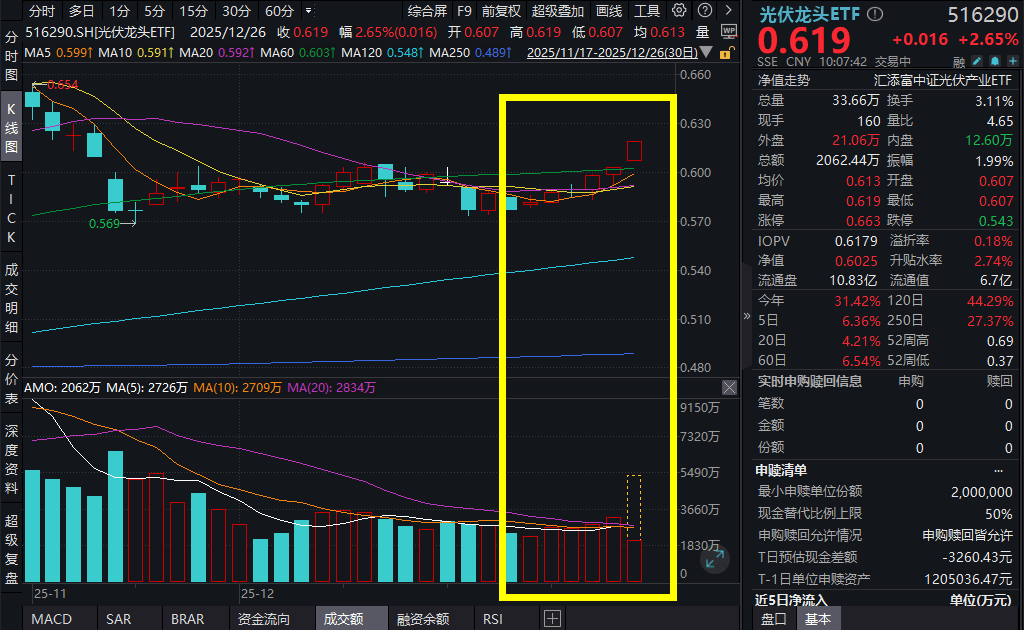
Group 1: Market Performance - The photovoltaic sector showed strong performance with the leading ETF (516290) opening high and increasing by 2.65% [1] - The battery ETF (159796) also saw a rise of 1.54%, marking its sixth consecutive increase, with a net subscription of 42 million shares [1] - Major stocks within the photovoltaic ETF, such as Dongfang Risheng and Xiexin Integration, reached their daily limit, while Yangguang Electric surged over 8% [3] Group 2: Price Increases in Raw Materials - Four leading silicon wafer companies significantly raised their prices, with average increases reaching 12% [6] - The price of polysilicon futures rebounded sharply, with a 4.8% increase to 60,760 yuan per ton, driven by strong market confidence [6] - Lithium carbonate futures also surged, breaking the 130,000 yuan mark with a 6.64% increase, indicating a tight supply-demand situation [6] Group 3: Industry Outlook and Trends - The lithium battery materials sector is experiencing positive changes, with demand for energy storage exceeding expectations, leading to a recovery in industry sentiment [7] - The electrolyte supply chain is expected to see an upward trend, supported by energy storage demand and rising lithium carbonate costs [7] - By 2026, the demand for lithium iron phosphate is projected to increase by nearly 340,000 tons, accounting for 12% of the overall phosphate demand [7] Group 4: Investment Strategies - The battery sector's fundamentals and technological catalysts are expected to support strong stock performance, suggesting a focus on index investments for easier exposure [9] - The battery 50 ETF (159796) has a high content of energy storage and solid-state battery components, making it a strong candidate for investment [9][11] - The photovoltaic leading ETF (516290) is highlighted for its low management fee of 0.15%, making it an attractive option for investors [14]



大化所开发溴基液流电池新体系
Zhong Guo Hua Gong Bao· 2025-12-26 03:22
Core Insights - A new bromine-based two-electron transfer reaction system has been developed, enabling the concept validation and system scaling of long-life zinc-bromine flow batteries [1][2] - The new reaction significantly improves energy density and reduces corrosion, addressing key challenges in traditional bromine flow battery systems [1][2] Group 1: Research and Development - The research team, led by Li Xianfeng from the Dalian Institute of Chemical Physics, has published their findings in the journal Nature Energy [1] - The new bromine flow battery relies on the redox reaction between bromide ions (Br-) and bromine (Br2), which has advantages such as abundant resources, high electrode potential, and high solubility [1] Group 2: Technical Innovations - The introduction of amine compounds as bromine scavengers effectively lowers the concentration of bromine in the electrolyte, enhancing battery performance [1] - The dual-electron transfer method from Br- to Br+ (brominated amine compounds) significantly increases the energy density of the battery [1] Group 3: Performance Metrics - In a scaled-up 5 kW system test, the battery demonstrated stable operation for over 700 cycles at 40 mA/cm², with a total lifespan exceeding 1400 hours and an energy efficiency of over 78% [2] - The extremely low concentration of bromine resulted in no corrosion of key materials such as current collectors, electrodes, and membranes before and after cycling, confirming the non-corrosive nature of the electrolyte [2] Group 4: Implications for Industry - This research provides a new approach for the design of long-life bromine flow batteries, laying the groundwork for further applications and promotion of zinc-bromine flow batteries [2]