飞机制造

Search documents
收评:股指表现强势沪指涨1.3% 汽车白酒爆发
Jing Ji Ri Bao· 2025-09-04 09:41
Market Performance - On November 5, the three major stock indices opened higher, with initial gains exceeding 1% before a pullback due to military stocks, but later strengthened again, with the ChiNext index increasing by 1% [1] - The Shanghai Composite Index closed at 3320.13 points, up 1.30%, the Shenzhen Component Index at 13894.26 points, up 1.72%, and the ChiNext Index at 2787.88 points, up 1.36% [1] - Total trading volume in the Shanghai and Shenzhen markets reached 8597.53 billion yuan, a significant increase from the previous day's 7297.60 billion yuan [1] Sector Performance - Most sectors saw gains, with notable increases in automotive, communication equipment, liquor, 5G, steel, consumer electronics, and photovoltaic sectors [1] - Conversely, sectors such as coal, medical devices, planting, cement, insurance, and logistics experienced relatively smaller gains [1] Economic Indicators - The Ministry of Commerce reported that foreign investment in China is expected to maintain a stable and positive trend in the fourth quarter, with actual foreign investment reaching 141.23 billion USD in 2019, a 2.1% increase year-on-year [2] - The China Logistics and Purchasing Federation indicated that the express logistics index for October was 108.6%, reflecting a 0.5 percentage point increase from the previous month, with the manufacturing business express index also rising to 111.9% [3] Institutional Insights - Institutions suggest that the current fundamentals support a strong A-share market, with a focus on technology and consumer sectors for medium to long-term investments [4] - Emphasis is placed on low-valuation financial sectors and the economic recovery theme, particularly in midstream manufacturing and raw materials [4]


西锐(02507):首次覆盖报告:人群渗透提升,领航高端消费
Western Securities· 2025-09-03 08:44
Investment Rating - The report gives a "Buy" rating for the company Cirrus (2507.HK) [4] Core Views - The private aircraft industry is experiencing an upturn, driven by factors such as improved flight infrastructure, aging aircraft replacement, and growth in high-net-worth individuals [1][2] - Cirrus has a leading position in product safety and performance, with a significant market share in the piston aircraft segment [1][2] - The company is expected to maintain its competitive advantage and achieve steady growth, supported by capacity expansion and service network development [2][15] Summary by Sections Industry Overview - The private aircraft market in the U.S. is mature, with a stable demand structure focused on high-net-worth individuals for commuting and travel [1][19] - The industry has seen a robust increase in both volume and price, benefiting leading companies like Cirrus [1][19] - The average price of piston aircraft in the U.S. is approximately $700,000 per unit [21] Competitive Landscape - Cirrus focuses on small private aircraft, with a strong market share and a competitive edge in product differentiation [44][51] - The company holds a 32% market share in the private aircraft sector, with its SR series leading in sales [51][54] Company Analysis - Cirrus emphasizes product safety, featuring the CAPS (Cirrus Airframe Parachute System) and the Safe Return™ automatic landing system, which enhances its safety profile [66][70] - The company has a strong governance structure and has shown rapid growth in performance metrics, with a balanced supply-demand situation [57][62] Future Outlook - Cirrus is expected to expand its production capacity and enhance its service offerings, which will contribute to revenue growth [2][4] - The company anticipates delivering 824, 899, and 965 aircraft in 2025, 2026, and 2027, respectively, with a steady increase in average selling prices [11][12] - The projected net profits for 2025, 2026, and 2027 are $170 million, $210 million, and $260 million, respectively, with corresponding P/E ratios of 14.0, 11.2, and 9.2 [2][15]
特朗普:美国手里有王牌没打,或对华加税200%,除非满足一个要求
Sou Hu Cai Jing· 2025-09-01 03:01
Group 1 - The core issue revolves around the U.S. reliance on China for rare earth magnets, with China controlling 90% of global rare earth processing capabilities, which is critical for U.S. defense technology [1][3] - President Trump’s threat of a 200% tariff on Chinese rare earth magnets highlights the vulnerability of the U.S. defense industry, as a complete cutoff from China could set back U.S. defense technology by several years [1][3] - The U.S. is facing a supply chain crisis, with production lines for fifth-generation fighter jets and missile factories at risk due to rare earth shortages [3] Group 2 - China has included rare earth magnets in its export control list as a countermeasure to U.S. tariffs, indicating a strategic move to leverage its position in the rare earth market [3] - The U.S. Department of Homeland Security announced a 50% tariff on Indian goods, reflecting a broader strategy to exert pressure on countries that engage in trade practices deemed unacceptable [3][5] - The U.S. is experiencing economic pressures, with national debt exceeding $36 trillion and a need to stabilize its economy, which may drive Trump to seek a trade agreement with China [5] Group 3 - Trump's potential visit to China is motivated by the need to address economic challenges and improve his approval ratings ahead of the 2026 midterm elections [5][7] - The U.S. is attempting to negotiate with China using various leverage points, such as Boeing orders and student visas, to secure stable rare earth supplies [7] - China's strategy involves accelerating technological independence and reducing reliance on the U.S. dollar, which could undermine U.S. negotiating power in the long run [7]

美国罕见把中国捧上神坛,中国成了香饽饽,美俄印三国争相巴结
Sou Hu Cai Jing· 2025-09-01 02:31
Group 1 - The U.S. Treasury Secretary's recent remarks reflect a significant shift in attitude towards China, moving from labeling it as the "largest economic and military competitor" to praising its economic progress and describing it as a "great country" [1] - U.S.-China trade data shows a projected 8.7% year-on-year increase in trade volume in the first half of 2025, with U.S. agricultural exports to China reaching a historical high and Boeing's orders from China accounting for 35% of its global total [3] - The U.S. has adopted a differentiated approach in its tariff policies, notably excluding China from recent tariff increases while imposing significant tariffs on other countries, indicating economic pressures [3] Group 2 - The U.S. has taken a confrontational stance towards India, imposing a 25% tariff on Indian imports, which raises the overall tariff rate to 50%, while India has responded with its own countermeasures [5] - The U.S. economy is facing challenges, with a projected GDP contraction of 0.5% in Q1 2025 and an annual growth forecast of only 1.8%, the largest decline among developed economies [6] - The trade war has resulted in significant financial losses for American households, averaging about $2,800 annually, and has disproportionately affected low-income families [6] Group 3 - China has strategically reduced its reliance on U.S. agricultural products, notably halting new orders for U.S. soybeans and increasing imports from Brazil, leading to a significant drop in U.S. soybean exports [8] - China is also diversifying its economic strategies by reducing its holdings of U.S. Treasury bonds and placing certain critical rare earth elements on a "licensing list" [10] - The relationship between China and India is improving, with high-level diplomatic engagements aimed at discussing trade and border issues, contrasting with the escalating tensions between the U.S. and India [11] Group 4 - The international landscape is shifting towards a multipolar world, with China gaining respect from the U.S. and attracting countries like Russia and India, as cooperation begins to replace confrontation [15] - Brazil has taken legal action against the U.S. at the WTO, indicating growing discontent among nations regarding U.S. trade policies [15]

西锐(02507.HK):1H25业绩超预期 产品升级提价盈利能力提升
Ge Long Hui· 2025-08-29 18:44
Core Viewpoint - The company reported strong financial performance for 1H25, with significant revenue and profit growth driven by increased delivery of next-generation products and service business expansion [1] Financial Performance - The company achieved revenue of $594 million in 1H25, representing a year-over-year increase of 24.90% [1] - Net profit reached $64.97 million, up 82.45% year-over-year, significantly exceeding expectations [1] - The gross margin and net margin improved by 1.8 percentage points and 3.4 percentage points, reaching 36.2% and 10.9% respectively [1] Business Segments - Aircraft manufacturing revenue was $498 million in 1H25, a year-over-year increase of 25.2%, accounting for 83.8% of total revenue [1] - Service revenue was $96 million, up 24.1% year-over-year, making up 16.2% of total revenue [1] - The company delivered 350 aircraft in 1H25, a 22% increase year-over-year, including 305 SR2X series aircraft and 43 Vision Jets [1] Order Backlog and Production Capacity - As of June 30, 2025, the company had a backlog of 1,056 orders, including 827 SR2X series and 229 Vision Jets, sufficient to sustain production for approximately 1.5 years [1] - The company plans to invest $13 million to expand the Grand Forks manufacturing facility from 165,000 to 195,000 square feet to meet strong downstream demand [2] Product Pricing and Upgrades - The average delivery price for SR2X increased from $1.04 million to $1.14 million, a 9.6% year-over-year rise, while the Vision Jet price rose from $3.33 million to $3.48 million, a 4.5% increase [1] - The introduction of the new SR Series G7+ product, featuring advanced safety and automation features, is expected to further enhance pricing power [1] Market Position and Outlook - The company has sold products to customers in 55 countries and established authorized service centers in 32 countries, enhancing ecosystem stickiness [2] - The company is positioned as a leading player in the global private jet market, with strong growth prospects supported by a robust order backlog and stable profitability [2] Earnings Forecast and Valuation - The net profit forecasts for 2025 and 2026 have been raised by 8.8% and 11.1% to $151 million and $177 million respectively [2] - The current stock price corresponds to a P/E ratio of 16.5x for 2025 and 14.0x for 2026, with a target price increase of 48.5% to HKD 63.85, indicating a potential upside of 21% [2]
李在明才是真正的“高手”
Hu Xiu· 2025-08-29 04:02
Group 1 - The article discusses the diplomatic approach of South Korean President Lee Jae-myung during his recent visits to Japan and the United States, highlighting his cautious and mature handling of international relations [2][3][4] - Lee's visit to Japan marked a significant shift in South Korea's diplomatic stance, as he addressed sensitive historical issues while maintaining a commitment to previous agreements, which reassured Japan [5][6][10] - A rare joint statement between South Korea and Japan was issued, indicating a united front against challenges posed by the Trump administration, showcasing a newfound cooperation [9][11] Group 2 - During his visit to the U.S., Lee faced a low-key reception, which raised concerns in South Korea about the state of bilateral relations [14] - Despite initial worries, Lee's meeting with Trump was productive, with both leaders engaging in a positive dialogue that lasted longer than expected [18][19] - Lee's diplomatic strategy included aligning his rhetoric with Trump's, which facilitated a favorable atmosphere during their discussions [20][22] Group 3 - Lee announced a significant order from Korean Air for approximately 100 aircraft from Boeing, marking the largest procurement in the history of Korean aviation [31] - He emphasized South Korea's role as a key partner for the U.S. in manufacturing and shipbuilding, proposing initiatives to enhance cooperation [32][33] - Lee articulated a shift in South Korea's foreign policy, moving away from a reliance on the U.S. for security and China for economic ties, reflecting a more balanced approach [34][36] Group 4 - The article outlines the strategic importance of security and trade in South Korea's national strategy, with a focus on the North Korean threat and economic dependencies [37][40] - It highlights the competitive dynamics between South Korea and China, particularly in key industries, and the implications for U.S.-South Korea relations [41][42] - The potential for a shift in South Korea's dependency on the U.S. could arise if progress is made on North Korean denuclearization [46][47]
中金:维持西锐(02507)跑赢行业评级 上调目标价至63.85港元
智通财经网· 2025-08-28 03:03
Core Viewpoint - The report from CICC indicates an upward revision of net profit forecasts for 2025 and 2026 by 8.8% and 11.1% to $151 million and $177 million respectively, driven by delivery pace and product upgrades [1] Financial Performance - In 1H25, the company achieved revenue of $594 million, a year-over-year increase of 24.9%, and net profit of $64.97 million, up 82.45% year-over-year, significantly exceeding market expectations [2] - The profit growth is attributed to an increase in the delivery proportion of next-generation products and significant price increases, alongside growth in service business [2] Business Growth and Orders - The aircraft manufacturing segment generated revenue of $498 million in 1H25, a 25.2% year-over-year increase, accounting for 83.8% of total revenue; the service segment generated $9.6 million, up 24.1% year-over-year, making up 16.2% of total revenue [3] - The delivery volume in 1H25 increased by 22% to 350 units, including 305 SR2X series aircraft and 43 Vision Jets, with Q1 and Q2 deliveries at 150 and 200 units respectively [3] - As of June 30, 2025, the company has a backlog of 1,056 orders, including 827 SR2X series and 229 Vision Jets, ensuring production capacity for approximately 1.5 years [3] Pricing and Profitability - The average delivery price for the SR2X increased from $1.04 million to $1.14 million, a 9.6% year-over-year rise; the Vision Jet price rose from $3.33 million to $3.48 million, a 4.5% increase [4] - The gross margin and net margin for 1H25 improved by 1.8 percentage points and 3.4 percentage points to 36.2% and 10.9% respectively, driven by a higher proportion of high-value new generation products [4] Service Ecosystem and Capacity Expansion - The company has sold products to customers in 55 countries and established authorized service centers in 32 countries, enhancing ecosystem stickiness [5] - A planned investment of $13 million will expand the Grand Forks manufacturing facility from 165,000 to 195,000 square feet to meet strong downstream demand [5] - The company is positioned for long-term growth as a leader in the global private jet market, with ongoing development in both aircraft manufacturing and service sectors [5]
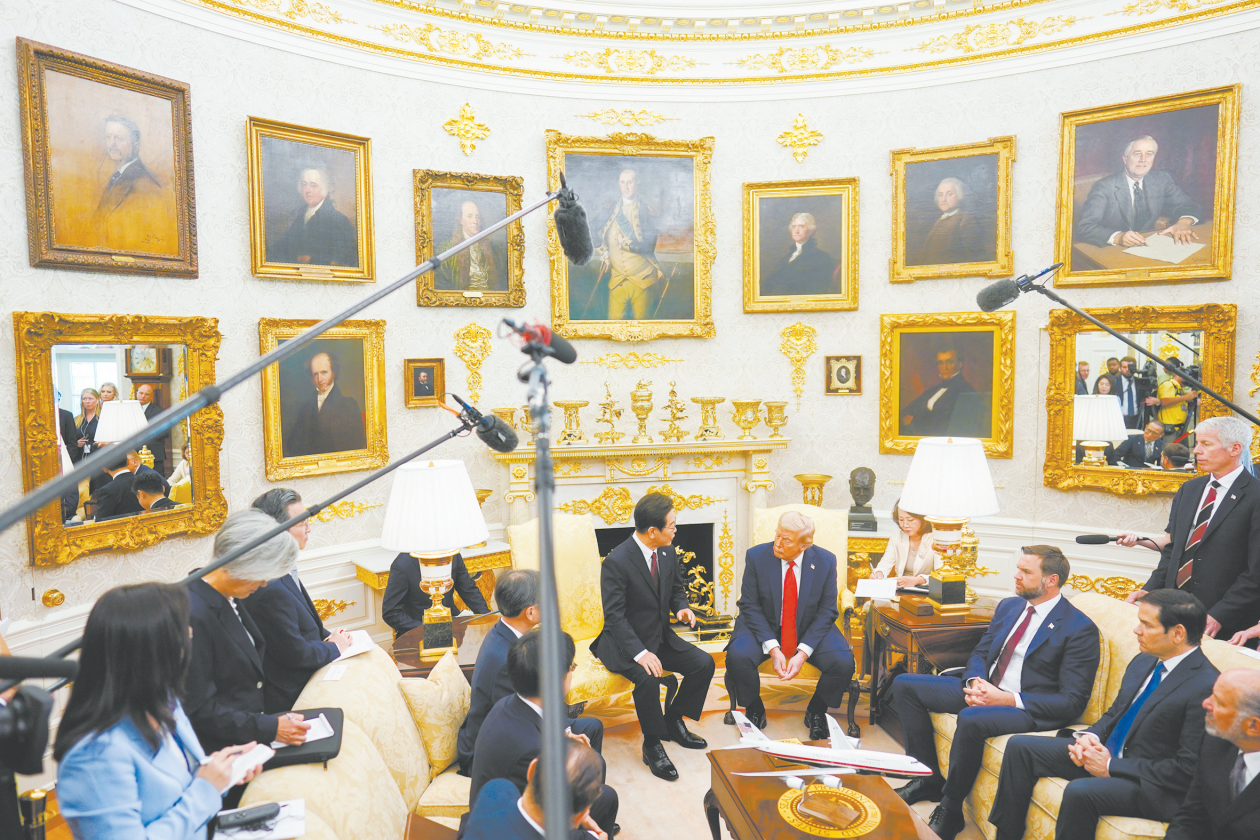
与美总统交流“积极友善”,未遭“椭圆形办公室伏击”,李在明离开白宫后韩国人松了口气
Huan Qiu Shi Bao· 2025-08-26 23:09
Group 1: Meeting Overview - The meeting between US President Trump and South Korean President Lee Jae-myung lasted approximately 140 minutes, including a 54-minute public session and a closed-door discussion [3][5] - The discussions covered various topics, including relations with North Korea, shipbuilding cooperation, and US-South Korea relations, with both leaders appearing to set a positive tone [1][6] - Despite the positive atmosphere, no joint statement or significant outcomes were announced, indicating unresolved issues in trade and security [1][6] Group 2: Key Issues Raised - Trump expressed a desire for South Korea to transfer ownership of some US military base lands, which has raised concerns in Seoul about potential implications for US-South Korea relations [3][6] - The meeting also touched on the renegotiation of the US-South Korea trade agreement, with Trump indicating openness to discussions but not guaranteeing any concessions [4][6] - Lee's comments about potential investments, such as the purchase of over 100 Boeing aircraft by Korean Air, highlight efforts to strengthen economic ties during the visit [4] Group 3: Domestic Reactions - The largest opposition party in South Korea criticized Lee's performance during the meeting, labeling it as "diplomatic disaster" and suggesting he was overly accommodating [5][6] - Observers noted that while the meeting appeared friendly, future negotiations on trade and security could be fraught with tension [6][7] - Lee's statements regarding a shift away from the "America-centric" approach in favor of a more balanced relationship with China have sparked debate about the feasibility of such a strategy [7][8]
万丰奥威:8月23日召开董事会会议
Mei Ri Jing Ji Xin Wen· 2025-08-25 13:33
Group 1 - The core viewpoint of the article is that Wan Feng Ao Wei (SZ 002085) held a board meeting on August 23, 2025, to discuss the revision of the "Board Meeting Rules" [1] - For the first half of 2025, the revenue composition of Wan Feng Ao Wei was 80.82% from automotive parts manufacturing and 19.18% from aircraft manufacturing [1] - As of the report date, Wan Feng Ao Wei has a market capitalization of 37.1 billion yuan [1] Group 2 - The A-share market has seen trading volumes exceed 2 trillion yuan for eight consecutive days, indicating strong market activity [1] - Major industry players are actively recruiting for the autumn season, with 25 job positions available, highlighting a demand for talent in the sector [1]

2025年8月PPI环比飙升0.9%现象解析:驱动因素、通胀影响与政策反应
Sou Hu Cai Jing· 2025-08-23 13:28
Overview - The Producer Price Index (PPI) in the U.S. surged by 0.9% month-on-month in August 2025, marking the largest single-month increase since June 2022, with a year-on-year increase of 3.3%, significantly exceeding market expectations. This indicates a potential resurgence of inflationary pressures in the U.S. economy, prompting a reassessment of the Federal Reserve's policy trajectory [1]. Key Drivers of PPI Surge - **Service Costs Surge**: Wholesale and retail sectors saw profit margins increase by 2% month-on-month in July, with machinery and equipment wholesale producers leading the PPI increase. Additionally, portfolio management costs surged by 5.8% to 6% due to asset price volatility, which is closely tied to financial market performance. Other service prices, such as air passenger services and cable/internet services, also rose significantly, contributing to higher service costs [1]. - **Tariff Policy Impact**: The tariffs imposed by the Trump administration are gradually taking effect, leading companies to pass on higher import costs to consumers. Despite a softening demand in the first half of the year, businesses are adjusting pricing strategies to offset cost pressures. Supply chain disruptions caused by tariff policies have further increased production costs [4][7]. - **Energy Price Volatility**: While prices for oil, coal, and other fuels decreased by 2% month-on-month, overall energy price fluctuations still impacted the PPI, particularly with diesel fuel-driven intermediate demand processing costs rising by 0.8% [4]. Impact of PPI Surge on Inflation - **Leading Indicator Role**: The PPI typically reflects price movement trends ahead of the Consumer Price Index (CPI). The sharp increase in July's PPI suggests that businesses may begin passing costs onto consumers, indicating potential upward pressure on future CPI [5]. - **Core PCE Forecast Adjustment**: Institutions like Goldman Sachs and UBS have adjusted their forecasts for the core Personal Consumption Expenditures (PCE) price index, predicting a year-on-year increase approaching 3.5% in the second half of 2025, although short-term forecasts have only slightly adjusted to 2.9%-3.0% [5]. Market Reactions and Investment Strategies - **Federal Reserve Policy Adjustments**: Following the PPI data release, market expectations for a 50 basis point rate cut by the Federal Reserve in September were largely eliminated, with a 93% probability still favoring a 25 basis point cut. However, uncertainty regarding future rate cuts has increased [11]. - **Market Sentiment**: The dollar index rose due to heightened inflation expectations, while prices for safe-haven assets like gold slightly declined, indicating a suppression of market risk appetite. The stock market experienced volatility, with major indices dropping after the PPI data release [11]. - **Investment Strategy Adjustments**: Analysts recommend that investors focus on the sustainability of high-volatility service items, such as portfolio management fees, rather than broad inflation pressures. Additionally, attention should be paid to the transmission effects of tariffs on commodity prices, especially in the latter half of the year and into the first half of the next year [11]. Conclusion and Future Outlook - The unexpected surge in the PPI in August 2025 highlights significant inflationary pressures driven by service cost increases, tariff impacts, and energy price volatility. This data suggests that inflation may rise again, despite relatively moderate CPI data. The market's expectations for Federal Reserve rate cuts have shifted, with a 25 basis point cut in September still likely [14]. - The future trajectory of inflation and Federal Reserve policy will be critical focal points for the market. If businesses continue to pass on tariff costs to consumers, core PCE may rise further, challenging the Federal Reserve's inflation targets. The Fed faces the challenge of balancing inflation control with avoiding an economic hard landing, potentially leading to a more tempered rate cut pace than the market anticipates [15].