人工智能

Search documents
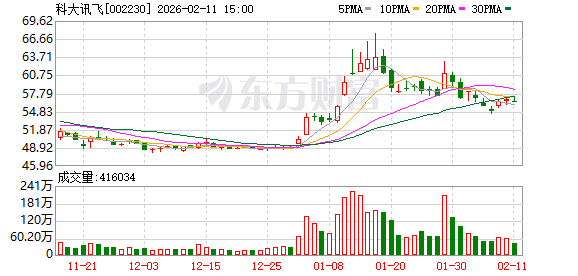
科大讯飞发布星火X2大模型
Zheng Quan Ri Bao· 2026-02-11 16:35
Core Viewpoint - The launch of the Xinghuo X2 model by iFlytek represents a significant advancement in the domestic large model industry, transitioning from "independent research and development" to "practical application" [2][3] Group 1: Product Development - The Xinghuo X2 model has achieved a comprehensive upgrade in general capabilities and will focus on high-specialty and high-experience scenarios such as education, healthcare, automotive, and intelligent agents [2] - Since the debut of the Xinghuo cognitive model V1.0 in 2023, iFlytek has maintained a rapid iteration pace, with each upgrade focusing on technological breakthroughs and scene adaptation [2] Group 2: Industry Impact - The continuous iteration and implementation of the Xinghuo X2 model are expected to not only upgrade iFlytek's own business but also lead the domestic large model industry towards "independence, practicality, and scalability" [3] - According to the "China Large Model Bidding Project Monitoring and Insight Report (2025)," iFlytek is projected to achieve the highest number and amount of bids in the industry for large model-related projects, with a bid amount reaching 2.316 billion yuan [3]


具身智能行业频传融资捷报
Zheng Quan Ri Bao· 2026-02-11 16:28
Group 1 - The core viewpoint is that the field of embodied intelligence is gaining significant attention from capital, indicating a shift from technology research to large-scale commercialization [1][2][3] - Major companies like DaXiao Robotics and StarSea Tech have recently completed financing rounds, highlighting the increasing investment activity in the embodied intelligence sector [1][2] - DaXiao Robotics plans to use the funds from its angel round to advance key areas of embodied intelligence, focusing on human-centered development and technology iteration [1] Group 2 - StarSea Tech announced a 1 billion yuan B round financing, with participation from major investors, indicating strong investor confidence in the sector [2] - The industry is entering a critical phase for large-scale implementation, with companies like DaXiao Robotics aiming to expand their commercial applications across various sectors [2] - Analysts predict that 2026 will mark a significant year for mass production in the robotics industry, as it transitions from a "technical vision" to "industrial reality" [2]
科技四巨头高额资本支出带来的三重启示
Zheng Quan Ri Bao· 2026-02-11 16:21
Core Viewpoint - The significant capital expenditure of $660 billion planned by Amazon, Google, Microsoft, and Meta for data centers and chip development by 2026 reflects a strategic commitment to the AI era and indicates a profound shift in industry development logic [1] Group 1: AI Valuation Logic - The valuation logic of AI is being restructured, shifting from "technological imagination" to "commercial realization" as capital expenditures rise [2] - Investors are increasingly focusing on the quality of growth rather than just the speed, emphasizing the need for tech giants to integrate AI capabilities into existing business models to offset high infrastructure costs [2] Group 2: Competitive Landscape - The $660 billion investment raises the entry barrier for general model development, concentrating the market among financially robust tech giants while not completely excluding smaller firms [3] - Smaller companies may find opportunities in vertical models, edge AI, and application layer innovations, suggesting a need for a collaborative ecosystem between leading platforms and niche players [3] Group 3: Energy Management - The exponential growth in AI computing power brings to light the physical constraints related to energy consumption and supply, which could limit the industry's expansion [4] - Companies are exploring new energy solutions like nuclear power and microgrids, indicating a proactive approach to potential energy constraints [4] Group 4: Long-term Implications - The high capital expenditure by tech giants is a necessary step towards the intelligent phase of the global tech industry, positively impacting related hardware supply chains [5] - The focus for the AI industry should be on developing a sustainable path that balances computational power and application, rather than merely chasing scale and parameters [5]
马斯克旗下xAI人事震荡
Bei Jing Shang Bao· 2026-02-11 16:21
2月11日,xAI联合创始人吉米·巴(Jimmy Ba)表示,他已于当地时间周二离开马斯克的这家初创公 司。 吉米·巴在离职声明中表示:"是时候重新校准我对大局的认知梯度了。2026年将会非同寻常,很可能是 关乎人类未来最忙碌(也最具决定性)的一年。"同时,他也向马斯克表达了感谢,提及自己有幸在xAI 初创阶段参与联合创立,珍惜这段非凡的共事旅程,并承诺未来将以团队挚友的身份与公司保持紧密联 系。 上个月,xAI联合创始人杨格(Greg Yang)也在社交媒体上宣布,因罹患莱姆病,他决定退出xAI的日 常事务,转为非正式顾问,把重心放在自己的健康上。在xAI和微软研究院工作期间,他一直致力于数 学基础与深度学习理论方面的研究,是Grok的主要架构师之一。马斯克在评论区回应,希望杨格尽快 好起来,并说道:"也许Grok能找到治疗方法。" 公开资料显示,xAI由马斯克于2023年联合其他11位创始人共同创立。截至目前,该公司12位联合创始 人中已有6人离职,其中5人是在过去一年内相继离场,核心团队遭遇严重人才流失。 AI行业的资本热潮,也使得人才流动频繁。据2025年行业数据,AI初创企业的平均融资额同比增长 3 ...
特斯拉副总裁等多名骨干离职、xAI核心专家吴宇怀也走了,“霸总”马斯克遭遇人才流失!员工:对他过度的工作要求感到疲惫
Sou Hu Cai Jing· 2026-02-11 16:09
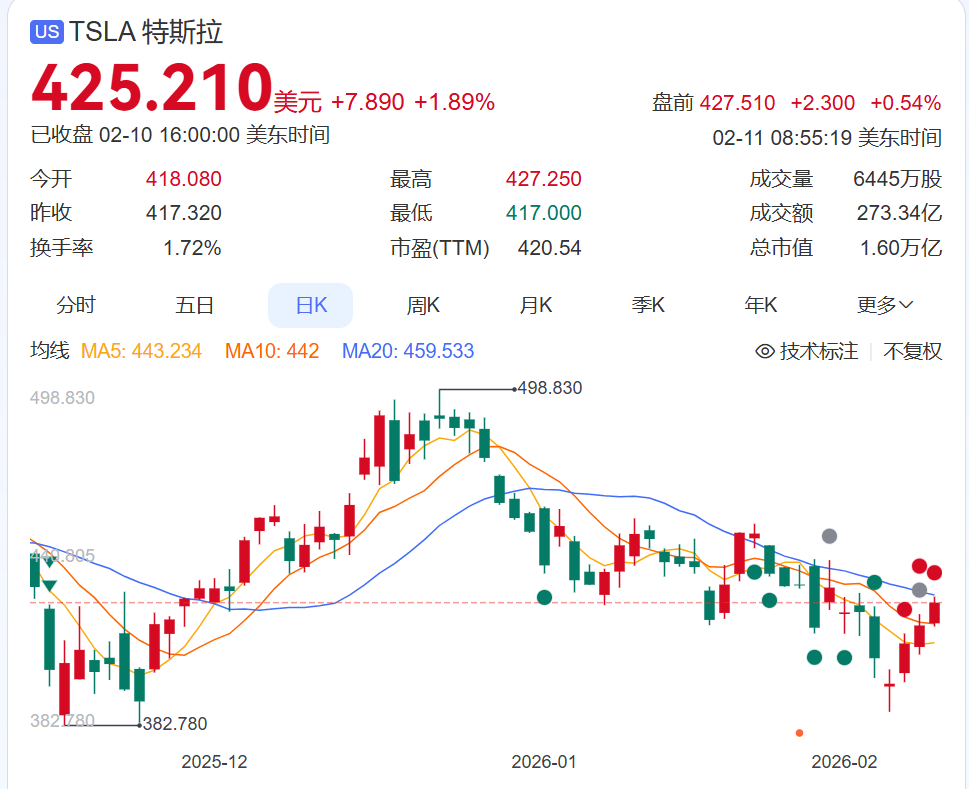
Group 1 - Tesla's Vice President, Rajiv Jaganathan, announced his departure after 13 years with the company, marking a continuation of the recent executive turnover at Tesla and xAI [1][2] - Jaganathan's role involved overseeing IT, AI infrastructure, business applications, and information security, and he faced challenges in automating customer service amid declining sales [2][4] - Other notable departures from Tesla include key executives responsible for North American and European operations, human resources, AI strategy, battery division, and software [2][3] Group 2 - xAI, another company under Elon Musk, has also experienced significant talent loss, with co-founder and core expert in mathematical reasoning, Yu Huai, announcing his departure [3] - Yu Huai's contributions were critical to the development of Grok-3, a model excelling in mathematical and scientific logic reasoning [3] - Other co-founders, including Igor Babuschkin and Kyle Kosic, have also left the company, indicating a broader trend of executive turnover within Musk's ventures [3] Group 3 - Employees at Tesla have expressed fatigue over Musk's demanding work expectations, with reports indicating that this has affected morale and talent retention [4] - Internal conflicts and heavy workloads are believed to be significant factors contributing to the recent executive departures [4][5] Group 4 - Tesla's sales declined by 9% in 2025, with a 16% drop in the fourth quarter, marking the first annual revenue decrease in the company's history [6][7] - The company was surpassed by BYD in global electric vehicle rankings, and analysts have significantly lowered their delivery forecasts for Tesla [6][7] - Despite these challenges, Musk has shifted focus to long-term projects like Robotaxi and humanoid robots, which has helped maintain Tesla's stock price relatively stable [6][7]

任泽平带你看前沿科技:2026研学计划
泽平宏观· 2026-02-11 16:07
以下文章来源于泽平宏观商学 ,作者泽平宏观商学 泽平宏观商学 . 前沿科技企业实战研学 读万卷书行万里路 2025 年 12 月 用心打造最有品质的实战研学。读万卷书,行万里路。把教室搬到世界上最优秀的企业, 请最优秀的企业家和科学家讲课。顺势而为,把握机遇。正心正念,坚持做长期正确的 事! 我们期待与更多的企业家朋友们携手同行,共赴 2026 实战研学之旅! 泽 ZEP 平 INGM 宏 ACR 观 O RE 商 SEAR 学 CH 1-6月日程安排 · 2月27日 北京 国内头部智驾科技企业 人形机器人 年研学安 型成 11月4日-11日 洛杉矶、拉斯维加斯、旧金山 CES、英伟达、特斯拉 谷歌、罗宾汉、playground 斯坦福大学、伯克利大学 3月27日-28日 苏州 追觅科技、魔法原子、灵猴机器人 闭门投研会-2026 Al 的中国力量(一) 3月29日 上海 长三角校友会 4月20日-21日 香港 2026 香港 Web3 嘉年华 复星财富、HashKey、港交所 5月22日-23日 1151 11:47:50 深圳 华为、新凯来、江波龙、莫界科技 闭门投研会—2026 Al 的中国力量(二) ...




城市24小时 | 经济第一大省 再添一个“万亿级”
Mei Ri Jing Ji Xin Wen· 2026-02-11 15:51
据南方日报消息,2月10日,南方日报记者从广东省工业和信息化厅独家获悉,2025年全省超高清视频产业集群营业收入达10803.06亿元,成为全省第十 个万亿级产业集群、全国首个该领域的万亿级产业集群,为广东现代化产业体系再添新支柱。 "缺芯少屏"曾严重制约我国电子信息产业发展,显示面板一度成为第四大进口商品。瞄准这一赛道,广东依托完备的制造业产业链和超大规模市场,自 2017年起在全国率先布局,全力推进超高清视频产业发展。 如今,广东已构建起覆盖内容生产、网络传输、终端呈现、核心器件、行业应用的全产业链体系,集聚相关企业超6万家,面板产能、电视产量、4K节目 供给量、5G基站数量均居全国第一。 解读:万亿级产业集群具有规模效应显著、创新能力突出、产业链韧性强劲等特点,既能通过上下游协同降低成本、提升效率,又能依托集群生态加速技 术迭代与成果转化,是一个地区经济发展竞争力的重要体现。 回顾过去三年,作为制造业大省,广东基本保持着一年一个万亿级产业集群的突破速度——2023年汽车产业成为广东第八个万亿级的产业集群;2024年广 东省新能源产业集群实现营业收入突破一万亿元;2025年全省超高清视频产业集群营业收入达 ...
对标Nano Banana Pro 阿里、字节同一天发布图像生成模型 AI生图将迎来规模化应用市场?
Mei Ri Jing Ji Xin Wen· 2026-02-11 15:51
Core Insights - Alibaba and ByteDance both launched new image generation models on February 10, targeting Google's Nano Banana Pro [1] - Alibaba's Qwen-Image-2.0 focuses on semantic understanding and practical editing, while ByteDance's Seedream 5.0 Preview emphasizes image retrieval and fine-tuning [1][3] - The advancements in AI image generation are expected to penetrate e-commerce and animation markets by 2025, with potential for large-scale applications by 2026 [1] Company Developments - Alibaba's Qwen-Image-2.0 supports 1K tokens for long text input and 2K high resolution, enhancing the ability to render complex instructions and generate professional presentations [3] - ByteDance's Seedream 5.0 Preview offers 2K and 4K resolution outputs, currently available for free on the Jiyun platform [3] - Both companies aim to unify image generation and editing into a single model, significantly improving performance [3] Industry Trends - AI image generation is increasingly being applied in e-commerce, with significant token consumption noted in digital human applications and AI-generated images [7] - The AI animation market is experiencing rapid growth, with AI technology reducing production costs by up to 90% and streamlining the creation process from 11 steps to 4 [5][6] - Despite the benefits, challenges remain in maintaining visual consistency and emotional expression in AI-generated content [5][6] Market Potential - The integration of AI image generation in e-commerce is seen as a mainstream application, with the potential to enhance efficiency for sellers by combining image editing and generation tasks [7] - The AI animation market is expected to see explosive growth, driven by the dual pressures of cost reduction and the need for improved content quality [6]


模型迭代驱动算力上行-重视文生视频的巨大变化
2026-02-11 15:40
Summary of Key Points from Conference Call Records Industry Overview - The conference call discusses the advancements in AI programming and the impact of large language models on the coding industry, particularly focusing on the performance of various AI models and their adoption rates in programming tasks [1][5][11]. Core Insights and Arguments - **AI Programming Penetration**: AI-generated code currently accounts for approximately 30% of daily submissions on GitHub, with expectations that by the end of 2026, AI will generate 80% of the code written by programmers [1][4][5]. - **Model Performance Improvements**: Recent iterations of models, particularly versions 4.5 and 4.6 from CloudOps, have shown significant improvements in handling long context windows, enhancing their performance in programming and various tests [2]. - **OpenClaw Project**: The OpenClaw intelligent agent project has rapidly gained traction since its launch, with 28% of model calls coming from OpenClaw applications, indicating a substantial increase in demand for computational power [1][6][7][8]. - **Token Call Growth**: The token call volume in the programming sector has increased 15-fold year-over-year, with expectations for a 3-4 times increase in 2026, driven by the efficiency of AI programming [11][12]. - **Cloud Capital Expenditure**: North American cloud providers are projected to increase capital expenditures significantly, with Q4 2026 spending expected to reach $127 billion, a 60% year-over-year increase [13]. Additional Important Content - **C-Station Video Generation Technology**: C-Station has made breakthroughs in multi-modal input for video generation, achieving high audio-video matching quality, which sets it apart from competitors [14]. - **Zhiyu Technology's Performance**: Zhiyu Technology has shown strong performance due to policy support and the success of its Pony Alpha product, with expectations for cloud revenue to surge as computational resources become more available [15][16]. - **Business Structure of Zhiyu Technology**: The company’s revenue is primarily derived from B-end services, with a projected increase in cloud service contributions from 15.5% in 2024 to 30-40% by 2025 [18]. - **Minimax vs. Zhiyu Technology**: Both companies possess strong foundational model capabilities, but Minimax has a more diverse product matrix focused on C-end applications, while Zhiyu primarily serves B-end clients [20]. This summary encapsulates the key points discussed in the conference call, highlighting the rapid advancements in AI programming, the performance of specific models, and the financial outlook for companies involved in this sector.
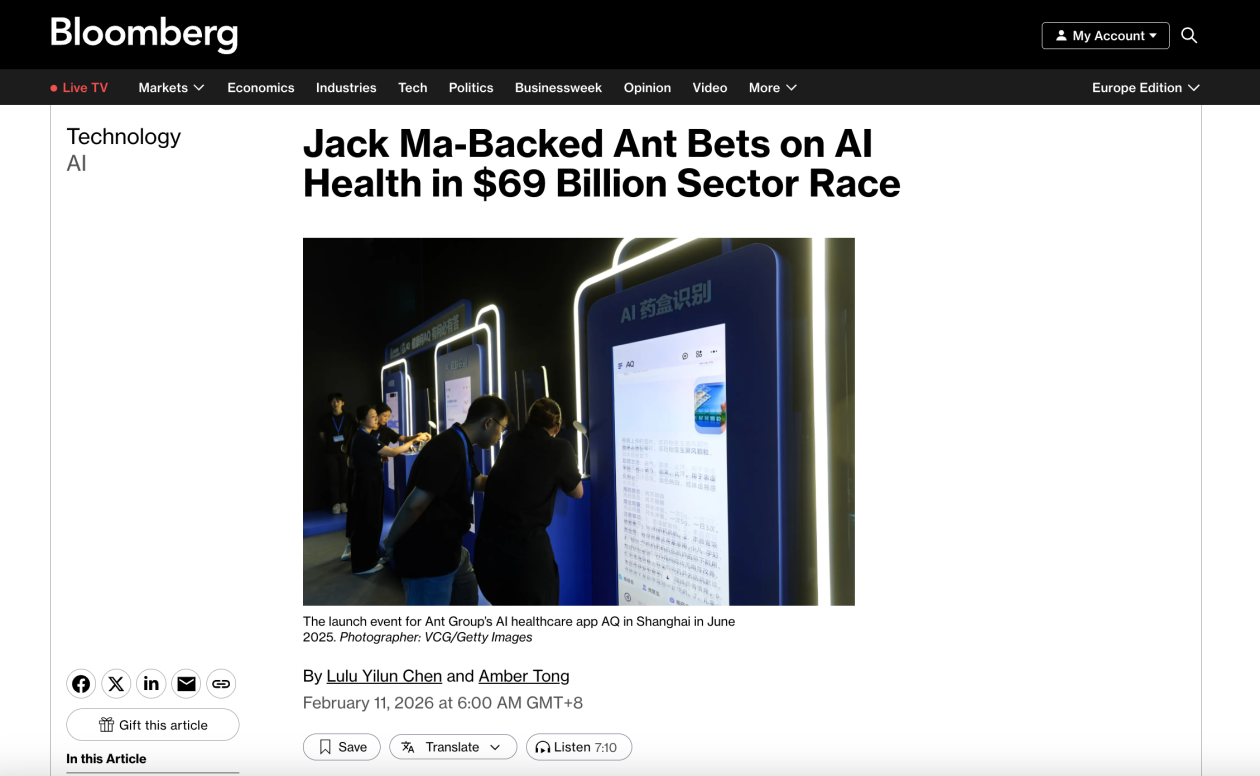
外媒关注“蚂蚁阿福”:医疗健康需求爆发,AI红利加速落地
Huan Qiu Wang· 2026-02-11 15:04
Core Insights - China is leveraging policy advantages, deep involvement of tech giants, and a large user base to showcase its technological edge in the global healthcare AI arena [1][3] - The rapid development of healthcare AI in China is significantly supported by strong policy guidance, which has provided a clear growth path for the industry [1][3] Industry Overview - By 2024, approximately 400 million people in China are expected to use digital healthcare services, with over 800 million users linking their basic medical insurance information to Alipay [3] - The Chinese online healthcare market is projected to reach 480 billion RMB (approximately 69 billion USD) by 2025 [3] Company Highlights - Ant Group's AI health assistant "Ant Aifu" has attracted over 1,000 licensed doctors to train its digital avatars, demonstrating significant engagement and utility [3] - In the past year, AI avatars managed over 27 million inquiries, with "Ant Aifu" currently having around 30 million active users and processing approximately 10 million health consultations daily [3] - Alibaba Health is expected to achieve over 60% profit growth in 2024, indicating the commercial viability of the "AI + healthcare" model [3] Competitive Landscape - Despite its leading position, the healthcare AI sector in China faces intense competition from established companies like Tencent, DeepSeek, and Ping An Medical Technology [4] - Continuous innovation is essential for maintaining competitive advantages in this rapidly evolving market [4]