
低空经济

Search documents
低空经济领域“利好”消息不断
Zheng Quan Shi Bao· 2025-08-03 08:20
Core Insights - China's self-developed electric vertical takeoff and landing (eVTOL) aircraft has successfully completed its first material transport flight to an offshore oil platform, marking a significant advancement in low-altitude logistics applications [1][3] - The Shenzhen Development and Reform Commission has announced a plan to establish 10 low-altitude economic industrial parks and over 1,200 low-altitude takeoff and landing points by the end of 2026, aiming to enhance the low-altitude economy [1][5][6] Group 1: Technological Breakthroughs - The 2-ton eVTOL aircraft, named "Kairiou," successfully transported fresh fruits and emergency medical supplies from a land takeoff point in Shenzhen to an offshore oil platform 150 kilometers away in 58 minutes [3] - The eVTOL technology offers advantages over traditional transportation methods, including lower operational costs, faster response times, and environmental benefits [3] Group 2: Policy and Infrastructure Development - The Shenzhen plan includes the construction of 10 low-altitude economic industrial parks and 2 specialized industrial parks, with a focus on technology research, production, and marketing [5][6] - By 2026, the plan aims to establish over 1,200 low-altitude takeoff and landing points and open more than 1,000 low-altitude commercial flight routes [6][7] Group 3: Market Opportunities and Investments - Recent developments in the low-altitude economy include a $1 billion order from UAE-based Autocraft for 350 eVTOL aircraft, indicating strong international demand [5][7] - The average price per eVTOL aircraft is approximately $2.857 million, suggesting significant market potential compared to other sectors like humanoid robotics [8]
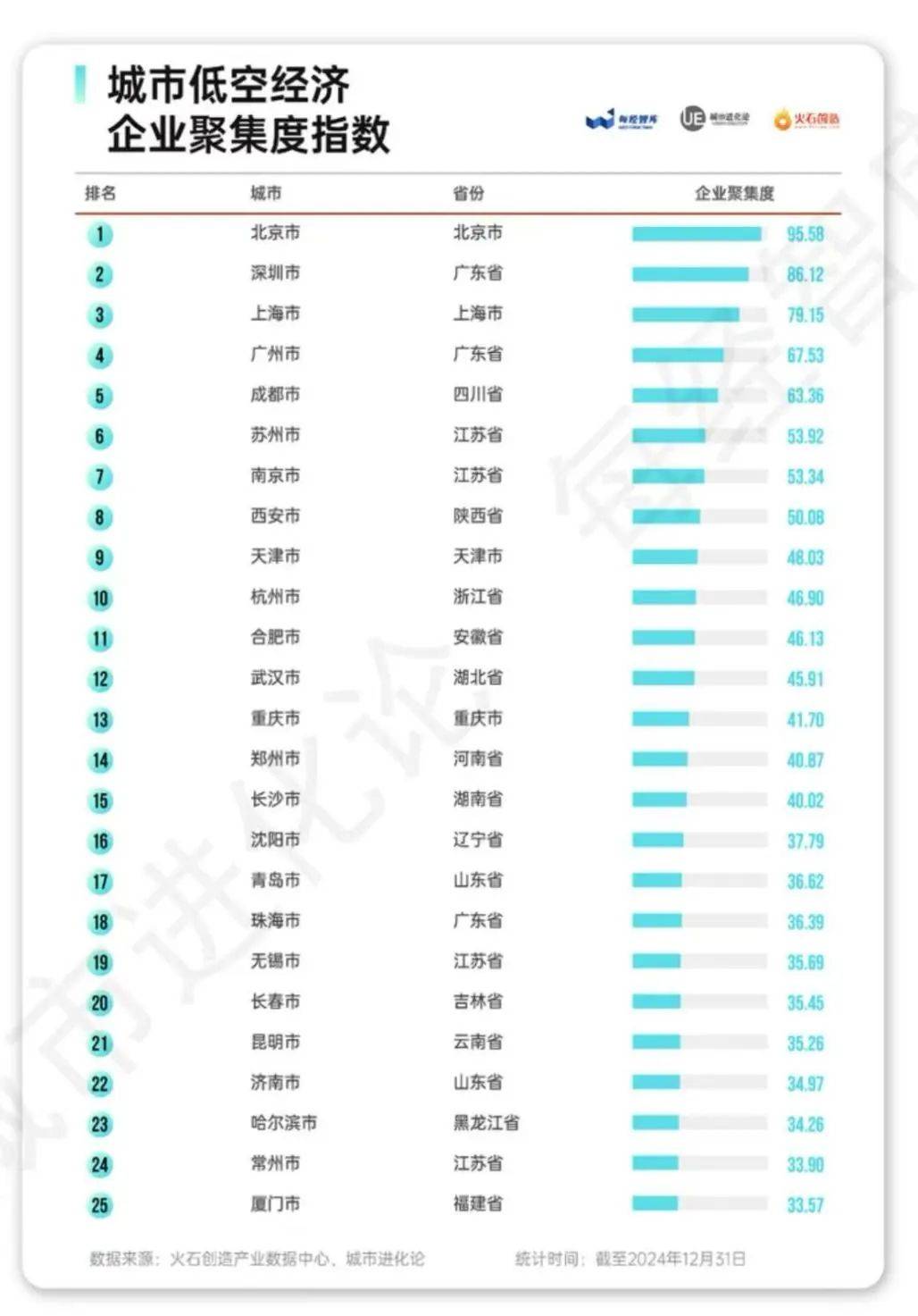
1.47万家低空经济企业,哪座城市聚集度最高
Hu Xiu· 2025-08-03 07:32
Core Insights - The article discusses the development of low-altitude economy infrastructure in cities, particularly focusing on Shenzhen's initiative to become a global leader in this sector [2][4] - It highlights the interconnectedness of various components of the low-altitude economy, including infrastructure, operational services, flight assurance, and manufacturing [3][4] - The report identifies cities with the highest concentration of low-altitude economy enterprises, emphasizing the importance of enterprise aggregation for industry health and competitiveness [4][5] Enterprise Aggregation - As of the end of 2024, the number of low-altitude economy enterprises in China reached 14,707, marking a year-on-year growth of 19.8%, significantly higher than the previous three-year average of 9.1% [7] - The top cities for enterprise aggregation in the low-altitude economy are Beijing and Shenzhen, with scores of 95.58 and 86.12 respectively, leading in overall scale and key enterprise metrics [8][9] - The report ranks cities based on their enterprise aggregation index, with Beijing and Shenzhen at the top, followed by Shanghai, Guangzhou, and Chengdu [9][12] Manufacturing and eVTOL Competition - The low-altitude economy market in China is projected to reach 1.5 trillion yuan by 2025 and 3.5 trillion yuan by 2035, with manufacturing and operational services contributing the most [18] - Major cities like Beijing, Shenzhen, and Shanghai have the highest number of low-altitude aircraft design and manufacturing enterprises, indicating a strong manufacturing base [19][20] - The eVTOL sector is highlighted as a key area of competition, with cities like Shanghai and Guangzhou leading in the number of eVTOL enterprises, showcasing their innovative capabilities [20][23][24] Innovation Aggregation - The innovation aggregation index ranks Beijing as the top city with a score of 100, followed by Shenzhen and Guangzhou, indicating a strong focus on innovation within the low-altitude economy [21][22] - Cities such as Shanghai and Guangzhou are noted for their leading eVTOL companies, which contribute significantly to their competitive edge in the low-altitude economy [23][24] - The report emphasizes the need for cities to cultivate leading enterprises and enhance their low-altitude economic ecosystems to compete effectively in this emerging market [17]


中国工程科技发展战略福建研究院咨询研究项目在榕启动
Jing Ji Guan Cha Bao· 2025-08-03 02:30
低空视界 据悉,该项目是福建研究院2025年重大咨询项目,由杨宏院士团队牵头,陈志杰、向锦武、张久俊、陈 鲸等4位院士和48位专家参与,将围绕福建省低空航空器研发制造、安全保障体系构建、创新应用场景 建设运营等,研究提出福建省低空经济全产业链发展路径及配套政策建议。 免责声明:本文观点仅代表作者本人,供参考、交流,不构成任何建议。 经济观察网 据福建日报,日前,中国工程科技发展战略福建研究院咨询研究项目"福建省低空经济产业 与运营模式研究"启动会在福州召开。 ...

昆山打造新千亿级产业集群
Su Zhou Ri Bao· 2025-08-02 23:11
Core Insights - The conference held on August 2, 2023, in Kunshan focused on the development of the embodied intelligence industry, with 56 projects signed, totaling an investment of 15.1 billion yuan, aiming for a scale of over 100 billion yuan by 2027 [1][9] - Kunshan is positioning itself as a hub for "Industrial AI," emphasizing collaboration and innovation in the field of embodied intelligence, which integrates AI algorithms with hardware [1][2] Investment and Development Plans - The "Action Plan for Promoting the Innovation and Development of the Embodied Intelligence Industry in Kunshan (2025-2027)" was officially released, outlining strategic goals for the industry [1][9] - The plan includes ten major industrial actions focusing on AI servers, intelligent robots, smart connected vehicles, and low-altitude aircraft [9] Technological Innovations - Kunshan is showcasing advanced technologies such as a 3D printing robot capable of voice interaction and visual detection, aimed at family scenarios [2] - The integration of short-distance communication technology is being explored to allow robots to adapt flexibly to various scenarios, akin to "Transformers" [2] Industry Ecosystem - Kunshan has established a complete industrial ecosystem for robotics, including R&D, core components, manufacturing, system integration, and application [5][6] - The city has built a strong industrial base with a focus on robotics since 2008, attracting major companies and creating specialized industrial parks [5][6] Collaborative Efforts - The conference highlighted the establishment of various collaborative platforms, including a humanoid robot application alliance and a drone test flight base, to enhance innovation and cooperation [7] - The Kunshan government is actively promoting partnerships between enterprises and research institutions to foster a collaborative innovation environment [6][7] Talent and Policy Support - Kunshan is implementing talent support policies, including housing subsidies for graduates, to attract skilled professionals to the region [9] - The city aims to create a comprehensive service system for talent, covering internship, employment, and entrepreneurial support [9] Future Outlook - Experts believe that Kunshan has a solid foundation for the development of embodied intelligence, leveraging its rich application scenarios and technological advancements [8] - The city is focused on enhancing its competitive edge in the rapidly evolving embodied intelligence sector, aiming to transform from a manufacturing hub to a center for intelligent ecosystem development [10]
华创交运低空经济周报(第48期):国家发改委明确下半年重点工作包括推进低空经济高质量发展-20250802
Huachuang Securities· 2025-08-02 14:47
行业研究 证 券 研 究 报 告 华创交运|低空经济周报(第 48 期) 国家发改委明确下半年重点工作包括推进低 推荐(维持) 空经济高质量发展 交通运输 2025 年 08 月 02 日 华创证券研究所 证券分析师:吴晨玥 证券分析师:吴一凡 邮箱:wuchenyue@hcyjs.com 执业编号:S0360523070001 邮箱:wuyifan@hcyjs.com 执业编号:S0360516090002 证券分析师:霍鹏浩 证券分析师:梁婉怡 邮箱:huopenghao@hcyjs.com 执业编号:S0360524030001 邮箱:liangwanyi@hcyjs.com 执业编号:S0360523080001 邮箱:liqingying@hcyjs.com 联系人:刘邢雨 邮箱:liuxingyu@hcyjs.com 行业基本数据 | | | 占比% | | --- | --- | --- | | 股票家数(只) | 121 | 0.02 | | 总市值(亿元) | 33,968.03 | 3.12 | | 流通市值(亿元) | 29,082.29 | 3.39 | 相对指数表现 | % | 1M ...
拓展低空基建重在场景开放
2 1 Shi Ji Jing Ji Bao Dao· 2025-08-02 01:18
《深圳市低空基础设施高质量建设方案(2024—2026年)》(下称"方案")近日发布。这份方案明确提 出,深圳全力打造"全球低空经济第一城"。其突出亮点是,跳出了传统基建"修路架桥"的单一思维,转 而构建"技术+场景+生态"三位一体的立体化体系,对全国城市竞逐低空经济新赛道具有重要借鉴价 值。 具体来看,方案提出的"四大中心"定位颇具前瞻性:全球总部研发中心瞄准核心技术突破,高端智造中 心强化产业链自主可控,全场景示范验证中心解决从实验室到市场的"最后一公里",一站式解决方案中 心则整合资源降低企业参与门槛。这种布局既避免了低空经济陷入"有设备无应用"的空转,又通过场景 开放倒逼技术创新,形成"研发—制造—应用"的闭环。 另一亮点是"低空+城市治理"的深度融合。方案中明确提到的城市治理起降点,将低空经济从物流配 送、旅游观光等消费领域,拓展到应急救援、环境监测、交通管理等公共服务场景。比如,用无人机替 代人工巡查高压线路,或是在拥堵时段通过空中通道运输急救药品,这些应用不仅提升了城市运行效 率,更让低空经济从"可选消费"升级为"城市刚需",为产业可持续性提供了底层支撑。 方案在标准建设上的布局也值得关注。低空 ...
高德地图副总裁董振宁:未来5—10年,低空经济有希望实现千亿规模
Tai Mei Ti A P P· 2025-08-02 00:21
Core Viewpoint - Gaode is transitioning from a ground navigation company to a comprehensive platform for the low-altitude economy, initiating a collaboration with Longgang District in Shenzhen to develop a low-altitude economic demonstration zone called "Aerial Gaode" [2][5]. Group 1: Project Overview - The "Aerial Gaode" project includes modules such as low-altitude three-dimensional digital foundation, low-altitude support, low-altitude services, and airspace management [2]. - Gaode has developed a fully automated, high-quality spatiotemporal reconstruction platform using implicit spatial modeling and AI deep learning technology, significantly reducing data generation costs and enabling daily updates of comprehensive data [2]. Group 2: Operational Efficiency - With the accurate digital foundation, the difficulty of developing operational systems for low-altitude companies is greatly reduced, allowing for rapid approval of flight route planning and airspace management [2][3]. - In the open low-altitude airspace, Gaode provides airspace planning and intelligent forecasting to support management departments in making more informed decisions [3]. Group 3: Service Integration - Gaode aims to create a low-altitude economic aggregation platform similar to its ride-hailing model, integrating data services, user services, and industry services across the entire low-altitude activity chain [3][4]. - The "One Network for Unified Flight" system has been developed to connect demand, supply, and operation ends, supporting urban governance applications such as city inspections and low-altitude emergency services [3]. Group 4: Market Potential - The low-altitude industry is projected to reach a business scale of hundreds of billions in the next 5-10 years, with Gaode positioning Shenzhen as a central hub for low-altitude capabilities in China [5]. - The Longgang "Aerial Gaode" project has established a 900 million yuan industrial fund and attracted over 10 low-altitude ecological enterprises for collaborative technology development [5].
江苏在推动科技创新和产业创新融合上“打头阵”
Jiang Nan Shi Bao· 2025-08-01 13:02
Group 1 - The "Future" deep-sea green intelligent technology test ship has been successfully delivered, led by the Taihu Laboratory in Wuxi, Jiangsu [1] - Jiangsu's "1650" industrial system has shown significant results, with 14 clusters selected as national advanced manufacturing clusters, accounting for nearly 1/5 of the national total [1] - Jiangsu ranked second in China's regional innovation capability evaluation last year, with Suzhou and Nanjing listed among the top 10 global innovation clusters [1] Group 2 - Jiangsu has organized 250 key projects in the past two years, achieving notable results such as the world's first 8-inch silicon-based gallium nitride production line [2] - The provincial government established a special fund for basic research amounting to 2.48 billion yuan last year, increasing to 2.68 billion yuan this year [2] - Major original breakthroughs include the first observation of a graviton mode in condensed matter and the discovery of the oldest multicellular eukaryotic fossil [2] Group 3 - Jiangsu has over 57,000 high-tech enterprises, with unicorn and potential unicorn companies accounting for 13% and 23% of the national total, respectively [3] - The province has 89,000 technology-based small and medium-sized enterprises and 114 companies listed on the Sci-Tech Innovation Board, both ranking first in the country [3] - 85% of R&D investment comes from enterprises, with nearly 80% of high-level innovation and entrepreneurship talent concentrated in companies [3] Group 4 - Jiangsu has established a technology transfer platform, hosting over 2,000 innovation results and 2,300 technology demands last year [4] - The province was approved to build the first regional technology transfer center in universities, with continuous collaboration with major scientific institutions [4] - The total value of technology contracts in Jiangsu reached nearly 530 billion yuan last year [4] Group 5 - Jiangsu promotes the coordinated innovation development of high-tech zones and higher education institutions, implementing organized research and transformation [5] - The province has 18 national high-tech zones, the highest number in the country, contributing significantly to the national economy and exports [5] - Jiangsu has been approved for 19 national innovative industrial clusters, with 9 high-tech zones entering the national top 50 [5] Group 6 - Jiangsu is advancing reforms in the education and technology talent system, including the modification of regulations for technology transfer [6] - The province supports the establishment of over 400 joint innovation centers and has achieved over 7,500 technology transfer results [6] - Jiangsu ranked first in the number of participants selected for national major talent projects in the technology sector last year [6] Group 7 - Jiangsu is planning a talent evaluation system for the low-altitude economy, which is becoming a new engine for high-quality economic development [7] - The province is setting new professional qualifications for technical personnel in the low-altitude economy industry chain [7] - Pilot programs for the low-altitude economy are being conducted in Suzhou and Taicang [7]
从长三角“半年报”看区域发展新动态
Xin Hua She· 2025-08-01 12:58
Economic Performance - The GDP of Shanghai reached 26,222.15 billion yuan, with a year-on-year growth of 5.1% in the first half of the year [1] - Jiangsu's GDP was 66,967.8 billion yuan, growing by 5.7% year-on-year [1] - Zhejiang's GDP stood at 45,004 billion yuan, with a growth rate of 5.8% [1] - Anhui's GDP reached 25,723 billion yuan, showing a year-on-year increase of 5.6% [1] - The total economic output of the four regions exceeded 160,000 billion yuan, with all showing growth rates above 5% [1] Emerging Industries - Strategic emerging industries are rapidly developing, with Shanghai's leading industries' manufacturing output increasing by 9.1% year-on-year [1] - Jiangsu's high-tech industry accounted for 51.8% of the total industrial output [1] - Zhejiang's revenue from computing services, data services, algorithm models, and smart terminals maintained double-digit growth [1] - Anhui's computer, communication, and other electronic equipment manufacturing grew by 27.8% [1] Trade and Logistics - The import and export scale of the Yangtze River Delta reached 81.6 billion yuan, with a year-on-year growth of 5.4%, accounting for 37.4% of the national total [2] - The logistics efficiency has significantly improved, with the time for cargo transport reduced from one week to as little as one day due to new rail-sea intermodal services [3] - A digital "trade chain" utilizing blockchain technology has been established, supporting over 300,000 enterprises in enhancing trade efficiency [3] Consumer Market - The policy of replacing old consumer goods has shown positive effects, with retail sales of energy-efficient home appliances in Shanghai increasing by 63.9% [4] - In Jiangsu, retail sales of old-for-new related products grew by 9.4% year-on-year [4] - In Zhejiang, retail sales of various consumer electronics and appliances saw year-on-year growth rates exceeding 60% [4]
2025年中期通信行业投资策略报告:算力引擎强驱动,星地空网共发展-20250801
Wanlian Securities· 2025-08-01 11:08
Core Insights - The communication industry has significantly outperformed the Shanghai and Shenzhen 300 indices in the first seven months of 2025, ranking third among 31 primary industries [1][12] - The valuation of the communication industry as of July 2025 is comparable to the beginning of the year but remains at a higher level than the historical three-year average [1][15] - The industry is experiencing stable operations in the first half of 2025, with emerging businesses playing a prominent role in driving growth [1][17] - The report emphasizes investment opportunities in the AI computing industry chain and the integration of space and ground networks [1][30] Investment Themes AI Computing Industry Chain - Major domestic and international companies are increasing capital expenditures, indicating a global arms race in computing power [2][37] - The demand for AI infrastructure is accelerating, with liquid cooling technology becoming mainstream in data center construction [2][37] - The demand for optical modules is transitioning to higher speeds, while high-speed copper connections still have market demand [2][37] Space and Ground Integration - The low-altitude economy is optimizing infrastructure, with leading eVTOL companies obtaining necessary certifications for commercial operations [6][30] - China's satellite internet industry is continuously launching low-orbit satellites, with advancements in mobile direct satellite connectivity accelerating commercialization [6][30] Industry Performance - The communication industry index has shown a cumulative increase of 21.16% from January to July 2025, outperforming both the Shanghai and Shenzhen 300 indices [12][14] - Emerging business revenues, including cloud computing and big data, have increased significantly, contributing to overall revenue growth in the telecommunications sector [19][25] - The number of fixed broadband users is steadily increasing, with a notable rise in users with gigabit access speeds [20][27] Policy and Future Outlook - The government report emphasizes the importance of nurturing emerging and future industries, including commercial aerospace and low-altitude economies [30][31] - The Ministry of Industry and Information Technology is working on standardizing emerging and future industries, which will support the development of the communication sector [32][34] - The report suggests that investment opportunities should focus on AI computing infrastructure and the integration of space and ground networks, driven by policy support and technological advancements [7][30]