软件

Search documents
不是word,也不是pdf!商务部公告附件首次改为wps格式冲上热搜
Mei Ri Jing Ji Xin Wen· 2025-10-13 07:04
10月12日,"商务部公告附件首次改为wps格式"词条登上微博热搜。 10月9日,商务部发布2025年第61号公告,对含有中国成分的部分境外稀土相关物项实施出口管制。 新规明确,军事用途出口原则上不予许可。 值得注意的是,除管制规则外,公告附件采用wps格式,申请文件须以中文提交两大细节引发热议。据悉,此前公告附件都是word或pdf格式。 最终用途为研发、生产14纳米及以下逻辑芯片或者256层及以上存储芯片,以及制造上述制程半导体的生产设备、测试设备和材料,或者研发具有潜在军 事用途的人工智能的出口申请,逐案审批。 其中部分条款自12月1日起实施,原产于中国的物项即日起执行。 金山软件始创于1988年,是国内最早的互联网软件企业之一。历经30余载,目前主要涉及金山办公、西山居、金山世游、金山云等业务线。金山办公主要 业务涉及WPS Office办公软件产品及服务的设计研发及销售推广;西山居及金山世游从事游戏研发及运营;金山云提供安全、可靠、稳定、高品质的云计 算服务。 金山办公于2019年11月18日在上海证券交易所上市。 8月20日晚,金山办公发布2025年半年报。上半年金山办公实现营业收入26.57亿元 ...


商务部公文采用WPS格式引爆市场!金山软件一度暴涨18%
Mei Ri Jing Ji Xin Wen· 2025-10-13 06:52
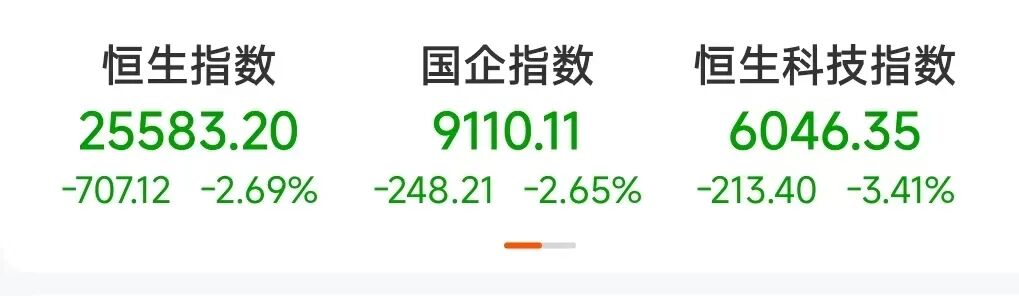
Market Overview - The Hong Kong stock market experienced a decline, with the Hang Seng Index dropping by 2.69% and the Hang Seng Tech Index falling by 3.41% [1] - Internet stocks collectively weakened, while the software and semiconductor sectors showed some localized activity [1] Company Performance - Kingsoft Software saw a significant increase, with its stock price rising over 18% at one point and closing up by 11.77% at HKD 35.9 per share [2] - Kingsoft Office also experienced a rise, with its stock price increasing by 7.19% to CNY 318.35 per share [5] Financial Highlights - Kingsoft Office reported a revenue of CNY 2.657 billion for the first half of 2025, marking a year-on-year growth of 10.12% [8] - The net profit attributable to shareholders was CNY 747 million, reflecting a year-on-year increase of 3.57% [8] - The number of monthly active devices for WPS Office reached 651 million, an increase of 8.56% year-on-year, achieving a historical high [8] Product and Innovation - Kingsoft Office launched the WPS 365 open ecosystem, which consists of capability, integration, and application layers, boasting over 8,000 partners and more than 60,000 applications [10] - The WPS 365 ecosystem aims to enhance collaborative office experiences and has achieved compatibility with the Model Context Protocol (MCP) [10] - The ecosystem currently provides APIs for various business scenarios, including cloud documents and calendars, with plans for future expansion [10] Regulatory Impact - The Ministry of Commerce announced new export controls on certain overseas rare earth-related items with Chinese components, emphasizing military use restrictions [7] - The announcement's attachment was notably formatted in WPS, highlighting the government's push for self-reliance in key technologies and information security [7]

什么是关键软件?美国为何对此出口管制?科技当自立!信创ETF基金一度涨超3%,大数据产业ETF逆市活跃
Xin Lang Ji Jin· 2025-10-13 06:07
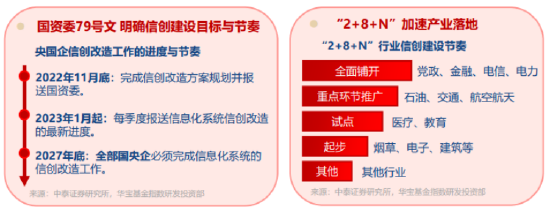
Group 1 - The U.S. President announced an additional 100% tariff on Chinese imports starting November 1, along with export controls on "critical software" [1] - Critical software includes operating systems, databases, and various industrial software, highlighting its strategic importance in national security and economic stability [1] - The move is expected to accelerate the domestic production of industrial and foundational software in China, as the country seeks to enhance its self-sufficiency in technology [1][2] Group 2 - The "信创" (Xinchuang) industry is transitioning from policy-driven to a dual-driven approach of policy and market, with significant growth expected in the coming years [2] - By 2026, the market size of the 信创 industry is projected to exceed 2.6 trillion yuan, with growth rates of 17.84% and 26.82% anticipated for 2025 and 2026, respectively [2] - Government procurement standards are being refined to support the replacement of foreign technology with domestic alternatives [2] Group 3 - The domestic software sector is experiencing active trading, with the 信创 ETF fund showing a price increase of over 3.1% at one point, indicating strong buying interest [4] - Key stocks in the sector, such as 华大九天 and 麒麟信安, have seen significant price increases, reflecting investor confidence in the domestic software market [4] - The 大数据产业 ETF is also showing positive performance, with stocks like 中国软件 and 中国长城 experiencing notable gains [6] Group 4 - The 信创 ETF fund tracks the core segments of the 信创 industry, which includes foundational hardware, software, and information security, and is characterized by high growth potential [8] - The current geopolitical climate and the push for self-sufficiency in technology are driving the demand for domestic solutions in the 信创 sector [8] - The 大数据产业 ETF focuses on data centers and cloud computing, with a strong emphasis on companies that are leading in the technology self-reliance movement [9]
刚刚,A股突变!发生了什么?
天天基金网· 2025-10-13 05:15
Market Overview - The A-share market opened lower but rebounded, with the Shanghai Composite Index closing at 3846.25 points, down 1.3% [3] - The total market turnover was 1.59 trillion yuan, slightly lower than the previous day, with 4545 stocks declining and 840 stocks rising [5] Sector Performance - The aerospace, banking, shipping, and environmental protection sectors showed gains, while sectors like automotive, communication, and media struggled [5] - The banking sector led the gains among major industries, with Shanghai Pudong Development Bank rising over 4% and Nanjing Bank up over 3% [10][11] Concept Stocks - Rare earth, photolithography, and semiconductor concept stocks performed well, with rare earth stocks rising by 7.77% and photolithography stocks by 6.10% [6] - Domestic software stocks surged, with Rongji Software and China Software hitting the daily limit, and Chengmai Technology and Kingsoft Office also seeing significant increases [15] Notable Stocks - WuXi Biologics fell over 9%, while WuXi AppTec and Sunny Optical Technology dropped more than 8%, leading the decline in the Hang Seng Index [9] - Environmental stocks like Huicheng Environmental Protection and Huahong Technology saw significant gains, with Huicheng Environmental Protection hitting the daily limit [12] Recent Developments - The Ministry of Commerce announced new export controls on certain rare earth-related items, which has sparked discussions in the market [17] - The upcoming Bay Area Semiconductor Industry Ecological Expo is expected to attract attention, with Shenzhen's semiconductor companies participating [19]







金山软件大涨
Sou Hu Cai Jing· 2025-10-13 05:13
Group 1 - Kingsoft Software (03888.HK) saw a significant stock price increase, rising over 18% during trading on October 13, and closing at 10.02% higher at HKD 35.34 per share [2] - The Ministry of Commerce announced export controls on certain foreign rare earth-related items containing Chinese components, with the announcement's attachment now requiring WPS format, which is developed by Kingsoft Software [3] - Kingsoft Software reported a revenue of approximately CNY 4.645 billion for the first half of the year, a year-on-year increase of 0.75%, and a net profit attributable to shareholders of CNY 816 million, up 20.41% year-on-year [3] Group 2 - Other Hong Kong software stocks also experienced gains, with China Software International (00354.HK) up 6.1%, Inspur Digital Enterprise (00596.HK) up 5.07%, and Kingdee International (00268.HK) up 1.04% [4] - Huachuang Securities noted that the demand for domestic software is accelerating due to the push for self-reliance in technology, with several procurement standards from the Ministry of Finance in 2024 emphasizing the need for self-controllable solutions [4] - The domestic software industry's performance is gradually improving, indicating a potential turning point for high-quality development in the sector [4]

Windows 10 明起“停服” 全球数亿设备面临安全危机
Xi Niu Cai Jing· 2025-10-13 04:48
由于一些旧电脑并不符合运行新系统的硬件要求,这些用户要不选择更换设备,要不就要花30美元或1000个微软奖励积分来注册微软的扩展安全更新程序, 以降低恶意软件攻击和网络安全威胁的风险。 10月13日,据媒体报道,微软将于10月14日起,停止对Windows 10系统提供安全更新和技术支持,这意味着大量用户的电脑可能更容易遭到网络攻击。 第三方数据显示,至少有约20%的Windows 10设备因硬件限制无法升级至Windows 11,将有超1亿台设备将沦为"安全孤岛"。 根据第三方数据,截至2025年7月,Windows 10仍占据全球桌面操作系统约45%的市场份额,全球目前仍有超5亿台活跃设备运行该系统,其中大量设备部署 于金融、医疗、制造等关键行业。一旦停服,这些设备将面临漏洞无补丁、攻击面扩大、合规风险上升等多重挑战。 此前微软曾表示,安装Windows 10系统的设备还可继续运行,但将不再接受定期的安全更新,同时部分应用程序的功能可能会减弱,并建议用户尽快升级 到Windows 11系统。 ...


600745开盘跌停!多重利好催化,这一领域受益,融资客大幅加仓名单出炉
Zheng Quan Shi Bao· 2025-10-13 04:45
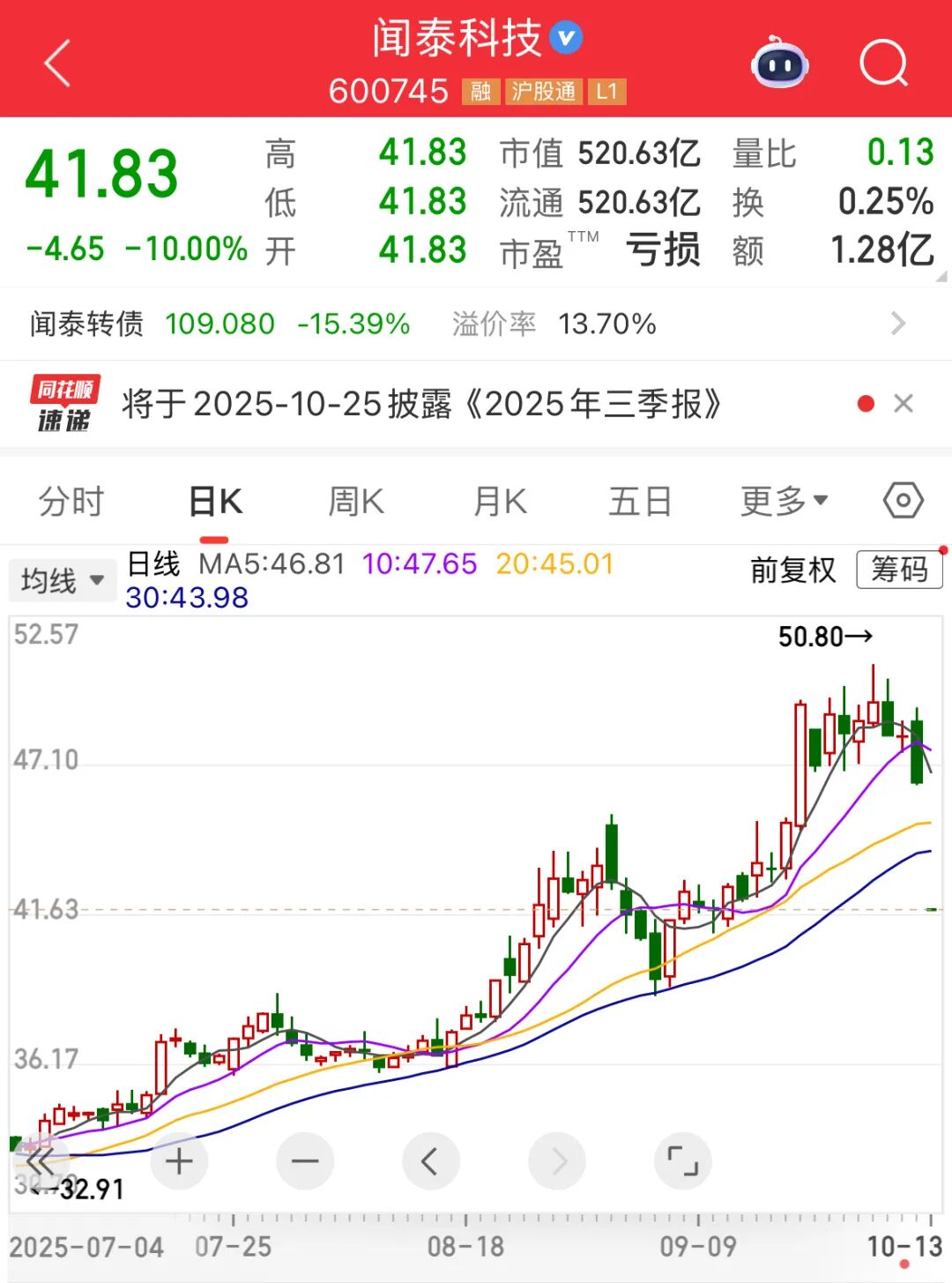
Market Overview - The three major stock indices opened lower but rebounded, with declines narrowing. The rare earth permanent magnet sector saw significant gains, with stocks like Galaxy Magnet and Baosteel rising to their daily limit [1] - The semiconductor industry chain experienced a surge, with companies like Huahong Semiconductor and Zhaoxin rising over 10%. However, the robotics, consumer electronics, CPO, and new energy vehicle sectors led the declines [1] Company-Specific Developments - Wenta Technology (600745) faced a trading halt at the opening, with a transaction volume of 1.28 billion yuan. The company announced that its core semiconductor assets, Nexperia, are under dual restrictions from the Dutch government, resulting in the freezing of assets for 30 global entities. Wenta expressed strong opposition to the politicization of commercial issues and criticized the Dutch government's actions as excessive intervention based on geopolitical bias [1] - The domestic software sector was active, with industrial software and Xinchuang leading the gains. Stocks like Kingsoft Office rose by 7.37%, while Rongji Software, China Software, and Yingjian Technology hit their daily limit [3] Policy and Industry Trends - The Ministry of Industry and Information Technology and six other departments recently issued a plan to promote service-oriented manufacturing innovation from 2025 to 2028, focusing on key productive service industries, including technology services, industrial design, software and information services, and energy-saving services [5] - The urgency for software localization has increased following Trump's announcement of export controls on critical software, highlighting opportunities for domestic operating systems, industrial software, databases, and office software [5] Financing and Stock Performance - A report indicated that over 70% of domestic software concept stocks received increased financing in October, with Kingsoft Office, Zhongke Shuguang, Zhongke Chuangda, and Youyou Network among those with net financing purchases exceeding 100 million yuan [7] - Kingsoft Office had the highest net financing purchase in October, totaling 643 million yuan. The company is primarily involved in various business lines, including Kingsoft Office and Kingsoft Cloud [7][8] - The average stock price increase for domestic software concept stocks this year is 26.17%, with Huasheng Tiancai and Dongtu Technology leading with increases of 155.22% and 126.83%, respectively [5][8]



异动盘点1013|中远海能涨超3%,光伏股集体走低;贝壳跌超3%,霸王茶姬美股跌超2%
贝塔投资智库· 2025-10-13 03:59
Group 1: Hong Kong Stocks - MicroPort Scientific Corporation-B (02252) rose over 3% as it announced that its commercialization process has accelerated, with overseas orders exceeding 60 units [1] - COSCO Shipping Energy Transportation Co., Ltd. (01138) increased over 3% following new sanctions announced by the U.S. OFAC against companies related to Iranian oil exports [1] - InnoCare Pharma-B (09606) gained over 3% as the company is expected to submit its first ADC for listing within the year [1] - Zijin Mining Group International (02259) rose over 4% after completing the acquisition of the Raygorodok gold mine project in Kazakhstan [1] - Hong Kong Travel International (00308) surged over 8% after announcing a proposal for the physical distribution of its tourism real estate business, which is expected to reduce the drag from non-core assets [1] - Kingsoft Corporation (03888) increased over 10% following the Chinese Ministry of Commerce's announcement of export controls on certain overseas rare earth-related items containing Chinese components [1] Group 2: Solar and Insurance Stocks - Solar stocks collectively declined, with Flat Glass Group Co., Ltd. (06865) down over 8%, Xinyi Solar Holdings Limited (00968) down over 7%, and Xinyi Glass Holdings Limited (00868) down over 6%, as the market focuses on capacity clearing and future installation demand [2] - Domestic insurance stocks fell across the board, with New China Life Insurance Co., Ltd. (01336) down over 5%, China Pacific Insurance (Group) Co., Ltd. (02328) down over 3%, and China Life Insurance Company Limited (02628) down nearly 4%, following Tianan Insurance's announcement of a 5.3 billion yuan debt default [2] Group 3: U.S. Stocks - Beike (BEKE.US) fell 3.87% as a report indicated that the sales of the top 100 real estate companies in September increased month-on-month, driven by seasonal factors and policy relaxations [3] - Stellantis (STLA.US) dropped 7.37% after preliminary third-quarter sales data showed a 13% year-on-year increase in global deliveries to 1.3 million units [3] - Intel (INTC.US) decreased 3.78% after revealing details about its new Core Ultra series processors [3] - Venture Global (VG.US) plummeted 24.88% after losing a legal dispute related to LNG cargo sales with BP [4] - Nokia (NOK.US) rose 2.70% after announcing a technology asset licensing agreement with HPE to enhance its AI wireless access network capabilities [4]


工业软件概念拉升,盈建科20%涨停,华大九天等大涨
Zheng Quan Shi Bao Wang· 2025-10-13 03:42
Group 1 - The industrial software sector experienced significant gains on October 13, with notable stocks such as Yingjianke hitting a 20% limit up, Huada Jiutian rising over 16%, and Haocen Software increasing by approximately 8% [1] - U.S. President Trump announced on October 10 that starting November 1, an additional 100% tariff will be imposed on Chinese products, along with export controls on all critical software [1] Group 2 - CITIC Securities indicated that the average tariff level imposed by the U.S. on China is currently around 57%, which could rise to over 150% following the implementation of the additional tariffs and software export restrictions [2] - The specific types of critical software subject to export controls have not yet been clarified by the U.S., but potential categories include database software, operating systems, middleware, office software, security software, and various industrial software [2] - The software mentioned plays a crucial role in enterprise management, daily operations, and manufacturing processes, highlighting the urgent need for domestic alternatives in certain sectors where China faces "bottleneck" challenges [2] - The issuance of state-led ultra-long special bonds began in the second quarter, with funding for domestic innovation and replacement projects gradually being allocated since the third quarter, accelerating the progress of related bidding and project acceptance [2] - Key industries such as finance, telecommunications, and energy are deepening their replacement processes, gradually penetrating core business systems [2] - The Ministry of Industry and Information Technology has set a target to replace 2 million sets of industrial software and 800,000 sets of operating systems by 2027, as outlined in the "Guidelines for Equipment Update and Technological Transformation in Key Industrial Sectors" released in October 2024 [2] - The increasing uncertainty in the international landscape may further accelerate the replacement process [2]

本次冲击或将小于“4·7行情”!把握黄金坑机会
Zheng Quan Shi Bao Wang· 2025-10-13 03:39
Group 1 - The traditional manufacturing sector in China is poised to benefit from the current geopolitical climate, as it can leverage its advantages to gain pricing power and move away from intense competition [2] - Recent export controls and licensing systems are aimed at protecting national interests and may help leading companies secure stable overseas market shares and better profitability [2] - The capital expenditure in traditional industries is showing signs of stabilization and recovery, providing a favorable environment for companies to improve their profit margins [2] Group 2 - External shocks leading to asset declines present a buying opportunity in the Chinese market, as the current trade risks are clearer compared to previous disruptions [3] - The demand for quality assets in China is surging, driven by the ongoing transformation of the economy and capital market reforms [3] - The focus remains on sectors that align with industrial development and stability, particularly in emerging technologies and cyclical finance [3] Group 3 - The market is expected to experience a short-term adjustment, but the overall resilience remains strong, with potential for new highs post-adjustment [5] - The current market conditions are more favorable than previous shocks, with investor sentiment and institutional support strengthening [5] - Key sectors to watch include military, semiconductors, and new consumption, which are positioned for marginal improvements [5] Group 4 - The core drivers of the current market rally remain unchanged, with a focus on medium to long-term policy expectations and liquidity trends [6] - Attention should be directed towards sectors with strong performance certainty, such as new productivity themes and large consumption [6] - Investment opportunities are identified in metals, agriculture, and energy sectors [6] Group 5 - The recent volatility in the technology sector is not expected to lead to significant long-term declines, as the market has learned from past experiences [7] - The focus should be on sectors that can benefit from domestic policies and self-sufficiency, including non-ferrous metals, banking, and agriculture [7] - Opportunities may arise from market corrections, particularly in sectors with strong growth potential [7] Group 6 - The mid-term outlook for A-shares remains optimistic despite external uncertainties, with a focus on traditional value sectors such as real estate and consumption [8] - The market is showing signs of a shift towards value-oriented investments, indicating a potential rebalancing of investment styles [8] - The gold market is expected to maintain a positive outlook, with no immediate signs of a peak [8] Group 7 - The current market environment is characterized by a lack of panic, suggesting that adjustments in global risk assets will be manageable [9] - The focus should be on domestic policies and the recovery of internal demand, which are expected to gain more attention in the market [9] - The recovery of manufacturing activities and investment acceleration are seen as key themes for future growth [9] Group 8 - The upcoming APEC summit is anticipated to be a significant event for potential shifts in the geopolitical landscape, impacting market sentiment [12] - The market is expected to respond positively to the stabilization of industry chains and economic resilience amid ongoing trade tensions [12] - Investment strategies should focus on sectors that align with anti-tariff measures and self-sufficiency, such as agriculture and military [12]