饮料

Search documents
钟睒睒四面出击,半年净赚76亿
3 6 Ke· 2025-08-27 23:46
Core Viewpoint - In the first half of 2025, Nongfu Spring reported strong financial results, with revenue reaching 25.622 billion yuan, a year-on-year increase of 15.6%, and net profit of 7.622 billion yuan, up 22.1% [1][3] Revenue Sources - The main revenue sources for Nongfu Spring remain tea beverages and packaged drinking water, accounting for over 70% of total revenue [1] - The tea beverage segment achieved revenue of 10.089 billion yuan, marking the first time it surpassed 10 billion yuan in the first half of the year, an increase of 16.59 billion yuan compared to the same period last year [1] - Packaged drinking water revenue was 9.443 billion yuan, reflecting a year-on-year growth of 10.7%, although it has not yet returned to pre-2024 levels [1] Product Performance - Other beverage categories also saw growth, with functional drinks generating 2.898 billion yuan, up 13.6%, and juice drinks reaching 2.564 billion yuan, a 21.3% increase [3] - The company has shifted its focus to packaged water sales in retail assessments, moving away from previous emphasis on tea products [3] Market Dynamics - The unsweetened tea market has experienced a slowdown in growth, with only a few brands, including Nongfu Spring, maintaining stable sales in the first half of 2025 [5][6] - Despite being a leading player in the unsweetened tea segment, Nongfu Spring faces competition and market saturation, prompting the need for innovative strategies [5][6] New Product Launches - In June 2025, Nongfu Spring launched a new carbonated tea product, "Ice Tea," with significant investment in research and promotion, aiming to enhance its product matrix [8][11] - The company is also exploring the ice tea market, which has seen increased competition from established brands like Yuanqi Forest [9][10] Expansion Strategies - Nongfu Spring is expanding its market presence, having entered the Hong Kong market with seven core product brands, aiming for internationalization and brand high-end positioning [12] - The company is also enhancing its collaboration with retail channels, such as Sam's Club, to introduce customized products [11][12]

香飘飘2025年中报简析:净利润同比下降230.13%
Zheng Quan Zhi Xing· 2025-08-27 22:56
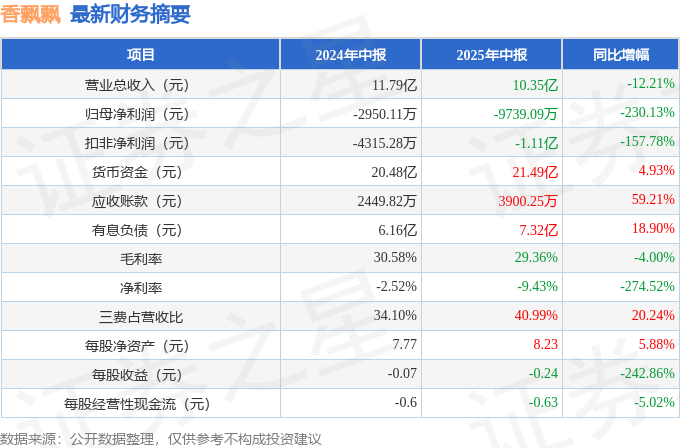
Core Viewpoint - The financial performance of Xiangpiaopiao (603711) in the 2025 mid-year report shows significant declines in both revenue and net profit, indicating potential challenges in the company's operations and market conditions [1]. Financial Performance Summary - Total operating revenue for 2025 is 1.035 billion yuan, a decrease of 12.21% compared to 2024 [1]. - The net profit attributable to shareholders is -97.39 million yuan, reflecting a dramatic decline of 230.13% year-on-year [1]. - The gross profit margin is 29.36%, down 4.00% from the previous year [1]. - The net profit margin stands at -9.43%, a decrease of 274.52% year-on-year [1]. - Total expenses (selling, administrative, and financial) amount to 424 million yuan, accounting for 40.99% of revenue, which is an increase of 20.24% [1]. - Earnings per share are -0.24 yuan, a decrease of 242.86% compared to the previous year [1]. Asset and Liability Changes - Cash and cash equivalents increased by 4.93% to 2.149 billion yuan [3]. - Accounts receivable rose by 59.21% to 39.0025 million yuan [3]. - Interest-bearing liabilities increased by 18.90% to 732 million yuan [3]. - Inventory decreased by 35.25% due to reduced stocking [4]. - Deferred tax assets increased by 55.42% due to increased deductible losses [7]. Revenue and Cost Analysis - Revenue from the bubble tea business declined, contributing to a 12.21% drop in operating income [10]. - Operating costs also fell by 10.67%, attributed to the same decline in sales volume [10]. - Research and development expenses increased by 49.11%, indicating a focus on innovation despite overall financial challenges [10]. Market and Operational Insights - The company’s return on invested capital (ROIC) was 4.57%, indicating weak capital returns compared to historical averages [10]. - The company maintains a healthy cash asset position, which is crucial for its operational sustainability [11]. - The company is currently managing channel inventory effectively, with a notable decrease in inventory levels compared to the previous year [11].

绿瓶退热 农夫山泉“复宠”红瓶水
Bei Jing Shang Bao· 2025-08-27 16:36
Core Viewpoint - Nongfu Spring reported a strong financial performance for the first half of 2025, with revenue of 25.62 billion yuan, a year-on-year increase of 15.6%, and a net profit of 7.62 billion yuan, up 22.1% year-on-year, leading to a significant stock price increase [1][3]. Financial Performance - In the first half of 2025, Nongfu Spring's revenue reached 25.62 billion yuan, reflecting a 15.6% increase compared to the previous year [1]. - The net profit attributable to shareholders was 7.62 billion yuan, marking a 22.1% year-on-year growth [1]. - The gross profit margin improved to 60.3%, up 1.5 percentage points from 58.8% in the same period last year, driven by lower raw material costs [4][7]. Packaging Water Business - The revenue from packaged drinking water was approximately 9.44 billion yuan, showing a 10.7% increase, reversing a decline seen in previous quarters [3][4]. - The company reduced subsidies for the green bottle water product, with subsidies dropping to 1 yuan per case in the first half of 2025, down from 2 yuan in 2024 [4][5]. - The red bottle water's share in packaged water revenue increased from about 75% in the second half of 2024 to over 78% in the first half of 2025, indicating a shift in consumer preference [4]. Market Strategy - Nongfu Spring has been focusing on promoting its red bottle natural water while scaling back on green bottle water subsidies, reflecting a strategic shift towards higher-margin products [5][6]. - The company is expanding its product offerings, including launching new products like "pure transparent ice" and entering the Hong Kong market with core products [6][7]. - The company aims to enhance its distribution network, which has expanded to 3 million outlets, leading to a decrease in sales expense ratio to 19.6%, the lowest in recent years [7]. Tea Beverage Segment - The tea beverage segment generated revenue of 10.09 billion yuan, with a year-on-year growth of 19.7%, although the growth rate has slowed compared to previous years [8]. - The company launched promotional activities for its sugar-free tea product, "Oriental Leaf," which saw its market share increase from 70% to approximately 75% [8][9]. - Despite the strong distribution network, the new carbonated tea product "Ice Tea" has faced challenges in consumer retention and sales performance [8][9].

爱普股份: 爱普香料集团股份有限公司2025年半年度报告
Zheng Quan Zhi Xing· 2025-08-27 15:59
Core Viewpoint - The company reported a decline in revenue but an increase in net profit, indicating a mixed performance in the first half of 2025, influenced by the disposal of a subsidiary and ongoing market dynamics [2][3][12]. Company Overview and Financial Indicators - The company, Apple Flavor & Fragrance Group Co., Ltd., specializes in the research, production, and sales of flavors, fragrances, and food additives [2][3]. - Key financial metrics for the first half of 2025 include: - Revenue: CNY 1,236.22 million, down 14.87% from CNY 1,452.11 million in the same period last year - Total profit: CNY 120.82 million, up 10.48% from CNY 109.35 million - Net profit attributable to shareholders: CNY 83.10 million, up 33.85% from CNY 62.09 million [2][3][12]. Industry and Main Business Situation - The company operates in the flavor and fragrance industry, serving sectors such as dairy, beverages, snacks, baking, personal care, and tobacco [3][12]. - The main products include food flavors, daily-use fragrances, and food additives, with a focus on R&D and manufacturing [3][12]. Business Performance Analysis - The decline in revenue is attributed to the disposal of a subsidiary, which significantly impacted the food additive segment [12][13]. - Despite the overall revenue drop, the flavor business showed steady growth, with revenue reaching CNY 328.18 million, an increase of 8.96% year-on-year [12][13]. - The food additive segment experienced a 22.69% decline in revenue, primarily due to the aforementioned subsidiary disposal [12][13]. Competitive Advantages - The company has established a full industry chain layout, providing integrated services of flavors and food additives, enhancing customer responsiveness and market adaptability [12][13][19]. - Automation in production has improved efficiency, reduced costs, and ensured product quality consistency [12][13][19]. - A strong focus on R&D has led to numerous patents and innovations, positioning the company as a leader in the domestic market [12][13][19]. Market Dynamics - The domestic consumption market is experiencing structural upgrades, driven by rising income levels and changing consumer preferences [12][13]. - The company is well-positioned to capitalize on these trends, with a focus on health and sustainable consumption [12][13].

农夫山泉20250827
2025-08-27 15:19
Summary of Nongfu Spring's Conference Call Company Overview - **Company**: Nongfu Spring - **Date**: August 27, 2025 Key Points Financial Performance - In the first half of 2025, Nongfu Spring achieved total revenue of RMB 25.622 billion, a year-on-year increase of 15.6% [4] - Net profit reached RMB 7.622 billion, up 22.1% year-on-year [4] - Gross margin improved by 1.5 percentage points to 60.3%, while net margin increased by 1.6 percentage points to 29.7% [4][2] - Sales and distribution expenses decreased by 2.8 percentage points to 19.6% of total revenue [4] Product Category Performance - All product categories experienced double-digit revenue growth: - Packaged drinking water: +10.7% [5] - Tea beverages: +19.7% [5] - Functional beverages: +13.6% [5] - Juice beverages: +21.3% [5][6] Cost Control and Efficiency - The increase in gross margin was attributed to lower procurement costs for PET, packaging materials, and sugar [7] - Reduced advertising and promotional expenses, along with lower logistics costs, contributed to the decrease in sales and distribution expenses [7] Water Source Development and Brand Promotion - Three new water sources were added: Hunan Badagong Mountain, Sichuan Longmenshan, and Tibet Nyainqentanglha, bringing the total to 15 nationwide [8] - Enhanced brand promotion through social media and sourcing activities, emphasizing the natural health concept [8] New Product Launches and Marketing Strategies - Introduced several new products, including a zodiac-themed bottle and new tea flavors, supported by online and offline marketing campaigns [9][10] - The company plans to continue exploring overseas markets, with core products launched in Hong Kong covering over 3,500 retail terminals [11] Future Outlook - Full-year revenue is expected to achieve mid-double-digit growth, with stable performance anticipated in the second half of 2025 [3] - Gross and net margins are projected to be slightly higher than in 2024 [3] Innovations and Market Trends - The company is focusing on product innovation, particularly in the functional beverage and juice segments, to meet consumer demand [18][25] - Nongfu Spring is also exploring new retail channels and customized products to cater to high-end consumers [13][14] Capital Expenditure and Growth Strategy - Capital expenditures are expected to be higher than in 2024, particularly for water source development and advanced equipment [19] - The company aims to balance the growth of pure water and natural water products while educating consumers on their differences [26] Dividend Policy - Nongfu Spring does not have a fixed dividend payout ratio, with a 70% payout ratio for 2024, and future dividends will be announced based on investment needs and cash flow [22] International Expansion Plans - The company is considering building a factory in the U.S. and will continue to expand its international presence, focusing on market demand [24] Conclusion - Nongfu Spring's strong financial performance, innovative product launches, and strategic market expansion position the company well for future growth in the competitive beverage industry. The focus on cost control, brand promotion, and consumer education will further enhance its market presence and profitability.
茶饮料增速放缓,包装水仍未“满血”:农夫山泉增长故事需要新引擎
Hua Xia Shi Bao· 2025-08-27 14:17
Core Viewpoint - Nongfu Spring is gradually overcoming the negative impact of a public relations crisis, with a reported total revenue of 25.622 billion yuan and a net profit of 7.622 billion yuan for the first half of 2025, reflecting year-on-year growth of 15.6% and 22.1% respectively [2] Revenue and Profit Performance - In the first half of 2025, Nongfu Spring's total revenue reached 25.622 billion yuan, marking a 15.6% increase year-on-year, while net profit was 7.622 billion yuan, up 22.1% [2] - The company's core product, packaged drinking water, saw a revenue of 9.443 billion yuan in the first half of 2025, representing a year-on-year growth of 10.7% [3][4] - Despite the recovery, packaged water revenue has not yet returned to the 10.442 billion yuan level of the same period in 2023 [4] Impact of Public Relations Crisis - In early 2024, Nongfu Spring faced its largest public relations crisis, which led to a 21.3% decline in packaged water revenue, dropping from 20.262 billion yuan in 2023 to 15.952 billion yuan [3][4] - The company has since shifted focus away from its green bottle pure water product, which was introduced as a competitive strategy during the crisis [3][4] Product Category Performance - Packaged water's revenue share has decreased from 54.9% in 2022 to 37.2% in 2024, overtaken by tea beverages, which accounted for 39% of revenue in 2024 [5][6] - In the first half of 2025, the revenue share of packaged water and tea beverages was 36.9% and 39.4% respectively, indicating a widening gap [4][6] Challenges in Tea Beverage Segment - Tea beverage revenue reached 10.089 billion yuan in the first half of 2025, with a year-on-year growth of 19.7%, showing a significant slowdown compared to previous years [7] - The competitive landscape for sugar-free tea has intensified, prompting Nongfu Spring to expand its large packaging offerings to maintain market share [7][8] Strategic Developments - Nongfu Spring has expanded its water source locations to ensure quality and create competitive barriers, with three new water sources operational in the first half of 2025 [8]
“星巴克的祖师爷”被卖了!
Zhong Guo Ji Jin Bao· 2025-08-27 14:16
Core Viewpoint - Keurig Dr Pepper (KDP) announced the acquisition of JDE Peet's, the parent company of Peet's Coffee, for €15.7 billion (approximately ¥130.3 billion), indicating a significant consolidation in the coffee industry as competitors face restructuring and sales [1][3]. Group 1: Acquisition Details - KDP will acquire 100% of JDE Peet's shares at a price of €31.85 per share, with existing shareholders also receiving a dividend of €0.36 per share [3]. - Following the announcement, JDE Peet's stock surged, while KDP's stock fell from $35 to around $29 [3]. - KDP aims to enhance its coffee positioning and plans to split its beverage and coffee businesses into two independent publicly traded companies in the U.S. after the acquisition [6]. Group 2: Market Context - The coffee sector is experiencing significant changes, with Coca-Cola reportedly evaluating the sale of Costa Coffee and Starbucks China also attracting interest from major investors [3]. - JDE Peet's, known for its 50+ brands, has seen its stock price decline from a peak of €40 to €16, a drop of 60% since 2021 [7]. - The acquisition news led to a rebound in JDE Peet's market value, nearly returning to its initial public offering level [8]. Group 3: Industry Trends - Peet's Coffee, often referred to as the "godfather of Starbucks," has been facing challenges in the competitive coffee market, with closures of several key stores in China due to poor profitability [12][13]. - The premium coffee segment is struggling, with over 32,000 coffee shops expected to close nationwide by mid-2025, averaging 170 closures per day [13]. - In contrast, budget coffee brands like Luckin Coffee are rapidly expanding, leveraging aggressive pricing strategies to capture market share [14][15].
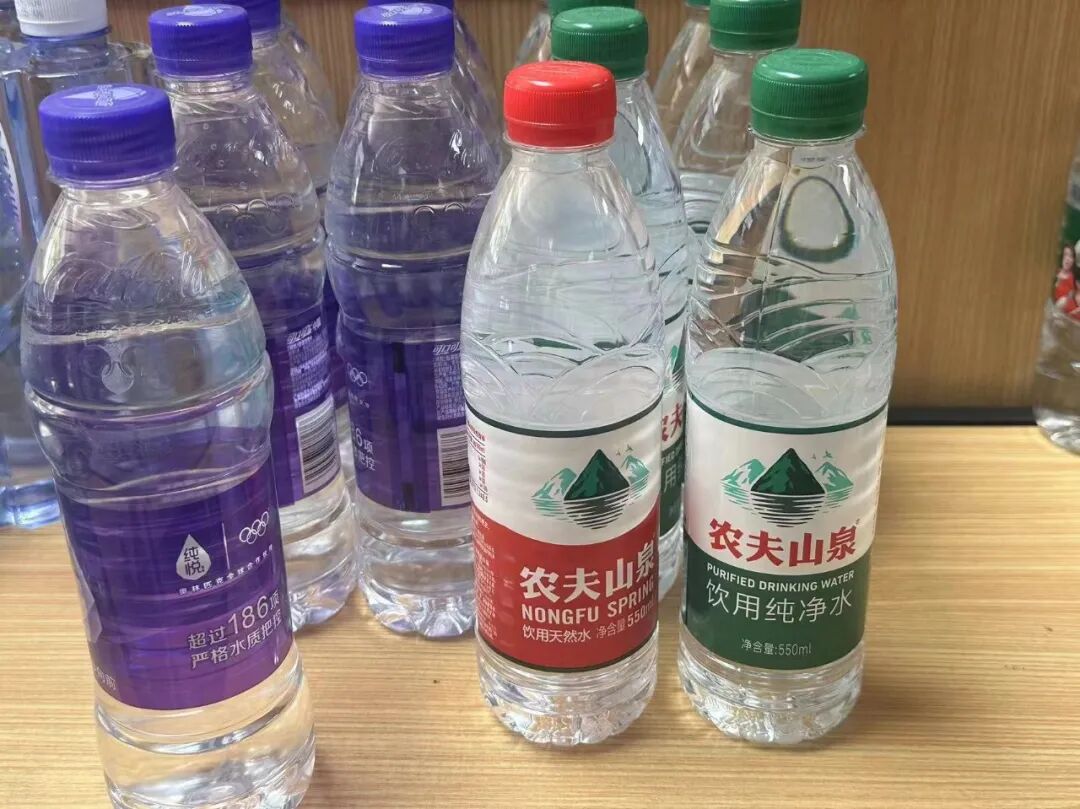
红瓶水向上,绿瓶水收缩,农夫山泉包装饮用水止跌回暖
Bei Jing Shang Bao· 2025-08-27 13:52
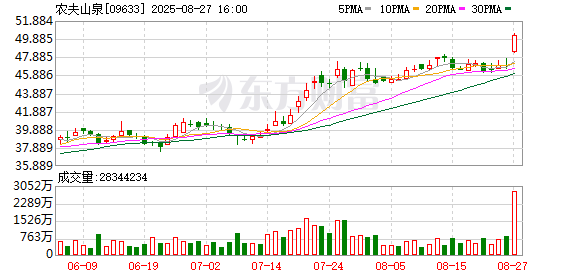
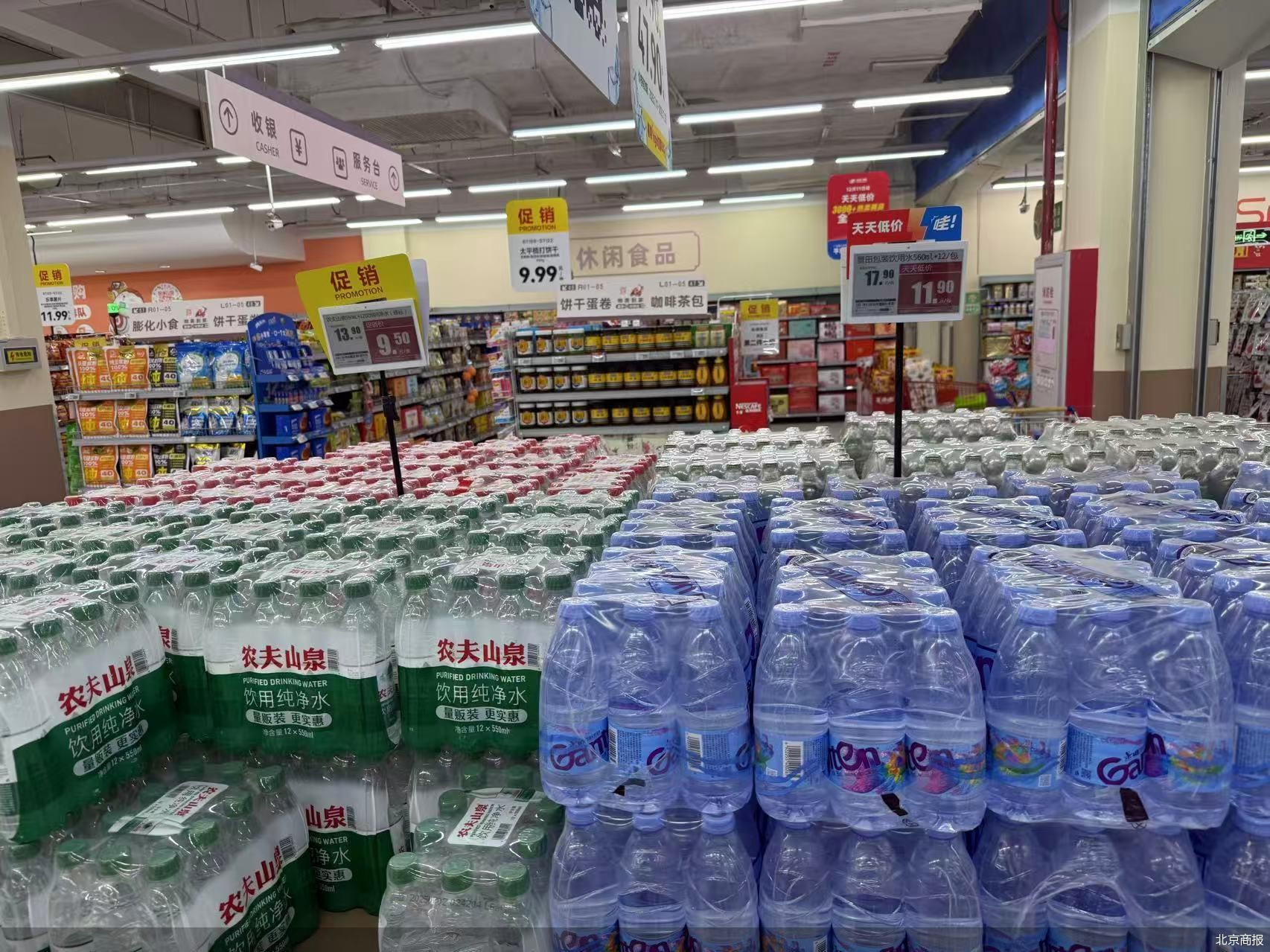
Core Insights - Nongfu Spring reported a revenue of 25.62 billion yuan for the first half of the year, a year-on-year increase of 15.6%, and a net profit of 7.62 billion yuan, up 22.1% [1] - Following the positive earnings report, Nongfu Spring's stock price surged by 7.11% to 50.3 HKD per share, with a total market capitalization of 565.7 billion HKD [1] - The company's bottled water business showed signs of recovery, achieving a revenue of approximately 9.44 billion yuan, a 10.7% increase, after two consecutive quarters of decline [1] Financial Performance - In 2024, Nongfu Spring's total revenue increased by 0.5% to 42.896 billion yuan, but revenue from bottled water products decreased by 21.3% compared to the same period in 2023 [1] - The gross profit margin for the group increased from 58.8% to 60.3%, attributed to lower procurement costs for PET materials and packaging [2] Market Strategy - The company has shifted its focus from the green bottle pure water to the red bottle natural water, with the latter's share in bottled water revenue increasing from approximately 75% in the second half of 2024 to over 78% in the first half of 2025 [2] - Nongfu Spring has reduced subsidies for green bottle water significantly, with subsidies dropping to 1 yuan per case in the first half of 2025, down from 2 yuan [2] - The company is promoting larger packaging sizes of red bottle water (1.5L, 2L, 4L) to cater to household and restaurant needs, which aligns with consumer preferences for health-conscious products [6] Product Development - Nongfu Spring has expanded its product offerings, launching core products like natural drinking water and sugar-free tea drinks in the Hong Kong market, covering over 3,500 retail terminals [4] - The tea beverage segment generated 10.09 billion yuan in revenue, a 19.7% increase, although growth has slowed compared to previous years [7] - The company introduced a new carbonated tea drink, "Ice Tea," and plans to invest 2 billion yuan in its research and promotion [7] Supply Chain and Cost Management - Nongfu Spring has added new water sources in Hunan, Sichuan, and Tibet, bringing the total to 15 major water sources nationwide, which helps in reducing production costs and enhancing supply efficiency [5] - The company has achieved a significant reduction in sales expense ratio to 19.6%, the lowest in recent years, due to an expansion of its distribution network to 3 million terminals [6]
读财报|红瓶水向上,绿瓶水收缩,农夫山泉包装饮用水止跌回暖
Bei Jing Shang Bao· 2025-08-27 13:38
Core Viewpoint - The financial performance of Nongfu Spring in the first half of the year shows significant growth, with revenue reaching 25.62 billion yuan, a year-on-year increase of 15.6%, and net profit attributable to shareholders at 7.62 billion yuan, up 22.1% [1][3]. Financial Performance - In the first half of the year, Nongfu Spring's revenue was 25.62 billion yuan, marking a 15.6% increase year-on-year [1]. - The net profit attributable to shareholders was 7.62 billion yuan, reflecting a 22.1% growth compared to the previous year [1]. - The packaging drinking water segment generated approximately 9.44 billion yuan in revenue, with a year-on-year growth of 10.7%, indicating a recovery after two consecutive quarters of decline [3]. Market Strategy - To regain market share, Nongfu Spring reintroduced the green bottle pure water product in April 2024, employing a low-price promotion strategy [3]. - The green bottle pure water was priced as low as 1 yuan per bottle or 9.9 yuan for a pack of 12 during intense price competition [3]. - The company has shifted focus to promoting the red bottle natural water while reducing subsidies for the green bottle pure water, with subsidies dropping to 1 yuan per pack in the first half of 2025 [4][5]. Product Positioning - The red bottle water has gained consumer preference due to its health label, leading to higher repurchase rates compared to the green bottle [5]. - The gross profit margin for Nongfu Spring increased from 58.8% to 60.3% year-on-year, attributed to lower raw material costs [5]. - The company is optimizing its product structure by reducing reliance on the lower-margin green bottle water and enhancing the red bottle's market presence [5]. Market Expansion - Nongfu Spring is expanding its product offerings, including launching core products like natural drinking water and sugar-free tea in the Hong Kong market, covering over 3,500 retail outlets [6]. - The company has added new water sources in Hunan, Sichuan, and Tibet, increasing its total to 15 major water sources nationwide [7]. - The company is also promoting larger packaging sizes of red bottle water to cater to household and restaurant needs, which aligns with consumer health concerns [8]. Tea Beverage Segment - The tea beverage segment achieved revenue of 10.09 billion yuan, growing 19.7% year-on-year, although growth rates are slowing compared to previous years [9]. - The company launched a promotional campaign for its sugar-free tea product, "Oriental Leaf," increasing its market share from 70% to 75% [9]. - Despite the strong distribution network, the new carbonated tea product "Ice Tea" has faced challenges in consumer retention and sales performance [10].
巴菲特的极简财富哲学:写给妻子的投资遗嘱
Sou Hu Cai Jing· 2025-08-27 12:55
Core Insights - Warren Buffett, beyond being a billionaire, symbolizes a stable investment philosophy, with Berkshire Hathaway's market value exceeding $1.16 trillion as of 2024, encompassing over 80 subsidiaries across various sectors [2] - Buffett's private letter to his wife before donating $100 billion reveals the essence of wealth management, advocating for a simple investment strategy: 10% in short-term government bonds and 90% in a low-cost S&P 500 index fund [2] Investment Strategy - The 10% allocation to short-term government bonds serves as a "risk buffer," backed by the U.S. government, providing stable cash flow during economic downturns [3] - The 90% investment in a low-cost S&P 500 index fund is a bet on "long-term compounding" and "economic growth," with a historical annualized return of 10.4% over the past 60 years [3] Cost Efficiency - Buffett's focus on "low cost" challenges the high fees associated with actively managed funds, which often charge 1%-2% annual management fees, and some hedge funds charge "2% management fee + 20% performance fee" [4] - His 2007 "bet" against top hedge funds demonstrated that high fees can erode excess returns, making low-fee index funds a better choice for ordinary investors [4] Behavioral Insights - Buffett's statement "you will do well" redefines the purpose of investing, emphasizing that the core of investment is not about becoming wealthy quickly but avoiding permanent loss [4][5] - This aligns with behavioral finance theories, where the pain of loss is significantly greater than the pleasure of gains, highlighting the importance of risk management [4] Wealth Transfer Philosophy - Buffett's approach to wealth transfer emphasizes transparency and the avoidance of "wealth curse," ensuring that children inherit enough to pursue their goals without becoming dependent on wealth [5][6] - His estate planning reflects a commitment to philanthropy, with 96% of his $30 billion estate donated to charity, leaving each child with $10 million [5] Long-Term Investment Perspective - Buffett's investment strategy focuses on long-term holdings, with core positions in companies like Apple and Coca-Cola held for over a decade, demonstrating trust in business value rather than market fluctuations [6] - His philosophy encourages investors to prioritize value assessment over complex trading techniques, advocating for a simplified approach to investing [6][7]