云计算

Search documents
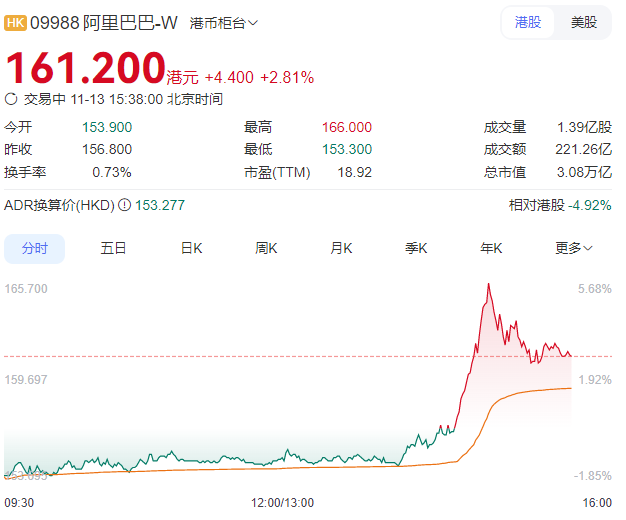
阿里巴巴,突传大消息!股价猛拉
Zheng Quan Shi Bao· 2025-11-13 07:58
Core Insights - Alibaba has secretly launched the "Qianwen" project, developing a personal AI assistant app to compete with ChatGPT, aiming for user monetization [1][3] - The company plans to gradually integrate Agentic-AI functionalities into the app to enhance shopping experiences on platforms like Taobao, with a goal of global expansion through an overseas version [3] - Alibaba's CEO has indicated a significant increase in AI infrastructure investment, with a commitment of 380 billion yuan over three years, reflecting the rapid growth and demand in the AI sector [3] Company Strategy - Alibaba is shifting its strategic focus back to core businesses after diversifying, enhancing competitiveness in e-commerce, cloud computing, and mobile internet [3] - The company aims to deepen the application of AI technology in key areas such as e-commerce and cloud computing, reinforcing its technological barriers and exploring new growth opportunities driven by AI [3] - As a leading player in domestic e-commerce and cloud computing, Alibaba is positioning AI as a core driver to maintain competitive advantages and unlock long-term growth potential [3]


阿里巴巴,突传大消息!股价猛拉
证券时报· 2025-11-13 07:52
Core Viewpoint - Alibaba has secretly launched the "Qianwen" project, aiming to develop a personal AI assistant app to compete with ChatGPT, with the goal of monetizing from the user end [1][5]. Group 1: Project Development - The Qianwen app will gradually incorporate Agentic-AI features to enhance shopping functionalities on platforms like Taobao [3]. - Over 100 developers have been mobilized from various departments to support this transformation, following CEO Wu Yongming's announcement of additional AI investments [3][6]. Group 2: Strategic Importance - This initiative follows Alibaba's earlier announcement of a 380 billion yuan investment in AI infrastructure, marking a significant step in its AI strategy [5]. - Wu Yongming highlighted the rapid development of the AI industry and the exceeding demand for AI infrastructure, indicating a commitment to a three-year plan for substantial investment [6]. Group 3: Market Positioning - Alibaba is refocusing its strategy from diversification back to core business areas, enhancing competitiveness in e-commerce, cloud computing, and mobile internet [6]. - The company aims to deepen the application of AI technology in key sectors, reinforcing its technological barriers and exploring new growth avenues driven by AI [6].
沪指创10年新高,宁德时代涨超7%,锂电池大面积涨停,阿里港股急涨5%
2 1 Shi Ji Jing Ji Bao Dao· 2025-11-13 07:33
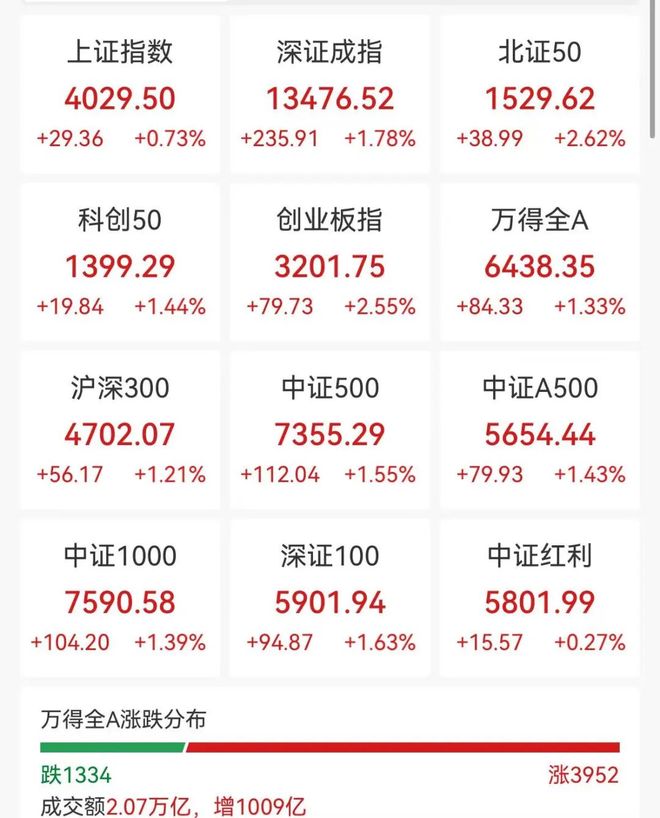
Market Performance - The market experienced a significant rally, with the Shanghai Composite Index reaching a ten-year high and the ChiNext Index rising over 2% [1][2] - The Shanghai Composite Index closed up 0.73%, the Shenzhen Component Index up 1.78%, and the ChiNext Index up 2.55% [1][2] - The total trading volume in the Shanghai and Shenzhen markets was 2.07 trillion [1] Sector Performance - The lithium battery industry saw widespread gains, with major stocks like Ningde Times rising over 7% and many lithium battery concept stocks hitting the daily limit [4][8] - The consumer sector also performed actively, with stocks like Bubugao reaching their daily limit [1][8] - The oil and gas sector faced declines, with companies like China National Offshore Oil Corporation showing weak performance [1] Lithium Battery and Energy Storage - The 2025 World Power Battery Conference was held in Yibin, Sichuan, showcasing significant advancements in battery technology and future development prospects [8] - Ningde Times announced the mass production of its fifth-generation lithium iron phosphate battery, achieving breakthroughs in energy density and cycle life [8] - The energy storage sector is expected to see substantial growth, with cumulative storage demand projected to exceed 2000 GWh, averaging 100 GWh annually [8][9] Investment Outlook - Analysts suggest that the current battery sector rally is driven by unexpected demand in energy storage, power, and AI data centers, indicating that the sector still has upward potential [8] - The energy storage market is anticipated to enter a new growth cycle, with demand expected to increase by 50% in 2026 [9] - The technology sector is experiencing internal rotation, with the electric equipment industry gaining relative strength [9]

沪指创10年新高,宁德时代涨超7%,锂电池大面积涨停,阿里港股急涨5%
21世纪经济报道· 2025-11-13 07:29
Market Performance - The market experienced a significant rally on the 13th, with major indices opening low and closing high, leading to the Shanghai Composite Index reaching a ten-year high. The Shanghai Composite Index rose by 0.73%, the Shenzhen Component Index increased by 1.78%, and the ChiNext Index surged by 2.55%. The total trading volume in the Shanghai and Shenzhen markets was 2.07 trillion yuan [1][2]. Lithium Battery Sector - The lithium battery industry saw widespread gains, with major consumer sectors performing actively. Companies like Bubugao and San Yuan Co. hit the daily limit, while Fujian-based stocks also rose significantly [3][4]. - The lithium battery index increased by 6.40%, reflecting strong market sentiment in this sector [5]. - Notable companies in the lithium battery space, such as Ningde Times, saw their stock prices rise over 7%, indicating robust demand and investor confidence [4][6]. Energy Storage and Future Outlook - The energy storage sector is experiencing explosive growth, driven by the transition in energy structure. The cumulative energy storage demand is expected to exceed 2000 GWh, with an average annual demand of around 100 GWh [7]. - Analysts predict that the energy storage industry will enter a sustained growth cycle over the next 3 to 5 years, with a significant increase in demand expected in 2026 [7]. - The recent World Power Battery Conference highlighted major advancements in battery technology and the strategic partnerships being formed, such as the agreement between Haibo Shichuang and Ningde Times for a substantial supply of battery capacity [6][7]. AI and Cloud Computing - The Alibaba Cloud concept saw a late rally, with stocks like Data Port hitting the daily limit. This reflects growing interest in AI and cloud computing sectors [8][9]. - Alibaba has initiated the "Qianwen" project, aiming to develop a personal AI assistant to compete with ChatGPT, marking a significant strategic move in the AI landscape [13].

一则消息提振 阿里巴巴午后快速拉升
Zheng Quan Shi Bao Wang· 2025-11-13 07:25
Core Viewpoint - Alibaba has launched the "Qianwen" project, developing a personal AI assistant app named Qianwen, which aims to compete directly with ChatGPT, marking a significant strategic shift towards AI technology in its business model [2] Group 1: Company Developments - Alibaba's stock experienced a rapid increase, rising over 5% at one point during trading, with a trading volume of approximately 17 billion HKD [2] - The company's management views the Qianwen project as a critical battle for the future in the AI era, leveraging the strengths of the Qwen open-source technology [2] Group 2: Strategic Focus - Financial analysis indicates that Alibaba is shifting its strategic focus from diversification back to core business areas, enhancing competitiveness in response to changing consumer environments and market competition [2] - The company plans to invest over 380 billion CNY in cloud and AI infrastructure from fiscal years 2025 to 2027, aiming to deepen the application and industrialization of AI technologies in e-commerce and cloud computing [2] - As a leading player in e-commerce and cloud computing in China, Alibaba is positioning AI as a core driver to solidify its competitive advantage and explore new growth opportunities [2]
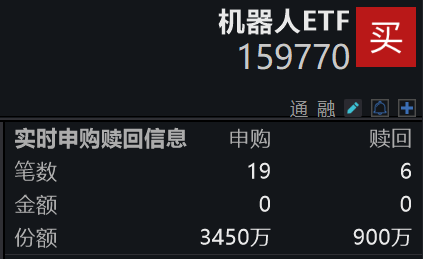
俄罗斯推出首款国产人形机器人,机器人ETF(159770)盘中净申购超2500万份,近20天合计“吸金”16.82亿元
Sou Hu Cai Jing· 2025-11-13 06:24
Core Insights - The Robot ETF (159770) has seen significant trading activity, with a transaction volume of 1.67 billion yuan and a net subscription of 25.5 million shares, indicating strong investor interest [1][2] - The underlying index, the CSI Robot Index (H30590), has increased by 0.35%, with notable gains from constituent stocks such as Hongying Intelligent (10.01%) and Haimu Star (3.78%) [1] - The Cloud Computing ETF Tianhong (517390) has also experienced growth, with a recent increase in scale of 10.1 million yuan over the past six months [3] ETF Performance - The Robot ETF (159770) has achieved a record high of 9.745 billion shares, reflecting a substantial increase of 479.993 million yuan over the past week [2] - The Cloud Computing ETF Tianhong (517390) has the highest turnover rate among similar products, with a transaction volume of 11.0849 million yuan [2] Industry Trends - The logistics sector is undergoing a digital transformation, as outlined in a recent government initiative aimed at reducing logistics costs through the application of technologies such as IoT, cloud computing, and AI [5] - The introduction of Russia's first domestic humanoid robot, Aidol, showcases advancements in AI and robotics, with features like emotion recognition and offline operation [6] - Analysts predict that 2026 will mark a pivotal moment for the global humanoid robot industry, with companies like UBTECH and others securing significant orders and expanding applications beyond research into industrial and educational sectors [6]

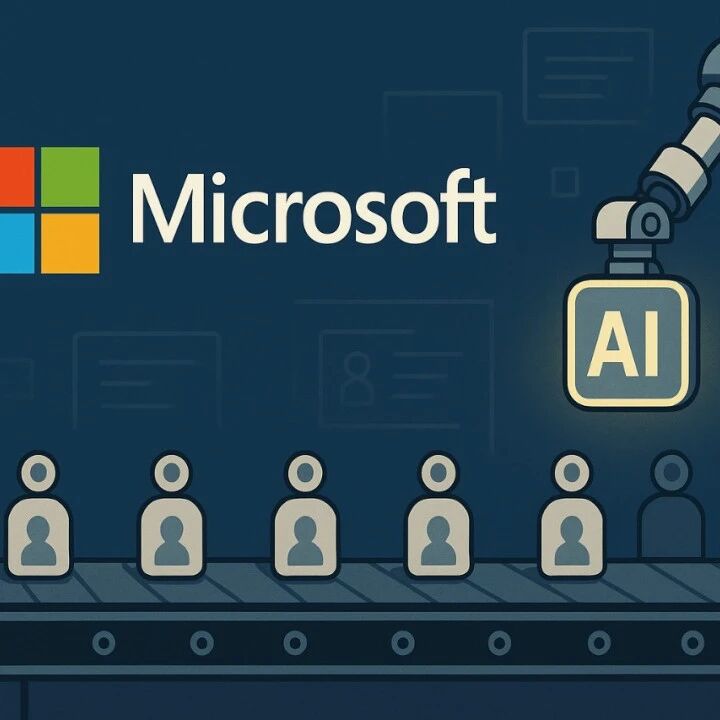
微软第一座“AI超级工厂”投入运营:将两座数据中心连接,构建分布式网络
美股IPO· 2025-11-13 03:39
Core Viewpoint - Microsoft has officially launched its first "AI Super Factory," connecting data centers across states to create a distributed computing cluster, marking a shift towards a networked collaborative era in AI infrastructure [1][3]. Group 1: AI Super Factory Concept - The "AI Super Factory" integrates geographically dispersed data centers into a virtual supercomputer, differing from traditional data center designs [5]. - This distributed network connects multiple sites, consolidating advanced GPUs, EB-level storage, and millions of CPU cores to support future AI model training with trillions of parameters [5][6]. Group 2: Infrastructure and Technology - The new data center in Atlanta spans 85 acres with over 1 million square feet designed specifically for AI workloads [6]. - Key features include a high-density architecture, advanced chip systems with NVIDIA GPUs, an efficient liquid cooling system, and high-speed internal connectivity [7][8]. Group 3: Network and Power Distribution - Microsoft has deployed 120,000 miles of dedicated fiber optic cables to create a high-speed network for AI traffic, ensuring data transmission at near-light speed [9]. - The decision to build across states is driven by land and power supply considerations, allowing for distributed power demand and avoiding overloading any single grid [9]. Group 4: Competitive Landscape - Microsoft’s "AI Super Factory" is a strategic asset in the escalating competition for AI computing power, with plans to double its data center footprint in the next two years to meet surging demand [4][10]. - Competitors like Amazon, Meta Platforms, and Oracle are also ramping up their infrastructure investments, indicating a broader industry trend towards massive AI-related capital expenditures [10].

微软第一座“AI超级工厂”投入运营:将两座数据中心连接,构建分布式网络
Hua Er Jie Jian Wen· 2025-11-13 00:29
Core Insights - Microsoft is launching a new chapter in its AI infrastructure by creating a distributed "AI super factory" that connects large data centers across different states, aiming to accelerate AI model training at an unprecedented scale and speed [1][2] - The company plans to double its data center footprint in the next two years to meet the surging demand for computing power, highlighting its core position in the AI infrastructure sector [1][2] Group 1: AI Super Factory Concept - The "AI super factory" concept integrates geographically dispersed data centers into a virtual single supercomputer, differing from traditional data center designs [3] - This distributed network will connect multiple sites, consolidating tens of thousands of advanced GPUs, exabyte-scale storage, and millions of CPU cores to support future AI model training with trillions of parameters [3][4] Group 2: New Data Center Design and Technology - The new "Fairwater" series data centers are specifically designed for AI workloads, with the Atlanta facility covering 85 acres and over 1 million square feet [4] - Key features include high-density architecture, advanced chip systems with NVIDIA's GB200 NVL72, efficient liquid cooling systems, and high-speed internal connectivity [4][5] Group 3: AI WAN and Power Distribution Strategy - Microsoft has deployed 120,000 miles of dedicated fiber optic cables to create an AI WAN, allowing data to be transmitted at near-light speed without congestion [6] - The decision to build across states rather than centralizing power is driven by land and electricity supply considerations, ensuring that no single grid is overburdened [6] Group 4: Competitive Landscape - Microsoft is not alone in this race; competitors like Amazon, Meta Platforms, and Oracle are also making significant investments in data center infrastructure [7] - By connecting data centers into a unified distributed system, Microsoft is preparing to meet the substantial demands of top AI companies [7]
工程师变身AI“指挥者”,吉利与阿里云的软件开发变革实验
自动驾驶之心· 2025-11-13 00:04
Core Insights - The automotive industry is facing unprecedented challenges in software engineering, with the proportion of software developers at Geely increasing from less than 10% to 40% in recent years, highlighting the exponential growth in complexity as the codebase for smart vehicles surpasses 100 million lines [3][5] - Geely is leveraging AI technology, specifically through collaboration with Alibaba Cloud's Tongyi Lingma, to enhance development efficiency, achieving a 20% increase in coding efficiency and over 30% of code generation being AI-driven [5][6] - The shift from hardware-dominated to software-centric automotive products necessitates a transformation in development models, moving towards agile and DevOps methodologies to support rapid iterations [8][19] Development Challenges - The automotive industry is transitioning from distributed ECU architectures to centralized computing and service-oriented architectures (SOA), which significantly increases system integration complexity [8] - Compliance with stringent international safety standards such as ISO 26262 and ASPICE poses additional challenges, creating tension between rapid agile development and necessary safety protocols [8] AI Integration - Geely's R&D system encompasses application software development, embedded development, and algorithm research, with AI tools like Tongyi Lingma being integrated across all areas [10][11] - AI is being utilized to automate repetitive tasks, allowing engineers to focus on system architecture and core business logic, leading to a 30% efficiency improvement in coding phases [16][18] Knowledge Management - AI's ability to quickly read and interpret legacy code helps mitigate the challenges of "technical debt," allowing new engineers to understand complex systems more rapidly [17][18] - The collaboration between Geely and Alibaba Cloud aims to create a proprietary knowledge base that enhances AI's contextual understanding of Geely's specific technical stack and business logic [14][15] Role Transformation - The role of engineers is evolving from executors to "AI commanders," where they define problems and oversee AI execution, shifting the focus from implementation to strategic oversight [20][21] - The ultimate goal is to achieve a highly automated R&D environment, where AI and human engineers collaborate throughout the entire development process [22][23] Industry Implications - The demand for cross-disciplinary talent that understands both mechanical hardware and software systems is increasing, highlighting a significant skills gap in the automotive industry [23] - The integration of AI in software development may lower technical barriers, enabling engineers with mechanical backgrounds to participate more actively in software engineering [23]

突发,黑天鹅!4.7万亿巨头,直线下挫
中国基金报· 2025-11-12 16:07
Core Viewpoint - Barclays Bank has downgraded Oracle's debt rating to "underweight," warning that its credit rating may eventually fall to BBB-, which is close to junk bond territory [4][5]. Group 1: Oracle's Financial Situation - Oracle's total interest-bearing debt has doubled over the past decade to $111.6 billion, with a debt-to-equity ratio of 500%, significantly higher than Amazon's 50% and Microsoft's 30% [5]. - The company has over $100 billion in off-balance-sheet lease commitments, raising concerns about its leverage levels [5]. - Barclays predicts that Oracle's cash reserves, currently around $11 billion, may be exhausted by November 2026, leading to refinancing needs [5]. Group 2: Market Reaction and Broader Implications - Following the downgrade, Oracle's stock opened sharply lower, dropping over 2% [2]. - The anxiety surrounding the AI bubble has spread to the bond market, with investors selling bonds issued by major cloud service providers like Google, Meta, Microsoft, and Oracle, causing bond spreads to rise to multi-month highs [10]. - The bond spreads for hyperscalers have increased to 78 basis points, the highest level since market turmoil in April, reflecting growing concerns about their debt financing for AI infrastructure [10].