
生物制造

Search documents
政策加力,激发民间投资新活力(新年谈“新”·五位民营企业家和金融界人士谈民间投资)
Ren Min Wang· 2026-01-04 22:44
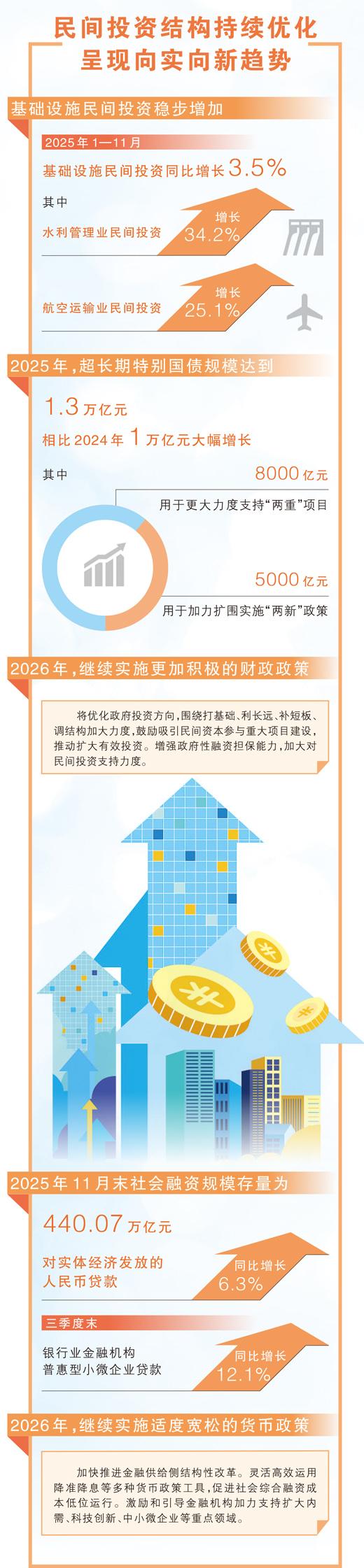
Group 1 - The structure of private investment continues to optimize, showing a trend towards practical and innovative sectors, with private investment in infrastructure steadily increasing by 3.5% year-on-year in the first eleven months of 2025 [1] - Private investment in the water management industry grew by 34.2%, while the aviation transport sector saw a 25.1% increase [1] - The scale of ultra-long-term special government bonds is expected to reach 1.3 trillion yuan in 2025, a significant increase of 800 billion yuan compared to 2024 [1] Group 2 - By the end of November 2025, the total social financing scale was 440.07 trillion yuan, with a year-on-year growth of 6.3% in loans to the real economy [2] - The banking sector reported a 21% year-on-year increase in loans to small and micro enterprises by the end of the third quarter [2] - A moderately loose monetary policy will continue to be implemented in 2026 to support effective investment [2] Group 3 - Private investment is a crucial support for stabilizing growth, adjusting structure, and promoting employment, with macro policies aimed at delivering benefits to business entities and stimulating private investment vitality [3] - The "one enterprise, one policy" approach enhances the investment confidence of private enterprises, as demonstrated by a small motorcycle export company that received a loan of 4.8 million yuan within five working days [3][4] - The financial support mechanism for small and micro enterprises has facilitated significant credit disbursement, with 768.19 billion yuan in loans provided by the end of November 2025 [4] Group 4 - Financial institutions are encouraged to enhance support for small and micro enterprises, aiming to expand private investment and boost development vitality [5] - The focus will be on improving financial support for key industrial chains and encouraging the development of financing products that meet private investment needs [5] - The collaboration between government, enterprises, and financial institutions is essential for achieving high-quality development in the bio-manufacturing industry [13] Group 5 - Companies like Yunnan Lishi Industrial Group have benefited from government policies that support private economic development, leading to significant investments in their core potato industry [6][7] - The company plans to deepen its supply chain and expand its market presence, supported by favorable policies and financial backing [8] - Changsha Jinlong Cable Technology Co., Ltd. has tripled its investment in 2025 and plans to further increase it in 2026, driven by confidence in market demand and supportive policies [9][11] Group 6 - Shanghai Kasei Biotechnology Co., Ltd. emphasizes the importance of stable R&D investment and long-term financial support for its growth [12] - The company has successfully raised approximately 5.5 billion yuan through its IPO, enabling significant expansion in investment and production scale [12] - The collaboration with financial institutions and government support is crucial for the company's future development and market expansion [12][13] Group 7 - Financial services in regions like Jinjiang are tailored to meet the unique needs of numerous small and micro enterprises, enhancing their operational stability and investment confidence [14][15] - The "factory quick loan" initiative allows companies to leverage their fixed assets for financing, facilitating smoother operations and growth [16] - The focus on providing long-term, stable financial support is essential for helping small enterprises concentrate on quality control and future investments [16]


政策加力 激发民间投资新活力(新年谈“新”·五位民营企业家和金融界人士谈民间投资)
Ren Min Ri Bao· 2026-01-04 22:28
Group 1 - The core viewpoint of the articles emphasizes the continuous optimization of private investment structure, showcasing a trend towards practical and innovative investments, particularly in infrastructure [1][3] - Private investment in infrastructure is steadily increasing, with a year-on-year growth of 3.5% from January to November 2025, particularly notable in the water management sector (34.2% growth) and the aviation transport sector (25.1% growth) [1] - The scale of special long-term government bonds is projected to reach 1.3 trillion yuan in 2025, a significant increase of 800 billion yuan compared to 2024, with funds allocated to support major projects and policies [1] Group 2 - By the end of November 2025, the total social financing scale reached 440.07 trillion yuan, with a year-on-year increase of 6.3% in loans to the real economy [2] - The banking sector has seen a 2.1% year-on-year increase in loans to small and micro enterprises, indicating a supportive financial environment for private investment [2] Group 3 - Private investment is recognized as a crucial support for stabilizing growth, adjusting structure, and promoting employment, with expectations for more proactive macro policies to stimulate private investment in 2026 [3][5] - The financial support mechanisms for small and micro enterprises have been enhanced, with significant loan disbursements and a focus on understanding the real financing needs of these businesses [5][6] Group 4 - Companies are increasingly leveraging favorable policies to enhance their investment capabilities, as seen in the case of a motorcycle export company that successfully expanded its market presence and production capacity through tailored financial services [4][10] - The importance of timely and precise financing support is highlighted, as it stabilizes expectations and boosts confidence among business operators, leading to increased investment [5][18] Group 5 - The articles illustrate the proactive measures taken by financial institutions to support private enterprises, including customized financing solutions and long-term stable funding to help businesses focus on quality control and growth [16][17] - The collaboration between government, financial institutions, and enterprises is emphasized as essential for fostering a conducive environment for private investment and innovation [15][19]
河南鹤壁:“三山”统筹绘就区域协调发展新图景
Xin Lang Cai Jing· 2026-01-04 01:28
(来源:中国改革报) 转自:中国改革报 □ 本报记者 张海莺 党的二十届四中全会明确提出,优化区域经济布局,促进区域协调发展。 近年来,河南省鹤壁市锚定区域协调发展战略,以宝山经开区、山城区、鹤山区(以下简称"三山")统 筹发展为核心载体,通过机制创新、规划引领、产业协同、要素聚合,打破行政壁垒与发展鸿沟,推 动"内卷式竞争"转向"共赢式合作",在豫北大地书写了统筹发展的生动实践。 机制规划双轮驱动 筑牢统筹发展根基 鹤壁市将顶层设计作为"三山"统筹的先手棋,印发《关于支持"三山"统筹促进高质量发展的意见》等文 件,建立由鹤壁市委、市政府主要领导任总召集人的联席会议制度,市、区两级同步成立协调服务专 班,形成"市级统筹、区级联动、专班推进"的工作格局,为"三山"差异化布局、统筹发展提供坚实制度 保障。 同时,鹤壁市还坚持"一盘棋"思维,"三山"联合编制宝山经开区发展规划、国土空间规划及环评报告, 同步推进安全发展评估、化工园区产业规划等专项编制,构建起"总规引领、专项支撑、分区落实"的规 划体系,成功创建河南省D级化工园区。 值得关注的是,鹤壁时丰站,作为国家重要能源通道瓦日铁路的关键支点,既是"陆上丝绸之路 ...
海南省发展改革委党组书记、主任綦树利:推动开放成果“由树木变森林”
Hai Nan Ri Bao· 2026-01-04 01:13
Core Viewpoint - The Hainan Provincial Development and Reform Commission aims to establish Hainan Free Trade Port as a significant gateway for China's new era of opening up, focusing on high-quality economic and social development post-closure [1] Group 1: Economic and Trade Development - The commission will leverage high-level openness to create a new open economic structure, emphasizing investment liberalization and facilitation, and optimizing market access [1] - Measures will be taken to reduce the negative list for foreign investment and explore a collaborative model for domestic and foreign investment access [2] Group 2: Industrial Development - The commission plans to build a modern industrial system with Hainan characteristics, focusing on innovation-driven development and the "45432" framework [2] - Key industries will be supported to enhance their supply chains and upgrade, while new industries such as biomanufacturing and hydrogen energy will be prioritized [2] Group 3: Reform and Market Environment - Continuous efforts will be made to eliminate hidden barriers for private enterprises, particularly in market access and project approval [3] - The commission will reform investment and financing systems to increase the proportion of private and foreign investment [3] Group 4: Regional Coordination and Development - The strategy includes enhancing regional collaboration and integrating with international and domestic markets, particularly through the Belt and Road Initiative [3] - A new regional development pattern will be established, focusing on urban-rural integration and resource sharing [3] Group 5: Social Welfare and Public Services - The commission emphasizes a people-centered approach, aiming to improve public services and social security systems to enhance the well-being of residents [4] - Efforts will be made to ensure equitable access to basic public services and improve living conditions [4] Group 6: Safety and Risk Management - The commission will focus on economic security, identifying and preventing risks in key areas such as food and energy supply [5] - Initiatives will be implemented to enhance the "Smart Hainan" infrastructure and manage social expectations effectively [5]
「微元合成」获近3亿元融资,以甲醇为原料、开发大宗生物基产品 | 36氪首发
3 6 Ke· 2026-01-04 00:08
Group 1 - The core viewpoint of the article is that "微元合成" has recently secured nearly 300 million yuan in a new round of equity financing, with the funds aimed at accelerating the research and development of methanol-based biomanufacturing products [1][2] - The company has made significant progress in the development and commercialization of human and animal nutrition products, including allulose, lutein, and mannitol [1] - The financing will focus on the strategic area of "methanol biomanufacturing," with the company having already developed multiple high-efficiency methanol-assimilating strains [2][3] Group 2 - The company has received administrative approval from the National Health Commission for the production of allulose through a unique fermentation process, making it the first in China to do so [1][2] - The innovative "one-step fermentation method" simplifies the production process and significantly reduces costs compared to traditional methods [2] - The global production of chemical products is approximately 2.3 billion tons annually, while biobased products account for only 180 million tons, highlighting the need for non-food carbon sources in biomanufacturing [3] Group 3 - Methanol is identified as an ideal alternative carbon source, with China's coal-to-methanol capacity exceeding 10 million tons, representing 67% of the global total [3] - The company aims to utilize methanol to produce bulk amino acids, thereby reducing reliance on imported soybean meal and ensuring food security [3] - The development of non-food biobased products, particularly using agricultural residues and carbon dioxide, is gaining industry attention despite challenges in cost and logistics [3]
纵贯京广 沿“带”而兴——看“十五五”时期许昌如何主动融入郑州都市圈和沿京广铁路城市发展带(下)
Xin Lang Cai Jing· 2026-01-03 00:41
Core Viewpoint - The article emphasizes the strategic decision of Xuchang to actively integrate into the Zhengzhou metropolitan area and connect with the cities along the Jingguang Railway, aiming for high-quality development and enhanced regional competitiveness [2][5][12]. Group 1: Strategic Integration - Xuchang's integration into the Zhengzhou metropolitan area is not merely a geographical choice but a strategic move to elevate its development capabilities within the broader provincial framework [2][5]. - The city aims to leverage its unique geographical and transportation advantages, positioning itself as a key node in the economic landscape of Central China [5][6]. Group 2: Development Plans and Investments - The "Xugang Industrial Belt Development Plan (2025-2035)" has been completed, with 740 billion yuan invested in 212 key projects within the first 10 months, achieving 90.1% of the annual investment target [3]. - The Huoyuan Lake Modern Service Industry Innovation Circle focuses on technology, finance, and business services, with 295 enterprises having settled in the area [3]. Group 3: Infrastructure and Transportation - Future plans include enhancing transportation to create a modern logistics system, aiming to transform Xuchang from a "transit station" to a high-efficiency "core node" [9]. - The city plans to optimize connections with Zhengzhou East Station and improve high-speed rail services, creating a "half-hour commuting circle" and a "same-day logistics circle" [9]. Group 4: Industrial Development - Xuchang will focus on high-quality construction of "one belt, one circle, and two valleys," expanding its industrial chains in electronics, new energy vehicles, and modern services [10]. - The city aims to establish a complete industrial ecosystem in the Central Electric Valley, enhancing its position in smart power equipment and technology innovation [10]. Group 5: Open Economic System - Xuchang plans to build an open economic system that enhances its external engagement, leveraging its proximity to Zhengzhou Airport and the Free Trade Zone [11]. - The city aims to facilitate the flow of goods and services through the Jingguang Railway, promoting its products nationally and globally while attracting quality capital and talent [11]. Group 6: Regional Collaboration - Xuchang's integration will extend the effects of Zhengzhou's urbanization along the Jingguang Railway, positioning it as a strategic hub connecting various regional economies [12][15]. - The city seeks to break administrative barriers and foster collaboration with neighboring cities, enhancing the overall development of the Central and Southern Henan region [12][15].

把AI当“研发搭子”,未来产业蕴含广阔前景
Xin Hua Wang· 2026-01-02 12:13
Core Insights - The article emphasizes the transformative role of artificial intelligence (AI) in scientific research, particularly in protein design and biomanufacturing, highlighting its potential to accelerate innovation and reduce costs [1][2]. Group 1: AI in Protein Design - Tianmu Technology has developed a protein design model that has processed over 10 billion protein data points and delivered more than 30 industrial projects, showcasing the efficiency of AI in generating optimal solutions for new projects [1]. - AI4S (AI for Science) is changing the traditional research paradigm by addressing the lengthy and costly processes associated with protein design, enabling the development of products that can withstand extreme industrial conditions [1][2]. - The ability of large models to extract features from vast datasets allows researchers to understand the structural characteristics of proteins that enable microorganisms to survive in extreme environments, thus enhancing biopharmaceutical and bio-agricultural research [2]. Group 2: Future Industry Trends - The Ministry of Industry and Information Technology plans to promote AI applications in biomanufacturing, with Tianmu Technology being one of the highlighted companies, indicating a broader trend towards upgrading the entire biomanufacturing industry chain [2]. - The "14th Five-Year Plan" suggests a forward-looking approach to future industries, exploring diverse technological routes and typical application scenarios, which includes fields like quantum technology, biomanufacturing, and brain-computer interfaces as new economic growth points [2]. - The emergence of intelligent research systems, such as the "Meta-Life" system led by the Lingang Laboratory, aims to revolutionize drug discovery by significantly shortening the target discovery cycle, demonstrating the potential of AI to transform the pharmaceutical industry [3]. Group 3: Systematic Development of Scientific Intelligence - The integration of AI into scientific research is not just about speeding up calculations but also about fundamentally transforming research paradigms and accelerating scientific discoveries [3]. - Industry experts believe that scientific intelligence is becoming a key engine for changing research paradigms, empowering industry development, and influencing economic structures globally [3]. - There is a call for deeper exploration in developing new theoretical frameworks and pathways to enhance the systematic advancement of scientific intelligence [3].
布局未来:六大产业引领“十五五”新开局
Guo Ji Jin Rong Bao· 2026-01-01 00:31
Core Viewpoint - The "14th Five-Year Plan" lays the foundation for the "15th Five-Year Plan," which aims to cultivate emerging and future industries as a key part of building a modern industrial system, positioning China strategically for the next round of global technological and industrial transformation [1][3] Group 1: Strategic Overview - The "15th Five-Year Plan" emphasizes the construction of a modern industrial system and the consolidation of the real economy as primary strategic tasks, signaling the necessity for a solid technological and industrial foundation for China's modernization [3] - Future industries are characterized by their frontier, disruptive, and high-growth nature, stemming from significant breakthroughs in basic science, and are expected to dominate global economic landscapes in the coming decades [3] Group 2: Key Future Industries - Six future industries identified in the "15th Five-Year Plan" are crucial for driving the next wave of technological revolution, interlinked and collaboratively evolving to form a new matrix of productive forces [5] - Quantum technology is positioned as a cornerstone for information security and computational advancements, with China leading in quantum communication and achieving "quantum supremacy" with prototypes [5] - Biomanufacturing connects green transformation with industrial upgrading, with a market size nearing 1 trillion yuan, showcasing potential in achieving carbon neutrality through innovative technologies [5] - Hydrogen and nuclear fusion energy represent ultimate solutions for energy, with ongoing developments in compact fusion devices pushing towards engineering applications [5] Group 3: Market and Technological Development - Brain-computer interfaces and embodied intelligence are redefining human-machine relationships, with significant market growth expected in these areas by 2025 [6] - The sixth generation of mobile communication (6G) is set to integrate communication, perception, computation, and artificial intelligence, with China establishing a leading edge in 6G technology [6] Group 4: China's Unique Advantages - China's unique advantages lie in the combination of a new type of national system and a super-large market, allowing for concentrated resource investment in strategic areas like quantum and fusion technologies [8] - A tailored approach is essential for developing future industries, focusing on 1-2 key segments based on local resources and industrial foundations [8] - Establishing a virtuous cycle of technology, capital, and talent is crucial for fostering innovation and long-term investment in emerging technologies [8]
第十届中国制造强国年会:“十五五”加速推进制造业升级
Zhong Guo Hua Gong Bao· 2025-12-31 06:08
Group 1 - The core viewpoint of the articles emphasizes the need for high-quality development and upgrading of China's manufacturing industry during the "14th Five-Year Plan" period, focusing on intelligent, green, and integrated industrialization [1][2][3] - The conference highlighted six key tasks for future development, including enhancing technological innovation, developing the digital economy, and fostering new industrial ecosystems [1] - Experts suggest that the key to upgrading China's manufacturing lies in developing competitive high-end equipment industries and fostering collaboration among teams focused on equipment organization, manufacturing, and key technology research [2][3] Group 2 - The strategy for the next decade should focus on solidifying the industrial foundation, advancing high-level technological self-reliance, and nurturing new productive forces [2] - There is a call for increased support for basic research and cutting-edge technologies in industries that have already reached a world-leading status [3] - The implementation of a "key breakthrough" strategy should be continued while also incorporating new industries such as smart instruments and biological manufacturing [3]
2026年新年献词|顺流逆流,守护我们内心的罗盘!
Zheng Quan Shi Bao Wang· 2025-12-31 02:44
Core Insights - The article reflects on the past year, emphasizing the intertwining of technology and personal experiences as society navigates through challenges and opportunities in 2026 [3][4][6]. Group 1: Technological Developments - The emergence of DeepSeek marked the beginning of a transformative year characterized as the "year of large models" and "year of applications," indicating a significant shift in AI's role across various industries [3]. - AI technologies are reshaping production and sales logic, bringing them closer to individual lives, highlighting the importance of emotional value and personalized connections in consumer services [3][4]. Group 2: Economic Environment - The global macroeconomic landscape is marked by unilateralism and geopolitical tensions, which test the resilience of economies, with China expected to achieve record import and export figures [4]. - The capital market has become a keen observer of these changes, with the Shanghai Composite Index surpassing 4000 points for the first time in a decade, and the total market capitalization of A-shares exceeding one trillion yuan [5]. Group 3: Consumer Trends - There is a growing demand for services that provide emotional resonance and tangible experiences, as seen in cultural events and consumer behaviors that prioritize personal connections over digital interactions [3][5]. - New consumption models that cater to offline experiences and emotional companionship are being revalued in the market, indicating a shift in consumer preferences [5]. Group 4: Future Outlook - The essence of resilience is portrayed as a proactive growth mindset, embracing future challenges with clarity and caution, reflecting a long-term commitment to innovation and development [6]. - The narrative emphasizes the importance of collective effort and shared experiences as society moves into 2026, suggesting that the future is shaped by collaborative actions and mutual support [7].