
氢能与核聚变能

Search documents
布局未来:六大产业引领“十五五”新开局
Guo Ji Jin Rong Bao· 2026-01-01 00:31
Core Viewpoint - The "14th Five-Year Plan" lays the foundation for the "15th Five-Year Plan," which aims to cultivate emerging and future industries as a key part of building a modern industrial system, positioning China strategically for the next round of global technological and industrial transformation [1][3] Group 1: Strategic Overview - The "15th Five-Year Plan" emphasizes the construction of a modern industrial system and the consolidation of the real economy as primary strategic tasks, signaling the necessity for a solid technological and industrial foundation for China's modernization [3] - Future industries are characterized by their frontier, disruptive, and high-growth nature, stemming from significant breakthroughs in basic science, and are expected to dominate global economic landscapes in the coming decades [3] Group 2: Key Future Industries - Six future industries identified in the "15th Five-Year Plan" are crucial for driving the next wave of technological revolution, interlinked and collaboratively evolving to form a new matrix of productive forces [5] - Quantum technology is positioned as a cornerstone for information security and computational advancements, with China leading in quantum communication and achieving "quantum supremacy" with prototypes [5] - Biomanufacturing connects green transformation with industrial upgrading, with a market size nearing 1 trillion yuan, showcasing potential in achieving carbon neutrality through innovative technologies [5] - Hydrogen and nuclear fusion energy represent ultimate solutions for energy, with ongoing developments in compact fusion devices pushing towards engineering applications [5] Group 3: Market and Technological Development - Brain-computer interfaces and embodied intelligence are redefining human-machine relationships, with significant market growth expected in these areas by 2025 [6] - The sixth generation of mobile communication (6G) is set to integrate communication, perception, computation, and artificial intelligence, with China establishing a leading edge in 6G technology [6] Group 4: China's Unique Advantages - China's unique advantages lie in the combination of a new type of national system and a super-large market, allowing for concentrated resource investment in strategic areas like quantum and fusion technologies [8] - A tailored approach is essential for developing future industries, focusing on 1-2 key segments based on local resources and industrial foundations [8] - Establishing a virtuous cycle of technology, capital, and talent is crucial for fostering innovation and long-term investment in emerging technologies [8]
21社论丨增量政策协同发力,实现“十五五”良好开局
21世纪经济报道· 2025-12-19 00:37
Core Viewpoint - The Chinese government plans to implement incremental policies in 2026 to boost economic growth, focusing on the integration of existing and new policies to achieve qualitative and quantitative improvements in the economy [1][2]. Group 1: Economic Growth Strategies - The primary task for 2026 is to maintain domestic demand as the main driver of growth, with consumption being the top priority. Current policies like the trade-in program for consumer goods have led to rapid sales growth, and the penetration rate of the new energy vehicle market is nearing 60% [1]. - The government aims to expand the scope of consumption policies from durable goods to more potential service sectors such as culture, tourism, and health [2]. Group 2: Investment and Infrastructure - Significant increases in investment are expected in 2026, particularly in new urbanization, technological innovation, and major livelihood projects. The central budget investment scale is projected to rise from 7.3 trillion yuan in 2025 to provide strong capital support for major projects [2][3]. - The introduction of new policy-based financial tools, with an expected increase of several hundred billion yuan in 2026, will continue to support key projects [3]. Group 3: Industrial Upgrading and New Growth Drivers - The government plans to enhance traditional industries through technological upgrades and green transformations, potentially unlocking an additional market space of approximately 10 trillion yuan [3][4]. - Development of emerging industries such as new energy, new materials, and aerospace is expected to create substantial market opportunities, with projections indicating the potential for tens of thousands of billions in new market scale [4]. Group 4: Policy Coordination and Structural Reforms - The implementation of macroeconomic policies will emphasize systemic and coordinated approaches, focusing on optimizing fiscal spending and maintaining a reasonable level of debt while ensuring effective use of government bond funds [4]. - Structural reforms will continue to deepen, particularly in establishing a unified national market, which includes standardizing market access and competition regulations [4].


A股或现“平顶慢牛” 四大布局主线显现
2 1 Shi Ji Jing Ji Bao Dao· 2025-11-07 05:45
Core Viewpoint - In 2026, China's economy is expected to focus on balancing growth stabilization and structural adjustment, with a projected GDP growth target of around 5% and continued policy support [1][2][3] Economic Policy and Outlook - The fiscal policy is anticipated to maintain momentum, with public fiscal deficit potentially increasing from 4% to 4.2%, adding approximately 1.7 trillion yuan to the broad deficit scale [2][3] - Monetary policy is expected to diversify, including measures such as central bank bond trading, reserve requirement ratio cuts, and open market operations [2][3] - The divergence between domestic demand and export performance is a key focus, with exports expected to grow by about 6% in 2026 despite external pressures [3][4] Domestic Demand and Supply Dynamics - The ideal policy combination for 2026 should prioritize "increasing demand" while also "optimizing supply," focusing on fiscal expansion and enhancing social security [3][4] - Fixed asset investment is projected to see limited recovery, with infrastructure investment growth remaining stable, while consumer spending is expected to shift towards service consumption [3][4] - Key measures to stimulate service consumption include introducing service consumption vouchers and promoting new urbanization [3][4] Capital Market Trends - The A-share market is expected to continue a "slow bull" trend in 2026, driven by asset replacement, capital market reforms, and economic transformation [5][6] - The market's focus is shifting from sentiment-driven to fundamental verification, with corporate earnings being crucial for valuation increases [6][7] - A clear investment direction is suggested, focusing on four main lines: technology growth (self-sufficiency in computing power, semiconductors, AI applications), PPI improvement, global competitiveness (automotive, electronics, machinery), and domestic demand transformation [7][8]
产业大脑|“十五五”产业机会前瞻:哪些赛道将催生新增长极?
Sou Hu Cai Jing· 2025-10-31 13:43
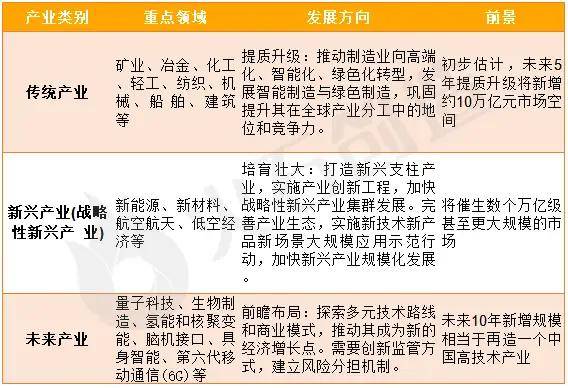
Core Viewpoint - The recently released "Suggestions on Formulating the 15th Five-Year Plan for National Economic and Social Development" lays the foundation for China's development from 2026 to 2030, highlighting the importance of a modern industrial system and the solidification of the real economy [1][2]. Modern Industrial System Framework - The plan emphasizes building a modern industrial system as a primary strategic task, focusing on the real economy's critical role in development [2]. - Four major tasks are outlined: optimizing traditional industries, nurturing emerging and future industries, promoting high-quality service sector development, and constructing a modern infrastructure system [2]. Key Areas of the 15th Five-Year Plan - Traditional industries such as mining, metallurgy, and chemicals will undergo quality upgrades, with an estimated market space of around 10 trillion yuan [3]. - Emerging industries will be supported through innovation projects and large-scale applications of new technologies [3]. - Future industries like quantum technology, biotechnology, and nuclear fusion are highlighted for their potential to drive economic growth [9]. Four Major Emerging Pillar Industries - The plan identifies four strategic emerging industries: new energy, new materials, aerospace, and low-altitude economy, which are expected to significantly contribute to the economy in the next five years [2][4]. New Energy - China has established the world's largest and fastest-growing renewable energy system, with wind and solar power capacities leading globally [4]. - The new energy sector is projected to maintain rapid growth, becoming a key economic driver under the "dual carbon" goals [4]. New Materials - The new materials industry supports the development of other emerging sectors and has made significant progress in areas like semiconductor materials and carbon fiber [5][6]. - The focus is on achieving breakthroughs in high-end materials to meet advanced manufacturing needs [6]. Aerospace - The plan emphasizes the role of commercial aerospace, with significant achievements in manned spaceflight and satellite technology [7]. - The commercial aerospace sector is expected to enter a rapid growth phase, driven by national support and market demand [7]. Low-Altitude Economy - The low-altitude economy is recognized as a strategic emerging industry, with rapid development in the drone sector [8]. - This sector is anticipated to become a new growth engine, with applications in logistics and urban air transport [8]. Six Major Future Industries - The plan highlights future industries such as quantum technology, biotechnology, hydrogen energy, brain-computer interfaces, embodied intelligence, and 6G technology, which are expected to foster long-term growth [9]. Quantum Technology - Quantum technology is prioritized for its strategic value, with China leading in quantum communication and making strides in quantum computing [10]. - The sector is expected to transition from research to industrial application, forming new high-tech clusters [10]. Biotechnology - The biotechnology sector is experiencing rapid growth, with innovations in biobased materials and pharmaceuticals [11]. - It is projected to significantly expand by 2030, contributing to a green economy [11]. Hydrogen and Nuclear Fusion Energy - Hydrogen energy is recognized as a key clean energy source, with ongoing advancements in fuel cell technology [13]. - The nuclear fusion sector is still in the experimental stage but is expected to achieve breakthroughs during the 15th Five-Year Plan [13]. Brain-Computer Interfaces - Research in brain-computer interfaces is advancing, with applications in medical rehabilitation [14]. - The technology is expected to progress from experimental to clinical use, driving new technological developments [14]. Embodied Intelligence - The embodied intelligence sector is growing, with significant advancements in robotics and autonomous driving [15]. - This industry is expected to see rapid growth, becoming a crucial driver of manufacturing and digital economy development [15]. Sixth Generation Mobile Communication - 6G technology is anticipated to surpass 5G in speed and connectivity, with global competition underway [16]. - The 15th Five-Year Plan period is critical for establishing a competitive edge in 6G technology, which will support future digital economic innovations [16].
中经评论:为何要再造一个高技术产业
Jing Ji Ri Bao· 2025-10-31 00:09
Core Insights - The Chinese government aims to recreate a high-tech industry over the next decade, which is expected to inject new momentum into the economy and support high-quality development [1][4] - The initiative addresses the current economic challenges of weakening traditional growth drivers and the slow emergence of new ones, aiming for a dual growth model that combines traditional industry upgrades with high-tech industry expansion [1][2] Industry Transformation - The move to recreate a high-tech industry is crucial for enhancing industrial competitiveness, as China has been a manufacturing giant but lacks strength in core components and high-end materials [2] - High-tech manufacturing currently accounts for less than 20% of the industrial value added, indicating a significant gap compared to developed countries [2] - The strategy aims to solidify China's leading position in advantageous sectors while seizing opportunities in future industries, ultimately transitioning from a manufacturing powerhouse to a manufacturing stronghold [2] Technological Advancement - The initiative is a strategic choice to capitalize on the ongoing technological revolution, particularly in areas like artificial intelligence, which is reshaping production processes and industry models [2][3] - The rapid emergence of new technologies presents both opportunities and uncertainties, making it essential to build a robust high-tech industry to mitigate risks and ensure sustainable economic growth [2][3] Economic Foundation - China's industrial foundation is strong, with the "three new" economies projected to contribute 24.29 trillion yuan to GDP in 2024, representing over 18% of the total [3] - The country has the largest and most comprehensive industrial system globally, with leading positions in sectors like new energy vehicles, photovoltaics, and 5G [3] - Continuous increases in R&D investment, with China ranking second globally in total R&D expenditure, support the potential for breakthroughs in cutting-edge fields [3] Future Industry Development - The focus will be on nurturing emerging and future industries, with strategic clusters in new energy, new materials, aerospace, and low-altitude economy expected to create significant market opportunities [3] - Future industries such as quantum technology, biomanufacturing, and sixth-generation mobile communications are targeted for development, transitioning from technological reserves to market applications [3] - The synergistic development of both emerging and future industries is anticipated to strengthen current economic foundations while expanding future growth avenues [3][4]
为何要再造一个高技术产业
Jing Ji Ri Bao· 2025-10-30 22:14
Core Insights - The Chinese government aims to cultivate and expand emerging and future industries, with the goal of creating a new high-tech industry equivalent to the size of China's existing high-tech sector over the next decade, injecting continuous new momentum into the economy and high-quality development [1][3] Economic Context - China's economic growth faces challenges due to the weakening of traditional growth drivers and the slow replacement by new drivers, necessitating the reconstruction of a high-tech industry to stabilize growth [1][2] - The current contribution of high-tech manufacturing to industrial value added is less than 20%, indicating a significant gap compared to developed countries, which positions the reconstruction of a high-tech industry as a strategic move to enhance competitiveness [2] Strategic Importance - The reconstruction of a high-tech industry is seen as a critical step in reshaping industrial advantages, allowing China to consolidate its leading position in advantageous sectors and seize opportunities in future markets [2][4] - The ongoing technological revolution, particularly in areas like artificial intelligence, presents both opportunities and uncertainties, making the establishment of a high-tech industry essential for capturing new technological advancements and mitigating risks [2][3] Industrial Foundation - China's "three new" economy is projected to contribute 24.29 trillion yuan to GDP in 2024, exceeding 18%, supported by a robust industrial system and leadership in sectors like new energy vehicles and 5G [3] - The country ranks second globally in R&D expenditure, with significant breakthroughs in quantum computing and artificial intelligence, indicating a strong foundation for the development of a new high-tech industry [3] Future Industry Development - The focus will be on nurturing emerging pillar industries such as new energy, new materials, and aerospace, which are expected to create substantial market opportunities and drive the expansion of the high-tech sector [3][4] - Future industries will be strategically developed in areas like quantum technology and brain-computer interfaces, transitioning from technological reserves to market applications, thus becoming new growth points for the economy [3] Transformation of Manufacturing - The initiative to rebuild a high-tech industry represents a qualitative transformation of Chinese manufacturing, moving away from being "big but not strong" to a more resilient and innovative position in global competition [4]
刚刚!证监会主席重磅表态!
摩尔投研精选· 2025-10-27 10:56
Core Viewpoint - The A-share market is experiencing a strong upward trend, with major indices rising over 1%, and the Shanghai Composite Index nearing the 4000-point mark, a level not seen since August 2015 [1][2]. Market Performance - The market is characterized by active hotspots, with over 3300 stocks closing in the green. The trading volume in the Shanghai and Shenzhen markets reached 2.34 trillion, an increase of 365.9 billion from the previous trading day [3]. - Key sectors showing significant gains include small metals, electronic chemicals, components, and semiconductors, with notable performance in concepts like storage chips, AI PCs, and Co-Packaged Optics (CPO) [3][4]. Storage Chip Sector - The storage chip sector continues to thrive, driven by exponential demand from AI servers for storage capacity and bandwidth [5]. - Prices for DRAM have surged, with a nearly 100% year-on-year increase in September, and certain DDR4 models seeing price increases of over 300% since April. Major players like Samsung and SK Hynix are expected to raise prices by 30% in Q4 [6]. High-Tech Industry Development - The Chinese government has set a goal to cultivate high-tech industries over the next decade, with projections indicating that the market size of seven key future industries could exceed 10 trillion yuan by 2030 [7]. - The focus is on emerging pillar industries, with the "Three New" economy expected to account for over 18% of GDP by 2024, particularly in sectors like new energy and aerospace [10]. Investment Directions - **Quantum Technology**: Emphasizes a gradient development approach, with quantum measurement leading in commercialization, followed by quantum communication and quantum computing [12]. - **Biomanufacturing**: Driven by technology substitution and scene expansion, with significant potential to replace 20%-30% of chemical products [13]. - **Hydrogen and Nuclear Fusion Energy**: Positioned as complementary forces in the energy revolution, focusing on industrial and transportation decarbonization [14]. - **Brain-Computer Interfaces**: Targeting medical applications first, with consumer applications expected to follow as technology matures [15]. - **Embodied Intelligence**: Focused on industrial applications initially, with consumer applications anticipated to explode later [16]. - **6G Technology**: Aiming for seamless global coverage and integration of AI, with commercial deployment expected by 2030 [17][19].

学习二十届四中全会:科技创新驱动增长
Capital Securities· 2025-10-27 06:18
Group 1: Key Concepts from the 20th Central Committee's Fourth Plenary Session - The session emphasizes "new quality productivity" and "high-level technological self-reliance" as core concepts for the 15th Five-Year Plan[8] - The focus is on technological innovation as the main line to ensure safety and resilience, promoting high-quality development and common prosperity[8] - The transition from a factor-driven growth model to an innovation-driven model is highlighted, marking a fundamental shift in economic growth[9] Group 2: Strategic Industry Development - The proposal aims to develop emerging pillar industries, accelerating the growth of sectors like new energy, new materials, and aerospace, potentially creating several trillion-level markets[11] - Hydrogen energy and nuclear fusion are identified as strategic future energy sectors, with significant market potential expected to reach trillion-level scales during the 15th Five-Year Plan[13] - The "three new" economy's contribution to GDP is projected to exceed 18% by 2024, indicating a strong focus on innovation-driven growth[11] Group 3: Policy and Market Implications - The government will provide strong support in planning, funding, and research for emerging industries, particularly hydrogen and nuclear fusion, over the next decade[14] - The integration of new energy technologies with manufacturing and smart control is expected to enhance the added value of manufacturing[12] - Risks include potential misinterpretation of policies and outcomes not meeting expectations, which could impact industry growth[15]