
高端装备

Search documents
新型储能纳入政府投资基金投向!国家首次作出系统规范
中关村储能产业技术联盟· 2026-01-13 12:15
Core Viewpoint - The article discusses the implementation of a new regulatory framework for government investment funds in China, aimed at optimizing their layout and guiding investment directions to support national strategies and industrial upgrades [2][3][4]. Group 1: Government Investment Fund Overview - Government investment funds are established by various levels of government to guide social capital in supporting industry development and innovation through market-oriented methods such as equity investment [2][12]. - The new framework includes a systematic approach to fund layout and investment direction, marking the first national-level regulation of government investment funds [2][4]. Group 2: Supported Investment Areas - The framework identifies key investment areas, including: - Emerging and future industries such as information technology, new energy, advanced manufacturing, and artificial intelligence [2][3]. - Upgrading traditional industries and supporting high-quality development in manufacturing [3][4]. - Promoting the digital economy through initiatives like "AI+" and the application of 5G technology [3][4]. Group 3: Policy Measures - The framework outlines 14 policy measures focusing on three main aspects: where to invest, how to invest, and who manages the funds [3][4]. - It emphasizes early, small, long-term investments in hard technology and aims to prevent homogeneous competition and crowding out of social capital [11][12]. Group 4: Evaluation Management - An evaluation management method has been established to assess the investment direction of government funds, focusing on compliance with national planning and industry directories [4][5]. - The evaluation system includes three main indicators: policy compliance (60% weight), optimization of productivity layout (30% weight), and policy execution capability (10% weight) [6][7]. Group 5: Specific Evaluation Indicators - The evaluation indicators cover aspects such as support for new productivity, technology innovation, green development, and the promotion of private investment [29][33]. - Specific metrics include the proportion of investments in encouraged industries, the effectiveness of fund management, and the impact on social welfare [29][33][40].

锚定五万亿,工业名城苏州再展硬核实力
Xin Lang Cai Jing· 2026-01-13 10:28
Core Insights - Suzhou aims to achieve an industrial output value of 4.89 trillion yuan by 2025, with a target of surpassing 5 trillion yuan by 2026, positioning itself as the second city in China to reach this milestone after Shenzhen [1][3] - The city's industrial growth has shown remarkable resilience despite global economic pressures, with an average annual increase of nearly 300 billion yuan over the past five years [3][4] Industrial Growth - Suzhou's industrial output surpassed 3.5 trillion yuan in 2020 and reached 4.43 trillion yuan in 2023, with projections of 4.7 trillion yuan in 2024 and 4.89 trillion yuan in 2025 [3][4] - The city has maintained an impressive growth rate, even amid external trade challenges, with an average annual increase exceeding 200 billion yuan in recent years [3][4] Industry Structure - Suzhou's industrial strength lies in its balanced multi-pillar industry system, which includes electronics, high-end equipment, and advanced materials, unlike Shenzhen's focus on electronics [3][4] - The electronic information, equipment manufacturing, and new materials sectors achieved output values of 1.36 trillion yuan, 1.47 trillion yuan, and 937.1 billion yuan respectively in 2025, all showing positive growth [4] Economic Drivers - Suzhou effectively combines foreign investment and domestic growth, hosting over 18,000 foreign enterprises with cumulative foreign investment exceeding 160 billion USD, while also nurturing local giants in emerging sectors [5][6] - The city is characterized by a strong industrial presence across various districts, with specialized industrial parks focusing on biomedicine, nanotechnology, and automotive components, creating a robust industrial landscape [5][6] Future Strategies - The city plans to leverage artificial intelligence to enhance industrial production, with initiatives such as the "Top Ten Actions for Suzhou Intelligent Manufacturing" aimed at elevating industrial capabilities [5][6] - Despite the ambitious targets, challenges remain, including the need for traditional industries to adapt and the increasing constraints on land and environmental resources [5][6] Competitive Landscape - Suzhou faces intense regional competition from cities like Shenzhen, Chongqing, Guangzhou, and others, as well as from neighboring cities within the Yangtze River Delta [6] - The city's industrial resilience is supported by a vast network of 160,000 industrial enterprises across 34 major industrial categories, highlighting its competitive edge in the global market [6]
最高补助1000万元,一地支持仪器仪表等企业
仪器信息网· 2026-01-13 09:07
Core Viewpoint - Shanghai has released a three-year action plan to support the transformation and upgrading of advanced manufacturing, aiming to add 100 enterprises with an annual output value exceeding 1 billion yuan by 2028, totaling over 600, and to drive the addition of 500 new large-scale industrial enterprises in the supply chain, while significantly increasing the proportion of R&D expenses in revenue [2][3][7]. Group 1: Main Goals - By 2028, the plan aims to add 100 manufacturing enterprises with an annual output value exceeding 1 billion yuan, totaling over 600, and to drive the addition of 500 new large-scale industrial enterprises in the supply chain [7]. Group 2: Implementation Actions - **Optimizing Traditional Advantage Industries**: The plan encourages petrochemical companies to reduce oil dependency and develop new functional materials, while supporting steel and non-ferrous metal companies to strengthen specialty steel and expand lightweight alloys [8]. - **Accelerating Leading Industry Strategies**: Support for integrated circuit companies to focus on equipment, advanced processes, and materials, aiming to cultivate internationally competitive leading enterprises [8]. - **Promoting Key and Emerging Industries**: The plan emphasizes the development of new-generation electronic information, smart connected vehicles, high-end equipment, and green low-carbon industries [9]. Group 3: Innovation and Technology - **Releasing Innovation Vitality**: The plan supports enterprises to increase basic research investment, providing financial subsidies based on the amount of R&D expenditure [9]. - **Accelerating Core Technology Breakthroughs**: Focus on supporting enterprises in laser manufacturing, quantum technology, and new functional materials to conduct foundational research [10]. Group 4: Quality and Efficiency Enhancement - **Promoting Technological Transformation**: Support for enterprises to upgrade production, R&D, and design processes, with financial support for fixed asset investment loans [10]. - **Deepening Digital Transformation**: The plan includes initiatives for AI integration in manufacturing, aiming for large enterprises to achieve full digital application coverage by 2027 [10]. Group 5: Resource and Support Actions - **Strengthening Talent Development**: The plan supports enterprises in attracting high-level talent, providing priority recommendations for national and local talent cultivation programs [11]. - **Enhancing Financial Support**: Focus on promoting low-interest, high-amount, and long-term loan products for manufacturing enterprises, with interest subsidies for key component and raw material loans [12]. - **Expanding Logistics Support**: The plan aims to build industrial logistics and warehousing facilities to integrate logistics with manufacturing [12].

“十四五”时期茂名GDP突破4000亿元 “五链共建”带动工业投资四年翻一番
Nan Fang Ri Bao Wang Luo Ban· 2026-01-13 09:06
Core Insights - During the "14th Five-Year Plan" period, Maoming's economy has reached a new milestone with a total economic output surpassing 400 billion yuan, maintaining its leading position in the Guangdong's western and northern regions [1] - The city is expanding from "five-chain co-construction" to "multi-chain co-construction," establishing a modern industrial system characterized by "3336" [1] - Traditional industries remain robust, with the petrochemical sector's total output value stabilizing around 180 billion yuan, and agricultural output exceeding 120 billion yuan [1] Economic Performance - Maoming's industrial investment and technological transformation are expected to double from 2020 to 2024, with the added value of advanced manufacturing accounting for 74% of the industrial output [2] - The main platform for industrial transfer has been optimized, achieving an "excellent" rating in the provincial industrial park monitoring for 2024, with the industrial output value from this platform expected to account for 80.1% of the city's total [2] - High-tech manufacturing investment is projected to grow at an annual rate of 46.9% during the "14th Five-Year Plan" period, with significant advancements in strategic emerging industries [2] Development Resilience - A total of 241 enterprises have achieved "small to standard" status, and 757 enterprises have undergone technological upgrades, indicating a strong push towards digital transformation [3] - Maoming has been recognized as one of the new pilot cities for inclusive financial reform, enhancing its economic resilience [3] - The city aims to reach a total economic output of 500 billion yuan during the "15th Five-Year Plan" period, focusing on new industrialization and urbanization [3]
万亿级“国家队”投资方向,明确了
3 6 Ke· 2026-01-13 08:27
Core Viewpoint - The article discusses the newly released "Work Method" which systematically regulates the layout and investment direction of government investment funds for the first time at the national level, aiming to guide the development of trillion-level government investment funds in China [1][7]. Group 1: Policy Measures - The "Work Method" proposes 14 policy measures focusing on three aspects: where to invest, how to invest, and who manages the funds [2][3]. - It emphasizes optimizing fund allocation to support major strategies, key areas, and weak links in resource allocation, promoting deep integration of technological and industrial innovation, and nurturing emerging pillar industries [2]. Group 2: Investment Guidance - Funds must align with national major plans and encourage industries listed in the national industrial directory, avoiding investments in restricted, eliminated, or prohibited sectors [3]. - Provincial development and reform departments are tasked with creating local priority investment lists to optimize fund allocation and direction [3]. Group 3: Evaluation Indicators - The "Management Method" establishes three primary and thirteen secondary indicators for evaluating fund performance, with a focus on policy compliance (60% weight), optimization of productivity layout (30% weight), and policy execution capability (10% weight) [4][6]. - The evaluation will consider whether fund investments support the development of new productive forces, including emerging and future industries such as AI, quantum information, and advanced manufacturing [4][5]. Group 4: Regional Strategy Alignment - The evaluation also assesses the alignment of fund investments with national regional strategies, including support for various regional development initiatives like the Western Development and Northeast Revitalization [6]. - Funds that meet these regional strategy requirements will receive higher evaluation scores [6]. Group 5: Differentiated Development - The National Development and Reform Commission highlights the need for differentiated development of government investment funds, addressing issues like mismatched local resources and homogeneous investment directions [7][8]. - National funds are to focus on supporting the construction of a modern industrial system and overcoming key technological challenges, while local funds should align with local industry foundations and development realities [8].
政府投资基金要变了
Sou Hu Cai Jing· 2026-01-13 08:10
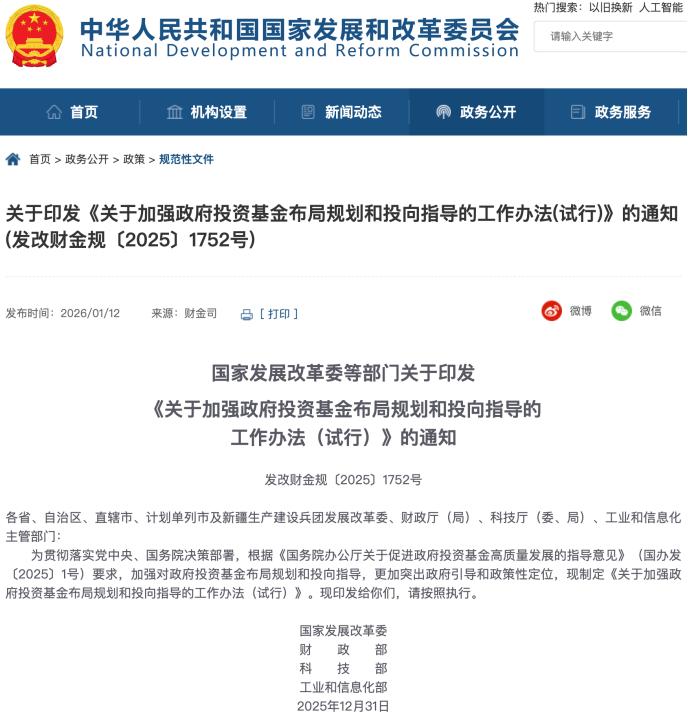
Group 1 - The core viewpoint of the news is the introduction of new regulations by the National Development and Reform Commission, in collaboration with other ministries, to guide the planning and investment direction of government investment funds, marking a systematic approach to fund layout and investment direction at the national level [1][2][12] - The "Work Method" defines government investment funds and emphasizes their role in guiding investments towards major strategies and key areas where the market cannot fully play its role [2][12] - The "Management Method" establishes a detailed evaluation system with 13 indicators to assess the investment direction and performance of government investment funds, focusing on policy compliance and optimization of productivity layout [8][10] Group 2 - The "Work Method" includes provisions to prevent homogenization of competition and the crowding out of social capital, aiming for a high-quality development pattern of government investment funds that is appropriately scaled, reasonably laid out, and scientifically managed [3][5] - Specific prohibited investment behaviors for government investment funds are outlined, including increasing local government hidden debt and engaging in speculative trading [6][10] - The evaluation system emphasizes support for emerging industries and future industries, including areas like quantum information, generative artificial intelligence, and new energy, while also promoting the transformation of traditional industries [9][10] Group 3 - The government investment funds are encouraged to collaborate with local funds, leveraging local resources to form a financial synergy in key areas of frontier technology and supply chains [5][12] - The evaluation criteria include a focus on early-stage investments and long-term investment periods, with a preference for projects that have a high proportion of social capital contributions [10][12] - The introduction of the "negative behavior list" for investment directions aims to ensure that funds do not engage in undesirable practices, with a scoring system that influences management fees and profit distribution based on performance [10][11]
上海发布先进制造业转型升级方案
Zhong Guo Hua Gong Bao· 2026-01-13 02:51
Core Viewpoint - The Shanghai Municipal Government has released a three-year action plan (2026-2028) to support the transformation and upgrading of advanced manufacturing, aiming to add 100 manufacturing enterprises with an annual output value exceeding 1 billion yuan by 2028, totaling over 600, and to drive the addition of 500 industrial enterprises above designated size in the industrial chain [1][2]. Group 1: Action Plans - The action plan includes four major actions: structural optimization and upgrading, innovation-driven foundational support, quality and efficiency enhancement, and resource and factor support [1][2]. Group 2: Structural Optimization and Upgrading - The first action focuses on optimizing and enhancing traditional advantageous industries, promoting the petrochemical sector to shift from oil to chemical products, and accelerating the strategic leadership of pilot industries [1]. - It supports integrated circuit companies to target equipment, advanced processes, photoresist materials, and 3D packaging to achieve breakthroughs across the entire industrial chain [1]. Group 3: Innovation-Driven Foundational Support - The second action encourages enterprises to focus on foundational research in cutting-edge technologies such as laser manufacturing, quantum, photonics, new functional materials, and new energy [2]. - It emphasizes support for key industrial chains and critical links in industries like integrated circuits, large aircraft, high-end equipment, instrumentation, and industrial software [2]. Group 4: Quality and Efficiency Enhancement - The third action supports existing chemical enterprises in chemical parks to undertake project construction without increasing environmental risks, while promoting digital transformation to achieve full coverage of smart factories by 2028 [2]. - It also encourages the development of green low-carbon products and supports energy-saving upgrades and equipment modifications [2]. Group 5: Resource and Factor Support - The fourth action aims to enhance logistics support and improve transportation infrastructure in areas like Lingang, Jinshan, and chemical zones [2]. - It includes increasing specialized logistics and warehousing resources and innovating hazardous materials storage supervision methods [2].
重磅利好!万亿级“国家队”投向明确了
Zhong Guo Jing Ji Wang· 2026-01-13 02:32
Core Viewpoint - The Chinese government has established a systematic framework for the development and direction of government investment funds, marking the first time such guidelines have been issued at the national level [1]. Group 1: Policy Framework - The "Work Method" outlines three main aspects: where to invest, how to invest, and who manages the funds, proposing 14 policy measures [3]. - The framework emphasizes supporting major strategies and key areas, particularly in sectors where market resources are insufficient, promoting deep integration of technological and industrial innovation, and focusing on nurturing emerging pillar industries [3]. Group 2: Investment Guidance - Funds must align with national major plans and encourage industries listed in the national industrial directory, while avoiding investments in restricted, eliminated, or prohibited sectors [3]. - Provincial development and reform departments are tasked with creating lists of key investment areas to optimize fund allocation [3]. Group 3: Evaluation Metrics - The "Management Method" establishes three primary indicators: 1. Policy compliance (60% weight), assessing the fund's role in supporting new productive forces, technological innovation, and green development [4]. 2. Optimization of productive layout (30% weight), evaluating alignment with national regional strategies and effective capacity utilization [5]. 3. Policy execution capability (10% weight), focusing on fund efficiency and the professional level of fund managers [5]. Group 4: Focus Areas - The investment focus includes emerging industries such as next-generation information technology, new energy, high-end equipment, and green technology, as well as future industries like the metaverse, brain-computer interfaces, and generative artificial intelligence [5].
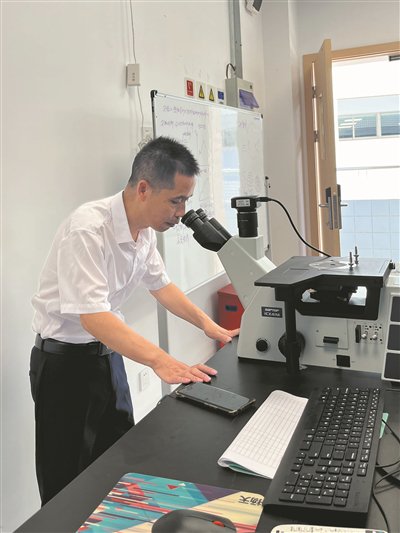
“科研不能关起门来做”
Xin Lang Cai Jing· 2026-01-12 21:04
Core Viewpoint - The article highlights the dedication and innovative approach of Zhong Meipeng, a prominent educator and researcher, in integrating education with industry practices to cultivate skilled talents in the field of mechanical engineering [3][4][5]. Group 1: Educational Approach - Zhong Meipeng emphasizes a "classroom teaching—research training—enterprise practice" model to enhance student learning and practical skills [4]. - He incorporates real-world industry cases, such as smart sensing and industrial IoT, into the curriculum to bridge the gap between theory and practice [3][4]. - His students have achieved notable success in various competitions, reflecting the effectiveness of his teaching methods [5]. Group 2: Research and Development - Zhong focuses on addressing real-world technical challenges through research, leading to significant advancements in precision manufacturing [5][6]. - His team developed a new ultrasonic-assisted grinding technology that resolves longstanding issues in the production of cylindrical rollers, contributing to industry upgrades [6]. - The successful implementation of his research has provided critical support for local industrial development [6]. Group 3: Community Engagement and Policy Advocacy - As a representative, Zhong has actively contributed to local governance by addressing issues such as the shortage of housing for high-level talent, resulting in the provision of 36 apartments for new talents [7]. - He has organized numerous events to facilitate knowledge sharing and support for young professionals in the community [6][7]. - Zhong's efforts in forming industry innovation alliances and conducting academic exchanges have fostered collaboration between academia and industry [6].
重磅利好,万亿级“国家队”投向明确了
2 1 Shi Ji Jing Ji Bao Dao· 2026-01-12 16:52
Group 1 - The National Development and Reform Commission, Ministry of Finance, Ministry of Science and Technology, and Ministry of Industry and Information Technology jointly released guidelines for the planning and investment direction of government investment funds, marking the first systematic regulation at the national level [1] - The evaluation of fund investment direction will focus on whether it supports the development of new productive forces, with targeted sectors including emerging industries and future industries [1] - Emerging industries include next-generation information technology, new energy, new materials, high-end equipment, new energy vehicles, green environmental protection, and civil aviation, while future industries encompass the metaverse, brain-computer interfaces, quantum information, and humanoid robots [1] Group 2 - On January 12, the A-share trading volume reached a historical high of 3.6 trillion, with over 4,100 stocks in the market showing positive performance [2]