
电动汽车

Search documents
谷歌Q2盈利超预期,将增加资本支出;电动汽车销量下滑,特斯拉Q2净利润同比下降23%丨全球科技早参
Mei Ri Jing Ji Xin Wen· 2025-07-24 00:15
Group 1 - Meta has developed a prototype gesture control wristband that allows users to control computers using hand gestures, including moving the cursor and writing in the air [1] - The wristband utilizes surface electromyography (sEMG) technology to detect electrical signals from muscle activity, enhancing its market presence in the smart hardware sector [1] Group 2 - Google's Q2 earnings exceeded expectations, with plans to increase capital expenditures by $10 billion by 2025 and further investments anticipated in 2026, leading to a 3% rise in stock price post-announcement [2] - The positive earnings report has boosted investor expectations for AI-related sectors, particularly cloud computing and AI hardware [2] Group 3 - Lovable, a Swedish startup, has surpassed $100 million in annual recurring revenue (ARR) within just eight months of its establishment, claiming over 2.3 million active users and 180,000 paying users [3] - This rapid growth positions Lovable as the fastest-growing software startup in history, drawing attention to the potential of AI applications [3] Group 4 - GitHub has launched an AI application development tool called GitHub Spark, enabling developers to create applications through simple descriptions without coding [4] - The tool utilizes Anthropic's Claude Sonnet 4 model to process user requests, potentially enhancing developer efficiency and signaling positive trends for cloud computing and AI applications [4] Group 5 - Tesla's Q2 financial results revealed a revenue of $22.5 billion, a 12% decline year-over-year, with adjusted net profit dropping by $419 million to $1.4 billion, a 23% decrease [5] - Sales of Tesla's best-selling models, Model Y and Model 3, fell by 12% compared to the previous year, while sales of more expensive models, including the Cybertruck, plummeted by 52%, leading to a 16% drop in automotive revenue [5]


特斯拉:营收、净利润双降
财联社· 2025-07-23 23:50
Core Viewpoint - Tesla's second-quarter financial results show a significant decline in both revenue and net profit, attributed to falling vehicle sales and reduced carbon credit income [1][2]. Financial Performance - Tesla reported second-quarter revenue of $22.496 billion, a year-on-year decrease of 12%, below market expectations of $22.826 billion [1]. - The net profit for the second quarter was $1.172 billion, down 23% year-on-year, slightly above the market expectation of $1.136 billion [1]. - Adjusted earnings per share were $0.40, also a 23% decline compared to the previous year, with expectations set at $0.42 [1]. Automotive Business - Revenue from Tesla's automotive business was $16.661 billion, reflecting a 16% year-on-year decline, following a 20% drop in the first quarter [2]. - The number of vehicles sold in the second quarter was 384,122, a decrease of 13.5% from 443,956 units sold in the same period last year [4]. Carbon Credit Income - Tesla's income from carbon credits was $439 million, less than half of the $890 million earned in the same quarter last year [2]. - The reduction in carbon credit income is expected to continue due to recent changes in U.S. federal tax laws that eliminate many electric vehicle subsidies and tax credits for the traditional automotive industry [2]. Strategic Adjustments - To attract buyers, Tesla has introduced a series of updates and financing incentives, including upgrades to the popular Model Y and the release of a lower-priced version of the Cybertruck [3]. - The company aims to improve and expand its Robotaxi service, with plans to allow half of the U.S. population access to autonomous ride-hailing by the end of the year [4]. Future Outlook - Tesla is seeking regulatory approval for its Robotaxi service in various states, including California, Nevada, Arizona, and Florida [4]. - The company is also adjusting its plans for the Optimus humanoid robot, aiming for mass production next year and a target annual output of 1 million units within five years [4].

昨夜,再创新高!特斯拉盘后大跌
第一财经· 2025-07-23 23:47
Group 1: Tesla - Tesla reported Q2 revenue of $22.5 billion, a 12% year-over-year decline, marking the largest drop in over a decade, with market expectations at $22.64 billion [3] - Net profit for Tesla was $1.172 billion, down 20.7% year-over-year, compared to market expectations of $1.136 billion [3] - Automotive revenue was $16.7 billion, down from $19.9 billion in the same period last year, with regulatory credit sales dropping from $890 million to $439 million [3] - Tesla's Q2 vehicle deliveries fell 14% year-over-year to 384,000 units, and the company did not provide an updated annual delivery forecast [3] - The recent "Inflation Reduction Act" will impact Tesla's business by eliminating the $7,500 federal electric vehicle tax credit by the end of Q3 [3] Group 2: Google - Google reported Q2 revenue of $96.43 billion, a 14% year-over-year increase, exceeding expectations of $94 billion [4] - Net profit for Google was $28.2 billion, up nearly 20% year-over-year [4] - Google's search and advertising segments continued to grow, with search revenue at $54.19 billion and advertising revenue increasing to $71.34 billion, a 10.4% rise from $64.61 billion year-over-year [4] - Cloud revenue reached $13.62 billion, a 31% increase [5] - Google raised its capital expenditure forecast for 2025 to $85 billion, citing strong demand for its cloud products and services [5] Group 3: Market Overview - U.S. stock markets saw a broad increase, with the Dow Jones rising 507.85 points (1.14%) to 45,010.29, just 4 points shy of its record close [1] - The Nasdaq Composite rose 0.61% to 21,020.02, marking its first close above 21,000 [1] - The S&P 500 index increased by 0.78% to 6,358.91, achieving its 12th record close of the year [1] - The U.S. Treasury yields rose, with the 2-year note up 4.3 basis points to 3.90% and the 10-year note up 3.7 basis points to 4.39% [7] - Market expectations indicate that the Federal Reserve will likely keep interest rates unchanged in the upcoming meeting [8]
与美贸易谈判,韩国、印度、马来西亚分别设“红线”
Huan Qiu Shi Bao· 2025-07-23 22:49
Group 1 - The U.S. government is nearing the end of a grace period for "reciprocal tariffs," prompting several countries to accelerate trade negotiations with the U.S. before the August 1 deadline [1] - South Korea has set a "red line" in its trade negotiations with the U.S., refusing to further open its beef and rice markets as bargaining chips [1] - South Korea remains the largest importer of U.S. beef, purchasing $2.22 billion worth in 2024, while the U.S. accounts for 32% of South Korea's rice import quota [1] Group 2 - India is facing challenges in reaching a temporary trade agreement with the U.S. by August 1, particularly regarding the reduction of tariffs on key agricultural products and dairy [2] - India has firmly rejected U.S. demands to lower dairy tariffs, maintaining its right to impose retaliatory tariffs on U.S. imports under WTO rules [2] - Malaysia is seeking to negotiate a reduction in the upcoming 25% tariffs imposed by the U.S., aiming to align closer to the 20% tariffs applicable to Indonesia and Vietnam [2][3] Group 3 - Malaysia's Minister of Investment, Trade and Industry expressed optimism about reaching a tax reduction agreement but warned against the risks of hasty agreements [3]
马斯克警告称:特斯拉处于一个“不寻常的转型期”。公司在美国丧失(电动汽车销售)激励政策。特斯拉恐怕会面临“好几个形势严峻的季度”。
news flash· 2025-07-23 22:35
马斯克警告称:特斯拉处于一个"不寻常的转型期"。 公司在美国丧失(电动汽车销售)激励政策。 特斯拉恐怕会面临"好几个形势严峻的季度"。 ...
马斯克催促美国消费者赶快下定
news flash· 2025-07-23 22:01
Group 1 - The core viewpoint is that President Trump's spending bill and tariffs will negatively impact demand in the electric vehicle market [1] - Orders placed by the end of August may not qualify for the federal electric vehicle tax credit [1] - The Trump administration's relaxation of carbon emission standards will harm conventional vehicle credit sales [1]
三年内跻身澳洲纯电动汽车品牌前五! 小鹏汽车隔空回应比亚迪 增值潜力超预期澳洲优质地段老旧房价逆袭 澳洲ETF黑马暴涨
Sou Hu Cai Jing· 2025-07-23 15:08
Group 1: Australian Small Businesses and Investment Climate - Following the RBA's decision to maintain the cash rate at 3.85%, small businesses are becoming more cautious in their investment decisions, with many delaying loan applications and withdrawals [1] - Banjo Loans reports that the current interest rate environment is making trade conditions more challenging for small enterprises, leading to a reduction in lending due to borrowers struggling to meet repayment capacity tests [1] Group 2: Australian Gaming Industry and ETF Performance - The Betashares ETF "GAME" has seen a remarkable annual growth of 90.3%, making it one of the best-performing ETFs in Australia, although its asset size remains relatively small at AUD 18 million [2] - The gaming industry is evolving into a global market comparable to film, music, and sports, with major companies like Nintendo and Tencent driving growth [2] - The Australian government’s introduction of a "digital games tax offset" is attracting international game developers, presenting new opportunities for the local gaming industry [2] Group 3: Real Estate Market Trends - Longview indicates that older homes in outer suburbs are experiencing price increases that exceed traditional "blue-chip" areas, driven by proximity to transport hubs and employment centers [2] - In the last fiscal year, property prices in Sydney's outer suburbs rose by 7%, significantly higher than the citywide average of 3.3%, while Melbourne saw a 6% increase compared to an average of 1.6% [2] Group 4: Electric Vehicle Market Dynamics - Xpeng Motors aims to rank among the top five electric vehicle brands in Australia within three years, despite BYD's current market dominance [4][5] - The Australian electric vehicle market is becoming increasingly competitive, with Xpeng emphasizing its commitment to innovation and long-term presence in the region [6] Group 5: Chinese Automotive Market Influence - Currently, Chinese vehicles account for approximately 17% of new car sales in Australia, with projections indicating this could rise to 43% by 2035 due to the rapid expansion of Chinese manufacturers like BYD and Chery [12] - BYD has surpassed Tesla to become the best-selling electric vehicle brand in Australia, with a staggering 368% year-on-year sales increase in June [12]


科技巨头的关键时刻!“七姐妹”财报季来袭,将如何定调美股后市?
智通财经网· 2025-07-23 13:41
Core Viewpoint - The earnings reports of the "Big Seven" tech giants, including Tesla, Microsoft, and Amazon, are under close scrutiny as they may set the tone for the overall market amidst economic uncertainty and inflation pressures [1] Group 1: Tesla - Tesla is expected to report earnings of $0.40 per share and revenue of $22.13 billion [1] - Investor sentiment is cautious due to challenges such as declining revenue, compressed profit margins, and reduced free cash flow [1][2] - Concerns have arisen regarding CEO Elon Musk's political activities potentially distracting from core business execution and brand image [2] Group 2: Alphabet - Alphabet is projected to report earnings of $2.20 per share and revenue of $93.98 billion [3] - The company is facing ongoing challenges from artificial intelligence impacting its core search business, but its adaptability keeps it competitive [3] - Investors will focus on Alphabet's ability to diversify revenue sources while managing AI-related disruptions [3] Group 3: Microsoft - Microsoft is anticipated to report earnings of $3.38 per share and revenue of $73.8 billion [4] - Growth is expected from rapid AI integration across its product lines, strong cloud service performance, and significant investments in data center infrastructure [4] - Key areas of investor interest include the integration of AI with Azure cloud services and the ability to convert AI-driven demand into recurring revenue [4] Group 4: Meta Platforms - Meta is expected to report earnings of $5.84 per share and revenue of $44.77 billion [6] - The company's stock has surged nearly 50% since April, driven by confidence in resilient advertising spending despite potential economic slowdowns [6] - AI remains a core growth engine for Meta, supported by the launch of the Llama 4 model and targeted acquisitions in the AI space [6] Group 5: Apple - Apple is projected to report earnings of $1.43 per share and revenue of $88.89 billion [7] - Investor focus will be on the growth of subscription services and other business segments, which are expected to enhance profit margins [7] - Concerns about slowing iPhone growth persist, but long-term investment logic is shifting towards service business growth [7] Group 6: Amazon - Amazon's stock performance has lagged behind the market, reflecting a significant disparity between revenue growth and profit growth [8] - The company is expected to see a 9.4% year-over-year revenue increase, but earnings per share growth is only projected at 3.6% [8] - Investors are keen on forward guidance, especially regarding cost control and operational resilience amid macroeconomic uncertainties [8]



美国电动汽车“缺血”,根源居然关联到中国
3 6 Ke· 2025-07-23 05:57
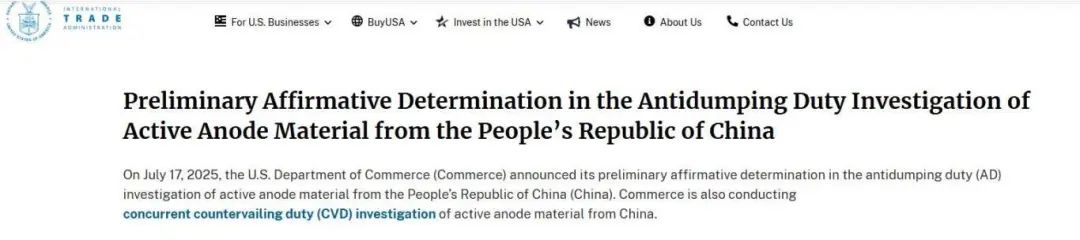
Core Viewpoint - The U.S. Department of Commerce announced a preliminary anti-dumping duty of 93.5% to 102.72% on active anode materials (AAM) imported from China, which could lead to an effective tariff rate of up to 160% on graphite products [1][2]. Group 1: Impact on Supply Chain - The new tariffs will significantly affect the supply chain for the global automotive industry, particularly for companies like Tesla, which rely heavily on Chinese graphite for battery production [5][8]. - Tesla has indicated that U.S. domestic graphite production currently cannot meet the quality and purity standards required for its batteries, leading to increased costs and potential supply chain disruptions [5][15]. - The International Energy Agency has identified graphite as a high-risk material in the supply chain, emphasizing the need for diversification [8][10]. Group 2: Financial Implications - The new tariffs are expected to impact approximately $340 million worth of imported graphite products, based on 2023 import volumes [4]. - The tariffs could increase the cost of battery cells by about $7 per kilowatt-hour, potentially erasing 1-2 quarters of profit for Korean battery manufacturers [5][8]. - Tesla's reliance on Chinese graphite is substantial, with projections indicating that it will indirectly procure around 80,000 tons of Chinese graphite in 2024, accounting for 67% of China's graphite exports to the U.S. [13][15]. Group 3: Broader Market Context - The global demand for graphite is projected to reach 16.02 million tons by 2040, quadrupling from 2021 levels, driven by the electric vehicle industry's transition to low-carbon manufacturing [11]. - Other countries like Canada, Madagascar, and Brazil have graphite resources, but they lack the processing capabilities that China possesses, which controls the entire supply chain from raw material purification to high-temperature graphitization [11][10]. - The U.S. has initiated actions to reduce dependence on Chinese graphite, but domestic production capabilities are currently insufficient to meet demand [10][15].
从造四轮车到转向二轮车,这家造车新势力遭遇了什么?
Zhong Guo Qi Che Bao Wang· 2025-07-23 05:54
Core Viewpoint - Rivian is facing significant challenges, including declining production and delivery numbers, increasing losses, and intense competition in the electric vehicle market, leading to a crisis of confidence among investors [2][3][6]. Production and Delivery - In Q2 2025, Rivian produced 5,979 vehicles, a year-on-year decline of 37.8%, and delivered 10,661 vehicles, down 22.7% [2]. - The company's production was impacted as it prepared for the launch of the 2026 model [2]. Financial Performance - Rivian has been experiencing continuous losses, primarily due to exorbitant manufacturing costs, which hinder its competitive pricing [3]. - The company's market share in the high-end electric SUV segment dropped from 12% in 2022 to 6% in 2024 [5]. Market Competition - Rivian's cumulative electric vehicle deliveries by the end of 2024 were only one-twentieth of Tesla's sales during the same period [4]. - The company faces fierce competition from models like Ford's F-150 Lightning and Tesla's Cybertruck, which are capturing significant market share [4]. Supply Chain and Quality Issues - Rivian has been affected by supply chain fluctuations, with battery raw material prices rising by 30%, increasing production costs [5]. - The company experienced multiple large-scale recalls in 2023, severely impacting customer satisfaction, which fell from 85 points in 2022 to 62 points in 2024 [5]. Investor Confidence - Rivian's market capitalization has plummeted over 90% from its peak of $150 billion, significantly outpacing the 60% decline of the Nasdaq Clean Energy Index [6]. Strategic Initiatives - Rivian is focusing on developing electric two-wheelers through its spin-off company, Also, which aims to innovate in the micro-mobility space [7]. - The company is betting on the upcoming R2 platform, a mid-size SUV expected to sell for $50,000, with a target of 150,000 annual sales [7]. - A joint venture with Volkswagen aims to develop next-generation electric architecture, supporting 800V fast charging, which could enhance Rivian's product competitiveness [8]. Future Outlook - Experts suggest that Rivian needs to refine its market positioning and focus on niche segments to uncover new growth opportunities [8].
