
航运业

Search documents
中美大消息!商务部,最新回应
证券时报· 2025-11-10 12:54
Core Viewpoint - The U.S. Trade Representative announced a one-year suspension of the Section 301 investigation measures against China's shipbuilding and related industries, effective from November 10, 2025, which reflects a mutual effort to enhance economic cooperation between the U.S. and China [1][3]. Group 1: U.S. Measures - The U.S. will suspend the imposition of port fees on Chinese vessels and additional tariffs on Chinese shore cranes and related equipment for one year [1]. - This decision is seen as a significant step towards implementing the consensus reached during the U.S.-China economic consultations in Kuala Lumpur [1]. Group 2: China's Response - In response, China will also suspend its countermeasures against relevant U.S. companies, including the suspension of retaliatory measures against five subsidiaries of Hanwha Ocean Co., Ltd. [3]. - China expresses willingness to engage in further communication and negotiation with the U.S. based on mutual respect and equality [1]. Group 3: Transportation Ministry Announcement - The Ministry of Transport announced the suspension of special port fees for U.S. vessels and the investigation into the impact on the maritime and shipbuilding industries, effective from November 10, 2025 [5]. - This action aligns with the broader suspension of the Section 301 measures and aims to maintain a fair competitive environment in international shipping and shipbuilding markets [5].


交通运输部公告:暂停实施,为期1年
Zhong Guo Neng Yuan Wang· 2025-11-10 10:47
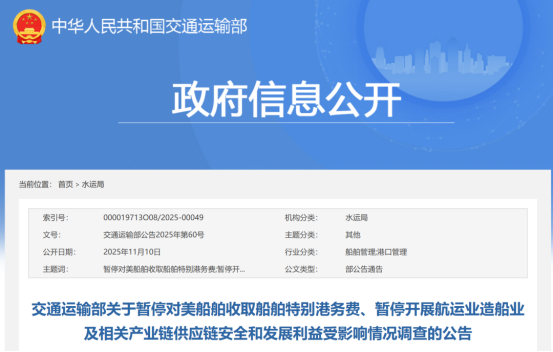
11月10日,交通运输部发布《关于暂停对美船舶收取船舶特别港务费、暂停开展航运业造船 业及相关产业链供应链安全和发展利益受影响情况调查的公告》。 以下为原文 | 中华人民共和国交通运输部 | | | Can Public | | --- | --- | --- | --- | | 政府信息公开 | | | | | 当前位置:首页 >水运局 | | | | | 索引号: | 000019713008/2025-00049 | 机构分类: | 水运局 | | 文号: 交通运输部公告2025年第60号 | | 主题分类: | 其他 | | 主题词: 暂停对美船舶收取船舶特别港务费:暂停开 ... | | 公文类型: | 部公告通告 | | 公开日期: 2025年11月10日 | | 行业分类: | 船舶建建:滇口管理 | | 交通运输部关于暂停对美船舶收取船舶特别港务费、暂停开展航运业造船业 | | | | 交通运输部 2025年11月10日 【责任编辑:刘澄谚 】 及相关产业链供应链安全和发展利益受影响情况调查的公告 为落实2025年中美吉隆坡经贸磋商达成共识,经国务院批准,自2025年11月10日13时01分起 ...
海航科技涨停,沪股通龙虎榜上净买入1554.60万元
Zheng Quan Shi Bao Wang· 2025-11-10 09:41
Core Viewpoint - HNA Technology (600751) experienced a trading halt today, with a turnover rate of 4.37% and a transaction amount of 547 million yuan, indicating significant market activity and interest in the stock [1] Trading Activity - The stock was listed on the Shanghai Stock Exchange's "Dragon and Tiger List" due to a price deviation of 9.59%, with a net purchase of 15.546 million yuan from the Shanghai-Hong Kong Stock Connect [1] - The top five trading departments accounted for a total transaction amount of 182 million yuan, with a net purchase of 73.4407 million yuan [1] - The leading buying department was the Shanghai-Hong Kong Stock Connect, which had a buying amount of 40.7723 million yuan and a selling amount of 25.2264 million yuan, resulting in a net purchase of 15.546 million yuan [1] Fund Flow - The stock saw a net inflow of 140 million yuan from major funds today, with a significant inflow of 136 million yuan from large orders [2] - Over the past five days, the net inflow of major funds totaled 99.3992 million yuan [2] Margin Trading Data - As of November 7, the stock's margin trading balance was 833 million yuan, with a financing balance of 831 million yuan and a securities lending balance of 2.0612 million yuan [2] - The financing balance increased by 44.7648 million yuan over the past five days, representing a growth of 5.70% [2] Financial Performance - According to the third-quarter report released on October 31, the company achieved an operating income of 1.046 billion yuan, a year-on-year increase of 25.06%, while the net profit was 96.8356 million yuan, reflecting a year-on-year decline of 13.29% [2]

交通运输部、商务部最新公告,暂停一年!
Qi Huo Ri Bao· 2025-11-10 06:34
Group 1 - The Ministry of Transport announced the suspension of special port fees for U.S. vessels and related investigations for one year, effective from November 10, 2025, at 13:01 Beijing time [1] - This decision aligns with the consensus reached during the 2025 China-U.S. Kuala Lumpur economic and trade consultations, approved by the State Council [1] - The suspension includes the implementation of various announcements related to maritime, logistics, and shipbuilding industries [1] Group 2 - The Ministry of Commerce decided to suspend countermeasures against five U.S. subsidiaries of Hanwha Ocean Corporation for one year, starting from November 10, 2025 [3] - This decision follows the U.S. announcement on November 9, 2025, to suspend its 301 investigations into China's maritime, logistics, and shipbuilding industries for one year [3] - The suspension is based on the Anti-Foreign Sanctions Law and its implementation regulations [3]

交通运输部公告:暂停实施,为期1年
中国能源报· 2025-11-10 05:47
Core Viewpoint - The Ministry of Transport announced the suspension of special port fees for U.S. vessels and the investigation into the shipping and shipbuilding industries, effective from November 10, 2025, to align with the consensus reached during the 2025 China-U.S. Kuala Lumpur economic and trade consultations [1][3]. Group 1 - The suspension of special port fees for U.S. vessels is part of the measures to implement the agreements made in the 2025 economic and trade consultations between China and the U.S. [3]. - The announcement includes the suspension of the implementation of the final measures related to the 301 investigation into China's maritime, logistics, and shipbuilding industries [3]. - The Ministry of Transport's announcement is officially documented as Announcement No. 54 of 2025 and is part of a broader strategy to enhance bilateral trade relations [3].

交通运输部:暂停实施,为期1年
中国基金报· 2025-11-10 05:07
来源:交通运输部网站 交通运输部网站10日发布关于暂停对美船舶收取船舶特别港务费、暂停开展航运业造船业及相关 产业链供应链安全和发展利益受影响情况调查的公告: 为落实2025年中美吉隆坡经贸磋商达成共识,经国务院批准,自2025年11月10日13时01分 起,与美方暂停实施对华海事、物流和造船业301调查最终措施同步暂停实施《交通运输部关于 对美船舶收取船舶特别港务费的公告》(交通运输部公告2025年第54号)、《交通运输部办公 厅关于印发<对美船舶收取船舶特别港务费实施办法>的通知》(交办水〔2025〕59号)、《交 通运输部关于启动航运业、造船业及相关产业链供应链安全和发展利益受影响情况调查的公告》 (交通运输部公告2025年第55号)1年。 ...

交通运输部:暂停对美船舶收取船舶特别港务费
Yang Shi Wang· 2025-11-10 04:40
Core Points - The Ministry of Transport announced the suspension of special port fees for U.S. vessels and related investigations into the shipping and shipbuilding industries [1][2] - This suspension is part of the consensus reached during the 2025 China-U.S. Kuala Lumpur economic and trade consultations, effective from November 10, 2025 [2] Group 1 - The suspension of special port fees for U.S. vessels will last for one year [2] - The Ministry of Transport's previous announcements regarding the implementation of special port fees and investigations into the shipping and shipbuilding industries are also suspended [2] - The decision aims to align with the final measures of the 301 investigation against China [2]
特朗普十月出两狠招!制裁俄两大石油商还拦碳税,全球格局晃?
Sou Hu Cai Jing· 2025-11-09 12:25
Group 1: Sanctions on Russian Oil - The sanctions imposed by Trump on Russian oil giants Lukoil and Rosneft are significant as they account for nearly half of Russia's oil exports [3][21] - Russia's response indicates that it has become "immune" to Western sanctions, having shifted its export focus to countries like China and India, using local currencies for transactions [6][16] - India's decision to potentially reduce oil purchases from Russia reflects its desire to maintain good trade relations with the U.S., but raises concerns about domestic supply and costs [7][21] Group 2: Impact on Global Shipping and Carbon Tax - Trump's actions at the IMO conference disrupted a carbon tax plan agreed upon by over 60 countries, which aimed to generate $3 trillion for green transformation by 2026 [9][17] - The delay in implementing the carbon tax is expected to reduce green investments by 30% among the top 20 shipping companies, hindering the industry's transition to sustainable practices [12][17] - The EU's intention to implement its own carbon tax in 2026 could lead to conflicts with U.S. policies, complicating transatlantic shipping trade [19][21] Group 3: Broader Implications for International Cooperation - Trump's approach undermines international cooperation, making it more challenging to achieve global consensus on issues like climate change and conflict resolution [19][22] - The sanctions on Russian oil and the halt of the carbon tax could lead to increased oil prices and shipping costs for consumers, ultimately impacting the general public [22]
银河期货每日早盘观察-20251107
Yin He Qi Huo· 2025-11-07 05:38
Report Industry Investment Ratings No relevant content provided. Core Views of the Report - The stock index futures are expected to test new highs again, while the bond market for treasury bond futures may be volatile in the short term [17][21]. - Agricultural products show different trends, such as soybean meal with fading bullish factors and a falling price, and sugar with a weakening international market and a fluctuating - weak domestic market [24][27]. - In the black metal sector, steel prices are range - bound, coking coal and coke are in high - level oscillations, and iron ore should be treated with a bearish mindset [57][59][62]. - For non - ferrous metals, precious metals are in range consolidation, copper prices are restricted by consumption, and aluminum prices are relatively strong due to supply concerns [68][71][78]. - In the energy and chemical sector, crude oil prices are weakly volatile due to economic concerns, and asphalt prices are under pressure [16][30]. Summaries by Related Catalogs Financial Derivatives Stock Index Futures - On Thursday, the market rose across the board, with major indexes and futures contracts gaining. The market sentiment was stimulated, and the stock index is expected to continue to rise. Trading strategies include not chasing high prices, conducting IM/IC long 2512 + short ETF cash - and - carry arbitrage, and using bullish spreads at low prices [19][20][21]. Treasury Bond Futures - On Thursday, most treasury bond futures contracts closed down. The central bank's net withdrawal of liquidity affected the market. In the short term, the bond market may be volatile, and trading strategies include waiting and conducting 30Y - 7Y term spread short - selling arbitrage [22][23]. Agricultural Products Soybean Meal - CBOT soybean and soybean meal indexes declined. Brazil's soybean and soybean meal exports are expected to increase. The domestic market has a loss in crushing profit, and the far - month price may face pressure. Trading strategies include short - selling in the far - month and using a short - straddle option strategy [25][26][27]. Sugar - The international sugar market is in a downward trend with increased production in major regions. The domestic market is affected by international prices and increased supply, but is also supported by import policies. Trading strategies include range - bound operations, short - selling international sugar and going long on Zhengzhou sugar [30][31][32]. Oilseeds and Oils - The prices of CBOT soybean oil and BMD palm oil decreased. The palm oil inventory in Malaysia and China shows different trends. Short - term trading strategies include short - term long positions or waiting [33][34][35]. Corn/Corn Starch - The CBOT corn futures price fell. The domestic corn inventory and consumption data are mixed. The price is expected to be range - bound, and trading strategies include short - term long and short positions at appropriate times [37][38]. Live Pigs - The pig price is generally stable or slightly rising. The overall supply pressure still exists. Trading strategies include short - selling and using a short - straddle option strategy [39][40]. Peanuts - The peanut price is weak. The oil mill's purchase is suspended. The peanut is in a short - term bottom - oscillating phase. Trading strategies include short - term long positions and selling a PK601 - P - 7600 option [42][43][44]. Eggs - The egg price is rising. The inventory of laying hens is high, and the price increase space is limited. Trading strategies include closing short positions and waiting [46][48]. Apples - The apple inventory data shows a decrease compared to last year. The price is at a high level with large market divergence. It is recommended to wait and see [50][51]. Cotton - Cotton Yarn - The new cotton is about to be listed in large quantities. The supply may increase, and the demand is in the off - season. The cotton price is expected to be slightly stronger in the short term. Trading strategies include waiting [55][56]. Black Metals Steel - The supply of five major steel products decreased, and the inventory decreased slightly. The steel price is range - bound, affected by production, inventory, and demand. Trading strategies include holding long positions and long - shorting the coil - rebar spread [58][59]. Coking Coal and Coke - The coking coal auction price increased, and the coke price rose for the third time. The supply may be restricted by safety supervision, and the short - term price is in high - level oscillations. Trading strategies include waiting and buying on dips in the medium term [60][61][62]. Iron Ore - The global iron ore supply is high, and the domestic demand is weak. The iron ore price is expected to be bearish. Trading strategies include short - selling [63][64]. Ferroalloys - The prices of silicon iron and manganese silicon are at a low - valuation level. The previous short positions can be reduced. Trading strategies include short - selling a virtual straddle option combination [66]. Non - Ferrous Metals Precious Metals - The prices of gold and silver fluctuated. The US economic and political factors have mixed effects on precious metals. The price is expected to be range - bound. Trading strategies include range - bound operations [68][70][71]. Copper - The copper price is affected by the US government shutdown and supply - demand factors. The supply is tight, and the consumption is insufficient. Trading strategies include waiting and conducting cash - and - carry arbitrage [72][73]. Alumina - The alumina price is in a bottom - oscillating phase. The supply is expected to decrease, but the actual reduction has not occurred. Trading strategies include waiting [75][77][78]. Electrolytic Aluminum - The aluminum price is relatively strong due to overseas supply concerns and domestic consumption growth. Trading strategies include going long on dips and long - shorting the SHFE - LME spread [79][80]. Cast Aluminum Alloy - The price of cast aluminum alloy is strongly oscillating with the aluminum price. It is supported by cost and supply - demand factors. Trading strategies include going long on dips [82][83]. Zinc - The zinc price is range - bound. The supply may decrease due to reduced processing fees and increased exports. Trading strategies include waiting [85][86]. Lead - The lead price may decline due to increased supply and decreased demand. Trading strategies include holding short positions [88][90][92]. Nickel - The nickel market has a loose supply - demand relationship, and the cost support may weaken. The price is in a weak oscillation. Trading strategies include short - selling a 2512 contract short - straddle combination [93][94][95]. Stainless Steel - The stainless steel market has weak supply - demand, and the production profit is difficult to achieve. Trading strategies include short - selling on rebounds [96]. Industrial Silicon - The demand for industrial silicon is weakening, and the supply may decrease due to power price increases. The price is range - bound. Trading strategies include buying on dips [98]. Energy and Chemicals Crude Oil - The crude oil price is weakly volatile due to concerns about the economic outlook [16]. Asphalt - The asphalt price is under pressure due to weak reality and expectations [30]. Fuel Oil - The supply pressure of high - sulfur fuel oil continues to increase [30]. PX & PTA - There are more maintenance operations, and the demand is acceptable [32]. Ethylene Glycol - The supply - demand relationship will become looser in the fourth quarter [33]. Short - Fiber - The demand support is limited, and the price follows the cost increase [33]. PR (Bottle Chip) - The demand is transitioning from the peak season to the off - season [34]. Pure Benzene and Styrene - The price is oscillating in the short term [35]. Propylene - The supply pressure remains, and the price is falling [36]. Plastic PP - PE&PP production increases year - on - year and month - on - month [37]. Caustic Soda - The caustic soda price is weak [37]. PVC - The price is mainly oscillating [38]. Soda Ash - The cost is pushed up by coal prices [39]. Glass - Although there are rumors of production line shutdowns, the demand is weak [40]. Methanol - There is short - term weak support from gas restrictions [41]. Urea - The price rebounds due to news stimulation [42]. Pulp - The pulp price is in a stalemate, and the futures market is strongly oscillating [42]. Logs - The spot price is weakly oscillating [43]. Offset Printing Paper - The market is under pressure, and price increases are not well - implemented [44]. Natural Rubber and 20 - Number Rubber - The tire production increases month - on - month [45]. Butadiene Rubber - BD&BR production shows marginal reduction and month - on - month tire production increase [46].
中谷物流(603565):25Q3业绩有所下滑,Q4内贸旺季有望带动盈利回升
CMS· 2025-11-07 05:32
Investment Rating - The report maintains an "Accumulate" investment rating for the company [4]. Core Views - The company experienced a decline in performance in Q3 2025, but the domestic trade peak season in Q4 is expected to drive a recovery in profitability [1]. - The foreign trade sector remains robust, with significant improvements in profitability due to high rental rates for container ships and an increase in the number of chartered vessels [2]. - The company is expected to maintain a high dividend payout ratio, indicating strong long-term investment value [7]. Financial Performance Summary - For the first three quarters of 2025, the company's revenue reached 7.9 billion yuan, a year-on-year decrease of 6.5%, while net profit attributable to shareholders was 1.41 billion yuan, an increase of 27.2% [1]. - Q3 revenue was 2.56 billion yuan, down 5.3% year-on-year, with a net profit of 340 million yuan, down 3.7% year-on-year and 35.4% quarter-on-quarter [1]. - The gross profit margin for the first three quarters of 2025 improved to 22.3%, an increase of 9 percentage points year-on-year [2]. Future Earnings Forecast - The company’s earnings for 2025-2027 are projected to be 1.967 billion yuan, 2.028 billion yuan, and 1.931 billion yuan respectively, with a slight downward adjustment for 2025 due to Q3 performance but an upward adjustment for 2026-2027 [7]. - The expected earnings per share (EPS) for 2025 is 0.94 yuan, with a price-to-earnings (PE) ratio of 11.8 [3][16]. Market Position and Shareholder Information - The company has a total market capitalization of 23.2 billion yuan, with a significant shareholder, Zhonggu Logistics Group, holding 57.46% of the shares [4]. - The company’s return on equity (ROE) stands at 21.6%, indicating strong profitability relative to shareholder equity [4].
