
药店

Search documents
国金证券:重磅交易增强创新药信心 ASCO临床数据带来丰富催化
智通财经网· 2025-05-26 07:02
Pharmaceutical Sector - The pharmaceutical sector in China is showing strong performance, with significant transactions such as the $1.25 billion deal enhancing market confidence in the quality and market value of Chinese innovative drugs [1] - Chinese pharmaceutical companies are increasingly making their mark in global licensing transactions and showcasing their clinical pipeline potential at major conferences like ASCO [2] - The outlook for the pharmaceutical sector is optimistic, with expectations of a reversal in market trends by 2025, driven by innovative drugs and the recovery of left-side sectors [1][2] Biopharmaceuticals - GSK announced FDA approval for mepolizumab as an additional maintenance treatment for poorly controlled chronic obstructive pulmonary disease (COPD) patients, with projected global sales of €1.784 billion in 2024 [3] - There is a growing interest in IL-5 targeted drugs, with several domestic companies already engaged in this area [3] Medical Services & Consumer Healthcare - Alcon reported Q1 2025 surgical business net sales of $1.338 billion, a 1% year-on-year decline, but a 2% increase at constant exchange rates [4] - Vision care business net sales reached $1.106 billion in Q1 2025, reflecting a 1% year-on-year growth, driven by innovations in contact lenses [4] Medical Devices - Johnson & Johnson Medical launched the SOUNDSTAR CRYSTAL ultrasound catheter in the U.S. for cardiac ablation procedures, indicating a rich pipeline of innovative products [5] - There is a strong long-term demand trend for innovative medical devices, with a focus on leading companies that are expected to rapidly scale new products [5] Pharmacies - A recent initiative by multiple government departments aims to enhance the health promotion functions of retail pharmacies, indicating a supportive policy environment for non-drug product expansion [6] - Continuous optimization of industry regulations and the implementation of drug traceability measures are expected to create a more favorable environment for pharmacies [6]

过去一年关店近4万家!昔日“狂飙”的连锁药店出路在哪?
21世纪经济报道· 2025-05-21 15:27
Core Viewpoint - The retail pharmacy industry in China is undergoing significant challenges, with a trend of store closures and a shift from aggressive expansion to a focus on quality and efficiency [3][4][10]. Group 1: Store Closures and Industry Trends - Major retail pharmacy chains, including Lao Bai Xing, Yi Feng Pharmacy, and Yi Xin Tang, have reported a continued strategy of closing underperforming stores while slowing down expansion efforts [3][4]. - In Q1 2025, Lao Bai Xing and Shu Yu Ping Min closed 161 and 86 stores respectively, while Yi Feng Pharmacy opened 94 stores but closed 84 [3][7]. - The overall closure rate in the retail pharmacy sector reached 5.7% in 2024, with over 39,000 stores shutting down [4][11]. Group 2: Financial Performance - Yi Feng Pharmacy reported Q1 2025 revenue of 600.9 million yuan, a year-on-year increase of 0.64%, while its net profit grew by 10.51% [7]. - In contrast, Lao Bai Xing, Yi Xin Tang, and Jian Zhi Jia experienced revenue declines of 1.88%, 6.53%, and 0.85% respectively in Q1 2025 [7][8]. - The financial performance of many listed pharmacy chains has shown a decline in both revenue and profit, indicating a challenging market environment [6][8]. Group 3: Market Dynamics and Future Outlook - The retail pharmacy industry is experiencing a consolidation phase, driven by increased market concentration and regulatory pressures [10][14]. - The shift from rapid expansion to a focus on closing unprofitable stores and improving operational efficiency is becoming a new trend in the industry [10][12]. - Companies are exploring new retail models and diversifying their offerings to adapt to changing market conditions, with some focusing on integrating online and offline sales [14][15].






药店大考进行时:过去一年关店近4万家,一季度收缩持续
2 1 Shi Ji Jing Ji Bao Dao· 2025-05-21 11:18
Core Viewpoint - The retail pharmacy industry in China is facing significant challenges, leading to a wave of store closures and a shift in focus from rapid expansion to improving operational efficiency and quality [1][6][8]. Group 1: Store Closures and Expansion Strategies - Major retail pharmacy chains, including Lao Bai Xing, Yi Feng Pharmacy, and Yi Xin Tang, are continuing to close underperforming stores while slowing down their expansion efforts [1][4]. - In Q1 2025, Lao Bai Xing closed 161 stores and opened 24, while Yi Feng Pharmacy opened 94 stores (26 self-built and 68 franchises) but closed 84 [1][4]. - The overall closure rate for retail pharmacies reached 5.7% in 2024, with over 39,000 stores shutting down [1][6]. Group 2: Financial Performance - Financial reports for Q1 2025 show a mixed performance among major chains, with Lao Bai Xing, Yi Xin Tang, and Jian Zhi Jia experiencing revenue and profit declines [3][4]. - Yi Feng Pharmacy reported a revenue of 6.009 billion yuan, up 0.64% year-on-year, and a net profit of 449 million yuan, up 10.51% [3][4]. - Dazheng Lin achieved a revenue of 6.956 billion yuan, up 3.02%, and a net profit of 460 million yuan, up 15.45% [3][4]. Group 3: Industry Trends and Challenges - The retail pharmacy sector is undergoing a deep transformation, moving from aggressive expansion to a focus on quality and efficiency due to market saturation and increased regulatory scrutiny [6][8]. - The number of pharmacies in China increased from 524,000 in 2019 to 667,000 in 2023, leading to structural oversupply [8][9]. - Industry experts predict that around 20% of small pharmacies may be eliminated, further increasing market concentration [8]. Group 4: New Retail Strategies - Leading chains are integrating online and offline operations to adapt to changing market dynamics, with Yi Feng Pharmacy reporting significant online sales growth [9][10]. - Dazheng Lin is focusing on building a prescription transfer system and enhancing professional service capabilities to differentiate itself in a competitive landscape [9][10]. - Yi Xin Tang is exploring diversification into non-pharmaceutical products and new business models, such as combining pharmacies with convenience stores [10].

一心堂(002727) - 2025年5月21日调研活动附件之投资者调研会议记录
2025-05-21 10:38
Group 1: Business Strategy and Goals - The company aims to enhance the operational quality of existing stores, focusing on relocation and renovation rather than significantly increasing the number of stores [2] - The mid-term goal is to increase the sales proportion of non-pharmaceutical products to around 40%, with a long-term target of approximately 50% [2] - The company plans to transform over 500 stores in Yunnan this year, with pilot stores showing an increase in non-pharmaceutical sales from 15% to over 35% [2] Group 2: Business Segments - Retail business includes pharmacies, drugstores, and convenience stores, with a strong push towards non-pharmaceutical sales [2] - The Chinese medicine segment plans to increase the number of registered formula granule products from nearly 350 to an additional 100 [3] - The health and wellness segment saw a 29.3% year-on-year growth in sales, with functional foods increasing by 120% [4] Group 3: Store Transformation and Management - Over 70% of stores are categorized as multi-category pharmacies, while over 20% are specialized pharmacies [6] - The company employs a digital management system to analyze customer demographics for product selection [7] - The transformation of specialized pharmacies is yielding new growth points, particularly in specialty drugs and oncology products [8] Group 4: Financial Impact and Future Planning - The company is committed to transformation and upgrading, with minimal financial impact due to the focus on product addition and employee skill enhancement [9] - New business models will be developed in collaboration with suppliers, leveraging digital analysis for gradual store renovations [9]
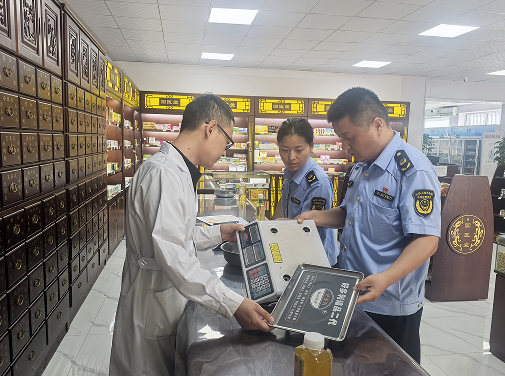
精准计量护健康 市场监管在行动
Zhong Guo Shi Pin Wang· 2025-05-19 08:57
Group 1 - The core viewpoint of the articles is the implementation of a special rectification action by the market supervision administration in Aimin County to regulate the use of measuring instruments in traditional Chinese medicine clinics and pharmacies, ensuring market measurement order and protecting consumer rights [2][3] - The special inspection focuses on electronic weighing scales and other measuring instruments used in traditional Chinese medicine clinics and pharmacies, verifying whether these instruments have been certified by legal institutions and are within their validity period, as well as checking for any unauthorized modifications or cheating behaviors [2] - Legal education is being promoted during the inspection process, informing operators about the Measurement Law of the People's Republic of China and its implementation rules, clarifying legal responsibilities and consequences of violations, and encouraging operators to self-regulate their measurement practices [2] Group 2 - The 12315 complaint and reporting channel is being utilized to encourage consumers to pay attention to the certification marks of measuring instruments when purchasing traditional Chinese medicine, and to report any issues such as short weights or cheating measurements [3] - As of now, 12 traditional Chinese medicine clinics and pharmacies have been inspected, with 2 clinics found to have measuring instruments without valid certification, leading to the issuance of evidence preservation notices [3] - The market supervision department plans to continue strengthening measurement regulation, expanding the scope of inspections, and regularly promoting supervision and legal education to combat measurement fraud and the use of unqualified measuring instruments, thereby maintaining market measurement order and creating a fair, honest, and safe consumption environment for the public [3]
一心堂(002727) - 2025年5月16日调研活动附件之投资者调研会议记录
2025-05-16 10:52
一心堂药业集团股份有限公司 网上业绩说明会会议记录 时间:2025 年 5 月 16 日 16:00-17:00 地点:全景网"投资者关系互动平台"(http://rs.p5w.net) 召 开 方 式 : 公 司 通 过 全 景 网 " 投 资 者 关 系 互 动 平 台 " (http://rs.p5w.net),采用网络远程的方式举行 2024 年度云南辖 区上市公司投资者网上集体接待日活动 投资者:通过全景网"投资者关系互动平台"(https://rs.p5w.net) 参与"2024 年度云南辖区上市公司投资者网上集体接待日"的全体 投资者 接待人:副总裁兼董事会秘书李正红先生、证券事务代表阴贯香女士 一心堂药业集团股份有限公司(以下简称"公司")于 2025 年 5 月 16 日(星 期五)下午 16:00-17:00 在全景网举办 2024 年度云南辖区上市公司投资者网上 集体接待日活动,本次投资者网上集体接待日活动采用网络远程的方式举行,公 司就投资者在本次说明会中提出的问题进行了回复,内容如下: 问题一:贵司药品零售价,线上平台和线下门店的零售价格有区别么? 心镜等数字化、智能化系统,由全资 ...
周度行情前瞻暨个股推荐(GLP-1方向)
2025-05-12 01:48
Summary of Conference Call Records Industry Overview - The pharmaceutical industry is projected to see a revenue decline of 0.46% in 2024, with net profit attributable to shareholders decreasing by 6.7% and non-recurring net profit declining by approximately 11% [1][4] - In Q1 2025, the fastest-growing sectors include medical services, CXO, and raw materials, while community pharmacies and research services lead in revenue growth [1][4] Key Insights on Specific Sectors Innovative Drug Sector - 23 innovative companies reported a total revenue of 62.8 billion yuan in 2024, reflecting a year-on-year growth of 23.8%, with net profit attributable to shareholders reaching 3.7 billion yuan, significantly outpacing the industry average [1][5] - In Q1 2025, these companies achieved a total revenue of 16.3 billion yuan, marking an 18.7% year-on-year increase, indicating a trend towards profitability [5] Research Services Industry - The research services sector saw a total revenue growth of 6.5% in 2024, although profits declined by 20%-16% [6] - In Q1 2025, total revenue grew by 4.7%, with scale profit increasing by 9% and non-recurring profit rising by 13%, indicating a recovery phase compared to the overall industry decline of 5% [6][7] CXO Industry - The CXO sector experienced a revenue decline in 2024 but rebounded in Q1 2025 with a 13% year-on-year revenue growth and a 23% increase in non-recurring net profit, showcasing strong development potential [8] Chemical Preparations Sector - The chemical preparations industry reported stable revenue in 2024, with a slight increase of 1.2%, and a minimal growth of 0.3% in Q1 2025, indicating a phase of stability [9][10] Raw Materials Sector - The raw materials sector faced a revenue decline of 3.8% in Q1 2025, following a 3.9% decrease in 2024, but non-recurring profit grew by 5%, suggesting that the most challenging phase post-pandemic has passed [10] Medical Devices and Traditional Chinese Medicine - The medical devices industry is projected to grow by 1% in 2024 and 0.3% in Q1 2025, with noticeable profit declines potentially linked to centralized procurement policies [11] - The traditional Chinese medicine sector experienced a 6% revenue decline in Q1 2025 due to high base effects, following a 3.9% decrease in 2024 [11] GLP-1 Receptor Agonists Developments - The development of GLP-1 receptor agonists is trending towards oral formulations and extended half-lives, with multi-target drugs becoming a research focus [3][14] - Notably, the revenue for semaglutide surpassed that of pembrolizumab, indicating strong consumer demand [13] - Companies such as Innovent Biologics, Federated Pharmaceuticals, and Boryung Pharmaceutical are making significant strides in the GLP-1 space [16] Market Performance - The overall pharmaceutical sector saw a 1% increase this week, with a year-to-date rise of 1.2%, slightly underperforming compared to the CSI 300 index, which fell by 1% [2] - Notable individual stock performances included Changshan Pharmaceutical (up 23%), Haichuang Pharmaceutical (up 22%), and Jinkai Biotechnology (up 19%) [2] Conclusion - The pharmaceutical industry is navigating a challenging landscape with mixed performance across sectors, but innovative drugs and specific niches like GLP-1 receptor agonists show promising growth potential. The recovery signs in research services and CXO sectors are noteworthy, indicating potential investment opportunities.
日元贬值催生洼地 绩优基金Orbis加码日本药店、地产股
智通财经网· 2025-05-07 09:44
Group 1 - Orbis International Equity Fund has doubled its investment in Japanese stocks, increasing the allocation from 10% to 24%, resulting in a year-to-date return of 16% [1][2] - The fund manager, Graeme Foster, highlights that the depreciation of the yen over the past decade has led to undervaluation of Japanese companies, creating a "golden pit" of investment opportunities [1][2] - The yen has appreciated nearly 10% against the dollar this year, making it the best-performing major currency globally, which is expected to provide "dual benefits" for foreign investors in Japanese import-oriented companies [1][2] Group 2 - Foster has allocated 4% of the fund to the Japanese pharmacy sector, focusing on companies like Tsuruha Holdings and Sundrug, which are expected to benefit from increased market concentration and bargaining power [2] - The fund holds significant positions in Asahi Group and Mitsubishi Estate, with the former showing a 40% dividend payout ratio and stock buyback plan, while the latter benefits from rising rental prices [2] - Outside of Japan, the fund has also seen gains from European defense and banking sectors, although it has exited positions in Rheinmetall due to high gains, while maintaining holdings in Hanwha Aerospace and Mitsubishi Heavy Industries [2] Group 3 - Foster emphasizes a strategy focused on free cash flow yield, seeking companies that can generate 12%-14% cash flow returns, which allows for less concern over external factors like AI advancements or political policies [3] - The fund is validating the potential for traditional "value traps" to transform into "growth soil" as Japan emerges from deflation [3]
医药行业2024年及2025Q1总结报告:药店、医药流通增长较好,CXO环比持续改善
Soochow Securities· 2025-05-05 11:50
Investment Rating - The report indicates a cautious outlook for the pharmaceutical industry, with a focus on recovery in 2024 after a challenging 2023 due to anti-corruption measures [6][19]. Core Insights - The pharmaceutical industry is projected to see a decline in sales revenue and net profit for 2024 compared to 2023, with total sales revenue growth at -0.46%, net profit at -6.73%, and non-recurring net profit at -11.97% [2][13]. - The fastest-growing segments in Q4 2024 are expected to be CXO, medical devices, and pharmaceutical distribution, while in Q1 2025, the growth leaders will shift to CXO, pharmacies, and pharmaceutical distribution [22]. - The report highlights a significant slowdown in growth for traditional Chinese medicine and a mixed performance across various sectors, with some showing resilience and others facing challenges [5][24]. Summary by Sector Pharmaceutical Industry - In 2024, the total revenue growth for 405 pharmaceutical companies is projected at -0.46%, with net profit declining by 6.73% [2][13]. - Q1 2025 shows a continued decline in revenue and net profit, indicating ongoing challenges [13]. Traditional Chinese Medicine - For 62 listed companies in traditional Chinese medicine, revenue and net profit are expected to decline by -3.9% and -14.6% respectively in 2024, with further declines in Q1 2025 [24][32]. Chemical Preparations - The 96 chemical preparation companies are expected to see revenue growth of 1.2% and net profit growth of 15.7% in 2024, with a slight slowdown in Q1 2025 [2][5]. Research Services - The 16 research service companies are projected to experience a revenue increase of 6.56% in 2024, despite a significant drop in net profit [2][5]. Medical Services - The 11 medical service companies are expected to face revenue growth of 1.4% in 2024, with a notable recovery in Q1 2025 [2][5]. Medical Devices - The 97 medical device companies are projected to see a slight revenue increase of 1.16% in 2024, with a decline in net profit [2][5]. Biopharmaceuticals - The 54 biopharmaceutical companies are expected to see a revenue decline of -6.9% in 2024, with a significant drop in Q1 2025 [3][5]. CXO - The 22 CXO companies are projected to experience a revenue decline of -4.14% in 2024, but a recovery is anticipated in Q1 2025 with a revenue increase of 13.1% [3][5]. Raw Materials - The 50 raw material companies are expected to see a slight revenue increase of 2.48% in 2024, with a recovery trend starting in Q1 2025 [3][5]. Pharmacies - The 7 pharmacy companies are projected to see revenue growth of 4.9% in 2024, but face challenges in Q1 2025 [2][5]. Pharmaceutical Distribution - The 22 pharmaceutical distribution companies are expected to see a slight revenue increase of 0.27% in 2024, with ongoing challenges in Q1 2025 [2][5].




医药健康行业研究:创新药独立行情贯穿全年,左侧板块下半年有望反转
SINOLINK SECURITIES· 2025-05-05 08:23
Investment Rating - The report indicates a cautious outlook for the pharmaceutical sector in 2024 and early 2025, with a strong focus on the innovative drug segment as a key investment opportunity [1][5]. Core Insights - The pharmaceutical sector is expected to face continued pressure on overall performance and profit margins due to factors such as healthcare payment environment, industry regulation, and changing consumer conditions in 2024 and Q1 2025 [1][18]. - Despite the challenges, there is optimism for a recovery in the pharmaceutical sector in the second half of 2025, driven by easing pressures from policies and fundamentals, leading to a potential turnaround in performance and stock prices [1][21]. - The innovative drug segment is highlighted as a primary focus for investment, with expectations for significant growth and valuation recovery for leading companies in this space [2][5]. Summary by Sections Pharmaceutical Sector Overview - The innovative drug segment is performing well, with leading companies like BeiGene and Hengrui Medicine showing strong revenue and business development (BD) income growth [2][22]. - The overall pharmaceutical sector is under pressure, with profit margins declining, except for the innovative drug segment which is experiencing independent growth [1][18]. Biopharmaceuticals - The biopharmaceutical sector is facing challenges, but there are opportunities for growth in specific areas such as long-acting interferons and insulin products, which are expected to see a turnaround [2][4]. Retail Pharmacy - The retail pharmacy sector is showing signs of marginal improvement, with expectations for a gradual return to normal growth in 2025 [2][4]. Medical Services and Aesthetic Medicine - The medical services and aesthetic medicine sectors are experiencing a mild recovery, with expectations for sustained performance in 2025 [3][4]. Traditional Chinese Medicine - The traditional Chinese medicine sector is expected to improve gradually throughout the year, following a challenging 2024 [4][12]. Medical Devices - The medical device sector is anticipated to recover gradually, with significant growth expected from overseas market expansion [4][12]. Investment Recommendations - The report emphasizes the importance of focusing on innovative drug opportunities throughout 2025, particularly in companies with strong international capabilities and those involved in business development [5][21].


