
铁路

Search documents
巴菲特卸任伯克希尔CEO 执掌60年创逾6.1万倍回报
Xin Lang Cai Jing· 2026-01-01 01:17
来源:环球网 【环球网财经综合报道】据路透社等外媒报道,在传奇投资者沃伦·巴菲特即将卸任首席执行官职务的 前夕,伯克希尔·哈撒韦公司(BRK_A)股价当地时间周三小幅收跌。当日,伯克希尔A类股下跌600美 元,跌幅0.1%,收于754,800美元;B类股下跌1.06美元,跌幅0.2%,收于502.65美元。同期,标准普尔 500指数下跌0.7%。 (图片来 自1965年巴菲特接任伯克希尔CEO以来,长期持有该公司股票的投资者获得了约6.1万倍的惊人回报 率,远超同期标普500指数约460倍的涨幅(含股息)。尽管伯克希尔在2025年及过去十年中从未出现年 度亏损,但其股价表现仍略逊于大盘。 伯克希尔的业务版图庞大,旗下子公司包括保险公司Geico、BNSF铁路公司、数十家制造与能源企业, 以及Brooks、Dairy Queen、Fruit of the Loom、See's Candies等知名零售品牌。截至2025年9月底,公司 持有3817亿美元的现金及现金等价物。 95岁的巴菲特在卸任CEO后,将继续担任董事长,并计划每日前往位于内布拉斯加州奥马哈的伯克希尔 总部(距其住所约3.2公里),协助继任者开展 ...


江西隆通智能科技有限公司成立,注册资本1000万人民币
Sou Hu Cai Jing· 2025-12-31 16:51
天眼查显示,近日,江西隆通智能科技有限公司成立,法定代表人为施宇飞,注册资本1000万人民币, 浙江隆通智能科技有限公司、江西大通低空经济发展有限公司持股。 经营范围含许可项目:民用航空器(发动机、螺旋桨)生产(依法须经批准的项目,经相关部门批准后 在许可有效期内方可开展经营活动,具体经营项目和许可期限以相关部门批准文件或许可证件为准)技 术服务、技术开发、技术咨询、技术交流、技术转让、技术推广,智能无人飞行器制造,导航、测绘、 气象及海洋专用仪器制造,航标器材及相关装置制造,智能无人飞行器销售,导航、测绘、气象及海洋 专用仪器销售,工业自动控制系统装置销售,机械电气设备销售,电池销售,气压动力机械及元件销 售,电车销售,消防器材销售,特种设备销售,新能源汽车整车销售,民用航空材料销售,智能机器人 销售,高性能纤维及复合材料销售,汽车销售,汽车零配件零售,人工智能行业应用系统集成服务,集 成电路芯片设计及服务,信息系统集成服务,新材料技术研发,工业设计服务,机械设备研发,电机及 其控制系统研发,碳纤维再生利用技术研发,工程和技术研究和试验发展,消防技术服务(除依法须经 批准的项目外,凭营业执照依法自主开展经营 ...
基础设施行业2026年度策略报告:优选个股、长线配置红利资产-20251231
CMS· 2025-12-31 08:05
Group 1: Infrastructure Industry Market Performance Review - The infrastructure sub-sectors underperformed relative to the Wind All A and Shenwan Transportation indices in 2025, with the Shenwan Highway Index down 9.2%, the Shenwan Railway Index down 13.3%, and the Shenwan Port Index down 1.4%, lagging behind the Wind All A by 17.9, 22, and 10 percentage points respectively [6][11] - The overall market style shift has led to a significant decline in the highway sector, which has seen a cumulative drop of 11.7% in 2025, underperforming the CSI 300 by 27.8 percentage points [17] Group 2: Highway Sector - The highway sector's fundamentals remain stable, with traffic revenue affected by road network changes and expansions, leading to varied performance among companies [20][24] - In 2025, the national highway passenger volume reached 8.57 billion people, a year-on-year decrease of 2.6%, while freight volume was 31.91 billion tons, showing a year-on-year increase of 4.1% [20] - Investment recommendations suggest focusing on individual stocks, particularly Anhui Expressway, which has shown significant revenue growth due to recent acquisitions and expansions [31] Group 3: Railway Sector - The railway sector has shown steady growth in passenger volume, with a total of 3.54 billion passengers transported in the first three quarters of 2025, reflecting a year-on-year increase of 6% [35] - Freight volume in the railway sector has been under pressure, with a total of 3.91 billion tons transported in the same period, showing a year-on-year increase of 3% [36] - The outlook for the railway sector remains positive, with expectations of continued growth in passenger volume and potential improvements in freight volume as macroeconomic conditions stabilize [43] Group 4: Port Sector - The port sector has demonstrated stable performance, with total cargo throughput reaching 1.357 billion tons in the first three quarters of 2025, a year-on-year increase of 4.6% [48] - Container throughput has outperformed bulk cargo, with a total of 26 million TEUs handled, reflecting a year-on-year increase of 6.3% [56] - Investment recommendations highlight Qingdao Port and China Merchants Port as attractive options due to their low valuations and strong cash flow, with expectations for dividend growth [79]
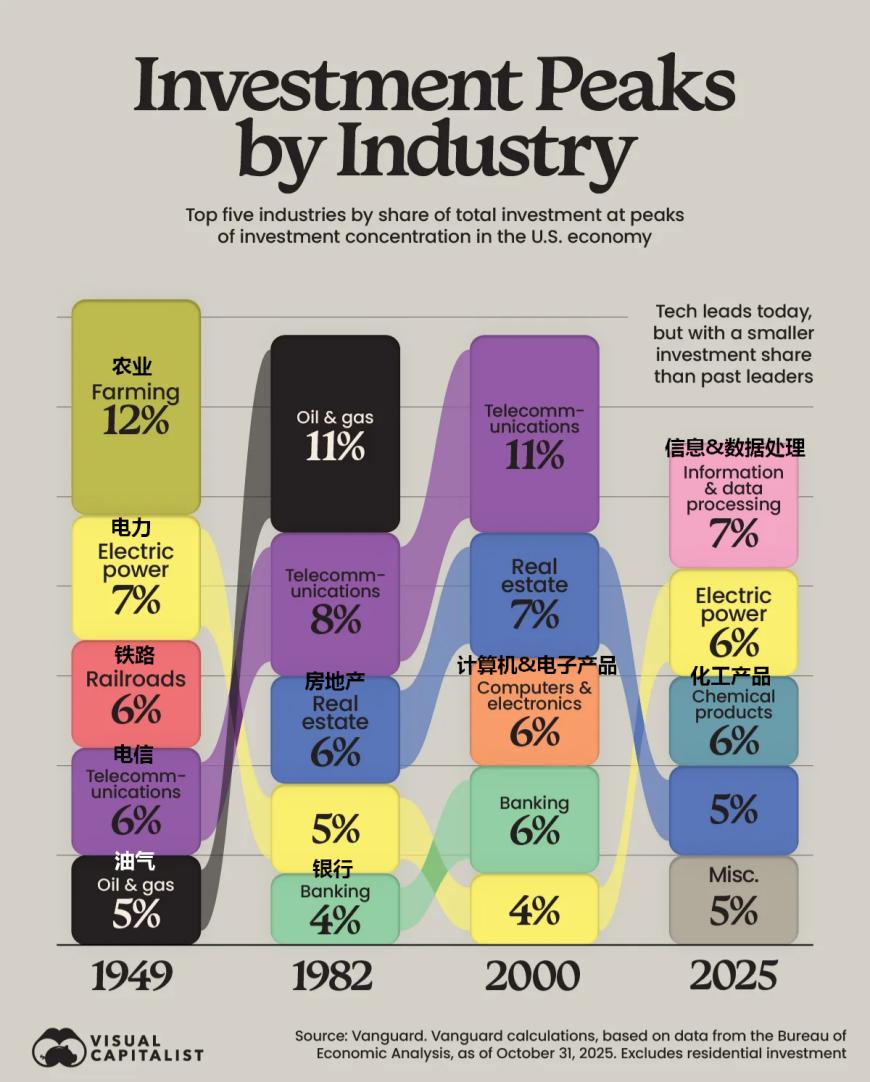
1949vs2025年美国投资额最高的五大行业
Ge Long Hui· 2025-12-30 08:21
Core Insights - The article outlines the evolution of investment focus in the United States from 1949 to projected trends in 2025, highlighting the dominant industries at various peak investment periods [1][2]. Investment Trends by Year - In 1949, the primary investment sector was agriculture, accounting for 12% of total investments, followed by electricity, railroads, telecommunications, and oil and gas [1]. - By 1982, the focus shifted to oil and gas, which represented 11% of total investments, with telecommunications and real estate gaining importance, alongside banking and electricity [2]. - The year 2000 marked the peak of the internet bubble, where telecommunications saw a significant rise in investment share, with computers and electronics also becoming major sectors, while real estate and banking maintained their relevance [2]. - Looking ahead to 2025, the information and data processing sector is expected to dominate, although with a lower concentration, while electricity, chemical products, and real estate are projected to each account for approximately 5% to 6% of total investments [2].
中车时代电气取得元学习与多尺度特征融合的受电弓状态检测方法专利
Jin Rong Jie· 2025-12-30 02:18
Core Insights - Zhuzhou CRRC Times Electric Co., Ltd. has obtained a patent for a method of "state detection of pantographs based on meta-learning and multi-scale feature fusion," with authorization announcement number CN116681928B, applied for on May 2023 [1] Company Overview - Zhuzhou CRRC Times Electric Co., Ltd. was established in 2005 and is located in Zhuzhou City, primarily engaged in the manufacturing of railway, shipbuilding, aerospace, and other transportation equipment [1] - The company has a registered capital of 1,411.54 million RMB [1] - The company has invested in 37 enterprises and participated in 5,000 bidding projects, holding a total of 3,697 patents and 151 administrative licenses [1]

中车时代电气取得基于MBOM自动构建SBOM专利
Jin Rong Jie· 2025-12-30 00:52
Core Insights - Zhuzhou CRRC Times Electric Co., Ltd. has obtained a patent for a method, system, and storage medium for automatically constructing SBOM based on MBOM, with the authorization announcement number CN117611063B and application date of December 2023 [1] Company Overview - Zhuzhou CRRC Times Electric Co., Ltd. was established in 2005 and is located in Zhuzhou City, primarily engaged in the manufacturing of railway, shipbuilding, aerospace, and other transportation equipment [1] - The company has a registered capital of 1,411.54 million RMB [1] - According to data analysis, the company has invested in 37 enterprises, participated in 5,000 bidding projects, and holds 3,697 patents, in addition to having 151 administrative licenses [1]
湖南已实现市市通高铁、县县通高速
Xin Lang Cai Jing· 2025-12-29 17:11
2025年,湖南高速公路网络进一步织密,干线通道逐步完善。记者从湖南省交通运输厅获悉,预计到今 年年底,全省公路总里程将达27万公里。其中,高速公路达8642公里,位列全国第9,实现"县县通高 速";普通国省道总里程达3.1万公里,位列全国第4,实现所有县市区及重要乡镇全覆盖;农村公路总 里程达23万公里,连接起千家万户。 平(平江县)洞(洞口县)高速益阳段的车流盛况(资料图片)。 湖南日报全媒体记者 童迪 摄 "家门口的高速终于通车了……"12月26日,这是邵阳市城步苗族自治县的居民李女士今年最盼望的一 天,家门口的衡南高速城步至龙胜段通车,让她去往湘桂的耗时从60分钟压缩至现在的25分钟。 2025年,湖南交通构建全域互联互通新格局。高速公路总里程突破8600公里,"县县通高速"目标全面达 成,"七纵七横"路网串联城乡,"市市通高铁"实现闭环。 ■文/视频 三湘都市报全媒体记者 李致远 今年湖南高速公路总里程突破8600公里 12月26日,G7221衡南高速城步至龙胜(湘桂界)段、G59呼北高速张家界至官庄段(高坪互通至终点 段)建成通车,湖南高速路网进一步织密。 衡南高速城步至龙胜(湘桂界)段,北起城步 ...

2024年长三角区域发展指数稳步提升 区域高质量发展行稳致远 - 国家统计局
Guo Jia Tong Ji Ju· 2025-12-29 09:36
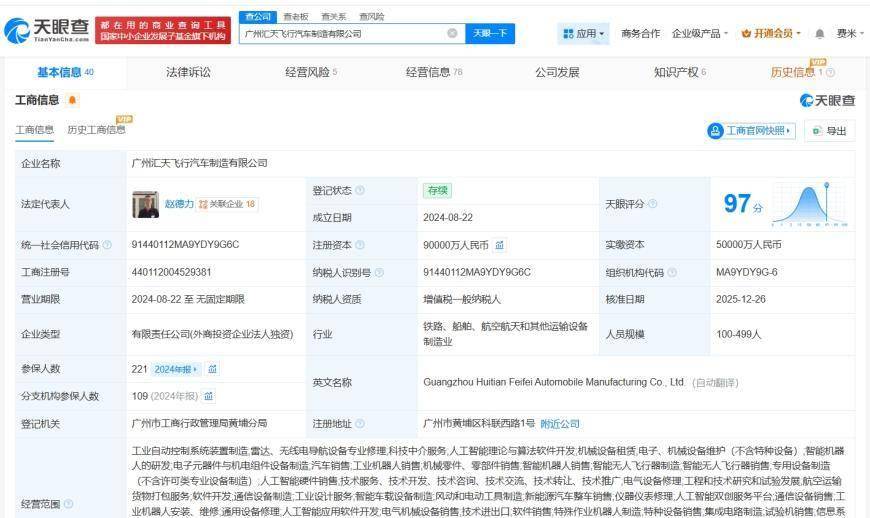
Core Insights - The Yangtze River Delta (YRD) region is solidifying its role as a strong growth engine and a model for high-quality development, with significant advancements in technological and industrial innovation, high-level openness, ecological protection, and improved public welfare in 2024 [1] Economic Development - The YRD's demonstration index for high-quality economic development reached 129.8 in 2024, a 2.4 increase from 2023, and an average annual increase of 2.3 since 2018 [2] - The region's GDP reached 33.17 trillion yuan, 1.5 times that of 2018, accounting for 24.7% of the national total, a slight increase of 0.1 percentage points from 2023 [2] - The digital economy is thriving, with the value added by the information transmission, software, and IT services sector reaching 1.88 trillion yuan, 2.3 times that of 2018, and nearly 30% of the national total [2] Innovation and R&D - The innovation co-construction index rose to 160.6 in 2024, an increase of 8.2 from 2023, with an average annual growth of 6.4 since 2018 [3] - R&D investment in the region reached 1.12 trillion yuan, a 10.5% increase from 2023, representing 30.9% of the national total [3] - The region saw nearly 300,000 new invention patents, with a per capita rate exceeding 12 patents per 10,000 people, 1.6 times that of 2018 [3] Infrastructure and Connectivity - The coordination index for the YRD remained stable at 131.0 in 2024, with an average annual increase of 4.4 since 2018 [4] - The region's railway network expanded to over 15,000 kilometers, a 43.6% increase since 2018, with high-speed rail accounting for over half of the total [4] - The income disparity among residents across provinces narrowed from 2.68:1 in 2018 to 2.40:1 in 2024 [4] Environmental Protection - The green co-protection index reached 163.8 in 2024, a 6.3 increase from 2023, with an average annual growth of 5.6 since 2018 [5] - The air quality improved, with an average of 84.5% of days classified as good air quality across 41 cities, a 0.8 percentage point increase from 2023 [5] - The proportion of good quality surface water reached 94.3%, an increase of 0.9 percentage points year-on-year, marking a historical high [6] Trade and Economic Openness - The openness index for the YRD was 106.6 in 2024, reflecting a resilient outward-oriented economy [7] - The region's total import and export volume exceeded 16 trillion yuan, accounting for 36.5% of the national total, with exports nearing 10 trillion yuan, representing 39.1% of the national total [7] - The seventh China International Import Expo attracted 3,496 exhibitors from 129 countries, with intended transactions exceeding 80 billion USD, of which the YRD accounted for 34% [7] Public Welfare and Services - The public welfare index increased to 130.4 in 2024, a 0.9 increase from 2023, with an average annual rise of 3.1 since 2018 [8] - The average disposable income per capita reached 57,137 yuan, a nominal increase of 5.2% year-on-year [8] - The number of hospital beds in the region increased to 1.6525 million, a rise of 361,800 since 2018, with nearly 7 beds per 1,000 people [8]
小鹏汇天飞行汽车制造公司增资至9亿 增幅约38%
Sou Hu Cai Jing· 2025-12-29 03:40
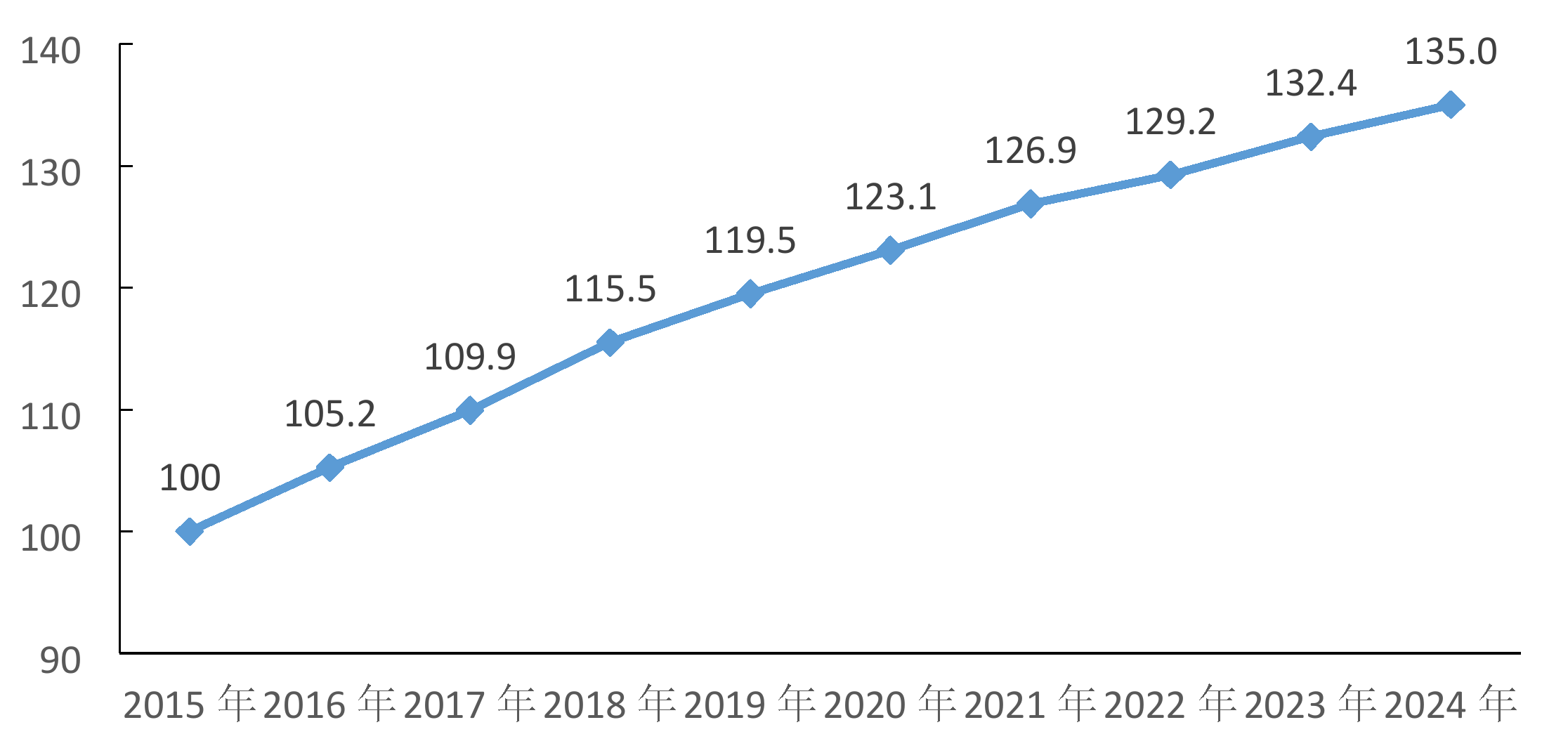
来源:市场资讯 天眼查显示,近日,广州汇天飞行汽车制造有限公司发生工商变更,注册资本由6.5亿人民币增至9亿人民币,增幅约38%。 该公司成立于2024年8月,法定代表人为赵德力,经营范围包括工业自动控制系统装置制造、科技中介服务、人工智能理论 与算法软件开发等,由广东汇天飞行汽车有限公司全资持股,后者为小鹏汽车旗下HT Flying Car (Hong Kong) Limited全资 子公司。 | | TIAN 都在用的意业资治工具 | 面包板 市关系 面风险 | | | | | --- | --- | --- | --- | --- | --- | | | | 广州汇天飞行汽车时遭有限公司 | 23 大殿一下 | 器应用 · | 商务合作 企业级产品· ★ 开通会员 · 鱼 费米 · | | 基本信息 40 | 法律诉讼 | 经营风险5 | 经营信息 78 公司发展 | 知识产权 6 | 历史信息 1 0 | | 工商信息 ● | | | | | 心天眼直 | | 工商信息 历史工商信息 | | | | | 【開目网站服 ■ 导出 | | 企业名称 | 广州汇天飞行汽车制造有限公司 | | | | | | ...
交通运输业当好发展先行官 服务保障能力不断提升
Jing Ji Ri Bao· 2025-12-29 01:40
Core Insights - The transportation sector in China is projected to see fixed asset investment exceed 3.6 trillion yuan, with cross-regional passenger flow surpassing 66 billion trips and freight volume exceeding 58 billion tons, all reflecting a year-on-year growth of approximately 3.5% [1] - The overall operation of the transportation sector has been stable and progressive, successfully meeting annual targets [1] Investment and Infrastructure Development - Major transportation infrastructure projects are progressing smoothly, with a total investment of 18.8 trillion yuan during the 14th Five-Year Plan period [3] - The national comprehensive transportation network has been largely completed, connecting over 80% of county-level administrative regions and serving about 90% of the country's economic and population totals [3] Service Improvement and Capacity Enhancement - The transportation sector has significantly improved service quality, with urban rail transit operating over 11,000 kilometers and serving more than 90 million passengers daily [3] - The opening of new high-speed rail lines, such as the Baotou-Yinchuan and Wuhan-Yichang sections, has reduced travel times and enhanced regional connectivity [2] Artificial Intelligence Integration - The integration of artificial intelligence in transportation is being accelerated, with initiatives to develop smart construction systems and enhance operational safety [5][6] - The Ministry of Transport plans to implement AI across various transportation modes, aiming to create a comprehensive data and intelligence platform [6] Consumer Trends and New Opportunities - The transportation sector is expanding consumer scenarios, particularly in self-driving travel and cruise tourism, with cruise passenger transport volume increasing by 27.8% year-on-year [7][8] - The small and micro car rental market is expected to grow significantly, with a projected annual growth rate of around 15% during the 14th Five-Year Plan period [8]