军工行业

Search documents
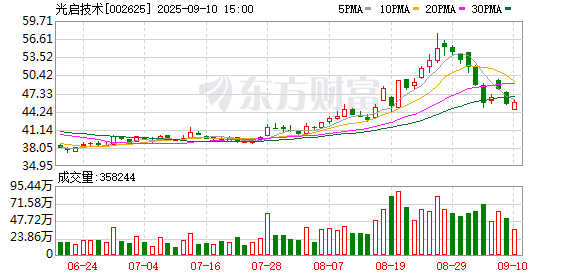
光启技术现3笔大宗交易 总成交金额1.73亿元
Zheng Quan Shi Bao Wang· 2025-09-10 12:01
Group 1 - The core point of the article highlights that Guangqi Technology executed three block trades on September 10, totaling 3.9 million shares and amounting to 173 million yuan, with a trading price of 44.40 yuan, reflecting a discount of 2.99% compared to the closing price of the day [2] - Over the past three months, Guangqi Technology has recorded a total of 24 block trades, with a cumulative transaction amount of 1.969 billion yuan [2] - On the same day, Guangqi Technology's closing price was 45.77 yuan, showing an increase of 0.86%, with a daily turnover rate of 1.66% and a total transaction amount of 1.631 billion yuan, while there was a net outflow of 140 million yuan in main funds [2] Group 2 - In the last five days, Guangqi Technology's stock has decreased by 6.06%, with a total net outflow of 919 million yuan [2] - The latest margin financing balance for Guangqi Technology is 7.193 billion yuan, which has increased by 94.34 million yuan over the past five days, representing a growth rate of 1.33% [2] - A detailed overview of the block trades on September 10 shows that the trading price was consistently 44.40 yuan, with three different brokerage firms involved in the transactions [2]


湘电股份: 湘潭电机股份有限公司2024年度向特定对象发行A股股票证券募集说明书(注册稿)
Zheng Quan Zhi Xing· 2025-08-21 08:19
Company Overview - Xiangtan Electric Manufacturing Co., Ltd. is planning to issue A-shares to specific investors, with a registered capital of RMB 1,325,406,445.00 and listed on the Shanghai Stock Exchange under the stock code 600416 [1][19]. - The company specializes in the manufacturing of electric motors, special products, and urban rail transit equipment, categorized under the electrical machinery and equipment manufacturing industry [19]. Issuance Details - The company intends to issue no more than 30% of its total share capital, amounting to 39,762.19 million shares, to specific investors, with a total fundraising target of up to RMB 200,000.00 million [4][6]. - The issuance will be conducted through a private placement to no more than 35 specific investors, including securities investment funds, securities companies, insurance institutions, and other legal entities [2][3]. Fund Utilization - The raised funds will be allocated to the development and industrialization of aviation electrical systems and magnetic levitation bearing high-speed motor systems, as well as to supplement working capital [5][6]. - The total investment for the aviation electrical system project is estimated at RMB 231,297.13 million, with the fundraising amount planned at RMB 200,000.00 million [5]. Shareholder Structure - As of June 30, 2025, the controlling shareholder, Xiang Electric Group, holds 13.66% of the company's shares, while the combined holdings of Xiang Electric Group and its concerted action partner, Xingxiang Group, amount to 30.70% [17][18]. - The actual controller of the company is the Hunan Provincial State-owned Assets Supervision and Administration Commission [17]. Industry Characteristics - The electric motor manufacturing industry is regulated by the National Development and Reform Commission and the Ministry of Industry and Information Technology, focusing on energy efficiency and technological innovation [19]. - The industry is characterized by a strong emphasis on energy-saving technologies and compliance with national standards for equipment efficiency [19].

摩根士丹利基金:“十五五”预计智能化无人化装备会成为军工板块投资重点
智通财经网· 2025-08-18 12:08
Group 1 - The core investment logic of the military industry includes budget stability, equipment upgrades, asset securitization, reform and innovation, and long-term investment, with excess returns often stemming from geopolitical events causing market fluctuations [1] - The growth of the military industry is closely linked to national military budgets, with the replacement of outdated equipment and the development of new equipment being key drivers of growth [1] - The acceleration of military asset securitization and the injection of state-owned enterprise assets into listed companies have effectively enhanced the profitability of listed companies, leading to a potential dual increase in profitability and valuation for the sector [1] Group 2 - The military sector is expected to maintain a relatively optimistic outlook, with a comparative advantage in the A-share market, as it is in the early stages of innovation acceleration during the "14th Five-Year Plan" [2] - The military sector's fundamentals are at the first year of a turning point, with a high certainty of continued improvement over the next two years, and core targets are expected to see valuation digestion from 2025 to 2027 [2] - The low base from the mid-cycle adjustment in the "Five-Year Cycle" and the demand for early stocking for the next "Five-Year Plan" contribute to high profit recovery expectations for the sector [2]
利好来了,重磅宣布!下周这个板块最受看好
Zheng Quan Shi Bao· 2025-08-10 11:49
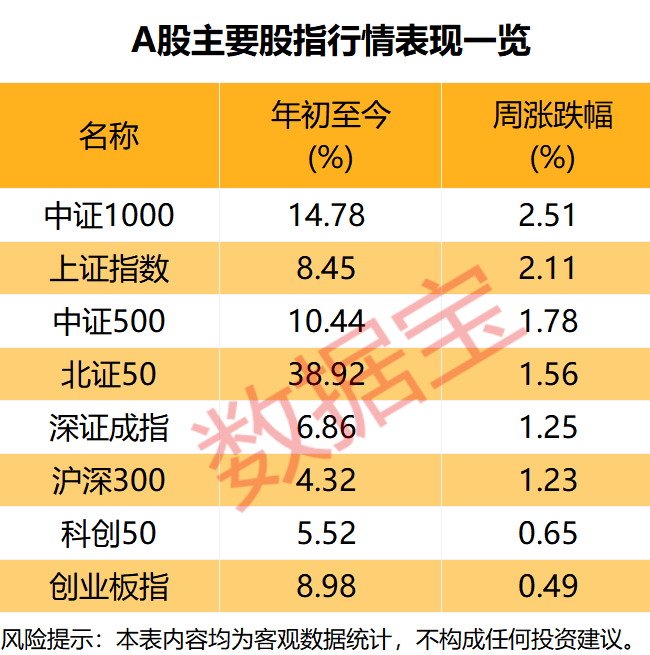
Group 1 - The core viewpoint of the news is the establishment of the Hubei Brain-Computer Interface Industry Innovation Development Alliance, which aims to create a comprehensive ecosystem covering basic research, clinical transformation, and industrial application [1] - The alliance will leverage support from research teams at universities such as Huazhong University of Science and Technology and Wuhan University, and will collaborate with companies like Yirui Technology and Zhonghua Brain-Computer [1] - Recent favorable policies from multiple government departments emphasize the goal of developing 2 to 3 industrial clusters by 2027 and nurturing globally influential leading enterprises by 2030 [1] Group 2 - The A-share market has seen a surge in brain-computer interface concept stocks, driven by a combination of technological innovation and policy incentives [2] - The A-share market experienced a steady increase, with the Shanghai Composite Index reaching a high of 3645.37 points during the week of August 4 to August 8, marking a weekly increase of 2.11% [3] - The defense, non-ferrous metals, and machinery equipment sectors ranked as the top three in terms of weekly growth, each exceeding 5% [5] Group 3 - A survey indicated that nearly 70% of respondents reported making profits in the A-share market, with 58% earning within 10% [8] - The sentiment towards the A-share market is increasingly optimistic, with 47% of respondents identifying it as a "bull market," a 10 percentage point increase from the previous week [9] - The military industry sector has seen a significant increase in investor interest, rising 5 percentage points to 17%, while the technology sector also gained traction [13]
关税阴霾下,欧洲企业盈利意外展现韧性
Hua Er Jie Jian Wen· 2025-08-06 06:46
Core Insights - European companies' Q2 performance unexpectedly exceeded market expectations, showcasing resilience in profitability despite tariff challenges [1] - Analysts noted that while luxury goods and automotive sectors faced significant impacts, industries like finance and infrastructure performed strongly, aided by fiscal stimulus [1][5] Group 1: Industry Performance - Luxury goods companies, such as Kering and LVMH, experienced pressure due to weak demand from the U.S. market [1] - The automotive industry, particularly manufacturers like Volkswagen and Mercedes-Benz, issued warnings about the negative effects of U.S. tariffs, leading to profit forecast downgrades [2] - Financial sector performance was robust, with major banks reaching their highest stock prices since the 2008 financial crisis, driven by higher interest rates [4] Group 2: Economic Stimulus and Investment - Germany's shift from a conservative fiscal stance to large-scale infrastructure modernization and increased defense spending is providing significant economic support [5] - Analysts believe that the scale of defense spending growth in Europe is larger than initially expected, benefiting both established and startup defense companies [5] Group 3: Diverging Perspectives on Tariffs - Within the automotive sector, there are differing views on the impact of tariffs, with some executives downplaying their significance and emphasizing the need for competitive product offerings [3] - Acknowledgment of the negative news from tariffs exists, but there is a growing certainty about tariff levels, which is preferred over uncertainty [3]
A股,午后爆发!
证券时报· 2025-08-04 09:08
Market Overview - A-shares maintained a narrow fluctuation in the morning and surged in the afternoon, with small-cap stocks being more active; Hong Kong stocks rose strongly, with the Hang Seng Index up nearly 1% and the Hang Seng Tech Index up over 1.5% [1][2] A-share Performance - The Shanghai Composite Index rose 0.66% to 3583.31 points, the Shenzhen Component Index increased by 0.46% to 11041.56 points, and the ChiNext Index gained 0.5% to 2334.32 points; the STAR 50 Index rose 1.22% [2] - The total trading volume in the Shanghai and Shenzhen markets was 15,184 billion yuan, a decrease of over 1,000 billion yuan compared to the previous day [2] - Nearly 3,900 stocks in the market were in the green, with the military industry sector experiencing a surge, including stocks like Beifang Changlong and Changcheng Military Industry hitting the daily limit [2][5] Military Industry Sector - The military sector saw a significant rally, with multiple stocks hitting the daily limit; notable performers included Beifang Changlong, Aileda, and Hengyu Xintong [5][7] - The current "14th Five-Year Plan" is nearing its conclusion, and events like the August 1st Army Day and the September 3rd military parade are expected to catalyze the military sector [7] - The military sector is viewed as a suitable investment area due to its moderate crowding and potential benefits from national strategic deployments [7] Humanoid Robot Sector - The humanoid robot concept saw renewed activity, with stocks like Xingyun Co. and Riyong Electronics hitting the daily limit; other stocks such as Xiashan Precision and Wuzhou Xinchun also performed well [9][11] - Tesla's CEO Elon Musk announced that the design of the third version of the Optimus robot is ready for mass production, which is expected to drive interest in the sector [11] Semiconductor Sector - The semiconductor sector experienced a rally, with Dongxin Co. hitting the daily limit and stocks like Xindao Technology and Xinyuan Technology rising over 10% [13] - The demand for high-performance semiconductor hardware is expected to grow due to the rise of AI applications and the ongoing trend of domestic substitution in the semiconductor industry [15]




热点思考 | 《美丽大法案》:再次引爆“国债恐慌”?(申万宏观·赵伟团队)
申万宏源宏观· 2025-07-06 14:35
Group 1 - The "Beautiful Bill" Act is expected to expand the total deficit by approximately $4.1 trillion, primarily continuing existing policies rather than introducing new ones [2][6][9] - The Act is projected to provide a mild boost to the U.S. economy, with an average annual increase in real GDP growth of 0.1% from 2025 to 2034, peaking at 0.8% during 2026-2028 [2][22][32] - The Act will negatively impact low-income households, with the lowest 10% of earners expected to see a 3.9% decrease in income due to cuts in medical assistance and SNAP benefits [3][32] Group 2 - Traditional and capital-intensive industries are likely to benefit from the Act, while the renewable energy and electric vehicle sectors may suffer due to reduced subsidies [3][32][55] - The Act includes significant increases in defense spending, with an additional $150 billion allocated, and immigration enforcement spending reaching a historical high of $1.74 trillion [13][16] - The Act's tax cuts are heavily skewed towards higher-income households, with the top 10% expected to see an average income increase of 2.3% [3][32] Group 3 - The liquidity of U.S. Treasuries is expected to remain stable, with manageable supply pressures and a friendly macroeconomic environment, although there may still be upward pressure on term premiums [4][35][45] - The projected federal debt-to-GDP ratio is expected to reach 103% by 2026 and 116% by 2030, but the likelihood of a sovereign debt crisis remains low [5][45][56] - The Act's impact on inflation is anticipated to be minimal, with peak inflation effects projected to be only 0.12% by 2027 [22][32]

如何看待参议院通过《美丽大法案》?(申万宏观·赵伟团队)
申万宏源宏观· 2025-07-02 14:44
Legislative Progress - The "Beautiful Act" has passed the Senate with a narrow margin of 51 to 50, entering the final legislative phase [1][13] - The bill will undergo review in the House of Representatives, with potential for further amendments [1][13] - Three possible timelines for final passage: before July 4, mid-July, or late July to August [2][13] Content Adjustments - The Senate version increases the deficit by approximately $4.1 trillion over the next decade, $550 billion more than the House version [2][14] - Corporate tax cuts are expanded while personal tax cuts are reduced, favoring high-income earners [2][14] - Significant cuts to healthcare and welfare spending, with medical assistance cuts increasing from $800 billion to $930 billion [3][14] Economic Impact - The "Beautiful Act" is expected to moderately boost the U.S. economy, potentially increasing annual GDP growth by 0.2 percentage points from 2025 to 2027 [4][15] - The lowest 20% of income households may see a 2.9% decrease in income, while the highest 20% could experience a 1.9% increase [5][15] - Capital-intensive industries (manufacturing, data centers) are likely to benefit, while the renewable energy sector may face challenges due to reduced tax incentives [5][15]

为什么A股一直没有形成盈利牛?
Datayes· 2025-07-01 11:09
Group 1: Military Industry - The military industry is currently in a state with significant upward potential and a solid bottom, despite weak performance expectations for 2024 and the first quarter of 2025 [1] - Major contracts and bidding notifications have been announced by several listed companies in the aerospace sector, enhancing market expectations for performance recovery [1] Group 2: Innovative Pharmaceuticals - The release of measures to support the high-quality development of innovative drugs has sparked renewed interest in the sector, with a focus on opening public data resources for innovative drug research and expanding commercial health insurance coverage [1] - Institutions have positively evaluated these measures, which are expected to facilitate China's transition from a "generic drug powerhouse" to an "innovative drug stronghold," benefiting leading innovative drug companies and the biotech sector [1] Group 3: Automotive Industry - The automotive industry in the Yangtze River Delta region is facing severe challenges, including high inventory levels, disordered market competition, and increased risks to the financial chain of enterprises [2][3] - Dealers have suggested that manufacturers allow reasonable inventory limits and adjust sales targets to better align with regional market capacities [3] Group 4: Market Performance - The A-share market showed mixed performance with the Shanghai Composite Index rising by 0.39% and the ChiNext Index falling by 0.24%, with a total market turnover of 14,967 billion yuan [6] - The innovative drug concept stocks surged in the afternoon, with companies like Shutaishen and Anglikang reaching historical highs [6] Group 5: Industry Trends - The PCB sector is experiencing activity due to a report from Citigroup predicting significant growth in AI-PCB markets in 2026 and 2027, with an estimated total addressable market of 53 billion yuan, reflecting a 53% year-on-year increase [6][7] - The report also highlights a projected supply gap of at least 3 billion yuan in AI-PCB from 2026, even without considering capacity expansion and assembly yield loss [7]




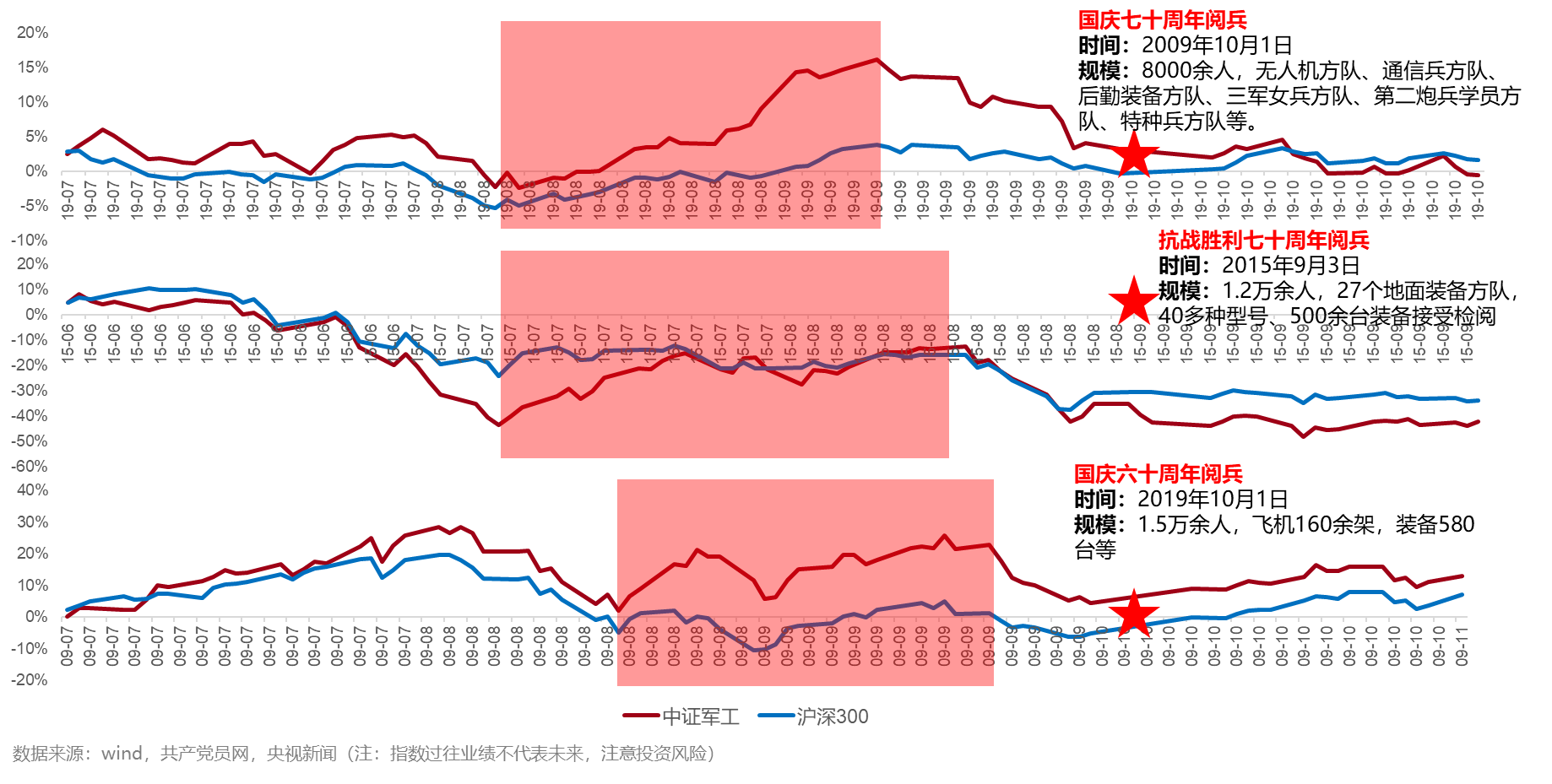
阅兵日历效应显著,军工超额行情或现,军工ETF(512660)近5日涨幅达8%
Mei Ri Jing Ji Xin Wen· 2025-07-01 03:56
Core Viewpoint - The upcoming military parade on September 3rd, commemorating the 80th anniversary of China's victory in the War of Resistance Against Japanese Aggression, is expected to boost the military industry sector, which has historically shown independent excess returns prior to such events [1][2]. Military Industry Performance - The military industry sector has been active recently, with the military ETF (512660) experiencing an 8% increase in the past five days. This performance is attributed to the upcoming parade as well as ongoing military trade demand and international geopolitical fluctuations [4]. - The military ETF (512660) has seen a significant increase in shares, growing over 40% year-on-year, with its current scale exceeding 15.6 billion yuan [4]. Military Trade Demand - Chinese military equipment has gained recognition in various real combat scenarios, leading to increased international demand. Pakistan has announced plans to acquire several advanced Chinese military products, including the J-35 stealth fighter and the Hongqi-19 air defense system [5]. Global Military Expenditure Trends - Global military expenditures are on the rise due to ongoing geopolitical risks. NATO members have agreed to increase military spending to 5% of GDP, while China's military spending remains below the average of major military powers, indicating potential for growth [8]. Emerging Themes in Military Industry - New themes such as low-altitude economy, commercial aerospace, deep-sea technology, large aircraft, and military intelligence are becoming increasingly active. These themes are expected to deepen and evolve, contributing to a potential recovery in the military industry [10]. Financial Performance and Outlook - The military industry sector is projected to see a recovery in margins and profitability starting in Q1 2025, following a dip in Q4 2024. The increase in total prepayments by 9.35% year-on-year suggests a rebound in downstream orders [12]. - The military ETF (512660) is noted for its liquidity and defensive characteristics, having shown the smallest decline during market downturns in 2018, 2022, and 2023, while ranking first in returns among peers in 2024 [14][17].