
原材料工业

Search documents
2025年12月物价数据点评:多重因素共振,年末物价数据全面回升
Dong Fang Jin Cheng· 2026-01-09 05:59
Group 1: CPI Analysis - In December 2025, the CPI increased by 0.8% year-on-year, up from 0.7% in the previous month, marking the highest increase since August 2023[2] - The cumulative CPI for January to December 2025 was 0.0%, indicating a stagnation in price growth over the year[1] - The main drivers for the December CPI increase included rising vegetable and fruit prices due to adverse weather, consumer promotion policies boosting appliance and vehicle prices, and an increase in international gold prices[3] Group 2: PPI Analysis - The PPI in December 2025 decreased by 1.9% year-on-year, a slight improvement from a 2.2% decline in November, with a cumulative decline of 2.6% for the year[1] - The December PPI saw a month-on-month increase of 0.2%, marking the third consecutive month of rising prices[6] - Key factors contributing to the PPI changes included improved supply-demand dynamics in certain industries and rising prices in the non-ferrous metals sector, with specific increases of 3.7% and 2.8% in mining and refining respectively[7][8] Group 3: Economic Outlook - The overall economic environment in 2025 was characterized by weak demand and a "strong supply, weak demand" scenario, leading to a continued decline in PPI[10] - Looking ahead to January 2026, the CPI is expected to drop to around 0.2% year-on-year due to a higher base effect from the previous year and seasonal price fluctuations[5] - The forecast for 2026 indicates a continued low inflation environment, with an expected annual CPI of approximately 0.4%[5]
国家统计局:12月PPI同比下降1.9% 降幅比上月收窄0.3个百分点
智通财经网· 2026-01-09 01:50
Core Viewpoint - The National Bureau of Statistics reported a year-on-year decline of 1.9% in the Producer Price Index (PPI) for industrial producers in December 2025, with a narrowing decline compared to the previous month. Month-on-month, the PPI increased by 0.2%, showing an expanded growth rate from the previous month [1]. Group 1: Year-on-Year Changes in Producer Prices - In December, the prices of production materials decreased by 2.1%, contributing approximately 1.53 percentage points to the overall decline in the PPI. The mining industry saw a price drop of 4.7%, while raw materials and processing industries experienced declines of 2.6% and 1.6%, respectively [4]. - Prices for living materials fell by 1.3%, impacting the overall PPI by about 0.35 percentage points. Food prices decreased by 1.5%, while clothing prices saw a slight decline of 0.1%. General daily necessities increased by 1.4%, but durable consumer goods prices dropped by 3.5% [4]. Group 2: Month-on-Month Changes in Producer Prices - In December, the prices of production materials increased by 0.3%, contributing approximately 0.24 percentage points to the overall increase in the PPI. The mining industry prices rose by 0.8%, raw materials by 0.6%, and processing industries by 0.2%. Prices for living materials remained stable [8]. - Among the prices of industrial producers' purchase, non-ferrous metal materials and wires increased by 2.5%, while fuel and power prices rose by 1.5%. Conversely, prices for black metal materials and chemical raw materials decreased by 0.4% and 0.2%, respectively [8]. Group 3: Key Data for December 2025 - The overall Producer Price Index for industrial producers decreased by 2.6% for the year 2025. The prices of production materials fell by 3.0%, while the mining industry experienced a significant decline of 9.0% [10]. - The prices of living materials decreased by 1.5% for the year, with food prices declining by 1.6% and durable consumer goods prices dropping by 3.3% [10].


国家统计局:2025年12月份工业生产者出厂价格同比降幅收窄,环比涨幅扩大
Yang Shi Wang· 2026-01-09 01:48
Group 1 - In December 2025, the national industrial producer price index (PPI) decreased by 1.9% year-on-year, with a narrowing decline of 0.3 percentage points compared to the previous month; month-on-month, it increased by 0.2%, with an expanded increase of 0.1 percentage points from the previous month [1] - The industrial producer purchase price index (PPPI) fell by 2.1% year-on-year, with a narrowing decline of 0.4 percentage points compared to the previous month; month-on-month, it rose by 0.4%, with an expanded increase of 0.3 percentage points from the previous month [1] - For the entire year of 2025, the industrial producer PPI decreased by 2.6%, while the PPPI decreased by 3.0% [1] Group 2 - In December, the prices of production materials decreased by 2.1%, contributing approximately 1.53 percentage points to the overall decline in the industrial producer PPI; the mining industry prices fell by 4.7%, raw materials industry prices fell by 2.6%, and processing industry prices fell by 1.6% [4] - Prices of living materials decreased by 1.3%, contributing approximately 0.35 percentage points to the overall decline in the industrial producer PPI; food prices fell by 1.5%, clothing prices fell by 0.1%, general daily necessities prices increased by 1.4%, and durable consumer goods prices fell by 3.5% [4] Group 3 - In December, the month-on-month prices of production materials increased by 0.3%, contributing approximately 0.24 percentage points to the overall increase in the industrial producer PPI; mining industry prices rose by 0.8%, raw materials industry prices rose by 0.6%, and processing industry prices rose by 0.2% [8] - Prices of living materials remained stable; food prices decreased by 0.1%, clothing prices increased by 0.2%, general daily necessities prices increased by 0.5%, and durable consumer goods prices decreased by 0.2% [8] Group 4 - In the industrial producer purchase price index, prices of building materials and non-metallic products fell by 6.4%, fuel and power prices fell by 5.7%, chemical raw materials prices fell by 4.9%, agricultural and sideline products prices fell by 4.1%, black metal materials prices fell by 3.3%, and textile raw materials prices fell by 1.9%; however, prices of non-ferrous metal materials and wires increased by 10.5% [7]
中国2025年12月PPI同比下降1.9%,环比上涨0.2%
Guo Jia Tong Ji Ju· 2026-01-09 01:38
Core Viewpoint - In December 2025, the national industrial producer price index (PPI) showed a year-on-year decline of 1.9%, with a month-on-month increase of 0.2%, indicating a narrowing of the decline compared to the previous month [1][10]. Group 1: Year-on-Year Changes - In December, the producer prices for industrial producers saw a decrease in production materials by 2.1%, contributing approximately 1.53 percentage points to the overall decline in producer prices [4]. - The mining industry experienced a price drop of 4.7%, while raw materials and processing industries saw declines of 2.6% and 1.6%, respectively [4]. - Consumer goods prices fell by 1.3%, with food prices down by 1.5% and durable goods prices down by 3.5% [4][11]. Group 2: Month-on-Month Changes - In December, the producer prices for industrial producers increased by 0.2%, with production materials rising by 0.3%, contributing approximately 0.24 percentage points to the overall increase [8]. - The mining industry saw a month-on-month price increase of 0.8%, while raw materials and processing industries increased by 0.6% and 0.2%, respectively [8]. - Consumer goods prices remained stable, with food prices slightly decreasing by 0.1% and general daily necessities increasing by 0.5% [8][11]. Group 3: Industrial Purchase Prices - The purchase prices for industrial producers showed a year-on-year decline of 2.1%, with a month-on-month increase of 0.4% [10][11]. - Significant declines were noted in building materials and non-metallic products by 6.4%, and fuel and power by 5.7% [7][11]. - Prices for non-ferrous metals and wires increased by 10.5%, indicating a contrasting trend within the industrial purchase prices [7].
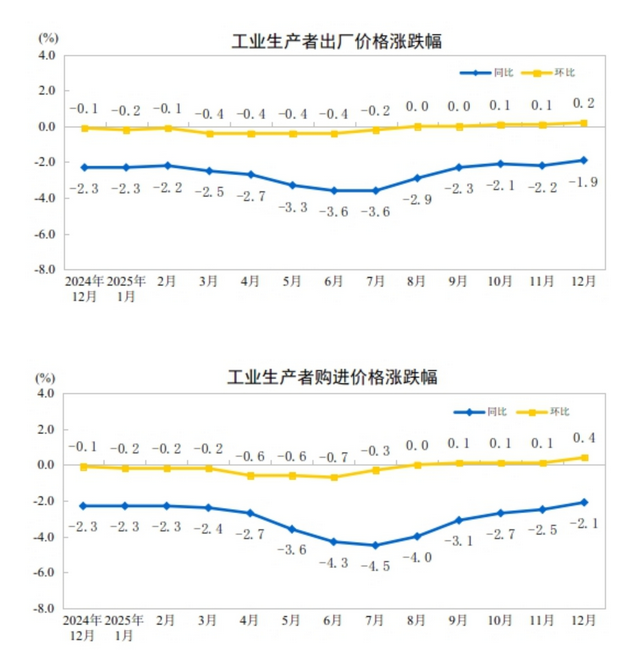
2025年12月份工业生产者出厂价格同比降幅收窄 环比涨幅扩大
Guo Jia Tong Ji Ju· 2026-01-09 01:33
Group 1: Yearly Overview - In December 2025, the national industrial producer's ex-factory prices decreased by 1.9% year-on-year, with a narrowing decline of 0.3 percentage points compared to the previous month; month-on-month, there was a 0.2% increase, which is an expansion of 0.1 percentage points from last month [1] - For the entire year of 2025, the industrial producer's ex-factory prices fell by 2.6%, while the industrial producer's purchase prices decreased by 3.0% [1] Group 2: Year-on-Year Changes - In December, the prices of production materials decreased by 2.1%, contributing approximately 1.53 percentage points to the overall decline in ex-factory prices; within this category, mining industry prices fell by 4.7%, raw materials industry prices decreased by 2.6%, and processing industry prices dropped by 1.6% [4] - The prices of living materials decreased by 1.3%, impacting the overall ex-factory price level by about 0.35 percentage points; food prices fell by 1.5%, clothing prices decreased by 0.1%, while general daily necessities prices increased by 1.4%, and durable consumer goods prices dropped by 3.5% [4] Group 3: Month-on-Month Changes - In December, the ex-factory prices of production materials increased by 0.3%, contributing approximately 0.24 percentage points to the overall increase in ex-factory prices; mining industry prices rose by 0.8%, raw materials industry prices increased by 0.6%, and processing industry prices went up by 0.2% [8] - Living materials prices remained stable; food prices decreased by 0.1%, clothing prices increased by 0.2%, general daily necessities prices rose by 0.5%, and durable consumer goods prices fell by 0.2% [8] Group 4: Purchase Price Changes - In the industrial producer's purchase prices, building materials and non-metallic prices decreased by 6.4%, fuel and power prices fell by 5.7%, chemical raw materials prices dropped by 4.9%, agricultural products prices decreased by 4.1%, black metal materials prices fell by 3.3%, and textile raw materials prices decreased by 1.9%; however, prices for non-ferrous metal materials and wires increased by 10.5% [7]
一图看懂!面向脑机接口、AI,工信部明确中试标准建设指南
Di Yi Cai Jing· 2025-12-30 05:48
Core Viewpoint - The Ministry of Industry and Information Technology (MIIT) of China has issued the "Manufacturing Industry Pilot Standard System Construction Guide (2025 Edition)" to accelerate the efficient transformation and application of major technological achievements, emphasizing the establishment of pilot verification and testing platforms [1][3]. Group 1: Standard System Construction - The guide aims to revise and establish over 50 standards by 2027 and 100 standards by 2030, creating an advanced manufacturing pilot standard system that includes basic general, key technology, and industry application standards [1][11]. - The manufacturing pilot is a transitional test that connects the technology chain, innovation chain, and industry chain, facilitating the flow of technological innovation to market application [7][1]. Group 2: Structure of the Standard System - The manufacturing pilot standard system consists of three parts: basic general standards, key technology standards, and industry application standards [2][13]. - Basic general standards provide the foundational support for the pilot system, while key technology standards define requirements for equipment, materials, platforms, validation, and outcome evaluation [2][13]. Group 3: Industry Application Focus - The guide emphasizes the need for industry-specific and actionable pilot standards, particularly in emerging and future industries such as brain-computer interfaces, the metaverse, artificial intelligence, quantum technology, and clean hydrogen [2][3]. - The industry application standards ensure that pilot activities are conducted scientifically within specific industries, covering sectors like raw materials, equipment manufacturing, consumer goods, and information technology [2][13]. Group 4: Development Status and Future Goals - China has established over 2,400 pilot platforms, with 241 selected as key cultivation platforms by MIIT, which have undertaken 25,000 pilot service projects [3][4]. - By the end of 2027, the goal is to further strengthen high-level pilot platforms and establish a modern pilot platform system with a nationwide service network [3][4].

8月全国工业生产者出厂价格同比下降
Guo Jia Tong Ji Ju· 2025-12-29 07:10
Group 1 - In August 2020, the national industrial producer price index (PPI) decreased by 2.0% year-on-year and increased by 0.3% month-on-month; the industrial producer purchase price index (PPPI) decreased by 2.5% year-on-year and increased by 0.6% month-on-month [1] - From January to August, the average industrial producer ex-factory price decreased by 2.0% compared to the same period last year, while the industrial producer purchase price decreased by 2.7% [1] - The prices of production materials decreased by 3.0% year-on-year, with the mining industry prices down by 5.8%, raw materials industry prices down by 6.4%, and processing industry prices down by 1.4% [1] Group 2 - In August, the prices of living materials increased by 0.6% year-on-year, with food prices up by 3.1%, clothing prices down by 1.3%, general daily necessities down by 0.4%, and durable consumer goods down by 1.5% [1] - The purchase prices of fuel and power decreased by 9.8%, chemical raw materials by 8.4%, and black metal materials by 0.5%; however, agricultural and sideline products increased by 6.3% and non-ferrous metal materials and wires by 2.9% [1] Group 3 - Month-on-month, the industrial producer ex-factory price increased by 0.4%, with mining prices up by 1.6%, raw materials prices up by 0.5%, and processing prices up by 0.2% [1] - The prices of living materials increased by 0.1% month-on-month, with food prices up by 0.2%, clothing prices down by 0.2%, general daily necessities up by 0.5%, and durable consumer goods down by 0.4% [1]
去库信号仍待观察
CAITONG SECURITIES· 2025-12-28 13:21
Profit Trends - In November, the profit of industrial enterprises decreased by 13.1% year-on-year, a significant drop from the previous value of -5.5%[5] - The profit margin for industrial enterprises in November was approximately 5.7%, which is significantly lower than seasonal levels[12] - The total profit for industrial enterprises in November was 676.6 billion yuan, marking the lowest level for the same period since 2021[12] Price and Cost Dynamics - The Producer Price Index (PPI) in November fell by 2.2% year-on-year, widening from a decline of 2.1% in October[9] - The cost per 100 yuan of revenue for industrial enterprises increased to 85.5 yuan, up by 0.16 yuan year-on-year[29] - The unit revenue expense for the first eleven months was 8.39 yuan, a slight decrease of 0.01 yuan year-on-year[32] Inventory Insights - As of the end of November, the inventory of finished products for industrial enterprises increased by 4.6% year-on-year, with a 0.9 percentage point rise from October[33] - The actual inventory growth rate, excluding PPI effects, was 6.8%, slightly up from 5.8% in October[33] - The PMI data indicated a divergence, showing a decrease in inventory while actual inventory levels were still rising, suggesting unclear signals regarding destocking[33] Sector Performance - The upstream mining sector showed significant improvement with revenue growth of 5.3% and profit growth of 24.4% in November[23] - The midstream intermediate goods manufacturing sector faced challenges, with revenue and profit growth rates of -10.7% and -21.2%, respectively[26] - The downstream consumer goods manufacturing sector reported a profit margin of 11.7%, but revenue and profit growth were both negative at -12.2% and -22.6%[27]
聚焦6个关键领域 加快制造业中试平台高水平建设
Ren Min Ri Bao· 2025-12-24 03:22
Core Viewpoint - The article emphasizes the importance of high-level construction of manufacturing pilot platforms to accelerate the transformation and application of major scientific and technological achievements in China. Group 1: Manufacturing Pilot Platforms - The Chengdu High-tech Zone's pilot base has successfully assisted over 300 products in reaching mass production by providing a full-chain service for product finalization, process optimization, and reliability verification [3] - The Ministry of Industry and Information Technology (MIIT) aims to establish a modern pilot platform system by the end of 2027, with a focus on multi-entity participation and multi-level service networks [3][4] - Currently, over 2,400 pilot platforms have been established in China, with 241 selected as key cultivation platforms by MIIT, which have undertaken 25,000 pilot service projects [5] Group 2: Importance of Pilot Testing - Pilot testing is identified as a critical link connecting the innovation chain, technology chain, and industrial chain, with an 80% success rate for industrialization when pilot testing is conducted, compared to only 30% without it [4] - The MIIT has released guidelines to address key issues in pilot platform construction, focusing on strategic positioning, basic capabilities, and future potential [6] Group 3: Development Strategies - The MIIT's strategy includes strengthening, activating, and supplementing pilot platforms to enhance their development and competitiveness, with a focus on key industries such as artificial intelligence, quantum technology, and biomedicine [6][7] - To avoid redundant construction and competition, the guidelines emphasize the need for complementary functions, resource sharing, and business promotion based on actual industrial development conditions [7]

聚焦6个关键领域,解决“建什么、谁来建、怎么建”等问题 加快制造业中试平台高水平建设(政策速递)
Ren Min Ri Bao· 2025-12-23 22:23
Core Viewpoint - The establishment and enhancement of manufacturing pilot testing platforms are crucial for accelerating the transformation and application of major scientific and technological achievements in China, with a focus on improving the success rate of industrialization through systematic support and development strategies [1][2][3]. Group 1: Manufacturing Pilot Testing Platforms - The Chengdu High-tech Zone's pilot testing base has successfully assisted over 300 products in reaching mass production by providing comprehensive services for product finalization, process optimization, and reliability verification [1]. - As of now, more than 2,400 pilot testing platforms have been established in China, with 241 selected as key cultivation platforms by the Ministry of Industry and Information Technology (MIIT), which have undertaken 25,000 pilot service projects [2]. - The success rate of industrialization for technologies that undergo pilot testing is 80%, compared to only 30% for those that do not [1]. Group 2: Guidelines for High-level Construction - The MIIT has released guidelines addressing key issues in the construction of pilot testing platforms, focusing on what to build, who will build it, and how to build it [3]. - The guidelines emphasize a systematic approach to strengthen, activate, and supplement pilot testing platforms, targeting strategic positioning, foundational capabilities, and future potential [3]. - Specific sectors and industries have been identified for the development of pilot testing platforms, including raw materials, equipment manufacturing, consumer goods, information technology, and emerging industries [3]. Group 3: Avoiding Redundant Construction - To prevent redundant construction and "involution" competition, the guidelines advocate for a resource-based approach that considers local conditions and industry foundations, promoting complementary functions and shared resources among pilot testing platforms [4].