
煤炭加工业

Search documents
2025年12月CPI同比上涨0.8% 物价低位温和回升
Jin Rong Shi Bao· 2026-01-12 03:16
Group 1 - The Consumer Price Index (CPI) in December 2025 increased by 0.8% year-on-year, marking the highest level since March 2023, driven primarily by rising food prices [2][3] - The core CPI, excluding food and energy, rose by 1.2% year-on-year, remaining above 1% for four consecutive months, supported by consumer promotion policies and price improvements in appliances and automobiles [3][4] - The Producer Price Index (PPI) increased by 0.2% month-on-month, marking three consecutive months of growth, while the year-on-year decline narrowed to 1.9%, indicating reduced downward pressure on industrial prices [4][5] Group 2 - The increase in CPI was attributed to a combination of effective consumption policies and seasonal demand during the holiday period, leading to a rise in consumer spending [2][4] - The PPI's month-on-month increase was influenced by improved supply-demand dynamics and rising prices in certain industries, particularly in coal mining and processing [4][5] - Experts suggest that the changes in CPI and PPI reflect a stable and improving economic environment in China, with a gradual recovery in demand and ongoing optimization of supply structures [5]
优化供需结构,持续提振投资与消费预期
2 1 Shi Ji Jing Ji Bao Dao· 2026-01-10 03:15
Group 1 - The latest data from the National Bureau of Statistics indicates that the domestic CPI rose by 0.8% year-on-year in December 2025, surpassing the previous value of 0.7%, with a month-on-month increase of 0.2%, marking a near three-year high [1] - The month-on-month increase in CPI is primarily driven by rising prices of industrial consumer goods excluding energy, which increased by 0.6%, contributing approximately 0.16 percentage points to the CPI increase [1] - The core CPI, excluding food and energy, rose by 1.2% year-on-year, maintaining a growth rate above 1% for four consecutive months, indicating a positive trend [1] Group 2 - The main factors affecting CPI include energy and automobile prices, with energy prices decreasing by 0.5% month-on-month and gasoline prices down by 1.2% [2] - PPI showed an expanding month-on-month increase and a narrowing year-on-year decline, with positive factors stemming from industry capacity governance and market competition order improvements [2] - International commodity prices, particularly for non-ferrous metals, have positively impacted domestic PPI levels, while the decline in international oil prices has negatively affected domestic oil extraction and refining prices [3] Group 3 - The current price recovery is a direct result of the demand-side expansion and supply-side governance policies in 2025, characterized by structural features and policy-driven characteristics [3] - The transition from short-term policy-driven effects to sustainable market-driven growth is a key task for 2026, with strong price expectations playing a crucial role in boosting investment and consumption [3] - Continued efforts to expand domestic demand and improve supply-demand relationships are essential for stabilizing the real estate market and stimulating stock market vitality, promoting a virtuous cycle in the Chinese economy [4]
21社论丨优化供需结构,持续提振投资与消费预期
21世纪经济报道· 2026-01-10 02:11
Group 1 - The core viewpoint of the articles indicates a positive trend in price recovery for 2025, with CPI and PPI showing simultaneous growth, suggesting a foundation for price warming in 2026 [1][2][3] - CPI increased by 0.8% year-on-year, surpassing the previous value of 0.7%, and the month-on-month CPI rose by 0.2%, marking a three-year high [1] - The rise in CPI is primarily driven by the increase in industrial consumer goods prices, excluding energy, which rose by 0.6%, contributing approximately 0.16 percentage points to the CPI increase [1] Group 2 - PPI showed a month-on-month increase of 0.2%, marking three consecutive months of growth, with the growth rate expanding by 0.1 percentage points compared to the previous month [1][2] - The improvement in PPI is attributed to industry capacity governance and market competition order, which have positively influenced supply-demand structures, leading to price increases in certain sectors [2][3] - International commodity prices, particularly in non-ferrous metals, have positively impacted domestic PPI levels, while the decline in international oil prices has negatively affected domestic oil extraction and refining prices [3] Group 3 - The current price recovery is a direct result of coordinated demand-side expansion and supply-side governance policies, with structural characteristics and policy-driven features [3] - The sustainability of this price recovery and its transmission to broader investment and consumption expectations will determine whether the economy can enter a virtuous cycle in 2026 [3] - Continued efforts to expand domestic demand and improve supply-demand relationships are essential for stabilizing the real estate market and stimulating the stock market, which will facilitate smoother transmission from PPI to CPI [4]


2025年物价低位温和回升
Xin Lang Cai Jing· 2026-01-09 22:52
Group 1: CPI Analysis - In December 2025, the Consumer Price Index (CPI) increased by 0.2% month-on-month and 0.8% year-on-year, with the core CPI (excluding food and energy) rising by 1.2% year-on-year, marking a stable recovery in demand [1][2] - The year 2025 saw the CPI remain flat compared to the previous year, while the PPI decreased by 2.6% year-on-year, indicating a low and moderate recovery in price levels [1][4] - The increase in CPI was primarily driven by rising prices of industrial consumer goods, with a notable increase in prices for communication tools, baby products, and entertainment durable goods, which rose between 1.4% and 3.0% [1][2] Group 2: PPI Analysis - The Producer Price Index (PPI) rose by 0.2% month-on-month in December 2025, marking three consecutive months of increase, influenced by improved supply-demand dynamics and ongoing capacity governance in key industries [2][3] - Year-on-year, the PPI decreased by 1.9%, but the decline was less severe than in previous months, reflecting positive changes in certain industries due to macroeconomic policies [3][5] - The PPI's year-on-year decline was initially exacerbated by insufficient external demand and structural adjustments, but improved market competition and policy effects led to a narrowing of the decline in the latter half of the year [5] Group 3: Economic Outlook - The changes in CPI and PPI in December 2025 indicate a stable and improving economic environment, with demand gradually recovering and supply-side structural optimization continuing [3][5] - The implementation of consumption-boosting policies and the deepening of the unified national market are expected to support a moderate and stable price environment moving forward [3][5] - Looking ahead to 2026, a more proactive macroeconomic policy is anticipated to foster economic growth and reasonable price recovery, with the potential for PPI to enter a recovery phase, although it may take time to turn positive [5]
提振消费政策显效、企业竞争秩序优化、新动能快速成长——2025年物价低位温和回升
Jing Ji Ri Bao· 2026-01-09 22:02
Group 1: CPI Analysis - In December 2025, the Consumer Price Index (CPI) increased by 0.2% month-on-month and 0.8% year-on-year, with the core CPI (excluding food and energy) rising by 1.2% year-on-year [1][2] - The year 2025 saw the CPI remain flat compared to the previous year, while the PPI decreased by 2.6% year-on-year, indicating a generally low and mild recovery in price levels [1][4] - The increase in CPI is attributed to rising prices of industrial consumer goods, with a notable increase in prices for communication tools, baby products, and entertainment durable goods, which rose between 1.4% and 3.0% [1][2] Group 2: PPI Analysis - The Producer Price Index (PPI) rose by 0.2% month-on-month in December 2025, marking three consecutive months of increase, despite a year-on-year decline of 1.9% [2][3] - The PPI's year-on-year decline narrowed by 0.3 percentage points compared to the previous month, reflecting improvements in supply-demand structures and effective policies in key industries [3][5] - Prices in the coal mining and processing sectors, as well as lithium-ion battery manufacturing and cement production, have shown consistent increases, indicating a positive trend in certain industries [2][3] Group 3: Economic Outlook - Analysts suggest that the changes in CPI and PPI reflect a stable and improving economic environment in China, with demand gradually recovering and supply-side structural optimization continuing [3][5] - The implementation of consumption-boosting policies and the deepening of the national unified market construction are expected to support a stable and mild recovery in prices moving forward [3][5] - Looking ahead to 2026, a more proactive macroeconomic policy environment is anticipated to foster economic growth and reasonable price recovery, with CPI expected to rise steadily [5]
固定收益点评:菜金主导物价,持续性待观察
GOLDEN SUN SECURITIES· 2026-01-09 09:16
1. Report Industry Investment Rating No relevant content provided 2. Core Viewpoints of the Report - The rise in prices is significantly influenced by short - term and single - commodity factors, and its impact on financing demand is limited due to the short - term and seasonal nature of food price increases and the limited ability of single - commodity price hikes to drive up financing demand [4][25][26] - Monetary policy mainly for demand adjustment may not effectively respond to the current price increases, and price increases have a limited impact on interest rates [4][26] - The bond market is expected to recover. It may remain volatile in January due to supply shocks and have a smoother recovery after late January [5][26] 3. Summary by Related Content CPI Analysis - In December, CPI year - on - year increase expanded by 0.1 percentage points to 0.8%, reaching the highest level since March 2023, and the month - on - month increase was seasonally higher than the average of the past three years [1][8] - The increase in CPI was mainly driven by the expansion of food price increases, especially fresh vegetables and fruits. However, vegetable prices started to decline in late December [1][4][9] - Core CPI increased by 1.2% year - on - year, remaining flat compared to the previous month, with a month - on - month increase of 0.2% turning from decline to rise. Gold prices still had a significant impact on CPI [2] - The other supplies and services sector in CPI increased by 17.4% year - on - year in December, with its growth rate rising by 3.2 percentage points compared to November, likely supported by the increase in gold prices [2][14] PPI Analysis - In December, PPI decreased by 1.9% year - on - year, with the decline narrowing by 0.3 percentage points, and increased by 0.2% month - on - month. The non - ferrous and coal industries still had a large pulling effect [3][22] - Input factors affected domestic non - ferrous metal - related industries, and prices in the coal industry increased for five consecutive months. Seasonal demand also drove up prices in the gas and power industries [3][22] - The prices of industries related to the construction of a unified national market saw their year - on - year declines continuously narrowing, and the prices of industries related to new - quality productivity increased year - on - year [3][22] - In December, the PPI of consumer goods decreased by 1.3% year - on - year, with the decline narrowing by 0.2 percentage points compared to the previous month [3] Impact on the Bond Market - The bond market is expected to recover. The mild implementation of the public fund fee - rate new regulations and the easing of banks' institutional indicator pressure may boost the allocation power and drive the bond market to warm up [5][26] - In January, supply shocks such as the large - scale supply of government bonds and the initial - stage credit shock may cause the bond market to remain volatile, but after late January, the recovery may be smoother [5][26]
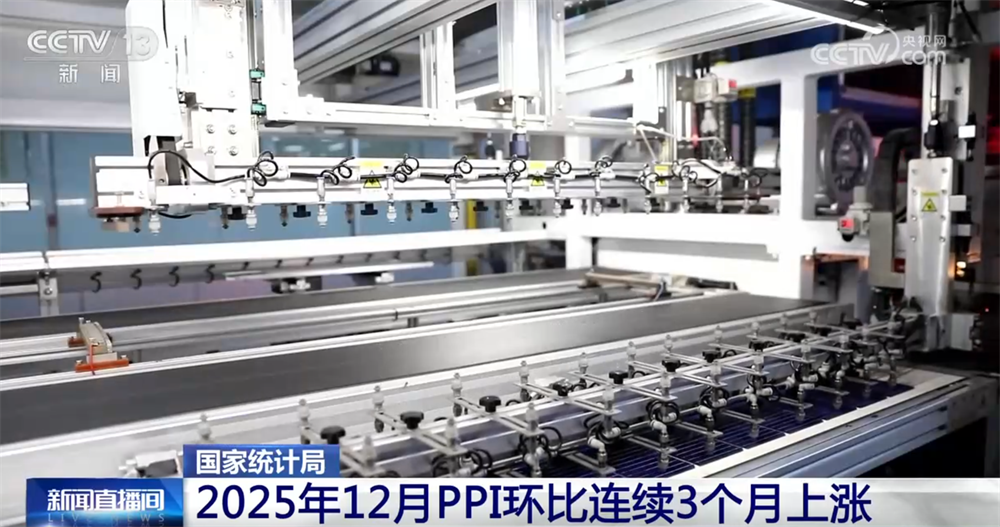
“数”说信心!去年12月PPI环比连续3个月上涨 相关行业价格出现积极变化
Yang Shi Wang· 2026-01-09 09:01
Group 1 - The core viewpoint of the articles indicates that the industrial producer price index (PPI) has shown signs of recovery, with a month-on-month increase for three consecutive months as of December 2025, reflecting improvements in market competition and price adjustments in key industries [1][3] - In December 2025, the PPI increased by 0.2% month-on-month, marking an expansion of 0.1 percentage points compared to the previous month, with notable price increases in coal mining and processing, lithium-ion battery manufacturing, and cement manufacturing [1] - The year-on-year decline in PPI has narrowed by 0.3 percentage points compared to the previous month, indicating a positive shift in pricing dynamics across various sectors due to effective macroeconomic policies [3] Group 2 - The ongoing comprehensive rectification of "involution-style" competition is leading to a significant reduction in price declines in industries such as electrical machinery and equipment manufacturing, while the demand for raw materials is increasing due to the green and intelligent transformation of industries [5] - There is a growing demand for high-quality consumer goods among residents, which is positively impacting the supply-demand situation in sectors like cultural, educational, and sports entertainment products, resulting in better price increases compared to previous years [5]
2025年12月物价数据点评:多重因素共振,年末物价数据全面回升
Dong Fang Jin Cheng· 2026-01-09 05:59
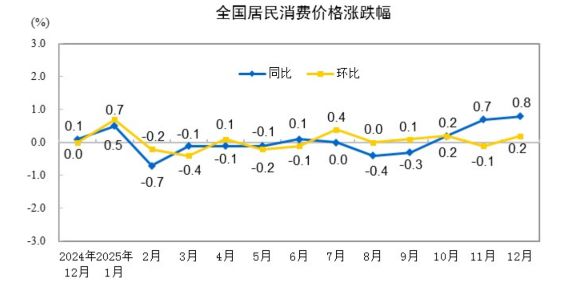
Group 1: CPI Analysis - In December 2025, the CPI increased by 0.8% year-on-year, up from 0.7% in the previous month, marking the highest increase since August 2023[2] - The cumulative CPI for January to December 2025 was 0.0%, indicating a stagnation in price growth over the year[1] - The main drivers for the December CPI increase included rising vegetable and fruit prices due to adverse weather, consumer promotion policies boosting appliance and vehicle prices, and an increase in international gold prices[3] Group 2: PPI Analysis - The PPI in December 2025 decreased by 1.9% year-on-year, a slight improvement from a 2.2% decline in November, with a cumulative decline of 2.6% for the year[1] - The December PPI saw a month-on-month increase of 0.2%, marking the third consecutive month of rising prices[6] - Key factors contributing to the PPI changes included improved supply-demand dynamics in certain industries and rising prices in the non-ferrous metals sector, with specific increases of 3.7% and 2.8% in mining and refining respectively[7][8] Group 3: Economic Outlook - The overall economic environment in 2025 was characterized by weak demand and a "strong supply, weak demand" scenario, leading to a continued decline in PPI[10] - Looking ahead to January 2026, the CPI is expected to drop to around 0.2% year-on-year due to a higher base effect from the previous year and seasonal price fluctuations[5] - The forecast for 2026 indicates a continued low inflation environment, with an expected annual CPI of approximately 0.4%[5]
2025年CPI数据发布
Di Yi Cai Jing Zi Xun· 2026-01-09 02:08
Core Viewpoint - In December 2025, the Consumer Price Index (CPI) increased by 0.8% year-on-year, with urban areas rising by 0.9% and rural areas by 0.6%, indicating a steady increase in consumer prices driven by food and non-food price changes [1][4][6]. CPI Summary - The CPI rose by 0.2% month-on-month in December, reversing a previous decline of 0.1% [5]. - Core CPI, excluding food and energy, increased by 1.2% year-on-year, maintaining a growth rate above 1% for four consecutive months [6]. - Food prices rose by 1.1% year-on-year, with significant increases in fresh vegetables (18.2%) and fresh fruits (4.4%), contributing to the overall CPI increase [6][8]. - Energy prices decreased by 3.8% year-on-year, with gasoline prices dropping by 8.4% [6]. PPI Summary - The Producer Price Index (PPI) increased by 0.2% month-on-month, marking three consecutive months of growth [8]. - Year-on-year, the PPI decreased by 1.9%, but the decline was less severe than in previous months, indicating some stabilization in industrial prices [9]. - Key industries such as coal mining and lithium-ion battery manufacturing saw price increases, reflecting improved supply-demand dynamics [8][9]. - Input factors like international commodity prices influenced the price trends in domestic industries, with non-ferrous metal prices rising due to global market conditions [8][9].
11月CPI同比涨幅扩大 PPI连续两个月上涨
Shang Hai Zheng Quan Bao· 2025-12-10 17:56
Group 1: CPI and Core CPI Trends - In November, the Consumer Price Index (CPI) increased by 0.7% year-on-year, marking the highest level since March 2024, with the core CPI rising by 1.2% year-on-year [1][2] - The increase in CPI was primarily driven by a turnaround in food prices, which shifted from a 2.9% decline in October to a 0.2% increase in November [2] - Fresh vegetable prices saw a significant increase, rising by 14.5% year-on-year in November after nine consecutive months of decline, attributed to adverse weather affecting supply [2] Group 2: PPI Trends - The Producer Price Index (PPI) rose by 0.1% month-on-month in November, marking the second consecutive month of increase [1][4] - The rise in PPI was influenced by seasonal demand increases in industries such as coal mining, with coal prices increasing by 4.1% month-on-month [4] - Year-on-year, PPI decreased by 2.2%, with the decline slightly widening compared to October, largely due to high base effects from the previous year [4] Group 3: Emerging Industries and Price Trends - Prices in emerging industries showed signs of recovery, with significant year-on-year increases in sectors such as external storage devices (up 13.9%) and integrated circuit manufacturing (up 1.7%) [5] - The price declines in photovoltaic equipment and lithium-ion battery manufacturing narrowed, indicating a potential stabilization in these sectors [5] - Overall, the outlook for prices suggests a moderate recovery, supported by improving international trade conditions and ongoing domestic demand policies [5]