有机化工

Search documents
国泰海通|石化:己内酰胺行业自发“反内卷”,相关企业有望受益
国泰海通证券研究· 2025-11-17 14:27
Core Viewpoint - Caprolactam is primarily used for producing nylon, with continuous growth in nylon capacity since 2011 driving the sustained establishment of caprolactam capacity in China. By 2024, China's caprolactam capacity is expected to reach approximately 6.94 million tons per year, with a production of 6.543 million tons and a consumption of 6.49 million tons per year. Entering 2025, the downstream demand for caprolactam is expected to slow significantly, leading to "weak costs, weak demand, and high inventory" pressures, causing prices to drop to a low point. In response, the caprolactam industry has initiated a "de-involution" process, with industry association members agreeing to implement a 20% production cut and raise product prices by 100 yuan per ton. It is believed that with the continued execution of "de-involution" measures, the supply-demand structure of the caprolactam industry is expected to improve [1][4]. Production and Demand Summary - In 2024, China's caprolactam capacity is projected to be around 6.94 million tons per year, with a production of 6.543 million tons and a consumption of 6.49 million tons per year. New capacity additions in 2024 will total 1.15 million tons per year, including new installations from Hunan Petrochemical (300,000 tons/year), Luxi Chemical (300,000 tons/year), Hubei Sanning (400,000 tons/year), and Hualu Hensheng's capacity expansion [2][3]. - The compound annual growth rate (CAGR) for caprolactam consumption from 2021 to 2025 is 13.5%, although demand growth rates will vary by year. Demand growth is expected to be robust in 2023-2024, but will significantly slow in 2025, leading to pressures of "weak costs, weak demand, and high inventory" [2][3]. Industry Response - The caprolactam industry has initiated a "de-involution" process due to increasing issues of overcapacity and price chaos. An industry meeting on November 5, 2025, confirmed the urgency of this initiative, with participants agreeing to implement a 20% production cut and raise prices by 100 yuan per ton. As of late October to early November, the caprolactam supply side has seen increased maintenance of some facilities, reducing capacity utilization to around 86%, and the weekly supply-demand balance has turned negative, alleviating some inventory pressure [3][4].


苯二甲酸市场规模逼近7714百万美元:行业报告预览
Sou Hu Cai Jing· 2025-10-22 04:38
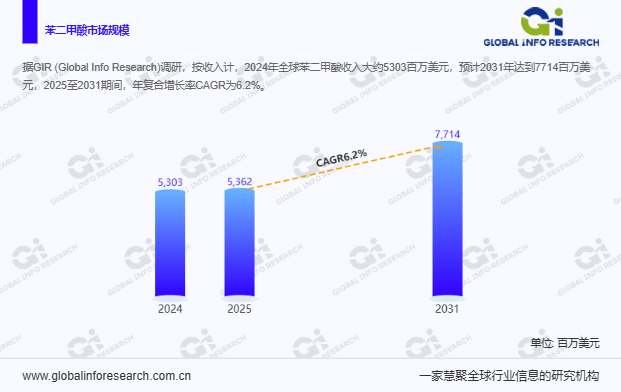
Core Insights - The global market for terephthalic acid is projected to grow from approximately $5.303 billion in 2024 to $7.714 billion by 2031, with a compound annual growth rate (CAGR) of 6.2% from 2025 to 2031, driven by the expansion of downstream industries such as plastics, textiles, and coatings [1][5]. Product Types and Applications - Terephthalic acid is categorized into three main types: ortho-phthalic acid, meta-phthalic acid, and para-phthalic acid, with para-phthalic acid being the most produced variant, essential for producing polyester (PET) used in water bottles, polyester fibers, and food packaging [3][4]. - Ortho-phthalic acid serves as a core component for plasticizers, enhancing the flexibility of polyvinyl chloride (PVC), commonly used in electrical insulation and medical device casings [3]. - Meta-phthalic acid is noted for its excellent corrosion and heat resistance, making it suitable for high-performance unsaturated polyester resins used in marine and chemical equipment coatings [3][4]. Global Market Competition and Company Positioning - The global terephthalic acid market features a competitive landscape with international chemical giants and regional leaders. Lotte Chemical from South Korea is a key player in para-phthalic acid production, providing stable supply for the polyester industry [3][4]. - Mitsubishi Gas Chemical has established a strong presence in the meta-phthalic acid sector, known for high purity and stability, catering to the high-end coatings market [3]. Chinese Market Dynamics - Chinese companies like Jiaxing Petrochemical and Hainan Yisheng Petrochemical have become major suppliers of para-phthalic acid, meeting domestic demand and exporting significantly to Southeast Asia [4][5]. - Zhejiang Hengyi has enhanced its market competitiveness through integrated operations from crude oil processing to terephthalic acid and polyester products [5]. Industry Trends and Data-Driven Development - The Asia-Pacific region is the largest consumer market for terephthalic acid, with significant demand growth in countries like China and India, while North America and Europe focus on the environmental performance of terephthalic acid products [5]. - Fluctuations in crude oil prices, tightening environmental regulations, and upgrades in downstream industries are key factors influencing the market's development pace [5]. - A comprehensive market research report can provide insights into historical data from 2020-2024 and forecast trends from 2025-2031, helping companies optimize production and product structures [5][6].
全球首套!生物基 1,5 - 戊二醇工艺试验成功
DT新材料· 2025-08-31 16:04
Core Viewpoint - The article highlights the successful trial of the world's first bio-based 1,5-pentanediol production process by the company, which utilizes a unique one-step hydrogenation method, achieving high purity and meeting international standards [2][5]. Group 1: Production Process - The company has developed a bio-based 1,5-pentanediol production technology that demonstrates significant innovation by employing a special catalyst in a one-step hydrogenation process [5]. - The industrial production of 1,5-pentanediol can follow two main technological routes: a petroleum-based route and a bio-based route, both requiring strict control of reaction conditions to ensure product purity [3][4]. - The bio-based route uses cyclopentene as a raw material, undergoing a photoxidation reaction to generate an epoxy pentenal intermediate, followed by catalytic hydrogenation under specific temperature and pressure conditions [4]. Group 2: Product Quality and Standards - The final products from both production routes must meet cosmetic ingredient standards, including purity ≥ 99%, moisture content ≤ 0.1%, and heavy metal residue ≤ 10 ppm [5]. - The bio-based 1,5-pentanediol produced by the company has a purity exceeding 99.5%, with color and moisture content well within the required limits, showcasing its compliance with or surpassing international standards [2][5]. Group 3: Market Applications - Bio-based 1,5-pentanediol is widely used in high-end cosmetics due to its excellent moisturizing and preservative properties, aligning with consumer demand for natural and green products [6]. - In the biopharmaceutical sector, 1,5-pentanediol is crucial for synthesizing various pharmaceutical intermediates, meeting the stringent requirements of the industry [6]. - The compound also plays a key role in producing high-end polyurethane and polyester materials, which are utilized in electric vehicle battery coatings and high-value apparel materials, among other applications [6].
供给端扰动不断,这一化工原料价格大幅上涨5000元/吨
Hua Xia Shi Bao· 2025-08-30 12:32
Core Viewpoint - TDI (Toluene Diisocyanate) prices have experienced significant fluctuations in 2023, with a notable increase due to supply constraints and rising demand, particularly from exports [2][3][4]. Supply Dynamics - TDI prices rose from below 10,000 yuan/ton in April to a peak of 17,000 yuan/ton in July, before retreating to around 15,000 yuan/ton in August [2][5]. - Supply disruptions have been caused by various factors, including production halts at major facilities such as Covestro's German plant and maintenance shutdowns at domestic producers like Wanhua Chemical [3][5]. - The global TDI supply capacity has contracted by approximately 16% due to these disruptions, with significant contributions from both domestic and international sources [3][5]. Demand Trends - Demand for TDI has exceeded expectations, with a reported 83% year-on-year increase in China's TDI exports in the first half of 2025, driven by tariff policies in the U.S. [4]. - The primary consumption sectors for TDI include flexible foam (73%), coatings (17%), and other applications, with the demand closely aligned with the distribution of downstream industries [6]. Price Movements - After a peak in July, TDI prices began to decline in August due to profit-taking and the resumption of some production facilities, alongside a decrease in export volumes [5][6]. - Despite the recent price drop, analysts suggest that the current price level of around 15,000 yuan/ton is relatively low compared to historical highs, indicating potential for future price rebounds [6][8]. Historical Context - The TDI market previously experienced a significant boom from 2016 to 2017, with prices soaring from 11,000 yuan/ton to 55,000 yuan/ton, driven by supply reductions and increasing demand from the real estate sector [8][9]. - The current market conditions, while challenging, are not expected to lead to a prolonged decline below 15,000 yuan/ton, as underlying demand and supply dynamics may support price stabilization [8].


供给端扰动不断 这一化工原料价格大幅上涨5000元/吨
Hua Xia Shi Bao· 2025-08-30 11:49
Core Viewpoint - TDI (Toluene Diisocyanate) prices have experienced fluctuations this year, rising significantly after a low in April, driven by supply constraints and increased demand, particularly due to external factors affecting production capacity [1][2][3]. Group 1: Price Trends - TDI prices rose from below 10,000 yuan/ton in April to a peak of 17,000 yuan/ton in July, before retreating to around 15,000 yuan/ton in August [1][4]. - The price increase in July was approximately 6,000 yuan/ton, attributed to supply tightness and increased export volumes [1][3]. Group 2: Supply Constraints - Supply disruptions have been significant, with major producers like Covestro and BASF facing production halts due to various incidents, leading to a global supply reduction of about 16% [2][3]. - Covestro announced a 10% reduction in supply to China to support the European market, following a previous warning about supply tightness [1][4]. Group 3: Demand Dynamics - Demand for TDI has unexpectedly increased, with a reported 83% year-on-year growth in TDI exports from China in the first half of 2025, driven by U.S. tariff policies [3]. - The primary consumption sectors for TDI include soft foam (73%) and coatings (over 17%), with significant applications in furniture, construction, and transportation [5][6]. Group 4: Market Outlook - Analysts suggest that while current price declines may continue, the fundamental market conditions, including inventory dynamics and export expectations, could lead to a rebound in prices [6][7]. - Historical context indicates that TDI prices have previously experienced significant volatility, with past peaks reaching as high as 55,000 yuan/ton in 2016-2017 due to supply reductions and rising demand [7].
商务部公布对原产于美国、欧盟、韩国、日本和泰国的进口苯酚所适用反倾销措施的期终复审裁定
Xin Jing Bao· 2025-08-28 08:09
Core Viewpoint - The Ministry of Commerce of China has announced the continuation of anti-dumping measures on imported phenol from the United States, EU, South Korea, Japan, and Thailand, effective from August 29, 2025, for a period of five years [2][3]. Group 1: Anti-Dumping Measures - The anti-dumping tax rates for phenol imports are as follows: - United States: 244.3% - 287.2% - EU: 30.4% - South Korea: 12.5% - 23.7% - Japan: 19.3% - 27.0% - Thailand: 10.6% - 28.6% These rates are consistent with the previous announcements [1][4]. - The Ministry of Commerce has determined that if the anti-dumping measures are terminated, the likelihood of continued or renewed dumping of phenol from the aforementioned countries remains, which could harm the Chinese phenol industry [2][3]. Group 2: Product Information - Phenol is an important organic chemical raw material used in the production of phenolic resins, bisphenol A, caprolactam, alkylphenols, and salicylic acid, among others. It is also utilized as a solvent, reagent, and disinfectant across various industries including synthetic fibers, plastics, pharmaceuticals, pesticides, fragrances, dyes, coatings, and refining [4]. Group 3: Implementation and Compliance - From August 29, 2025, importers of phenol from the specified countries must pay the corresponding anti-dumping duties to the Customs of the People's Republic of China, calculated based on the customs-determined taxable price of the imported goods [3][6]. - The calculation formula for the anti-dumping tax is: Anti-dumping tax amount = Customs-determined taxable price × Anti-dumping tax rate [6]. Group 4: Legal Recourse - Parties dissatisfied with the review decision may apply for administrative reconsideration or file a lawsuit in the People's Court according to the Anti-Dumping Regulations [7]. Group 5: Effective Date - This announcement will take effect from August 29, 2025 [8].
纯苯期货和期权上市在即 企业表态将积极参与交易
Zheng Quan Ri Bao· 2025-08-08 07:27
Core Viewpoint - The launch of pure benzene futures and options on July 8 by Dalian Commodity Exchange is expected to provide effective risk management tools for the pure benzene industry, with companies eager to participate in initial trading [1][4]. Industry Overview - Pure benzene is a key organic chemical raw material with downstream applications in various sectors including electrical appliances, construction materials, packaging, and fiber materials. China is the largest producer and consumer of pure benzene globally [2][3]. - The rapid changes in the supply-demand structure of the spot market have increased uncertainties for companies in the pure benzene industry, highlighting the urgent need for suitable risk management tools [2]. Challenges Faced by Companies - Companies face several operational challenges, including a lack of pricing power in the domestic pure benzene market, increased credit risk due to price volatility, and mismatched product liquidity between pure benzene and its derivatives [3]. - The reliance on traditional methods such as long-term contracts and inventory adjustments for risk management is insufficient, especially during extreme market fluctuations [2][3]. Futures and Options Details - The first batch of pure benzene futures will consist of four contracts, with a trading unit of 30 tons per contract and physical delivery [4]. - Initial trading limits are set at 7% of the previous day's settlement price, with a 14% limit on the first trading day. The margin requirement is 8% of the contract value [4]. Participation and Expectations - Companies have expressed strong interest in participating in the futures and options market to enhance their risk management capabilities and improve price discovery [5]. - The expectation is that the futures market will enhance liquidity, optimize the structure of market participants, and attract more industry clients and financial institutions [5].
中国己内酰胺产业链知识图谱、进出口贸易及发展趋势洞察报告
Sou Hu Cai Jing· 2025-08-05 04:54
Core Viewpoint - The domestic caprolactam (CPL) industry in China is experiencing significant growth in both production capacity and consumption, with a projected capacity of approximately 6.94 million tons and a production of 6.543 million tons in 2024, reflecting a consumption growth rate of around 27% [1]. Industry Overview - Caprolactam is a crucial organic chemical raw material in the nylon industry, characterized by its excellent thermal stability, processability, mechanical properties, and chemical resistance [3]. - The industry is supported by government policies aimed at enhancing domestic production capabilities and promoting innovation within the sector [5][7]. Production and Consumption - In 2024, the overall operating rate of caprolactam enterprises is expected to remain high, indicating robust demand and supply dynamics [1]. - The apparent consumption of caprolactam is projected to reach 6.49 million tons in 2024, with a strong growth trajectory in both supply and demand [1]. Price Trends - The price of caprolactam is anticipated to experience fluctuations, with a general trend of decline throughout 2024. Price rebounds are primarily supported by favorable cost factors, while downward pressures stem from the release of new production capacities [1]. Policy Environment - Recent government initiatives, such as the "Implementation Plan for the Innovative Development of the Fine Chemical Industry (2024-2027)," aim to enhance the supply chain capabilities and promote green and intelligent technologies within the caprolactam sector [5][7]. - The introduction of restrictions on production capacities below 100,000 tons per year is expected to raise entry barriers for new companies, thereby consolidating the market [12]. Industry Development History - The caprolactam industry has evolved through several stages, from initial development in the 1950s to rapid capacity expansion in the 2010s, culminating in recent environmental upgrades and industry consolidation [8]. Competitive Landscape - The production of caprolactam involves significant technical and financial barriers, with established players like Sinopec and Hengshen Group holding advanced technologies and large-scale production capabilities [10][11]. - New entrants face challenges in meeting stringent quality requirements and securing sufficient funding for production facility development [11].
研判2025!中国氯化苯行业产量、价格及开工率分析:产能释放叠加需求回暖,中国氯化苯2025年上半年产量同比激增71.43%[图]
Chan Ye Xin Xi Wang· 2025-08-04 06:49
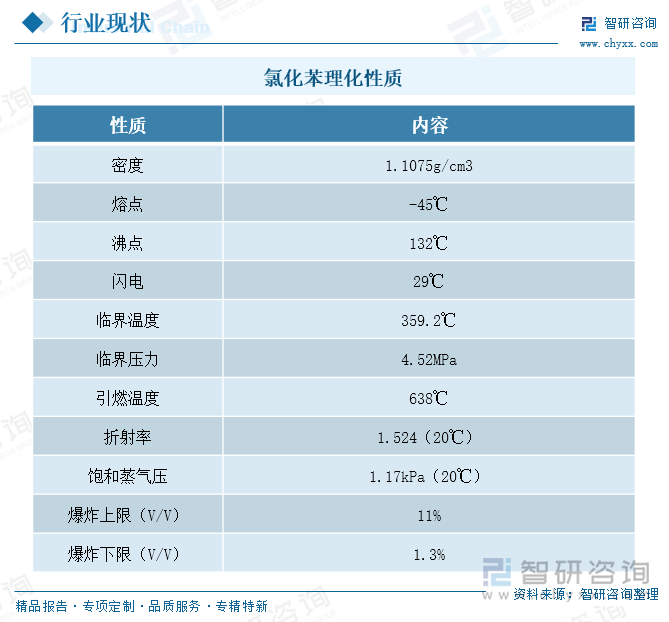
Industry Overview - Chlorobenzene is a key organic chemical intermediate with irreplaceable strategic importance in agriculture, pharmaceuticals, dyes, and polymer materials [1][5] - In the first half of 2025, China's chlorobenzene industry is expected to experience a concentrated release of production capacity, leading to a significant increase in output, which is projected to reach 211,300 tons, a year-on-year growth of 71.43% [1][5] Industry Chain - The upstream of the chlorobenzene industry includes raw materials such as benzene, chlorine gas, and catalysts, as well as production equipment like chlorination reactors and distillation towers [3] - The midstream involves the production and manufacturing of chlorobenzene, while the downstream applications span agriculture, pharmaceuticals, dyes, pigments, fine chemicals, and synthetic materials [3] Current Industry Status - As of June 2025, the price of chlorobenzene is 4,964 yuan per ton, a year-on-year decrease of 33.25% due to increased market supply and reduced upstream raw material costs [7] - The industry operating rate in June 2025 is 55.69%, a decrease of 8.00 percentage points month-on-month but an increase of 21.21 percentage points year-on-year, driven by new production capacity and improved downstream demand [9] - The inventory level in the last week of June 2025 is 8,630 tons, a year-on-year increase of 643.97%, indicating a supply-demand imbalance [11] Key Enterprises - The chlorobenzene industry in China is highly concentrated, with a few large enterprises dominating the market. Anhui Bayi Chemical Co., Ltd. is the largest producer with an annual capacity of 320,000 tons [13] - Sinopec Nanjing Chemical Industry Co., Ltd. has an annual capacity of 150,000 tons and is a significant player in production technology and product quality [13] Industry Development Trends 1. The industry is transitioning from "scale expansion" to "quality upgrade," with technological advancements such as catalytic chlorination expected to reduce energy consumption and emissions [19] 2. The demand for chlorobenzene is expanding into high-value-added fields, particularly in pharmaceuticals and electronic chemicals, driven by the expiration of patents for key drugs [20] 3. Stricter environmental policies are pushing for a green transformation, leading to increased industry concentration as smaller firms face elimination due to rising compliance costs [21]


纯苯期货首日成交47.88亿元,230家法人客户抢滩新品种!
Sou Hu Cai Jing· 2025-07-08 23:27
Core Viewpoint - The launch of pure benzene futures and options on the Dalian Commodity Exchange provides a crucial risk management tool for the aromatic industry, enabling companies to hedge against price volatility effectively [1][5]. Group 1: Trading Performance - On the first day of trading, four contracts were listed: BZ2603, BZ2604, BZ2605, and BZ2606, with a total trading volume of 26,900 contracts and a cumulative transaction value of 4.788 billion yuan [3]. - The closing price for the main contract BZ2603 was 5,931 yuan/ton, reflecting a 0.53% increase from the benchmark price of 5,900 yuan/ton, indicating a stable market response [3]. - A total of 230 institutional clients participated in the trading, with institutional holdings accounting for 62.7% of the positions, highlighting strong interest from major industry players [3]. Group 2: Industry Context - Pure benzene is a critical organic chemical raw material, linking upstream oil and coal resources to downstream industries such as synthetic resins, fibers, and rubber, with applications in textiles, home appliances, automotive, and construction [4]. - China is the world's largest producer, consumer, and importer of pure benzene, with a projected production of 25.13 million tons and a consumption of 29.26 million tons in 2024, leading to a market size of 208.6 billion yuan [4]. - The volatility of pure benzene prices has increased significantly, with prices dropping from a peak of 7,780 yuan/ton to 5,375 yuan/ton since 2025, a decline of 31% [4]. Group 3: Risk Management Demand - The introduction of pure benzene futures and options addresses the strong demand for risk management tools within the industry, allowing companies to lock in prices and mitigate risks associated with price fluctuations [5]. - Companies like Hengshen Holdings and Xuyang Group actively participated in the first day of trading, indicating a proactive approach to managing raw material procurement costs through futures contracts [4].