稀土开采与加工

Search documents
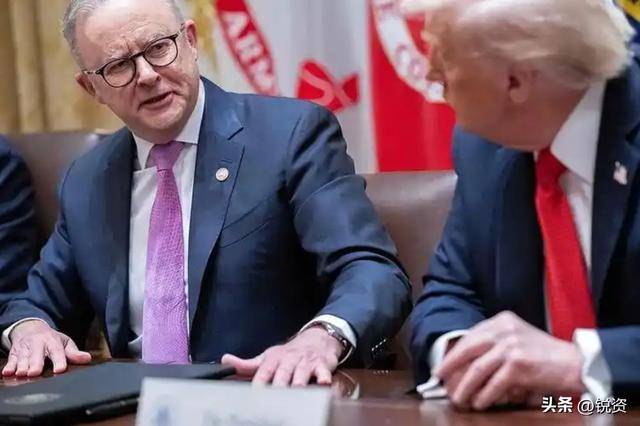
中国稀土封锁被突破?美国军工前景堪忧,美、澳达成85亿新协议!
Sou Hu Cai Jing· 2025-10-25 09:18
Core Viewpoint - The $8.5 billion rare earth agreement between the U.S. and Australia is largely seen as a political maneuver rather than a substantial investment, with skepticism about its actual impact on reducing U.S. dependence on China for rare earth materials [1][3][4]. Group 1: Agreement Details - The $8.5 billion figure is not a concrete investment but rather a framework agreement filled with "plans" and "intentions," similar to verbal agreements in a market [3]. - Both the U.S. and Australia have claimed different investment amounts, with the U.S. Export-Import Bank's $2.2 billion being based on seven letters of intent, requiring an additional $5 billion in private capital to move forward [3][4]. - The timeline for establishing a rare earth supply chain is lengthy, with estimates suggesting it could take three to four years to produce any output, contradicting claims of immediate surplus [4][6]. Group 2: Strategic Implications - The agreement signals a shift from U.S. reliance on China, as over 70% of U.S. rare earth imports currently come from China, highlighting the risks of supply chain disruptions [4][6]. - The partnership is tied to broader defense agreements, such as AUKUS, indicating a strategy of "resource for security," which may complicate U.S.-Australia relations in the long term [6][7]. - The U.S. is attempting to leverage Australia's resources while maintaining a tough stance on tariffs, which could undermine the competitiveness of Australian rare earths due to higher processing costs [7][8]. Group 3: Technological and Competitive Landscape - The U.S. lacks the necessary rare earth refining technology, with China holding the majority of global patents and expertise in this area, making it difficult for the U.S. and Australia to establish a competitive supply chain [7][9]. - The so-called "rare earth triangle alliance" involving Japan is also seen as weak, as Japan relies heavily on Chinese refining capabilities, limiting its ability to support U.S. initiatives [8][9]. - China's dominance in rare earth processing and technology poses a significant barrier for the U.S. and Australia, as they would need to develop their own capabilities to compete effectively [9][10]. Group 4: China's Response and Strategy - China has implemented stricter export controls on rare earth technologies, aiming to prevent the transfer of critical knowledge to Australia and the U.S. [9][10]. - The establishment of futures trading for rare earths in China is seen as a move to regain pricing power in the global market, potentially impacting international pricing dynamics [10][12]. - China's long-term strategy focuses on maintaining a closed-loop supply chain from mining to processing, which has been developed over decades, contrasting with the U.S. and Australia's nascent efforts [10][12].


欧洲主动打电话示弱,发出一封邀请函,恳请中方回到谈判桌,共商稀土合作!
Sou Hu Cai Jing· 2025-10-22 08:45
Core Insights - The EU's recent shift towards dialogue with China regarding rare earth resources marks a significant change in its previously hardline stance, driven by the need to address China's export controls and enhance strategic autonomy [1][3][5] Group 1: Importance of Rare Earth Elements - Rare earth elements are critical for various industries, including electric vehicles, defense technology, and the digital economy, with China controlling over 90% of global rare earth processing capabilities [1][3] - The EU's limited domestic rare earth mining and processing capabilities make it heavily reliant on Chinese supplies, which poses a risk to its automotive and machinery sectors [3][5] Group 2: EU's Strategic Shift - The EU's approach reflects a broader strategic awakening, recognizing the need for autonomy rather than relying on external powers, contrasting with the previous alignment with U.S. policies [5][7] - Internal divisions within the EU complicate its negotiations with China, as countries like Germany and Italy oppose strict measures due to their dependence on rare earths, while Southern European nations adopt a more aggressive stance [5][7] Group 3: Future Implications - The EU's current negotiations are not just about economic interests but also about building trust and establishing rules for cooperation, indicating a long-term dependency on China that is projected to exceed 70% for rare earth processing and technology until 2035 [5][7] - The challenge for the EU lies in diversifying its resource supply chains to avoid over-reliance on a single source, which is crucial for maintaining its strategic interests in a globalized economy [7]

美澳85亿稀土协议落地,特朗普:一年后将有好多稀土,都用不完
Sou Hu Cai Jing· 2025-10-22 06:34
Group 1 - The core agreement between the US and Australia involves establishing a dedicated group to monitor rare earth supply, with both governments gaining partial ownership of related mining facilities, ensuring priority supply of rare earths to them [1] - Despite the agreement's ambitious claims, significant challenges exist, particularly regarding Australia's processing capabilities, which lag far behind China's. Australia lacks a complete chemical infrastructure, large-scale smelting equipment, and experienced engineers, with many rare earth projects still in the feasibility study phase [1][2] - The rare earth industry is complex, involving multiple stages from mining to material production, and it took China decades to develop a mature system. The prospect of the US and Australia establishing a similar system in the short term is nearly impossible [1] Group 2 - Environmental concerns are significant in Australia, with local councils, indigenous groups, and environmental organizations likely to strongly oppose high-pollution projects, raising questions about the feasibility of advancing these projects [2] - Analysts in Australia have indicated that completing these rare earth projects by 2027 presents an extraordinarily high level of difficulty, suggesting that political statements about immediate supply increases are unrealistic [2]
A股晚间热点 | 外交部回应美方关税威胁 黄金再创历史新高 后市如何走?
智通财经网· 2025-10-13 14:55
Group 1 - The U.S. plans to impose a 100% tariff on Chinese goods starting November 1, in response to China's export controls on rare earths, with China firmly opposing these measures and indicating it will take corresponding actions to protect its interests [1] Group 2 - Gold prices have surged, with COMEX December contracts breaking $4100 per ounce, marking a 2.5% increase, while spot gold reached $4082.09 per ounce, up 1.6%. Silver also saw a significant rise of over 5% [2] - Bank of America has raised its price forecasts for gold and silver for next year to $5000 per ounce and $65 per ounce, respectively, citing extreme imbalances in the physical silver market [2] Group 3 - Advanced Semiconductor Manufacturing Co., a subsidiary of Wintech, has lost control due to dual regulatory actions from the Dutch government and courts, leading to a significant drop in the company's stock price [3] - Wintech's semiconductor business relies heavily on China, with nearly 80% of its production capacity and about half of its revenue generated in the mainland [3] Group 4 - Sichuan province is accelerating the development of its AI industry, aiming to establish over 10 leading enterprises and 20 high-level projects by 2027, along with creating 50 benchmark application scenarios across various sectors [4] Group 5 - Northern Rare Earth and its affiliate Baolan Environmental Protection Company received regulatory warnings for failing to disclose non-operating fund occupation issues, leading to a surge in rare earth stocks on the A-share market [5] Group 6 - Notable investor Duan Yongping publicly expressed his continued confidence in Kweichow Moutai by purchasing shares, reinforcing his positive outlook on the leading liquor brand [6] Group 7 - The U.S. Department of Defense plans to invest $1 billion in the procurement of critical minerals, including cobalt and antimony, to enhance its strategic resource capabilities [8] Group 8 - Saudi Aramco's CEO projected that by 2030, data centers could consume three times the electricity of the global electric vehicle fleet, highlighting the growing demand for energy in the tech sector [10]

我国对出口稀土严控之后,五角大楼马上让采购10亿美元关键矿产
Sou Hu Cai Jing· 2025-10-13 14:02
Core Points - The Chinese Ministry of Commerce announced stricter controls on rare earth exports, effective from November 8, 2025, targeting heavy and medium rare earth elements, including five newly added elements: holmium, erbium, thulium, europium, and ytterbium [1] - The announcement is part of a broader trend of increasing export restrictions on rare earth products, which began in 2023 and 2024, with previous measures including export licensing for gallium and germanium [1][3] - The U.S. Department of Defense plans to spend up to $1 billion on critical minerals, including rare earth metals, to establish strategic reserves and mitigate supply chain risks, with a focus on domestic and allied sources [3][5] Group 1: Chinese Export Controls - The new export controls require companies to report end-users and specific applications for rare earth elements, affecting industries reliant on these materials [1] - The measures are framed as necessary for national security and are not outright bans, but rather enhanced management of exports [1][7] - The controls apply to both Chinese and foreign companies, requiring approval for products containing over 0.1% Chinese rare earths [3] Group 2: U.S. Response and Procurement Plans - The U.S. Defense Logistics Agency's procurement plan emphasizes the importance of heavy and medium rare earths for defense applications, including the F-35 fighter jet [4][5] - The procurement plan follows previous investments by the U.S. Department of Defense in rare earth processing facilities, indicating a long-term strategy to diversify supply chains away from China [5][8] - Following the announcement of the procurement plan, U.S. rare earth companies saw stock price increases, reflecting investor optimism about domestic production stimulation [5] Group 3: Market Implications - The tightening of export controls by China has led to increased global price volatility for rare earths and related materials, with significant price increases observed in 2024 [7] - The U.S. government's focus on building strategic reserves and enhancing domestic production capabilities is a direct response to China's dominant position in the rare earth market, where China accounts for 61% of global mining output and over 90% of processing [1][7] - The competitive dynamics between China and the U.S. in the critical minerals sector are intensifying, with both countries implementing measures to secure their supply chains [7]
美国砸5亿抢巴铁稀土,想破中国稀土优势,谁知巴铁做法亮了
Sou Hu Cai Jing· 2025-10-08 19:44
Core Insights - Pakistan's Prime Minister and Army Chief signed a $500 million mineral cooperation memorandum with a U.S. strategic metals company, marking a significant partnership in the mineral sector [1] - The initial investment from the U.S. is seen as crucial for Pakistan, which is facing an economic crisis with external debt reaching $1.3 trillion and foreign reserves falling below $9 billion [3] - The agreement allows for a maximum cooperation period of 15 years, after which Pakistan can reclaim mining rights or change partners, indicating a strategic balancing act in geopolitics [5] Economic Context - Pakistan's economic situation is dire, with a pressing need for foreign investment to stabilize its economy and develop its mineral resources, estimated at $6 trillion [3] - The U.S. aims to reduce its reliance on China for rare earth elements, which are critical for various industries, including defense [7] Geopolitical Dynamics - The cooperation with the U.S. is part of Pakistan's strategy to balance its relationships in South Asia, especially in light of deteriorating U.S.-India relations [3] - Pakistan's willingness to allow Chinese companies to participate in mineral projects reflects its intent to maintain flexibility in its foreign partnerships [5] Challenges Ahead - The mining resources in Pakistan are primarily located in regions with challenging terrain and security issues, which could hinder operational efficiency [11] - Pakistan lacks sufficient mineral processing technology and infrastructure, which may delay the transition from raw material extraction to production [11] Comparison with China - China's dominance in the rare earth supply chain, including extraction and processing capabilities, poses a challenge for Pakistan's new partnership with the U.S. [9] - The depth of cooperation between China and Pakistan in various sectors, including military and agriculture, highlights the complexity of Pakistan's foreign relations [12]
中国为何不阻拦?巴铁总理赴美签字,卖稀土矿给美国续命
Sou Hu Cai Jing· 2025-10-04 07:37
Core Viewpoint - Pakistan's Prime Minister Sharif and Army Chief Munir recently visited the U.S. and signed a memorandum of cooperation, focusing on establishing multi-metal refining facilities in Pakistan to enhance the processing and export of minerals like copper, gold, tungsten, and rare earth elements [1] Economic Context - Pakistan is facing long-term fiscal pressures, heavy external debt, and insufficient foreign exchange reserves. Attracting foreign investment in mineral resources could potentially generate foreign exchange income and alleviate the debt burden [1] - The cooperation with the U.S. is seen as a strategy to diversify Pakistan's economic partnerships and foreign investment sources, reducing reliance on a single country [4] U.S.-Pakistan Cooperation - The agreement primarily revolves around the extraction and rough processing of rare earth materials rather than advanced processing, which does not pose an immediate threat to China's dominance in the rare earth sector [7] - The U.S. is actively seeking to expand its rare earth supply chain globally, including partnerships in Australia, Northern Europe, and Africa, indicating a broader strategy rather than a focused effort on Pakistan alone [9] China's Position - China maintains a dominant position in the rare earth sector due to its technological advantages, controlling approximately 90% of global rare earth magnet manufacturing. This technological edge is crucial as the extraction and processing of rare earths are complex and require advanced separation techniques [4] - Even if Pakistan and the U.S. begin cooperation in rare earth mining, the actual development may still be handed over to China due to potential funding and technical challenges faced by the U.S. [4][5] Implementation Challenges - The transition from cooperation intentions to actual execution is often lengthy and uncertain, with estimates suggesting that establishing a U.S. rare earth industry chain could take over a decade, during which geopolitical dynamics may shift [9]
A股集体翻红,超3300股上涨,猪肉股爆发
21世纪经济报道· 2025-08-26 03:54
Market Overview - A-shares opened lower but rebounded, with the Shanghai Composite Index up 0.11%, Shenzhen Component Index up 0.73%, and ChiNext Index up 0.21% at midday [1] - The total trading volume in the Shanghai and Shenzhen markets reached 1.68 trillion [1] Sector Performance - The gaming, pork, and Huawei Ascend sectors saw significant gains, while rare earth permanent magnets and banking sectors experienced declines [3] - The pork sector showed strength, with Muyuan Foods nearing a limit-up, following a limit-up for Aonong Biological and gains for Jingji Zhino and Lihua Shares [3] Pork Market Insights - The national average pig-to-grain price ratio has dropped below 6:1, entering a warning zone as per the National Development and Reform Commission [5] - To stabilize the pork market, the National Development and Reform Commission will collaborate with relevant departments to conduct central frozen pork reserve storage, with 10,000 tons stored on August 25 [5] Rare Earth Sector Analysis - The rare earth permanent magnet sector saw significant adjustments, with Baotou Steel and Northern Rare Earth both declining over 5% [6] - The recent release of the "Interim Measures for Total Control Management of Rare Earth Mining and Separation" marks the beginning of supply-side reforms in the rare earth industry [8] - July saw a substantial increase in magnet exports, with expectations for continued price increases due to supply disruptions and seasonal demand [9]

【A股收评】牛市号角吹响!两市成交破3万亿,创业板涨3%
Sou Hu Cai Jing· 2025-08-25 09:41
Market Performance - The A-share market saw significant gains, with the Shanghai Composite Index rising by 1.51%, the Shenzhen Component Index by 2.26%, and the ChiNext Index by 3% [2][3] - Over 3,200 stocks in the two markets experienced an increase, with a total trading volume of approximately 3.14 trillion yuan [3] Rare Earth Sector - The rare earth sector experienced a collective surge, with companies like Jinli Permanent Magnet rising by 20% and others such as Lingyi Technology and Northern Rare Earth also showing substantial gains [3] - Prices of major rare earth products have increased since August, driven by tightening supply and structural demand surges, leading to a supply-demand imbalance [3] Alcohol Industry - The liquor sector showed strong performance, with Shede Liquor rising by 10% and other major brands like Moutai and Wuliangye also increasing [3] - Longjiang Securities noted that the industry is currently in a destocking phase, but with macroeconomic recovery, demand is expected to improve [3] AI Computing Sector - The AI computing sector saw significant gains, with companies like Zhongji Xuchuang rising by 14.74% and others like Cambrian Technology also achieving over 11% growth [4] - Central Securities highlighted optimistic capital expenditure outlooks for leading cloud companies by 2025, driven by AI development and the construction of large data centers [4] Real Estate and Consumer Stocks - Some real estate, consumer, and military stocks performed well, with companies like Bona Film Group and China Satellite both rising by 10% [4] - Shanxi Securities indicated that 2025 will be a pivotal year, with demand gradually improving and military sector performance expected to rebound in the second half of 2025 [5] Declining Sectors - The beauty and personal care sector showed weakness, with companies like Marubi Biotechnology declining by over 6% [6]


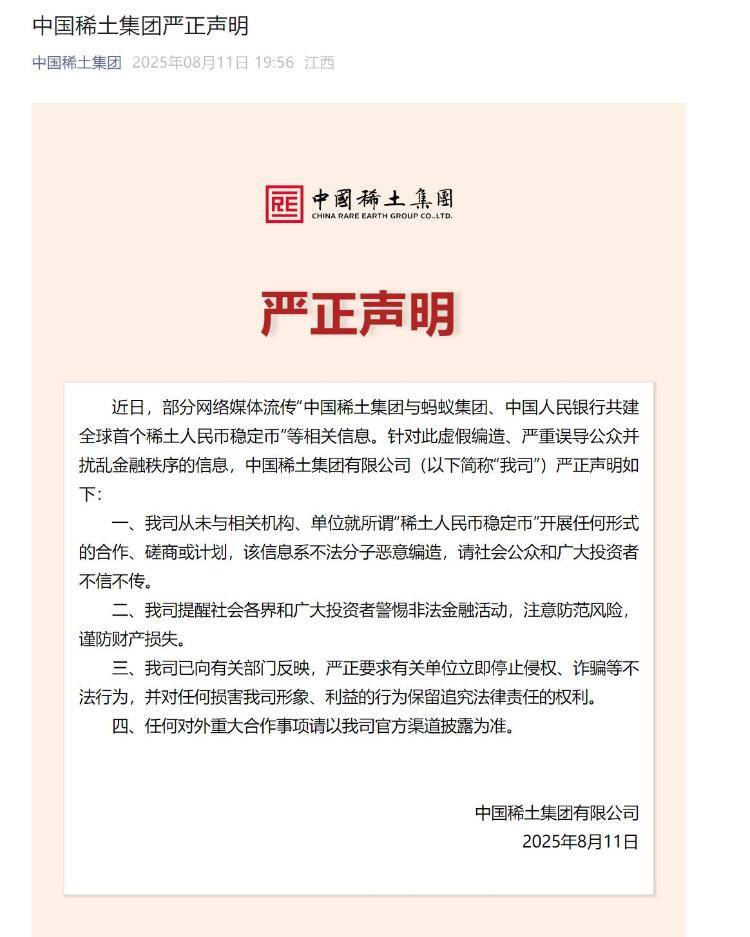
中国稀土集团:从未就所谓“稀土人民币稳定币”开展任何形式的合作
Sou Hu Cai Jing· 2025-08-12 04:47
Core Viewpoint - China Rare Earth Group has issued a stern statement denying any collaboration with Ant Group and the People's Bank of China regarding the establishment of a rare earth RMB stablecoin, labeling the information as false and misleading [1][4][5] Group 1: Company Position - The company has never engaged in any form of cooperation, consultation, or planning related to the so-called "rare earth RMB stablecoin," asserting that the information is maliciously fabricated by illegal entities [1][4] - The company warns the public and investors to be vigilant against illegal financial activities and to be cautious to prevent financial losses [1][4] - The company has reported the matter to relevant authorities, demanding an immediate cessation of infringement and fraudulent activities, while reserving the right to pursue legal action against any actions that harm its image and interests [1][4] Group 2: Communication Protocol - The company emphasizes that any significant external cooperation matters should be disclosed through its official channels [1][4]