高耗能行业

Search documents
1月份制造业PMI为49.3%
Ren Min Ri Bao Hai Wai Ban· 2026-02-02 01:48
Group 1 - The manufacturing Purchasing Managers' Index (PMI) for January is 49.3%, a decrease of 0.8 percentage points from the previous month, indicating a decline in manufacturing activity due to seasonal factors and insufficient market demand [2] - The production index stands at 50.6%, indicating continued expansion in manufacturing production, while the new orders index is at 49.2%, reflecting a drop in market demand [2] - Certain industries such as agricultural processing and aerospace have production and new orders indices above 56.0%, indicating strong demand, while sectors like petroleum and automotive show indices below the critical point, suggesting a slowdown in market demand [2] Group 2 - The main raw materials purchasing price index and the factory price index are at 56.1% and 50.6%, respectively, both showing increases from the previous month, with the factory price index rising above the critical point for the first time in nearly 20 months [3] - Large enterprises maintain a PMI of 50.3%, indicating continued expansion, while medium and small enterprises show PMIs of 48.7% and 47.4%, reflecting a decline in their economic performance [3] - High-tech manufacturing leads with a PMI of 52.0%, remaining above 52.0% for two consecutive months, while consumer goods and high-energy industries show lower PMIs of 48.3% and 47.9%, indicating a decrease in their economic conditions [3] Group 3 - The production and business activity expectation index is at 52.6%, indicating optimism among enterprises, particularly in agricultural processing and food industries, which have indices above 56.0% [4] - The non-manufacturing business activity index for January is 49.4%, a decrease of 0.8 percentage points from the previous month, indicating a decline in overall non-manufacturing activity [4] - The service industry business activity index is at 49.5%, down 0.2 percentage points, with sectors like financial services showing high activity indices above 65.0%, while the real estate sector drops below 40.0%, indicating weak performance [4]

1月份制造业PMI为49.3% 高技术制造业持续领跑
Jin Rong Shi Bao· 2026-02-02 01:14
Group 1 - The manufacturing Purchasing Managers' Index (PMI) in January was 49.3%, a decrease of 0.8 percentage points from the previous month, indicating a decline in manufacturing activity due to seasonal factors and insufficient market demand [1] - The production index was at 50.6%, indicating continued expansion in manufacturing production, while the new orders index fell to 49.2%, reflecting a drop in market demand [1] - Industries such as agricultural processing and aerospace showed strong production and new orders indices above 56.0%, while sectors like petroleum and automotive experienced a slowdown with indices below the critical point [1] Group 2 - The price indices for major raw materials and factory prices rose to 56.1% and 50.6%, respectively, influenced by recent increases in commodity prices, marking an improvement in the overall price level in the manufacturing market [1] - The raw material inventory index decreased to 47.4%, indicating a continued reduction in the inventory of major raw materials in manufacturing [1] - High-tech manufacturing PMI was at 52.0%, maintaining a strong performance, while the equipment manufacturing PMI was at 50.1%, indicating expansion [2] Group 3 - Large enterprises maintained a PMI of 50.3%, indicating continued expansion, while small and medium-sized enterprises saw declines in their PMIs to 48.7% and 47.4%, respectively [2] - The production and business activity expectation index was at 52.6%, showing optimistic expectations among enterprises, particularly in the agricultural and food sectors [2] - Macroeconomic policies are expected to become more proactive, focusing on expanding domestic demand, with recent government initiatives aimed at stimulating consumption [3]

1月份中国采购经理指数有所回落
Guo Jia Tong Ji Ju· 2026-02-02 01:05
Group 1: Manufacturing Sector - The manufacturing Purchasing Managers' Index (PMI) decreased to 49.3% in January, indicating a decline in economic sentiment compared to the previous month [1][2] - The production index remained above the critical point at 50.6%, suggesting continued expansion in manufacturing production, while the new orders index fell to 49.2%, indicating a drop in market demand [2] - Large enterprises maintained a PMI of 50.3%, indicating ongoing expansion, while small and medium-sized enterprises saw declines in their PMIs to 48.7% and 47.4%, respectively [3] - High-tech manufacturing continued to lead with a PMI of 52.0%, reflecting a positive development trend in this sector [3] - The price indices for major raw materials and factory prices rose to 56.1% and 50.6%, respectively, indicating an overall improvement in market price levels [2] Group 2: Non-Manufacturing Sector - The non-manufacturing business activity index fell to 49.4%, reflecting a decrease in overall economic sentiment in this sector [1][4] - The service industry business activity index was at 49.5%, with significant activity in financial services, while the real estate sector's index dropped below 40.0%, indicating weak sentiment [4] - The construction industry experienced a notable decline, with its business activity index at 48.8%, influenced by adverse weather and the upcoming holiday [4] - Despite the decline in current activity, the service industry business activity expectation index rose to 57.1%, indicating increased confidence among service sector enterprises [4] Group 3: Composite PMI - The composite PMI output index was recorded at 49.8%, showing a slight decrease from the previous month, indicating a general slowdown in production and business activities [1][5] - The manufacturing production index and non-manufacturing business activity index were 50.6% and 49.4%, respectively, contributing to the overall composite PMI output index [5]
1月制造业PMI为49.3% 高技术制造业发展态势持续向好
Shang Hai Zheng Quan Bao· 2026-02-01 18:14
□ 1月生产指数为50.6%,高于临界点,制造业生产保持扩张 □ 1月高技术制造业PMI为52.0%,连续2个月位于52.0%及以上较高水平,行业发展态势持续向好。装备 制造业PMI为50.1%,保持在扩张区间 □ 1月主要原材料购进价格指数和出厂价格指数分别为56.1%和50.6%,分别比2025年12月上升3.0个百分 点和1.7个百分点。其中,原材料购进价格指数创2024年6月以来新高,出厂价格指数是近20个月来首次 升至临界点以上 □ 1月制造业企业生产经营活动预期指数为52.6%,继续高于临界点 □ 1月服务业业务活动预期指数为57.1%,比2025年12月上升0.7个百分点,连续2个月环比上升,表明服 务业企业对近期市场发展信心有所增强 ◎记者 陈芳 从制造业PMI的分项指标看,企业生产增势有所放缓,但整体仍保持扩张态势,市场需求承压运行,新 订单指数和新出口订单指数均回落。 数据显示:1月生产指数为50.6%,高于临界点,制造业生产保持扩张;新订单指数为49.2%,较2025年 12月下降1.6个百分点;新出口订单指数为47.8%,较2025年12月下降1.2个百分点。 对于需求回落的原因,中国 ...
国泰海通:1月PMI淡季回落,价格回升
Ge Long Hui· 2026-02-01 03:53
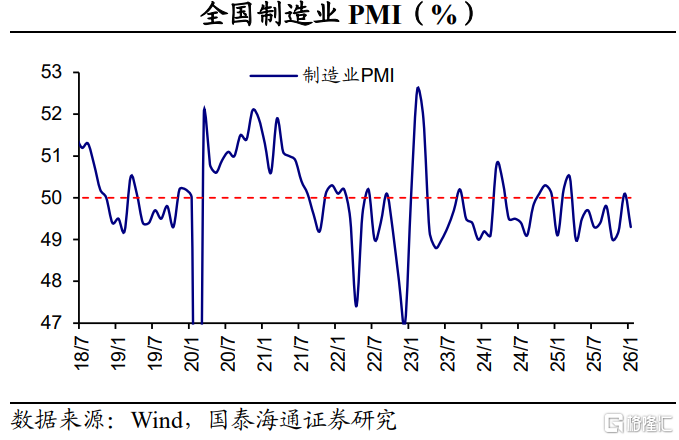
本文来自格隆汇专栏:梁中华宏观研究 作者: 侯欢、梁中华 投资要点 本月制造业PMI淡季回落,需求待提振,扩产较谨慎。受大宗商品涨价影响,价格指数明显回升。此外,服务业景气平稳,建筑业活 跃度还需政策呵护。 2026年1月份,制造业PMI为49.3%,比上月下降0.8个百分点。建筑业商务活动指数为48.8%,比上月下降4.0个百分点;服务业商务活 动指数为49.5%,比上月下降0.2个百分点。 制造业PMI:淡季回落。为了缓解春节假期因素的扰动,国泰海通证券把本月PMI与近年春节前一个月对比。结果发现,本月PMI不及 近年同期平均水平,降幅强于季节性。一方面,企业规模分化加剧,大型企业PMI仍位于扩张区间, 中、小型企业PMI在收缩区间低位 运行。另一方面,经济结构转型加快。高技术制造业PMI连续两个月位于较高水平,装备制造业保持在扩张区间。相比之下,消费品 行业和高耗能行业处于收缩区间,景气水平有所回落。 需求有待提振,扩产较为谨慎。2026年1月份,生产指数为50.6%,虽然高于临界点,但是比上月下降1.1个百分点,除了淡季因素的影 响,还与需求的回落有关。同期,新订单、新出口订单指数分别为49.2%、4 ...

高技术制造业PMI连续两个月为52.0%及以上 新动能延续扩张态势
Jing Ji Ri Bao· 2026-02-01 01:30
国家统计局服务业调查中心、中国物流与采购联合会1月31日发布数据显示,2026年1月份,制造业采购 经理指数(PMI)、非制造业商务活动指数和综合PMI产出指数分别为49.3%、49.4%和49.8%,比上月下降 0.8个、0.8个和0.9个百分点,经济景气水平有所回落。 服务业运行稳定 1月份,受建筑业等行业景气度下降等因素影响,非制造业商务活动指数为49.4%,比上月下降0.8个百 分点,非制造业总体景气水平有所回落。 "但从企业感受来看,市场需求不足的问题趋于缓解。"中国物流信息中心专家文韬表示,1月份反映市 场需求不足的制造业企业比重为54.9%,较上月下降9.4个百分点,意味着当前的市场需求放缓属于正常 变化,市场需求趋稳运行态势没有改变。 新动能延续扩张态势,产业结构持续优化。1月份,高技术制造业PMI为52.0%,连续两个月位于52.0% 及以上较高水平,相关行业发展态势持续向好;装备制造业PMI为50.1%,保持在扩张区间;消费品行 业和高耗能行业PMI分别为48.3%和47.9%,景气水平有所回落。 从价格看,受近期部分大宗商品价格上涨等因素影响,主要原材料购进价格指数和出厂价格指数分别为 ...
新动能延续扩张态势
Xin Lang Cai Jing· 2026-01-31 22:37
Group 1: Manufacturing Sector - In January 2026, the Manufacturing Purchasing Managers' Index (PMI) was reported at 49.3%, indicating a decrease of 0.8 percentage points from the previous month, reflecting a decline in economic sentiment [1] - The production index stood at 50.6%, indicating continued expansion in manufacturing production, while the new orders index fell to 49.2%, suggesting a decrease in market demand [2] - High-tech manufacturing PMI was at 52.0%, remaining above 52.0% for two consecutive months, indicating a positive development trend in related industries [2] - Large enterprises reported a PMI of 50.3%, indicating sustained expansion and a strong supporting role in the manufacturing sector [3] Group 2: Non-Manufacturing Sector - The Non-Manufacturing Business Activity Index was reported at 49.4%, down 0.8 percentage points from the previous month, indicating a decline in overall non-manufacturing sentiment [4] - The financial sector's business activity index rose above 65%, showing a significant increase compared to the same period last year, providing a favorable financing environment for growth [4] - The service sector's business activity expectation index rose to over 57%, indicating optimism among enterprises regarding the impact of the upcoming Spring Festival on service sector demand [4][5] Group 3: Economic Outlook - Experts suggest that the market demand issue is gradually easing, with a decrease in the proportion of manufacturing enterprises reporting insufficient demand, down 9.4 percentage points to 54.9% [2] - The manufacturing production and operational activity expectation index was at 52.6%, indicating confidence in future manufacturing activities [3] - Post-Spring Festival, it is anticipated that investment-related demand will be released, potentially boosting the construction sector's sentiment [5]
高技术制造业PMI连续两个月为52.0%及以上—— 新动能延续扩张态势
Jing Ji Ri Bao· 2026-01-31 22:09
企业预期保持乐观 "1月份,部分制造业行业进入传统淡季,加之市场有效需求仍显不足,制造业景气水平较上月下 降。"国家统计局服务业调查中心首席统计师霍丽慧说。 从供需两端看,生产指数为50.6%,高于临界点,制造业生产保持扩张;新订单指数为49.2%,市场需 求有所回落。 国家统计局服务业调查中心、中国物流与采购联合会1月31日发布数据显示,2026年1月份,制造业采购 经理指数(PMI)、非制造业商务活动指数和综合PMI产出指数分别为49.3%、49.4%和49.8%,比上月 下降0.8个、0.8个和0.9个百分点,经济景气水平有所回落。 1月份,制造业生产经营活动预期指数为52.6%,继续高于临界点。农副食品加工、食品及酒饮料精制 茶等行业生产经营活动预期指数连续两个月位于56.0%以上较高景气区间,相关企业对近期行业发展信 心较强。 文韬认为,1月份,受季节性因素和外部因素影响,制造业运行有所波动,但市场需求有趋稳迹象,生 产活动保持扩张,市场价格联动上升,产业结构继续优化,制造业后市回稳运行具备基础。预计2月 份,受春节假期影响,制造业运行或继续有所放缓。随着春节过后经济社会回归正常运行,制造业将继 续 ...
数据点评 | 1月PMI:春节效应前置(申万宏观·赵伟团队)
Xin Lang Cai Jing· 2026-01-31 16:26
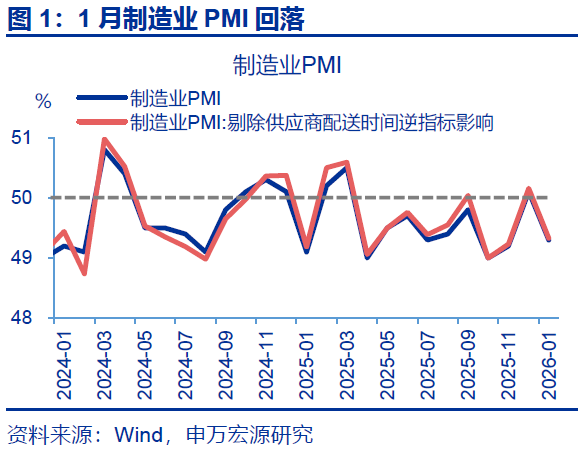
Core Viewpoint - The significant decline in January PMI is attributed to the early return of workers for the Spring Festival and weak domestic demand, with manufacturing PMI dropping to 49.3% from 50.1% and non-manufacturing PMI falling to 49.4% from 50.2% [1][6][7] Group 1: Manufacturing PMI Analysis - The manufacturing PMI fell below the growth threshold, decreasing by 0.8 percentage points to 49.3%, influenced by statistical factors and the early return of workers for the Spring Festival [1][7] - The production index decreased by 1.1 percentage points to 50.6%, while the new orders index fell by 1.6 percentage points to 49.2%, indicating a decline in manufacturing activity [4][38] - The purchasing index dropped significantly by 2.4 percentage points to 48.7%, reflecting a weaker supply side due to the early return of workers [2][16] Group 2: Sector-Specific Insights - Labor-intensive sectors such as consumer goods and high-energy industries experienced a more pronounced decline in PMI, with consumer goods PMI down 2.1 percentage points to 48.3% and high-energy PMI down 1 percentage point to 47.9% [2][22] - In contrast, capital-intensive sectors like high-tech and equipment manufacturing saw smaller declines, with PMIs of 52% and 50.1%, respectively, remaining above the growth threshold [2][22] Group 3: Non-Manufacturing PMI Insights - The non-manufacturing PMI also showed a decline, dropping by 0.8 percentage points to 49.4%, primarily due to a significant decrease in the construction sector, which fell by 4 percentage points to 48.8% [4][43] - The service sector PMI remained relatively resilient, only decreasing by 0.2 percentage points to 49.5%, with certain areas like railway transport showing strong performance [3][25] Group 4: Economic Outlook - The early Spring Festival may distort PMI readings for January and February, but the overall economic recovery trend is expected to continue, supported by consumer demand and service sector policies [3][32] - Despite short-term weaknesses in manufacturing and construction, the average PMI over the next two months is anticipated to reflect ongoing economic recovery [3][32]
数据点评 | 1月PMI:春节效应前置(申万宏观·赵伟团队)
赵伟宏观探索· 2026-01-31 16:03
Core Viewpoint - The significant decline in January PMI is primarily attributed to the early return of workers for the 2026 Spring Festival and weak domestic demand, with manufacturing PMI dropping to 49.3% from 50.1% and non-manufacturing PMI falling to 49.4% from 50.2% [2][8][61] Group 1: Manufacturing PMI Analysis - The manufacturing PMI fell below the neutral line, decreasing by 0.8 percentage points to 49.3%, influenced by statistical factors and the early return of workers [2][8][61] - The manufacturing production index declined by 1.1 percentage points to 50.6%, while the new orders index decreased by 1.6 percentage points to 49.2% [5][41] - The purchasing index for manufacturing dropped significantly by 2.4 percentage points to 48.7%, indicating a notable contraction in supply [3][15][62] Group 2: Sector-Specific Insights - Labor-intensive sectors such as consumer goods and high-energy industries experienced a more pronounced decline in PMI, with consumer goods PMI falling by 2.1 percentage points to 48.3% and high-energy PMI down by 1 percentage point to 47.9% [3][22][62] - In contrast, capital-intensive sectors like high-tech and equipment manufacturing saw smaller declines, with PMIs of 52% and 50.1%, respectively [3][22][62] Group 3: Non-Manufacturing PMI Insights - The non-manufacturing PMI showed asymmetric characteristics, with the construction PMI dropping to 48.8%, a decline of 4 percentage points, while the service sector PMI only slightly decreased by 0.2 percentage points to 49.5% [4][25][62] - The construction sector's decline is more significant than historical averages, indicating a substantial impact from the early return of workers [4][25][62] Group 4: Economic Outlook - The early Spring Festival may disrupt PMI readings for January and February, but the overall economic outlook remains positive, with expectations of recovery in the coming months [4][34][63] - Recent trends in service consumption and travel during the Spring Festival are expected to support service sector growth, highlighting the importance of monitoring consumer demand [4][34][63]