AI行业

Search documents
陶冬:当美国AI股遭遇S形瓶颈怎么走
Di Yi Cai Jing· 2025-11-17 04:06
Group 1 - The current AI wave is driven by the stock market, characterized by ample funding but volatile stock prices, leading to investor impatience regarding profit realization [1][5] - Concerns over excessive investment in AI have intensified, with major AI companies experiencing stock price fluctuations, particularly after a significant fund liquidated its holdings in a leading chip company [1][3] - The Federal Reserve officials have expressed a cautious stance on further interest rate cuts, with a notable statement from Boston Fed President Susan Collins suggesting that maintaining current rates may be more appropriate for the time being [1][2] Group 2 - The swap market's expectations for a December rate cut have shifted from nearly certain to a 50-50 probability, indicating increased uncertainty regarding future financing costs [2] - There is a growing skepticism among investors and analysts regarding the astronomical levels of infrastructure investment in the AI sector, with estimates suggesting a total investment of $5 trillion in AI and related industries by 2030 [3][4] - The rapid iteration of AI chip investments poses challenges for tech companies, as the depreciation period of 8-10 years may not align with the fast-paced technological advancements, potentially affecting future profitability [4][5]
10.17犀牛财经晚报:深圳水贝市场金饰克价突破1000元 多家银行开展长期不动户清理工作
Xi Niu Cai Jing· 2025-10-17 10:31
Group 1: Tax Revenue and Market Activity - The Ministry of Finance reported that stamp duty revenue for the first three quarters reached 314.2 billion yuan, a year-on-year increase of 34.5% [1] - Securities transaction stamp duty accounted for 144.8 billion yuan, showing a significant year-on-year growth of 103.4% [1] - In September, the number of newly opened margin trading accounts reached 205,400, marking a year-on-year increase of 288% [2] Group 2: Market Trends in Precious Metals - The gold price in Shenzhen's Shui Bei market surpassed 1,000 yuan per gram, reaching 1,006 yuan, up from approximately 796 yuan in early September [3] - Major jewelry brands, such as Chow Tai Fook, have adjusted their prices in response to rising gold prices, with their gold jewelry priced at 1,279 yuan per gram [3] - Lao Pu Gold announced a price increase for the third time this year, with many of its products currently out of stock [3] Group 3: Industry Developments in Battery Recycling - The market for battery recycling in China is expected to exceed 100 billion yuan, with a projected recovery volume of over 300,000 tons by 2024 [4] - The rapid growth of the electric vehicle industry is driving the demand for battery recycling [4] Group 4: Corporate Financial Performance - Pianzaihuang reported a 20.74% decline in net profit for the first three quarters, with revenue down 11.93% [13] - Shentong Technology experienced a remarkable 584.07% increase in net profit year-on-year, with revenue up 34.65% [14] - Ying Shi Network reported a 12.68% increase in net profit for the first three quarters, with revenue growth of 8.33% [15] - Tengjing Technology's net profit grew by 15% year-on-year, with a revenue increase of 28.11% [16] - Jinshiyao expects a net profit increase of 48.99% to 83.95% for the first three quarters [18] Group 5: Market Reactions and Stock Performance - The market saw a significant decline, with the ChiNext index dropping by 3.36% and nearly 4,800 stocks falling [19] - Defensive sectors, such as gas and banking, showed resilience, while several heavyweight stocks weakened [19]
“从汽车到战斗机全是痛点,但特朗普记吃不记打”
Guan Cha Zhe Wang· 2025-10-13 14:49
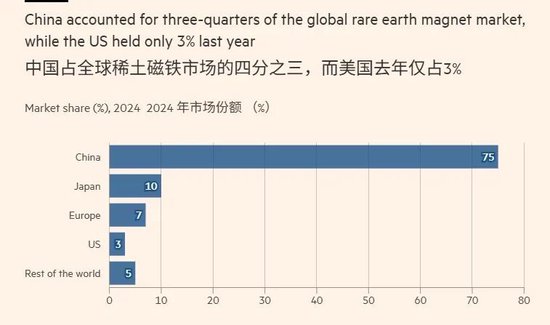
Core Points - China has implemented new regulations on rare earth exports, significantly impacting global manufacturing industries, particularly in automotive and military sectors [1][4][5] - The new rules require foreign companies to obtain Chinese approval for exporting products containing Chinese rare earth elements or utilizing Chinese technology [4][5][9] - The regulations are seen as a response to increasing trade tensions and are expected to enhance China's influence over critical manufacturing sectors globally [1][5][10] Group 1: New Regulations Overview - The new regulations cover a wide range of products, including those with 0.1% or more Chinese rare earth content, and will take effect on December 1 for certain items [8][9] - Military-related exports will generally not be permitted, and applications for AI technologies with potential military uses will be reviewed on a case-by-case basis [5][9] - The regulations expand the scope of existing procedures, requiring exporters to submit technical drawings and usage explanations for products made with Chinese rare earths [5][9] Group 2: Impact on Industries - The automotive industry is particularly affected, with many manufacturers facing delays in obtaining export licenses for components that rely on Chinese rare earths [6][8] - European automotive suppliers have already halted production due to shortages of rare earth components, highlighting the immediate impact of the new regulations [8][9] - Companies are attempting to reduce reliance on Chinese rare earths by sourcing from alternative suppliers, but the new rules indicate that Chinese jurisdiction extends to these activities as well [9][10] Group 3: Geopolitical Reactions - The new regulations have raised concerns among Western nations, particularly regarding their military supply chains and support for Ukraine [5][10] - The measures are perceived as a counteraction to the EU's tariffs on Chinese electric vehicles, reflecting China's dissatisfaction with recent trade policies [5][10] - China's Ministry of Commerce has stated that these export controls are a normal action to enhance its export control system in response to external pressures [10]

保时捷女销冠的反击
第一财经· 2025-10-12 09:37
Core Viewpoint - The article discusses the legal actions taken by a woman against the malicious use of AI-generated content that defamed her, highlighting the need for stricter regulations and standards in the AI industry to combat such issues [5][6][8]. Group 1: Incident Overview - On October 11, a woman in Qingdao reported being defamed by AI-generated fake videos and images, which led to severe personal impacts [5]. - The Qingdao police issued an administrative punishment to an individual who spread defamatory content, resulting in a five-day detention [6]. - The woman has initiated legal proceedings against all involved parties, including those who created the AI-generated content [6]. Group 2: Regulatory Developments - The governance of AI-generated content in China has progressed from principle advocacy to a phase of legal and technical standardization [8]. - On September 14, 2024, the National Internet Information Office released a draft for the "Identification Measures for AI-Generated Synthetic Content," which includes explicit and implicit labeling requirements [8][9]. - Major platforms like Douyin, Kuaishou, Tencent, Weibo, and Bilibili have implemented dual labeling features and associated penalties for non-compliance [9]. Group 3: Challenges in AI Content Governance - Despite regulatory efforts, issues with AI-generated content persist due to several factors, including lowered technical barriers and ineffective content review mechanisms [10]. - The ease of removing labels and watermarks from AI-generated content has led to a rise in gray market activities, such as celebrity face-swapping and unauthorized medical promotions [10]. - Continuous optimization of governance measures is necessary, including enhancing watermark robustness, increasing penalties, and improving content review efficiency [10].
联储降息后的分歧
2025-10-09 02:00
Summary of Conference Call Notes Industry Overview - The discussion revolves around the **U.S. economy** and its various indicators, particularly in the context of recent **Federal Reserve interest rate cuts** and their implications for the market. Key Points and Arguments Economic Data Divergence - The U.S. economy shows a clear divergence in data: while the **employment market is deteriorating** (unemployment rate at a cycle high and negative non-farm employment growth), other indicators such as **production, income, consumption, and GDP** remain robust. The second quarter GDP data was significantly revised upwards, with **personal consumption expenditures (PCE)** contributing notably [2][5] Future Economic Outlook - The future trajectory of the U.S. economy leans towards marginal weakening or stabilization, with a low risk of recession due to the Federal Reserve's rapid intervention, which has reduced the likelihood of a financial crisis evolving into a systemic crisis [2][6] Aging Population Impact - The aging population in the U.S. is increasing, with wealth concentration shifting towards older demographics. Their consumption is more linked to asset income from the stock market and real estate rather than the employment market, suggesting that consumption resilience is more dependent on stock market performance than on employment figures [2][9] Interest Rate Cuts and Market Reactions - The Federal Reserve recently cut rates by 25 basis points, bringing the federal funds rate to a range of **4% to 4.25%**. This has led to increased market divergence regarding future rate paths and economic outlooks, with Treasury yields rising post-cut [3][4] Financial Conditions and Asset Prices - The impact of rate cuts on the U.S. economy has changed over time. Currently, various asset prices reflect rate cut expectations quickly, and the **financial conditions index** is a crucial indicator for observing the effects of rate cuts. However, the marginal improvement in this index is limited, indicating constrained improvements in the real estate and credit markets [2][10] Monetary and Fiscal Policy Predictions - The current monetary policy remains insufficiently accommodative, with about **100 basis points** gap from neutral rates. The fiscal deficit is expected to remain high, around **5.96%** in 2025, which could hinder overall consumption and economic growth [11] Stock Market Outlook - The stock market shows less divergence compared to Treasuries and the dollar, with a strong consensus on its stability. However, potential risks remain, and investors should closely monitor macroeconomic indicators for timely strategy adjustments [7][8] AI Industry's Economic Contribution - The AI sector's capital expenditure has reached a historical peak in its contribution to GDP. A slowdown in this growth could exert pressure on the stock market, necessitating attention to guidance from major tech companies regarding capital expenditures [4][16] Treasury Yield Predictions - The forecast for Treasury yields suggests a continued decline, with expectations that the **10-year Treasury yield** will drop below **4%** by the end of 2026, influenced by the ongoing rate cut cycle and marginal economic weakening [12][14] Dollar Index Fluctuations - The dollar index is expected to fluctuate between **95-102**, with limited chances of breaking above **105**. This scenario is favorable for the Chinese yuan, which is likely to appreciate even if the dollar rises slightly [15] Other Important Insights - The Federal Reserve's rate cuts are expected to influence domestic markets through sentiment, liquidity improvements, and policy transmission channels. There is potential for new stimulus measures in the near future, which could support the A-share market [17]
赚钱效应扩散,多主题轮动延续——2025年8月资产配置报告
华宝财富魔方· 2025-08-06 11:14
Macro Overview - The U.S. labor market shows signs of fatigue, with non-farm employment growth nearly stagnating over the past two months, which historically indicates economic distress or the need for intervention [4] - Despite the weak labor data, the probability of a recession remains manageable, with the New York Fed predicting a 28.71% chance of recession in the next 12 months [4] - The U.S. economy is experiencing a slowdown in consumption and investment due to high interest rates and uncertainty in tariff policies, although the overall economic resilience was strong in the first half of the year with a GDP growth rate of 5.3% [4] Domestic Policy Insights - The current policy focus is on observing the economic conditions in consumption, exports, and real estate, with a shift towards long-term mechanisms for sustainable economic development [4] - The government is expected to prioritize high-quality economic development and establish long-term sustainable growth mechanisms during the "14th Five-Year Plan" period [4] - If GDP growth falls below 4.7% in the third quarter, there may be considerations for additional policy measures [4] Market Strategy and Asset Allocation - The A-share market is expected to experience a slow upward trend, supported by strong economic fundamentals and high market activity, although valuation recovery may slow down [4] - The focus for investment should be on long-term allocations in sectors such as banking, dividends, and broad-based indices, with a cautious approach to chasing high valuations [4] - The market is witnessing a structural rotation with opportunities in themes like technology (AI, computing power, chips), military, pharmaceuticals, stablecoins, rare earths, and cyclical sectors [4] Asset Class Outlook - A-shares are viewed as relatively optimistic, while Hong Kong stocks and U.S. stocks maintain a neutral stance [6] - Credit bonds and convertible bonds are also seen as relatively optimistic, indicating a favorable outlook for fixed-income investments [6] - The outlook for commodities like oil remains cautious, reflecting ongoing uncertainties in the global market [6]

数字智能是否会取代生物智能?
小熊跑的快· 2025-07-27 00:26
Core Viewpoint - The ultimate consideration in the AI industry is whether digital intelligence (silicon-based) can irreversibly surpass biological intelligence (carbon-based) when energy becomes sufficiently cheap [1] Summary by Sections Two Paradigms for Intelligence - Digital intelligence can instantaneously propagate knowledge across groups by directly copying brain knowledge, a capability that biological intelligence cannot match [1] Development Over Thirty Years - The evolution of AI over the past three decades has led to significant advancements, including the acceptance of "feature vectors" by computational linguists and the introduction of the Transformer model by Google, showcasing the powerful capabilities of large language models [4][8] Large Language Models - Large language models understand language in a manner similar to humans, transforming words into feature vectors that can effectively combine with other words, akin to building structures with Lego blocks [2][8] Knowledge Transfer and Efficiency - The best method for transferring knowledge is through distillation from a "teacher" to a "student," allowing for efficient sharing of learned knowledge among digital agents [8] Current Situation and Future Implications - If energy is cheap, digital computation will generally have advantages over biological computation, particularly in knowledge sharing among agents [8] - The potential for superintelligence to manipulate humans for power raises significant concerns about the future of AI and its implications for human safety [12]

深化经济体制改革 推进中国式现代化 ——全国政协十四届常委会第十二次会议大会发言摘编
Ren Min Ri Bao· 2025-06-25 22:16
Group 1 - The core viewpoint emphasizes the importance of building a unified national market to enhance economic resilience and promote effective market and government collaboration [1][2] - Recommendations include strengthening fair competition reviews, addressing barriers to economic circulation, and enhancing regulatory frameworks to support market integration [1] - The establishment of a long-term mechanism for private enterprises to participate in national technology initiatives is suggested, focusing on improving the development environment for private companies [3][4] Group 2 - The need for a unified technology transfer system and a platform for rapid matching of innovation results with market demands is highlighted to enhance the conversion of scientific achievements [5][6] - Investment in human capital is proposed as a strategy to drive high-quality development, linking improvements in living standards with economic growth [7] - Recommendations for optimizing the fiscal relationship between central and local governments to ensure balanced regional development and effective public service delivery are presented [8][9] Group 3 - The financial system's role in supporting private enterprises and technological innovation is emphasized, with suggestions for improving financial support mechanisms [10] - A multi-faceted investment growth mechanism is proposed to foster future industries, focusing on government guidance and innovative financing models [11][12] - The importance of addressing challenges in the AI industry, particularly in data sharing and computational power, is discussed to promote innovation [13][14] Group 4 - Recommendations for enhancing agricultural technology promotion through systemic reforms and innovative service models are outlined to support agricultural development [15][16] - The role of county-level cities in urban-rural integration is emphasized, with suggestions for improving infrastructure and public services [17][18] - Strategies for promoting high-quality employment for college graduates, including enhancing cooperation between educational institutions and industries, are proposed [19] Group 5 - The need for a new model of real estate development is highlighted, focusing on meeting the housing needs of new citizens and young people while ensuring market stability [20] - Suggestions for enhancing investment quality and efficiency in the Belt and Road Initiative are presented, emphasizing financial coordination and risk management [21][22] - The importance of stabilizing and improving the quality of foreign investment and trade is discussed, with a focus on attracting high-end service industries and supporting domestic enterprises in international markets [23]
“时代红利”过去后,努力真的没用吗?
虎嗅APP· 2025-03-06 13:48
Core Viewpoint - The article discusses the "rosy retrospection" phenomenon, where individuals tend to remember the past more positively than it actually was, especially when dissatisfied with their current lives. This leads to a romanticized view of past opportunities and a misunderstanding of the challenges faced by previous generations [1][2]. Group 1: Perception of Past Opportunities - The "rosy retrospection" effect is particularly pronounced when individuals face pressures in their current lives, leading them to idealize their childhood and the perceived opportunities of past decades [2]. - There is a narrative among older generations that suggests younger people are not working hard enough, while simultaneously, some individuals adopt a more favorable stance towards the younger generation, arguing that past successes were due to easier circumstances [2][3]. Group 2: Survivor Bias and Historical Context - The article highlights that true opportunities in any era are not evenly distributed, and the so-called "era dividends" are often a product of survivor bias, where only the successful stories are told [5]. - Historical examples, such as the entrepreneurial successes of the 1980s and 1990s, are contrasted with the reality that many individuals faced significant hardships and low survival rates in their ventures during those times [5][7]. Group 3: Individual Efforts vs. Era Influence - While acknowledging the impact of the era on personal development, the article emphasizes that the majority of individuals do not benefit from the same opportunities, with a significant percentage of contemporaries experiencing failure [10]. - The narrative that success is solely due to favorable times overlooks the personal efforts and sacrifices made by individuals, which are crucial for achieving success [14]. Group 4: Current Opportunities and Future Outlook - The article notes that despite challenges in the current job market, there are still significant opportunities, particularly in emerging sectors like AI and renewable energy, where younger individuals are actively participating [11]. - It encourages a mindset shift from viewing the past as a golden age to recognizing that every era has its unique challenges and opportunities, and that success requires adaptation and innovation [12][15].