二手车

Search documents
中国汽车流通协会:7月7日-13日二手车日均交易量6.38万辆 环比微降0.94%
智通财经网· 2025-07-17 09:25
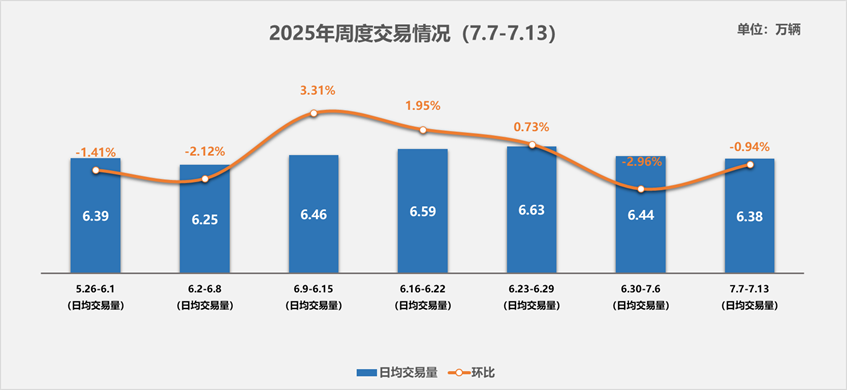
Core Insights - The average daily transaction volume of used cars in China from July 7 to July 13 was 63,800 units, showing a slight week-on-week decrease of 0.94% and a year-on-year decline of 1.2%, indicating normal market fluctuations [1] Regional Performance - In East China, the average daily transaction volume was 20,800 units, down 4.32% week-on-week, with significant declines in cities like Linyi (over 20% drop) and Nanchang, Jining, and Jinhua (double-digit declines) [5] - North China saw an average daily transaction volume of 2,500 units, decreasing by 1.78%, with notable declines in Langfang (15% drop) and Beijing (3.6% drop), while Taiyuan experienced over 20% growth [5] - Northeast China reported an average daily transaction volume of 2,300 units, up 2.76%, with Dalian showing a remarkable increase of 18.5% [6] - Southwest China had an average daily transaction volume of 12,900 units, down 3.12%, with Chengdu declining by 6.5% and Kunming by 10%, while Guiyang saw over 15% growth [7] - Central South China recorded an average daily transaction volume of 24,300 units, up 3.35%, with Guangzhou experiencing a significant increase of 25% [7] - Northwest China had an average daily transaction volume of 900 units, down 5.32%, with both Yulin and Xining seeing declines exceeding 20% [7] Market Sentiment - 50% of surveyed enterprises reported stable pricing, indicating cautious pricing strategies among used car dealers to maintain market stability and profitability [3] - 20% of enterprises noted a rebound in terminal sales prices, suggesting a recovery in demand for certain segments or models, with increased consumer acceptance and willingness to purchase [3]

二手车消费新能源化趋势显著,纯电车占比最多
Zhong Guo Qi Che Bao Wang· 2025-07-16 01:21
Core Insights - The automotive consumption potential, particularly in the used car market, has been significantly released since 2025 due to consumption-boosting policies and the impact of "new energy" vehicle consumption trends [1][3] Group 1: Market Trends - The retail sales of new energy vehicles (NEVs) reached 5.468 million units in the first half of 2025, marking a year-on-year growth of 33.3%, with the penetration rate of NEVs in the domestic passenger car market exceeding 53.3% for four consecutive months [1] - The used car market is experiencing a "dumbbell" consumption structure, with passenger cars dominating transactions; in the first half of 2025, sedans, SUVs, and MPVs accounted for 58%, 39%, and 2% of NEV transactions, respectively [4] - The average retail price of NEVs in the used car market was approximately 96,000 yuan, with significant demand for models priced between 80,000 and 150,000 yuan [4] Group 2: Consumer Preferences - The top three provinces for NEV used car purchases are Guangdong, Jiangsu, and Zhejiang, indicating that economically developed regions are leading in used car consumption [3] - The most popular models in the NEV used car market include Hongguang MINIEV, Model 3, and Model Y, with average transaction prices of over 20,000 yuan, 130,000 yuan, and 170,000 yuan, respectively [4][5] Group 3: Challenges and Solutions - The used NEV market faces challenges such as price transparency and battery condition assessment; Guazi used car platform is addressing these issues by offering extensive vehicle sources and a transparent pricing model [2][8] - Guazi has introduced a "100-day battery buyback guarantee" for NEVs sold on its platform, ensuring that if battery degradation exceeds 10% within 100 days or 5,000 kilometers, the vehicle will be repurchased at the original price [9] Group 4: Brand Performance - Domestic brands dominate the NEV market, with 8 out of the top 10 high resale value models being from Chinese manufacturers; Xiaomi Auto leads with a resale rate exceeding 90% [11] - The resale value of NEVs aged 2-3 years remains above 50%, with Porsche leading at 63% [11] Group 5: Industry Recommendations - The industry is urged to enhance product competitiveness and brand resale value through improvements in quality, technology, and after-sales service, which will foster consumer confidence and promote healthy market development [12]


破除二手车流通“梗阻” 多地推进二手车销售“反向开票”、异地交易登记等举措
Zhong Guo Jing Ying Bao· 2025-07-15 23:40
Core Viewpoint - The Beijing municipal government has issued a plan to enhance the second-hand car market by implementing measures such as "reverse invoicing" and facilitating cross-regional transaction registrations, aiming to boost consumer confidence and streamline transactions in the second-hand car sector [1][4]. Group 1: Government Initiatives - Multiple local governments, including those in Shanxi, Guangdong, and Henan, have adopted measures to promote second-hand car sales through "reverse invoicing" and improved credit systems for market participants [1]. - The "reverse invoicing" policy is a key reform that simplifies the tax process for second-hand car transactions, allowing dealers to issue invoices to individual sellers, thereby reducing costs and time for businesses [4]. Group 2: Market Growth and Statistics - The second-hand car market is showing significant growth, with a cumulative transaction volume of 9.57 million units and a total transaction value of 623.24 billion yuan in the first half of 2025, marking a year-on-year increase of 1.99% [2]. - In 2024, the total transaction volume reached 19.61 million units, with a transaction value of 1,285.20 billion yuan, reflecting a year-on-year growth of 6.52% and setting historical records for both metrics [2]. Group 3: Industry Challenges - Despite growth in transaction volume and value, the second-hand car industry faces challenges such as declining profit margins due to intense competition from the new car market and issues related to trust and transparency in transactions [3]. - Problems such as hidden vehicle conditions and false advertising persist, undermining the industry's reputation and leading to high transaction costs and risks for consumers [3][5]. Group 4: Industry Transformation - The second-hand car market is shifting from a focus on quantity to quality, with dealers increasingly transitioning from brokerage to dealership models, enhancing operational efficiency and transparency [2][6]. - The establishment of a credit system and the promotion of a transparent information-sharing environment are essential for building consumer trust and ensuring the healthy development of the second-hand car market [5].
瓜子二手车2025上半年趋势报告:新能源二手车零售均价约9.6万
Xin Lang Ke Ji· 2025-07-15 07:42
Core Insights - Guazi used data from the first half of 2025 to release a report on the consumption trends of used new energy vehicles, highlighting significant market dynamics and consumer preferences [1][2] Group 1: Market Overview - The largest sources of used new energy vehicles are from Guangdong, Jiangsu, and Shandong, with Guangdong contributing over 16% of the total supply [1] - Passenger cars dominate the used car market, with sedans, SUVs, and MPVs accounting for 58%, 39%, and 2% of transactions respectively [1] - The average retail price of used new energy vehicles in the first half of 2025 was approximately 96,000 yuan [1] Group 2: Consumer Preferences - Price and vehicle type are critical factors for consumers when purchasing used cars, with a notable increase in the transaction share of vehicles priced between 80,000 and 150,000 yuan [1] - The most popular used new energy vehicle models were Hongguang MINIEV, Model 3, and Model Y, with average transaction prices of over 20,000 yuan, 130,000 yuan, and 170,000 yuan respectively [1] Group 3: Vehicle Age and Condition - The average age of used new energy vehicles sold was less than 27 months, with 71% being under 3 years old, indicating a trend towards lower-aged vehicles [2] - Over 50% of the vehicles sold were less than 2 years old, significantly higher than the national average of 33% [2] - Only 4% of the vehicles sold were over 6 years old, compared to the national average of 14.7% [2] Group 4: Technology and Model Popularity - The three main technology routes for new energy vehicles are pure electric, plug-in hybrid, and range-extended, with pure electric vehicles making up nearly 75% of retail sales [2] - The most popular models in the pure electric category were dominated by Tesla and Wuling, while BYD led in the plug-in hybrid segment [2]
“失控”的二手车
Zhong Guo Qi Che Bao Wang· 2025-07-14 01:07
Core Viewpoint - The case of remote vehicle hijacking highlights significant concerns regarding data security and ownership rights in the context of second-hand car transactions, emphasizing the need for better protection of consumer rights and data privacy in the automotive industry [2][8][10]. Group 1: Incident Overview - A case in Shenzhen involved a former car owner remotely controlling a second-hand vehicle, leading to theft and safety risks for the new owner [2][3]. - The court found the former owner guilty of theft and endangering public safety, sentencing him to four years in prison and a fine of 6,000 yuan [3]. Group 2: Technical Analysis - Experts suggest that the former owner likely installed unauthorized remote control devices, which pose significant safety risks [3][5]. - Mercedes-Benz clarified that their vehicles do not support remote shutdown while in motion, indicating that the incident was due to unauthorized modifications [4]. Group 3: Data Security Concerns - The availability of remote control devices for vehicles on e-commerce platforms raises concerns about misuse by criminals, leading to potential safety hazards for legitimate users [5][6]. - Experts recommend that regulatory bodies define and manage the nature of these devices to protect vehicle owners' safety and property [6]. Group 4: Second-Hand Vehicle Transactions - The transfer of digital rights during second-hand car sales is often overlooked, allowing former owners to retain access to vehicle information and control [7][10]. - Consumers are advised to change account permissions and reset vehicle settings after purchasing a second-hand car to prevent privacy breaches [10][11]. Group 5: Regulatory Recommendations - There is a call for the establishment of clear standards for data deletion and account transfer during second-hand vehicle transactions to protect consumer privacy [11]. - Upcoming regulations, such as the GBT 44464-2024, aim to enhance data security by mandating timely deletion of sensitive information upon request [11].

“零公里二手车”繁荣背后有隐忧
Zhong Guo Chan Ye Jing Ji Xin Xi Wang· 2025-07-10 22:49
Core Viewpoint - The phenomenon of "zero-kilometer used cars" is gaining attention in the market, where vehicles are sold at prices significantly lower than new cars, raising concerns about market dynamics and consumer protection [1][2]. Group 1: Market Dynamics - The circulation of "zero-kilometer used cars" is increasing, with 12.7% of the used car market consisting of vehicles registered for less than 3 months and having mileage under 50 kilometers, indicating a significant impact on new car sales and pricing structures [2]. - The presence of these vehicles is expected to disrupt the profit margins of new car retailers, leading to a potential decline in new car sales and increased pressure on manufacturers to adopt aggressive market strategies [2][4]. Group 2: Consumer Risks - Consumers purchasing "zero-kilometer used cars" may face hidden risks, including the loss of warranty rights, as many manufacturers only provide warranty coverage to the first owner, which could lead to high repair costs for subsequent owners [3]. - The export of "zero-kilometer used cars" to overseas markets has raised concerns about anti-dumping allegations and potential tariffs, posing a threat to the reputation and interests of Chinese automotive manufacturers [3]. Group 3: Regulatory Response - The industry is experiencing a push for regulatory measures to address the "zero-kilometer used car" phenomenon, with the Ministry of Commerce and the China Automotive Industry Association advocating for fair competition and the cessation of price wars [4][5]. - Initiatives are being implemented to promote healthy market practices, including enhancing product consistency checks and enforcing regulations against unfair competition, aimed at fostering a sustainable automotive industry [4][5].
二手车行业寻破局之路
Zheng Quan Ri Bao· 2025-07-10 16:15
Core Insights - The second-hand car market is facing significant challenges despite the influx of vehicles due to government policies promoting vehicle replacement, leading to a shift from quantity accumulation to quality enhancement in the industry [2][5] - The industry is at a crossroads, grappling with issues such as price competition, lack of transparency, and the need for new profit models [3][4] Industry Challenges - In 2024, only 3 out of 16 listed second-hand car companies reported profit growth, while 8 companies faced losses, indicating a tough market environment [3] - The cumulative transaction volume of second-hand cars in the first five months of the year reached 7.91 million units, showing a slight year-on-year increase of 0.62%, but growth is slowing [3] - Key challenges include difficulties in acquiring vehicles, maintaining value, selling cars, and slow turnover, exacerbated by intense competition from the new car market [3][4] Trust and Transparency Issues - Many second-hand car operators have historically compromised on integrity, leading to issues like misrepresentation of vehicle conditions and high transaction costs [4] - The lack of a unified and rigorous vehicle condition assessment standard hampers the development of a trustworthy market [4] Path to Transformation - The industry is exploring diverse strategies to overcome challenges, including enhanced marketing through live streaming and improved customer service offerings [5][6] - New business models are emerging, such as manufacturer replacement services and digital solutions that enhance transaction transparency [6][7] Ecosystem Reconstruction - The industry is shifting from a competitive to a collaborative ecosystem, emphasizing integrity and sustainable growth [7][8] - Initiatives like the "行" certification aim to standardize vehicle condition assessments and improve consumer trust [7] - Financial and policy support is crucial for sustaining the market's growth and innovation [8]
中国汽车流通协会:6月全国二手车市场交易量165.75万辆 环比增长3.34% 同比增长9.12%
智通财经网· 2025-07-10 09:15
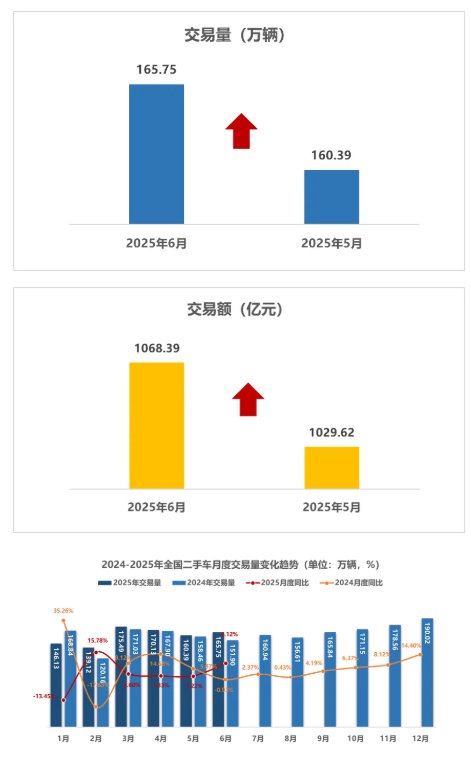
Core Insights - The second-hand car market in China showed moderate growth in June 2025, with a transaction volume of 1.6575 million units, reflecting a month-on-month increase of 3.34% and a year-on-year increase of 9.12% [1][3] - The total transaction amount for June reached 106.839 billion yuan, while the cumulative transaction volume for the first half of 2025 was 9.5701 million units, representing a year-on-year growth of 1.99% [1][3] Market Performance - The second-hand car market experienced a stable performance in June, attributed to a stable pricing system in the new car market and a reduction in promotional models, which positively impacted the second-hand market [3] - The average inventory cycle for June extended to 43 days, with 35.6% of companies facing inventory cycles exceeding 30 days, indicating increased operational pressure on dealers [5] Segment Analysis - In June, the transaction volume for basic passenger cars was 922,700 units, with a month-on-month increase of 2.22% and a year-on-year increase of 5.80% [8] - The MPV segment saw a significant year-on-year growth of 15.27%, while commercial vehicles also performed well, with a 17.17% increase in the transaction volume of cargo vehicles [8][9] Regional Insights - The East China region led the growth with a transaction volume of 471,900 units, a month-on-month increase of 3.03%, particularly driven by Shanghai's impressive growth of 6.8% [15] - The North China region showed a notable recovery, with a transaction volume of 255,000 units, reflecting an 8.83% month-on-month increase, especially in Beijing, which grew by 18.6% [16] Usage Age Analysis - In June, vehicles aged 3-6 years accounted for 42.23% of transactions, while vehicles under 3 years old saw a growth trend, indicating a shift in consumer preferences [12] Cross-Regional Flow - The second-hand car transfer rate was 29.52%, showing a slight decrease from the previous month but a year-on-year increase of 1.1 percentage points, with a total transfer volume of 489,200 units [20]
交易透明,才能放心买卖,淘车车二手车让新客秒变“安利官”
Zhong Guo Chan Ye Jing Ji Xin Xi Wang· 2025-07-09 06:29
Core Insights - The article highlights the innovative approach of He Jian, a procurement specialist at Taoche, who utilizes professionalism and sincerity to bridge the trust gap in the used car selling process [1][2][3] Group 1: Professional Background and Skills - He Jian has a diverse career background, transitioning from a restaurant owner to a used car procurement expert, leveraging his experience in customer service to enhance the car selling process [2] - His expertise includes the ability to assess vehicle conditions through auditory and tactile cues, which he developed during his years in the used car industry [2] Group 2: Customer-Centric Approach - He Jian emphasizes a customer-first philosophy, establishing dedicated service groups for each car owner to keep them updated on vehicle inspection progress, thereby ensuring transparency [2] - He Jian's approach includes detailed analysis and communication regarding vehicle pricing, which helps alleviate customer concerns about being underpriced [3] Group 3: Service Excellence and Impact - The article illustrates a specific instance where He Jian's empathetic communication and professional advice led to a successful transaction, showcasing his commitment to customer satisfaction [3] - His exceptional service has resulted in positive word-of-mouth referrals, indicating a growing reputation for reliability and trustworthiness in the used car market [3] Group 4: Future Aspirations - He Jian aims to continue enhancing his professional skills while balancing vehicle quality and customer satisfaction, with the goal of promoting "reliable used cars" to a wider audience [3]
价格战冲击与转型阵痛:中国二手车市场如何破局?
Sou Hu Cai Jing· 2025-07-08 09:36
Core Viewpoint - The ongoing price competition in the new car market is significantly impacting the used car sector, leading to a decline in used car transactions and prices due to consumers opting for new cars at similar or slightly higher budgets [1][4]. Group 1: Used Car Market Performance - In May, the used car transaction volume decreased by 5.72% month-on-month and only increased by 1.22% year-on-year, primarily due to the diversion and pressure effects from the active new car market [1]. - The average resale value of three-year-old fuel vehicles dropped from 56.8% in 2023 to 51.8% in 2024, with mainstream brands seeing values fall to 45%-50% [6]. - The average resale value of three-year-old electric vehicles (BEVs) is below 50%, with specific figures showing 44.2% for BEVs and 46.1% for plug-in hybrids (PHEVs) [8]. Group 2: Market Challenges - The fundamental issue in the used car market is its struggle amidst the rapid transformation towards new energy vehicles, with inadequate certification, circulation systems, and supporting services [3][11]. - The used car industry faces integrity issues, with some operators engaging in deceptive practices that harm the overall industry image [3]. - The financial penetration rate for used car loans is only 48%, significantly lower than that for new cars, indicating a lack of supporting financial services [3]. Group 3: Market Dynamics and Future Outlook - The price war in the new car market is intensifying, with a record number of manufacturers participating and significant discounts being offered [5]. - Despite the challenges, the used car industry is entering a development window, supported by a large existing vehicle stock of 353 million units and the removal of inter-regional sales restrictions [11]. - The intensity of the price war is expected to decrease, with industry organizations advocating for healthier competition and regulatory measures being implemented to stabilize the market [12][14]. Group 4: Export Opportunities - The used car sector is looking towards overseas markets for growth, which require adherence to established regulations and standards, potentially benefiting the domestic used car industry [15].