
农产品种植

Search documents
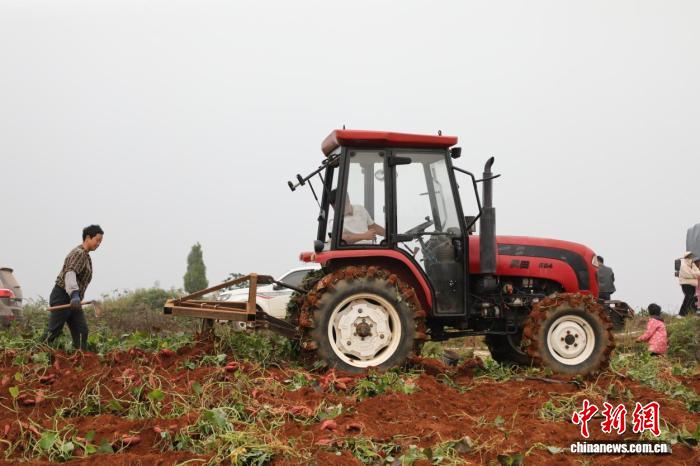
村民家门口就业稳增收 湖南新田特色农业赋能乡村振兴
Zhong Guo Xin Wen Wang· 2025-12-12 02:15
Core Insights - The article highlights the successful agricultural initiatives in Xintian County, Hunan, focusing on the cultivation of "Watermelon Red" sweet potatoes and mustard greens, which are contributing to local employment and income generation for villagers [1][3]. Group 1: Agricultural Production - The "Watermelon Red" sweet potato is cultivated on 230 acres with an average yield exceeding 5,000 pounds per acre, and the harvesting period lasts about half a month [1][3]. - The wholesale price for "Watermelon Red" sweet potatoes ranges from 1.6 to 1.7 yuan per pound, indicating strong market demand due to its desirable taste and nutritional value [3]. - The mustard greens are grown on over 200 acres, with the first harvest yielding approximately 2,000 kilograms per acre and the second harvest potentially reaching 4,000 kilograms per acre [3][4]. Group 2: Employment and Economic Impact - The sweet potato harvesting operation employs over 40 local villagers daily, facilitating "employment at their doorstep" [3]. - The mustard greens harvesting also engages around 20 villagers daily, allowing them to manage household responsibilities while working [5]. - The initiatives are part of a broader strategy in Xintian County to enhance agricultural efficiency and farmer income by optimizing crop structures and extending industrial chains [5].

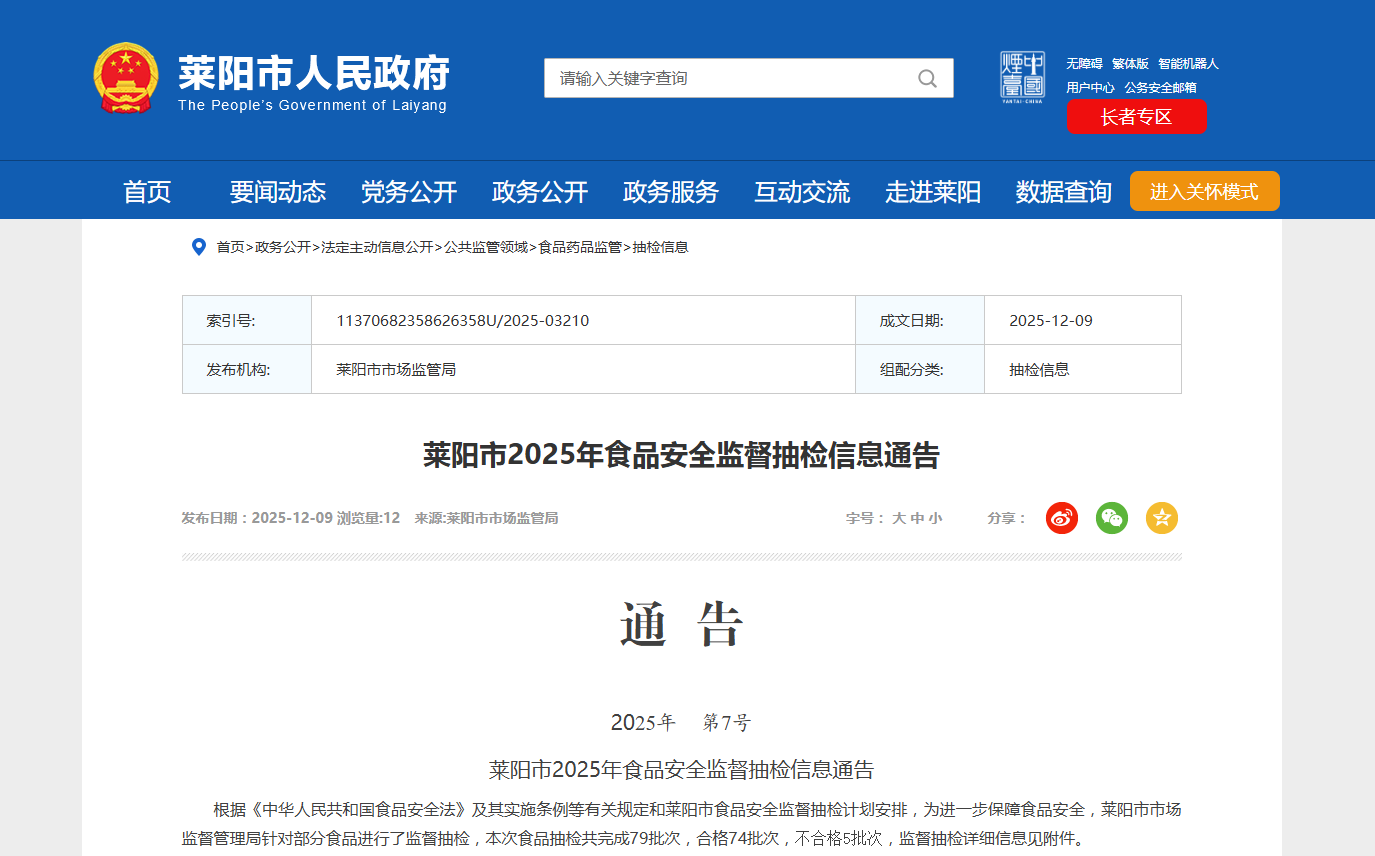
山东省莱阳市2025年食品安全监督抽检信息通告
Zhong Guo Zhi Liang Xin Wen Wang· 2025-12-10 09:01
Core Insights - The Laiyang Market Supervision Administration conducted a food safety inspection, completing a total of 79 batches, with 74 passing and 5 failing the quality standards [4]. Group 1: Inspection Results - A total of 79 food samples were tested, with 74 deemed compliant and 5 identified as non-compliant [4]. - The inspection aimed to enhance food safety in accordance with the Food Safety Law of the People's Republic of China [4]. Group 2: Non-compliant Products - Specific details regarding the non-compliant products were documented, including the types of food and the nature of the violations [4][5]. - The non-compliant products included items with pesticide residues exceeding the permissible limits, such as a sample from a kindergarten canteen showing 0.040 mg/kg of a pesticide, which is above the standard of 0.02 mg/kg [4][5]. Group 3: Compliance Details - The report includes a list of compliant products, detailing their production companies, addresses, and inspection results [6][7]. - The inspection results are part of a broader initiative to ensure food safety and compliance with established standards in the region [4].
国富期货早间看点-20251210
Guo Fu Qi Huo· 2025-12-10 06:20
Industry Investment Rating - Kenanga Research maintains a "neutral" view on the plantation sector [7] Core View - The report presents overnight and spot market conditions for various commodities, including palm oil, soybeans, and related products. It also provides important fundamental information such as weather in major production areas, international supply - demand data from USDA reports, and macro - economic news both internationally and domestically. These factors collectively influence the investment opportunities and risks in the agricultural commodity market [1][2][4] Summary by Directory Overnight Market - Overnight closing prices and percentage changes are provided for commodities like Malaysian palm oil, Brent crude, US crude, US soybeans, US soybean meal, and US soybean oil. Exchange rate data for multiple currencies are also given [1] Spot Market - Spot prices, basis, and basis daily changes are presented for DCE palm oil, DCE soybean oil, and DCE soybean meal in different regions. CNF quotes and CNF premiums for imported soybeans from different origins are also included [2] Important Fundamental Information Production Area Weather - Brazil's soybean - growing regions will have widespread rainfall, which is beneficial for crop growth. Argentina's main soybean - producing areas have good soil moisture, but some areas face drought risks [4] International Supply - Demand - USDA estimates for the 2025/26 palm oil season show a downward revision in production, ending stocks, and exports compared to last month. Kenanga Research expects edible oil supply to improve in 2026 but remain tight overall. Felda and FGV will resume operations in their palm oil plantations in Terengganu. USDA's December oilseed report provides data on soybean ending stocks, production, and other supply - demand indicators for the US, Brazil, and Argentina. Other supply - demand data for soybeans, soybean meal, and soybean oil are also presented, along with export forecasts for Brazil and Argentina [6][7][9] Domestic Market Transactions - On December 9, the total trading volume of soybean oil and palm oil decreased compared to the previous trading day. The trading volume of soybean meal in major domestic oil mills decreased, with changes in spot and far - month basis trading volumes. The national dynamic full - sample oil mill operating rate increased. The national soybean oil port inventory decreased. The national pork supply was sufficient in November, and the price decreased slightly [15] Macroeconomic News International News - The probability of the Fed cutting interest rates in December and January is high. ADP's weekly employment report shows an average increase in private - sector jobs. US economic indicators such as the NFIB small - business confidence index, JOLTs job openings, and the Conference Board leading index are presented, along with API crude oil inventory data [17] Domestic News - On December 9, the US dollar/Chinese yuan exchange rate increased (yuan depreciation). The Chinese central bank conducted 7 - day reverse repurchase operations, resulting in a net withdrawal of funds [19] Fund Flow - On December 9, 2025, the futures market had a net capital outflow of 16.149 billion yuan, with outflows in commodity futures, stock index futures, and treasury bond futures [21] Arbitrage Tracking - No specific content provided in the given text [22]
油料日报:豆一现货强势但物流受限,花生产区惜售价格偏强-20251210
Hua Tai Qi Huo· 2025-12-10 03:33
Report Industry Investment Rating - The investment rating for both soybeans and peanuts is neutral [3][6] Core Viewpoints - The soybean market is supported by a tightening supply of grain at the grassroots level, with farmers' remaining grain generally only 2 - 30% and strong reluctance to sell. The main constraint on the spot market is the logistics issue. The peanut market shows a stable - to - strong price trend due to farmers' reluctance to sell in some areas, but the overall price fluctuation is limited, and the strict acquisition indicators of oil mills cannot boost the market [3][5] Market Analysis of Soybeans Futures and Spot Market - Yesterday, the closing price of the soybeans No.1 2601 contract was 4089.00 yuan/ton, up 4.00 yuan/ton or 0.10% from the previous day. The edible soybean spot basis was A01 + 11, down 4 or 32.14% from the previous day [1] Market Information - The new - season soybean spot prices in the Northeast production area are rising, with an increase of 30 - 80 yuan/ton. The actual soybean purchase and sales are slow, and the tower - grain prices are stable. The future soybean trend depends on downstream consumption [2] Market Trends - The main soybean futures contract rebounded slightly. The core support for the soybean market is the tightening of grassroots grain sources. As the traditional pre - Spring Festival grain - purchasing period approaches, farmers are reluctant to sell, making it difficult for traders to buy grain. The impact of soybean auctions on the spot market is minimal. The spot price is strong, and the main constraint is the logistics problem [3] Market Analysis of Peanuts Futures and Spot Market - Yesterday, the closing price of the peanut 2601 contract was 8060.00 yuan/ton, up 42.00 yuan/ton or 0.52% from the previous day. The peanut spot average price was 8182.00 yuan/ton, with no change from the previous day. The spot basis was PK01 + - 1260.00, down 42.00 or 3.45% from the previous day. The national average price of peanut general - quality rice was 4.09 yuan/jin, up 0.03 yuan/jin [4] Market Trends - The main peanut futures contract fluctuated sideways. Some farmers in the Northeast and Henan are reluctant to sell again, leading to a stable - to - strong peanut price. Traders are cautious in purchasing. In some regions, the sales situation varies. The overall peanut price fluctuation is small, and there may be a slight increase in some areas. The strict acquisition indicators of oil mills cannot boost the peanut market [5] Strategies - For soybeans, the strategy is neutral [3] - For peanuts, the strategy is also neutral [6]
国泰君安期货商品研究晨报:农产品-20251210
Guo Tai Jun An Qi Huo· 2025-12-10 01:50
2025年12月10日 国泰君安期货商品研究晨报-农产品 观点与策略 | 棕榈油:关注MPOB报告利空出尽反应 | 2 | | --- | --- | | 豆油:美豆驱动不足,豆油震荡为主 | 2 | | 豆粕:USDA报告平淡,盘面低位震荡 | 4 | | 豆一:反弹震荡 | 4 | | 玉米:关注现货 | 6 | | 白糖:偏弱运行 | 7 | | 棉花:震荡偏强关注下游需求20251210 | 8 | | 鸡蛋:现货震荡 | 10 | | 生猪:提前交易冬至预期 | 11 | | 花生:关注油厂收购 | 12 | 国 泰 君 安 期 货 研 究 所 棕榈油:关注 MPOB 报告利空出尽反应 豆油:美豆驱动不足,豆油震荡为主 | | | 【基本面跟踪】 油脂基本面数据 | | 棕榈油主力 | 单 位 元/吨 | 收盘价 (日盘) | 涨跌幅 -0.67% | 收盘价 (夜盘) | 涨跌幅 0.74% | | --- | --- | --- | --- | --- | --- | --- | | | 豆油主力 | 元/吨 | 8,648 8,190 | -0.49% | 8,712 7,998 | -2.3 ...
“菜心流量”变“文旅留量”,这场嘉年华让清远农文旅甜上心头
Nan Fang Nong Cun Bao· 2025-12-09 13:08
"菜心流 量"变"文旅留 量",这场嘉年 华让清远农文旅 甜上心头_南方 +_南方plus 冬日傍晚,清远 市南岸码头被灯 光和欢声笑语点 亮。人群中,一 位来自广州的游 客何女士兴奋地 向同伴展示手机 屏幕——她刚刚 用购买连州菜心 的消费凭证,抽 中了一张连州地 下河景区的门 票。"本来只是 来买点新鲜菜 心,没想到 还'赚'了一次旅 行!"她笑着说 道。这一幕,正 是"天赋风土·自 在清远"2025年 清远市暖冬消费 季之连州菜心嘉 年华系列活动 (下称"嘉年 华")主打农文 旅融合的生动缩 影。 嘉年华活动现场市民游客积极参与消费抽奖。 一次"从舌尖甜 到心头"的文旅 新体验 本次嘉年华的核 心现场——南岸 码头"连州菜心 一条街",化身 为一个集农产 品、美食与旅游 推介于一体的沉 浸式消费空间, 打破了传统农货 市场的单一印 象,将"购 物"与"游乐"紧 密结合。 最受市民游客欢 迎的,无疑 是"吃连州菜 心,游清远胜 景"的联动抽奖 活动。奖品清单 涵盖古龙峡、飞 来峡、连州地下 河、湟川三峡等 景区项目门票以 及"连州菜心 号"北江游船 票,直接将农产 品消费与清远的 核心旅游资源挂 钩。这一 ...

农产品日报:苹果质量偏差走货较慢,红枣新货价差明显-20251209
Hua Tai Qi Huo· 2025-12-09 02:57
Report Industry Investment Rating - The investment rating for both the apple and jujube industries is neutral [4][9] Core Views - For the apple industry, the current入库量 and入库结构 expectations are already reflected in the price. Future focus should be on terminal market consumption recovery, the impact of入库结构 differentiation, and pre - Chinese New Year inventory adjustment by merchants. The market is in a seasonal off - peak, and caution is needed when chasing high prices [4] - For the jujube industry, if the sales situation in the distribution areas improves, the jujube price may rebound during the consumption peak. However, due to the large inventory of new and old seasons, the upward rebound space is expected to be limited [9] Summary by Related Catalogs Apple Market News and Important Data - Futures: The closing price of the apple 2605 contract yesterday was 9506 yuan/ton, a change of - 133 yuan/ton or - 1.38% from the previous day [1] - Spot: The price of Shandong Qixia 80 first and second - grade late Fuji was 4.10 yuan/jin, unchanged from the previous day; the price of Shaanxi Luochuan 70 and above semi - commercial late Fuji was 4.20 yuan/jin, unchanged from the previous day. The spot basis AP05 - 1306 and AP05 - 1106 increased by 133 from the previous day respectively [1] Recent Market Information - The mainstream market price of late Fuji in storage remains stable, with trading on an as - needed basis. In the western production areas, there are sporadic inquiries from merchants, mainly for farmers' two - grade goods, and the transaction volume is limited. In some areas of Gansu, merchants are shipping Huaniu and high - quality goods, with fair transactions. In Shandong, there is sporadic shipping, and the export of small fruits through foreign trade channels has slowed down. The arrival volume at the wholesale market has changed little, and downstream consumption is weak [2] Market Analysis - Yesterday, the apple futures price fluctuated downward. Compared with previous years, the apple inventory is lower, and the quality is relatively poor. Farmers and traders are less willing to sell, and the shipping speed in each production area is slow. Most merchants are still waiting and watching. The new - season late Fuji has completed warehousing, with the warehousing volume more than 10% lower than the same period last year. The overall mentality of merchants is optimistic. The inventory started to decline last week, and the overall shipping is average. Affected by the seasonal off - peak, consumption is mainly on an as - needed basis, and the demand side is under pressure. The increase in the listing volume of citrus fruits squeezes the sales space of apples, and the sentiment in the distribution areas is relatively pessimistic [3] Strategy - The recommendation is neutral. Given that the expectations of warehousing volume and structure are already priced in, future attention should be on terminal consumption recovery, the impact of warehousing structure differentiation, and merchants' inventory adjustment in the warehouse before the Chinese New Year. It is expected that the double - holiday stocking has not started in large quantities this week, and the market is still in an off - peak situation, so caution is needed when chasing high prices [4] Jujube Market News and Important Data - Futures: The closing price of the jujube 2601 contract yesterday was 9180 yuan/ton, a change of + 5 yuan/ton or + 0.05% from the previous day [5] - Spot: The price of first - grade grey jujubes in Hebei was 8.60 yuan/kg, an increase of 0.10 yuan/kg from the previous day. The spot basis CJ01 - 580 increased by 95 from the previous day [5] Recent Market Information - In the Xinjiang production areas, the acquisition of grey jujubes is nearing completion, with only some low - quality and price - holding sellers remaining. The mainstream prices in different areas vary. In the Hebei market, there was a small amount of new - season jujubes arriving at the parking area over the weekend, and they are gradually being processed after being brought back to the factory. The new - season jujubes have a large price difference due to cost and quality. In the Guangdong Ruyifang market, there were 9 trucks of jujubes arriving, and the market supply is sufficient. Some holders are reducing prices to avoid storage costs, and downstream merchants are purchasing on an as - needed basis. In the Hebei distribution area, the supply of new - season jujubes is increasing, and it is expected that the spot price will remain stable in the short term [6][7] Market Analysis - The jujube futures price fluctuated slightly yesterday. Merchants from various places are actively purchasing, and the market trading activity is increasing. However, the inventory is still at a high level, and the sales pressure remains. The trading in the distribution areas is mainly for new - season jujubes, which have a large price difference due to cost and quality. The acquisition of grey jujubes in the Xinjiang main production areas is about 90% complete, and the prices have stopped falling and stabilized, with the cost becoming clearer. The prices in the distribution areas have also stabilized, and some holders are slightly increasing their quotes as downstream purchases increase. The inventory of 36 sample points has increased significantly, reaching the highest level in recent years, and the supply - demand contradiction has not been substantially alleviated. The market's future expectations are pessimistic, which has led to a significant decline in futures and spot prices in the past month. As the weather gets colder, jujubes enter the consumption peak season, and the actual consumption situation on the demand side will become another focus [8] Strategy - The recommendation is neutral. If the sales situation in the distribution areas improves, the jujube price may rebound during the consumption peak. However, due to the large inventory of new and old seasons, the upward rebound space is expected to be limited even if the consumption data improves [9]
资讯早班车-2025-12-09-20251209
Bao Cheng Qi Huo· 2025-12-09 01:29
投资咨询业务资格:证监许可【2011】1778 号 期货研究报告 资讯早班车-2025-12-09 一、 宏观数据速览 | 发布日期 | 指标日期 | 指标名称 | 单位 | 当期值 | 上期值 | 去年同期值 | | --- | --- | --- | --- | --- | --- | --- | | 20251020 | 2025/09 | GDP:不变价:当季同比 | % | 4.80 | 5.20 | 4.60 | | 20251130 | 2025/11 | 制造业 PMI | % | 49.20 | 49.00 | 50.30 | | 20251130 | 2025/11 | 非制造业 PMI:商务活 动 | % | 49.50 | 50.10 | 50.00 | | 20251114 | 2025/10 | 社会融资规模增量:当 | 亿元 | 8161.00 | 35299.00 | 14120.00 | | | | 月值 | | | | | | 20251113 | 2025/10 | M0(流通中的现金):同 比 | % | 10.60 | 11.50 | 12.80 | | 202511 ...
融出乡村振兴好“丰”景
Hai Nan Ri Bao· 2025-12-09 01:17
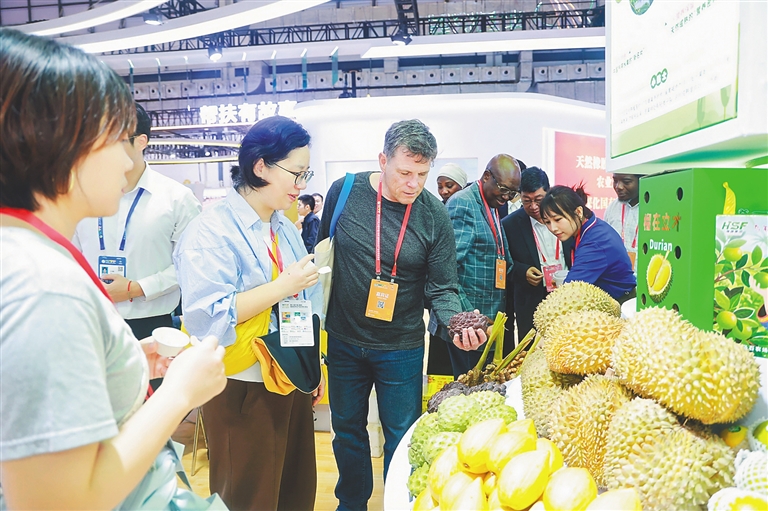
Core Viewpoint - The article highlights the successful integration of agricultural products and rural revitalization efforts showcased at the Winter Trade Fair, emphasizing the importance of industry collaboration and innovation in enhancing local economies and agricultural practices [7][8][9]. Group 1: Product Showcase - A variety of unique agricultural products, including colorful peanuts and specialty sweet potatoes, were presented at the Winter Trade Fair, demonstrating the achievements of the integration of agricultural and local resources [7]. - The Hainan Agricultural Reclamation Group showcased its innovative products and collaborative efforts with local governments to promote agricultural development and rural revitalization [7][8]. Group 2: Innovative Mechanisms - The partnership between Hainan Agricultural Reclamation Group and Wenchang City’s Gongpo Town introduced a new model of industry integration, involving the establishment of strong village companies and the appointment of rural CEOs to enhance local agricultural practices [8][9]. - The collaboration aims to revitalize local assets and create job opportunities for villagers by leveraging the strengths of state-owned enterprises in technology and market experience [9][10]. Group 3: Support Mechanisms - The "Five Unifications" mechanism was established to ensure stable agricultural development by providing unified supply of seeds, feed, technology, prevention, and sales, alleviating farmers' concerns [11]. - Since 2021, over 1,200 farmers have collaborated with the company, generating a total output value of 10.05 billion yuan, demonstrating the effectiveness of deep integration between enterprises and farmers [12]. Group 4: Technological Empowerment - The Hainan Agricultural Reclamation Group has focused on technological empowerment to enhance agricultural production, integrating high-quality agricultural capabilities with local service demands [14]. - The establishment of the rural property transaction service platform has facilitated efficient management and flow of rural assets, contributing to the digital transformation of agricultural practices [15].

美国将为受关税政策影响农民提供120亿美元救助
Xin Hua She· 2025-12-08 19:42
美国总统特朗普8日下午在白宫宣布,联邦政府将为美国农民提供规模为120亿美元的救助,以应对美关 税政策对美农业的"反噬"。 特朗普政府今年早些时候出台大范围加征关税政策,扰乱全球贸易秩序,结果导致美国出口市场受阻。 美国大豆和玉米等农产品售价低迷,加上化肥和农用机械成本升高,美国农场经营难以盈利,不少农民 陷入困境。 (文章来源:新华社) ...