医疗器械

Search documents
普门科技20260313
2026-03-16 02:20
Summary of the Conference Call for Pumen Technology Company Overview - **Company**: Pumen Technology - **Industry**: In Vitro Diagnostics (IVD) and Consumer Health Key Points Industry and Market Dynamics - Domestic IVD business policy impacts are expected to clear up, with a market turnaround anticipated in the second half of 2026 [2][5] - The IVD industry is projected to see growth in testing volumes due to aging population trends, despite ongoing price pressures [6] Product Lines and Growth Strategies - **Core Product Lines**: CRP, Glycated Hemoglobin, and Electrochemiluminescence are expected to stabilize and recover through grassroots screening and high-end replacements [2] - **Overseas Business**: Targeting a growth rate of ≥20% annually, with overseas revenue now exceeding 40% of total income [2][7] - **Consumer Health**: Focus on skin aesthetics and ToC health, with expectations for over 50% growth in the aesthetics segment by 2026 [2][5] Financial Performance and Projections - The company aims to achieve a sales target of over 100 million RMB in the ToC business by 2026, with a doubling of revenue expected in 2025 [2][4] - The consumer health business is projected to turn profitable in 2025 after significant growth [16] Strategic Initiatives - **Cost Management**: Emphasis on self-sourcing core materials to alleviate cost pressures due to healthcare cost control [2][5] - **International Expansion**: Establishing subsidiaries in key markets (e.g., Russia, India, Mexico) to mitigate risks associated with agency limitations and payment issues [2][7][10] Technological Integration - AI technologies are deeply integrated into business lines, with projects in AI interpretation of chromatograms and thrombus prevention systems [3][17] - The company is exploring brain-machine interface applications in home rehabilitation [3][17] Regulatory and Market Challenges - Anticipated regulatory changes in the domestic IVD market, including payment reforms and collection of testing packages, are expected to impact growth in 2025 [5] - The company is cautious about the medical aesthetics market, which is currently undergoing adjustments due to regulatory changes [13] Future Product Development - New product lines in endoscopy and aesthetics are in the registration phase, with expectations for market entry in 1-2 years [12] - The company is focusing on high-value consumables in its aesthetics product line, with significant potential for products like ultrasound knives and gold microneedles [14] Sales and Distribution Strategy - The company employs a mixed sales strategy, combining direct sales for large clients with authorized distribution for others to maintain market stability [14] Online Business Strategy - The consumer health business has seen rapid growth, with a focus on effective product development rather than gimmicky offerings [15][16] - The online business is expected to achieve profitability in 2025, with clear profit targets set for 2026 [16] Conclusion - Pumen Technology is strategically positioned for growth in both domestic and international markets, with a strong focus on innovation, cost management, and regulatory compliance. The integration of AI and a robust product pipeline in consumer health and aesthetics are key components of its future success.

医药行业周报:关注具备价格主动权的品种
Huaxin Securities· 2026-03-16 01:24
Investment Rating - The report maintains a "Recommended" rating for the pharmaceutical industry as of March 16, 2026 [1] Core Insights - The report emphasizes the importance of products with price leadership amid rising costs in the supply chain due to geopolitical tensions and policy changes affecting raw material prices [2] - The report highlights the significant price increases in pharmaceutical raw materials, particularly vitamins and amino acids, which have seen price increases of 40.54% and 84.66% respectively since the beginning of the year [2] - The report notes the approval of China's first invasive brain-machine interface, marking a significant milestone in the medical device sector [5] - The report indicates a strong trend in China's innovative pharmaceuticals going global, with a notable increase in licensing-out transactions [6] Summary by Sections 1. Supply Chain Dynamics - The report discusses the impact of rising prices in upstream chemical products on pharmaceutical raw materials, stressing that the ability to pass on these costs is crucial for maintaining profitability [2] - It mentions that 90% of monitored products have seen price increases, with the chemical product price index rising by 28.52% since the beginning of the year [2] 2. Market Trends in Disposable Gloves - The report details the price increases in disposable nitrile gloves and PVC gloves due to rising costs of raw materials like butadiene and acrylonitrile, which have increased by 84.43% and 47.30% respectively [3] - It notes that the domestic utilization rate for nitrile gloves has improved, and export prices have been rising since late 2025 [3] 3. Regulatory Environment - The report highlights the impact of dual-use item management on the pricing of key materials, creating significant price disparities between domestic and international markets [4] - It suggests that stricter controls on resources like rare earths could enhance the competitive advantage of domestic medical products [4] 4. Innovations in Medical Devices - The report discusses the approval of the brain-machine interface by the National Medical Products Administration, which is expected to open new market opportunities [5] - It outlines the potential for significant market growth in this area, given the high number of spinal cord injury patients in China [5] 5. International Expansion of Chinese Pharmaceuticals - The report notes that there have been 39 licensing-out transactions in the innovative drug sector, with upfront payments totaling approximately $2.953 billion [6] - It emphasizes that the trend of Chinese pharmaceuticals going global continues to strengthen, with a focus on small nucleic acid drugs and dual antibodies [7] 6. Stock Recommendations - The report recommends focusing on raw material suppliers with price leadership, such as Zhejiang Medicine and Chuan Ning Biological, and highlights companies like Inco Medical and Blue Sail Medical in the disposable glove sector [8] - It also suggests monitoring companies involved in the invasive brain-machine interface and small nucleic acid drugs, indicating potential for growth in these areas [8]



加速心脏电生理产品国产替代,「艾科脉医疗」完成超亿元Pre-B轮融资|早起看早期
36氪· 2026-03-16 00:01
Core Viewpoint - Aikoma Medical has achieved significant revenue in its first year of commercialization, with several million yuan in earnings, following a successful over 100 million yuan Pre-B round financing aimed at accelerating the development and commercialization of its innovative cardiac electrophysiology technologies [4][7]. Group 1: Company Overview - Aikoma Medical focuses on the cardiac electrophysiology sector, particularly in developing pulse field ablation (PFA) technology, which selectively targets myocardial cells without damaging surrounding tissues [4][5]. - The company has established a comprehensive product matrix that includes a three-dimensional mapping system and a range of electrophysiological consumables [4][6]. - Aikoma Medical's PFA system has achieved a 100% immediate pulmonary vein isolation rate during procedures, with a 12-month follow-up success rate of 87.7% [6][7]. Group 2: Technology and Innovation - The PFA system features a unique variable circle diameter design to accommodate various clinical scenarios, enhancing its adaptability [8]. - Aikoma Medical has developed an intelligent algorithm to monitor catheter positioning, improving the effectiveness of the ablation process [6]. - The company is leveraging AI technology to process vast amounts of surgical data, enhancing the precision of three-dimensional cardiac models and simplifying surgical procedures [7][8]. Group 3: Market Potential and Investment - The global cardiovascular market is the second largest medical device market, with cardiac electrophysiology experiencing over 20 years of continuous growth [4]. - Investors recognize the broad market potential for PFA technology, which is becoming a mainstream treatment in the cardiac electrophysiology field [8]. - Aikoma Medical's products have been implemented in nearly 100 hospitals nationwide, with significant market access facilitated by successful procurement processes in regions like Beijing [7].


医药生物行业周报:地缘政治催化,一次性手套行业迎来战略机遇期
KAIYUAN SECURITIES· 2026-03-15 13:30
Investment Rating - The industry investment rating is "Positive" (maintained) [1] Core Insights - The geopolitical tensions in the Middle East have led to increased volatility in international energy markets, affecting the prices of upstream raw materials and consequently the prices of glove products [5][14] - The production cost of nitrile gloves has risen approximately 28.9% due to significant increases in the prices of key raw materials, specifically butadiene and acrylonitrile, which have risen by 84.43% and 45.33% respectively since the end of 2025 [20][19] - The expected price for nitrile gloves is projected to rise to 17.5 yuan per thousand pieces [5] Summary by Sections Geopolitical Impact on Disposable Gloves - The geopolitical situation has caused a surge in oil prices, which directly impacts the prices of key raw materials for glove production [14][15] - The cost increase in raw materials is expected to be passed down the supply chain, leading to higher prices for end products [20][19] Medical Device Investment Directions for 2026 - The medical device sector is anticipated to see a gradual recovery in profits, driven by policy adjustments and the implementation of new procurement strategies [34] - Key areas of focus include brain-computer interfaces, AI medical technologies, and surgical robots, which are expected to receive increased attention and investment [34] Recommendations for Investment - Focus on leading companies that are likely to experience a turnaround in 2026, benefiting from brand strength and channel advantages [7] - Emphasize companies with strong R&D capabilities and clinically differentiated products to capitalize on policy corrections in high-value consumables [7] - Consider firms with established overseas operations and successful business development models to leverage international growth opportunities [7] - Target companies that are positioned to benefit from domestic policy support and accelerated localization efforts [7] - Monitor innovative sectors such as brain-computer interfaces and AI medical technologies for potential high-growth opportunities [7] Market Performance Overview - The pharmaceutical and biological sector saw a decline of 0.22%, underperforming the CSI 300 index by 0.41 percentage points [44] - The medical consumables sector experienced the highest growth, while the medical equipment sector faced the largest decline [46]



德适生物通过港交所聆讯:将成「医学影像大模型第一股」,收入迎爆发式增长
IPO早知道· 2026-03-15 13:10
Core Viewpoint - The article highlights that Deshi Biotechnology is set to become the first publicly listed company focused on medical imaging AI models, aligning its development direction with national strategies for healthcare innovation [1][2]. Company Overview - Deshi Biotechnology, established in 2016, specializes in developing medical imaging products and services, with a diverse product portfolio that includes six medical imaging software products, three commercialized medical devices, four main reagents and consumables, and two licensed technology products [2]. Key Product Details - The core product, AI AutoVision®, is designed for chromosome karyotype analysis and is intended for use in birth defect prevention, pre-marital and pre-pregnancy screening, and assisted reproduction. It has completed clinical trials and is set to submit a Class III medical device registration application to the National Medical Products Administration in May 2025 [3]. - In a clinical trial involving 1,518 real samples, AI AutoVision® achieved a sensitivity of 100.00% and specificity of 100.00% for detecting numerical abnormalities, and a sensitivity of 94.05% and specificity of 100.00% for structural abnormalities, demonstrating significant efficiency improvements over traditional methods [3]. Market Position - According to Frost & Sullivan, Deshi Biotechnology holds the leading market share of 30.6% in China's chromosome karyotype analysis sector, with the market expected to grow rapidly to RMB 2.038 billion by 2030 and further to RMB 6.000 billion by 2035 [4]. Technological Advantages - The success of AI AutoVision® is attributed to the proprietary iMedImage® medical imaging base model, which supports 19 imaging modalities and covers over 90% of clinical imaging scenarios. This model is designed for reasoning-oriented learning and training in the medical field [5][6]. Future Development Plans - Deshi Biotechnology plans to enhance the iMedImage® model's capabilities to support a broader range of imaging modalities and clinical specialties, as well as improve its computational power for processing large-scale medical imaging data [7]. - The company aims to authorize the iMedImage® model for localized deployment to address challenges in remote areas, thereby supporting local healthcare institutions [7]. Financial Performance - For the first three quarters of 2025, Deshi Biotechnology reported revenue of RMB 112 million, a 470% increase from RMB 20 million in the same period of 2024, with a gross margin of 75.9% [8]. - The funds raised from the IPO will primarily be used for the R&D and commercialization of AI AutoVision®, as well as for developing other medical imaging software and devices, enhancing AI technology, and expanding market penetration both domestically and globally [8].

医药生物行业周报:地缘政治催化,一次性手套行业迎来战略机遇期-20260315
KAIYUAN SECURITIES· 2026-03-15 11:08
Investment Rating - The industry investment rating is "Positive" (maintained) [1] Core Insights - The geopolitical tensions in the Middle East have led to increased volatility in international energy markets, affecting the prices of upstream raw materials and consequently the prices of glove products [5][14] - The production cost of nitrile gloves has risen approximately 28.9% due to significant increases in the prices of key raw materials, specifically butadiene and acrylonitrile, which have risen by 84.43% and 45.33% respectively since the end of 2025 [20][29] - The expected price for nitrile gloves is projected to rise to 17.5 yuan per thousand pieces [5] Summary by Sections Geopolitical Catalysts in the Disposable Glove Industry - The geopolitical situation has caused a surge in oil prices, which directly impacts the prices of essential raw materials for glove production [14][15] - The cost of butadiene and acrylonitrile has increased significantly, leading to higher production costs for nitrile gloves [18][19] 2026 Medical Device Investment Directions - The medical device sector is expected to see a gradual recovery in profits, driven by policy adjustments and increased focus on high-value consumables [34] - The emphasis on brain-computer interfaces, AI medical technology, and surgical robots is anticipated to catalyze growth in related sectors [34] Recommended Focus Areas - Focus on leading companies that are expected to reverse their challenges in 2026, confirming performance inflection points [35] - High-value consumables are expected to see a correction in pricing policies, presenting opportunities for companies with strong R&D capabilities [36] - The international expansion of medical devices is opening new growth avenues, with companies that have established overseas certifications and partnerships being particularly well-positioned [38] - Domestic policies are accelerating the pace of localization, benefiting companies that are core beneficiaries of these policies [40] - The convergence of new technologies is creating significant opportunities in innovative sectors, with a focus on companies that can quickly commercialize their technologies [41] - Companies that can successfully expand into new business areas are likely to uncover new growth trajectories [42] Pharmaceutical Layout and Recommended Targets - The report maintains a positive outlook on the innovative drug sector and its supply chain, including CROs and AI technologies [8] - Monthly recommendations include companies such as WuXi AppTec, CSPC Pharmaceutical, and InnoCare Pharma, while weekly recommendations feature companies like HengRui Medicine and Frontier Biotech [8]
医药生物行业跟踪周报:“十五五”聚焦脑机接口、首款产品获批,关注:微创脑科学、翔宇医疗、爱朋医疗等
Soochow Securities· 2026-03-15 10:45
Investment Rating - The report maintains a "Buy" rating for the industry, focusing on companies involved in brain-computer interfaces and innovative pharmaceuticals [1]. Core Insights - The report highlights significant advancements in the brain-computer interface sector, particularly the approval of the world's first invasive brain-computer interface by BoRuiKang, marking a pivotal moment for commercialization in this field [18][24]. - The report emphasizes a favorable outlook for innovative drugs, particularly in the small nucleic acid segment, and suggests a diversified investment strategy across various sub-sectors within the pharmaceutical industry [3][11]. Summary by Sections Industry Performance - The A-share pharmaceutical index has shown a slight decline of -0.22% this week and -0.13% year-to-date, underperforming the CSI 300 index by -0.41% and -0.97% respectively [11]. - The report notes that the medical device sector has seen a positive performance, with raw materials and medical devices increasing by 1.32% and 0.60% respectively [11]. Brain-Computer Interface Developments - BoRuiKang's invasive brain-computer interface, NEO, has received approval from the National Medical Products Administration, representing a breakthrough in the commercialization of brain-computer interfaces [18][20]. - The product is designed for patients with cervical spinal cord injuries, utilizing a minimally invasive implantation technique that reduces risks associated with traditional methods [20][24]. Investment Recommendations - The report ranks sub-sectors in the following order of attractiveness: innovative drugs > research services > CXO > traditional Chinese medicine > medical devices > pharmacies [3][11]. - Specific companies to watch include: - PD1 PLUS: Sanofi Biopharma, Kangfang Biopharma, and others [14]. - ADC: YingEn Biopharma, Kelun Biotech, and others [14]. - Small nucleic acids: Frontier Biopharma, Fuyuan Biopharma, and others [14]. - CXO and research services: WuXi AppTec, Haoyuan Biopharma, and others [14]. - Medical devices: United Imaging Healthcare, Yuyue Medical, and others [14]. Regulatory and Market Insights - The report discusses the supportive regulatory environment for brain-computer interfaces, with policies aimed at facilitating research and commercialization [24]. - It also highlights the importance of technological breakthroughs in driving the industry forward, with BoRuiKang setting a benchmark for future product approvals [24].



医药生物行业跟踪周报:“十五五”聚焦脑机接口、首款产品获批,关注:微创脑科学、翔宇医疗、爱朋医疗等-20260315
Soochow Securities· 2026-03-15 10:26
Investment Rating - The report maintains a "Buy" rating for the pharmaceutical and biotechnology industry, focusing on brain-machine interface technologies and companies like Microinvasive Brain Science, Xiangyu Medical, and Aipeng Medical [1]. Core Insights - The report highlights significant advancements in the brain-machine interface sector, particularly the approval of the first product, which marks a pivotal moment for the industry. This approval is expected to facilitate further commercialization and development within the sector [18][24]. - The report ranks sub-industries in the following order of attractiveness: innovative drugs > research services > CXO > traditional Chinese medicine > medical devices > pharmacies. It emphasizes high elasticity in innovative drugs, especially in small nucleic acid therapies, and high dividend yields in traditional Chinese medicine and pharmacies [3][11]. Summary by Sections Industry Trends - The A-share pharmaceutical index has shown a slight decline of -0.22% this week and -0.13% year-to-date, underperforming the CSI 300 index by -0.41% and -0.97% respectively. The Hang Seng Biotechnology Index has also decreased by -4.00% this week [11]. - Notable stock performances include Yingke Medical (+35.18%), Zhonghong Medical (+25.26%), and *ST Jingfeng (+15.64%) for gains, while Yifang Biological (-11.59%) and Huakang Clean (-10.79%) faced significant losses [11]. R&D Progress and Company Dynamics - The report details the approval of several innovative drugs, including HSK31679 for non-alcoholic fatty liver disease and the GLP-1 receptor agonist Enoglutide, which has received approval in China [2][3]. - Companies to watch include: - From the PD1 PLUS perspective: Sanofi Biopharma, Kangfang Biopharma, and others - From the ADC perspective: Ying'en Biopharma and others - From the small nucleic acid perspective: Frontier Biopharma and others - From the CXO and upstream research services perspective: WuXi AppTec and others [3][14]. Brain-Machine Interface Developments - The report emphasizes the approval of the NEO brain-machine interface by the National Medical Products Administration, which is the first of its kind globally. This product is designed for patients with cervical spinal cord injuries and offers a minimally invasive solution with high signal quality and low tissue damage [18][20]. - The approval is seen as a breakthrough that sets a standard for future products in the brain-machine interface space, supported by government policies and funding initiatives aimed at fostering industry growth [24][25].


脑机接口专题报告:半侵入安全完胜,更具消费级潜力
Orient Securities· 2026-03-15 09:43
Investment Rating - The report maintains a "Positive" investment rating for the pharmaceutical and biotechnology industry in China [6] Core Viewpoints - The report emphasizes that semi-invasive brain-machine interfaces (BMIs) demonstrate significant safety advantages over invasive methods, making them more suitable for consumer applications [9][10] - The potential for semi-invasive BMIs to address safety concerns during implantation, long-term use, and removal is highlighted, suggesting a greater development potential [9][10] - The report identifies that the market for BMIs is expected to grow significantly, particularly in the treatment of neurological diseases, which will pave the way for future consumer-level applications [19][21] Summary by Sections 1. Semi-Invasive Surgery: Smaller Incisions and Shallow Implantation - Semi-invasive techniques are less invasive, reducing surgical risks compared to invasive methods [9][10] - The report notes that semi-invasive BMIs can achieve shallower implantation depths, minimizing damage to brain tissue [9][10] - The potential for algorithm advancements to further enhance implantation techniques is discussed [49] 2. Long-Term Safety and Higher Channel Limits - Semi-invasive BMIs do not form scar tissue, maintaining neuron integrity, which is crucial for long-term stability [51][57] - The report indicates that semi-invasive designs can avoid electrode displacement, which is a significant risk in invasive methods [61][67] - The ability of semi-invasive BMIs to manage thermal limits effectively is emphasized, allowing for higher channel counts without compromising safety [69][73] 3. Safer Removal and Greater Consumer Potential - The report highlights that removing semi-invasive electrodes poses less risk of damaging blood vessels compared to invasive electrodes [11][14] - The increasing frequency of hardware upgrades in BMIs necessitates safer removal methods, which semi-invasive designs can provide [11][14] - The report suggests that as the market for BMIs expands, semi-invasive methods will better meet consumer demands for easy replacement and upgrades [11][14] 4. Investment Recommendations and Targets - The report recommends focusing on semi-invasive BMI solutions with clear clinical progress and government support [14] - It suggests exploring companies within the semi-invasive BMI supply chain that show potential breakthroughs in the medical field and can extend into consumer markets [14]

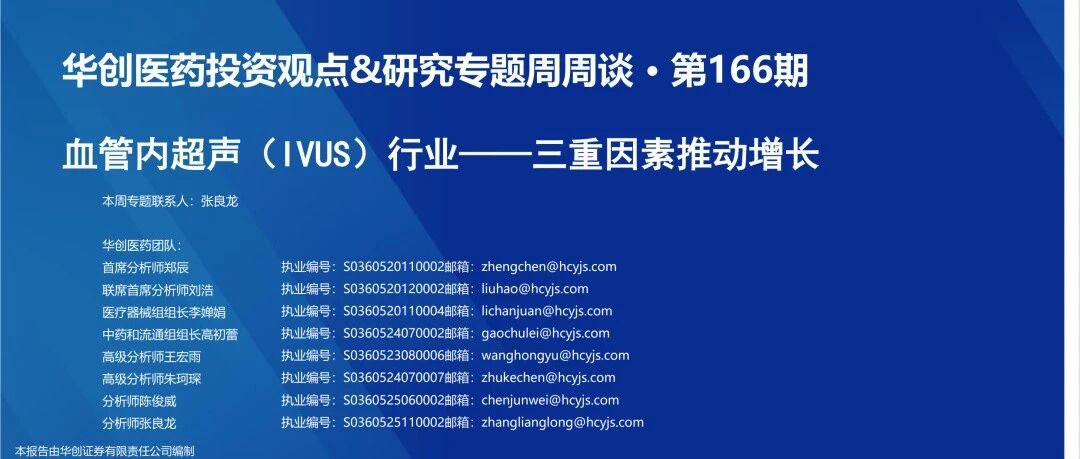
华创医药周观点:血管内超声(IVUS)行业——三重因素推动增长 2026/03/15
华创医药组公众平台· 2026-03-15 03:33
Core Viewpoint - The article discusses the growth of the intravascular ultrasound (IVUS) industry, driven by three main factors: the increasing volume of PCI surgeries, the rising penetration rate of IVUS in PCI procedures, and the significant potential for domestic replacement of imported IVUS products [9][24][26]. Group 1: PCI Surgery Volume Growth - The mortality rate from coronary artery disease (CAD) remains high, with a significant number of patients. In China, the death rates for rural and urban residents due to coronary heart disease were 14.82 and 13.51 per 10,000 respectively in 2021 [14]. - The number of CAD patients in China is projected to grow from 27 million in 2022 to 32 million by 2030, with a CAGR of approximately 2.2%. Globally, the number of CAD patients is expected to increase from 213 million to 250 million during the same period, with a CAGR of about 2.0% [14][19]. - PCI has become the mainstream treatment for CAD, with advantages such as minimal invasiveness, effective results, and quick recovery times [14]. Group 2: Increasing IVUS Penetration in PCI - The penetration rate of IVUS in PCI procedures in China was only 15.4% in 2021, significantly lower than developed countries. The U.S. and Japan have penetration rates exceeding 23% [22][26]. - The domestic IVUS penetration rate has rapidly increased from 8.5% in 2020 to 15.4% in 2021, indicating a near doubling within a year. The usage of IVUS consumables in China is projected to rise from approximately 322,800 units in 2022 to 553,700 units in 2024 [26]. - The overall market size for IVUS in China is expected to grow from about 1.76 billion RMB in 2024 to 5.11 billion RMB by 2030, with a CAGR of 19.4% [26]. Group 3: Domestic Replacement Potential - The IVUS market in China is currently dominated by imported brands, with Boston Scientific and Philips holding 81.4% of the market share in 2024. Domestic brands like Beixin Life and Kaili Medical are gradually entering the market [24]. - As domestic supply increases and product quality improves, the trend towards domestic replacement is expected to accelerate, supported by favorable policies and market conditions [24][26]. - The domestic IVUS market is characterized by a growing number of approved products, with 10 products already on the market and one in clinical research [24].