
科技行业

Search documents
东方富海董事长陈玮:中国股市未来至少会增加100万亿市值
Xin Lang Cai Jing· 2025-12-05 08:24
Core Viewpoint - The Chinese stock market has significant growth potential, supported by unprecedented government policies aimed at boosting the market and direct financing, with a reasonable target for the market to exceed 150% of GDP, indicating that the 4000-point level may just be the beginning, and the 3000-point level may not be seen again [1][2]. Group 1 - The Chinese GDP is projected to surpass the United States by 2037, with an expected increase of 15 trillion USD from the current 18 trillion USD [2][3]. - The Chinese stock market is anticipated to increase by at least 10 trillion USD in market value, rising from the current 11 trillion USD, with this growth driven by new sectors including artificial intelligence [2][3]. - The era of large technology companies in China is emerging, with the largest Chinese company, Tencent, valued at approximately 770 billion USD, compared to nearly 5 trillion USD for the largest U.S. company, highlighting the potential for growth in the number of companies valued at over 1 trillion USD in China [2][3].
把握质量与股息成长因子,构建美股防御性资产配置
Xin Lang Cai Jing· 2025-12-05 04:09
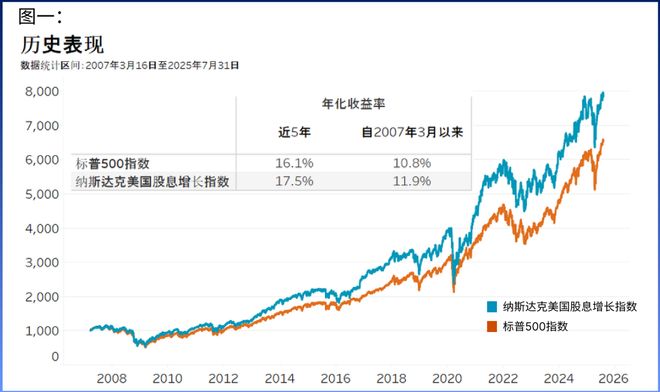
Core Insights - The article emphasizes the importance of selecting defensive and long-term growth potential U.S. stocks in the context of increasing market volatility and uncertainty due to factors like interest rate cuts and global trade wars [1][2]. Group 1: Market Performance - Over the past two decades, the U.S. stock market has experienced significant adjustments, including the 2008 financial crisis, the 2020 COVID-19 pandemic, and the 2022 Russia-Ukraine conflict, leading to heightened market volatility [2]. - The Nasdaq U.S. Dividend Growth Index has consistently outperformed the S&P 500 by approximately 1.1 to 1.4 percentage points in annualized returns, showcasing its stability and resilience during various market cycles [2][14]. Group 2: Index Characteristics - The Nasdaq U.S. Dividend Growth Index demonstrates superior downside protection during bear markets, with a win rate increasing from 32% in bull and correction phases to 66% in bear markets, achieving an excess return of 2.2% [4]. - The index employs a quality screening and dividend growth factor strategy, focusing on companies with stable revenue and dividend growth, making it suitable for investors seeking long-term stable returns amid market fluctuations [9][14]. Group 3: Asset Allocation Strategies - Investors can adopt differentiated risk and return management strategies based on their age, investment goals, and risk tolerance, with three asset allocation combinations corresponding to growth, balanced, and defensive styles [7]. - Increasing the allocation of the Nasdaq U.S. Dividend Growth Index from 25% in a growth style to 75% in a defensive style may slightly sacrifice returns but can reduce annualized volatility by 2%, thereby enhancing the Sharpe ratio of the investment portfolio [7]. Group 4: Fund Performance - As of July 31, 2025, the ETF tracking the Nasdaq U.S. Dividend Growth Index (code RDVY) has reached a total asset management scale of $15 billion, leading its peers in total return over five years and attracting the highest fund inflows in the same period [10]. - The index's sector weight distribution shows a significant allocation to the financial sector, approximately 30%, while maintaining a diversified exposure to the technology sector, which helps reduce volatility during economic downturns [12]. Group 5: Investment Logic - The index employs an equal-weight distribution for its top holdings, ensuring that no single tech giant dominates the portfolio, which has resulted in stable annualized returns exceeding those of the S&P 500 over the past two decades [12][14]. - The systematic factor strategy of the index is designed to achieve long-term stable performance without relying on individual strong stocks, highlighting its robust stock selection logic [12][14].

纽币NZDUSD难反攻:高端房市开始塌、政府财政赤字超预期,新西兰经济雪上加霜
Xin Lang Cai Jing· 2025-12-04 23:37
Group 1 - New Zealand's construction costs are showing signs of upward pressure, with average costs for standard residential construction in major cities rising by 0.5% over the last three months, marking an annual increase of 1.1% [1][21] - The most significant increases in construction costs are observed in structural timber (up 5.2%), cladding systems (up 5.0%), and concrete (up 4.5%) [1] - The rise in costs is attributed to early signs of cost pressure returning, as indicated by construction surveyors [1][21] Group 2 - A report indicates that 777 companies went bankrupt in the third quarter, a 5% increase from the previous quarter, highlighting ongoing structural challenges in the economy [1][2] - The construction industry has the highest number of bankruptcies at 192, although its failure rate is relatively low compared to its economic size [2] - Industries such as transportation, distribution, and manufacturing are experiencing the largest increases in bankruptcy numbers due to rising costs and weak demand [3] Group 3 - New Zealand's local government tax rate cap proposal has raised concerns among credit rating agencies, particularly Standard & Poor's, regarding its potential negative impact on the financial stability and credit ratings of local governments [4] - The proposal aims to set an annual increase cap for local council tax rates between 2% and 4%, which could limit councils' ability to repay debts and invest in critical infrastructure [4][21] - Local government leaders have criticized the proposal, arguing it could lead to deterioration of municipal assets and limit borrowing capacity for essential projects [4] Group 4 - In the U.S., initial jobless claims fell to a three-year low, indicating that employers are still trying to retain employees despite recent layoffs [5][6] - The number of initial jobless claims decreased by 27,000 to 191,000, which is below market expectations [6][7] - Despite a wave of layoffs, the data suggests that actual layoffs remain limited, alleviating concerns about a rapid deterioration in the labor market [7][8] Group 5 - U.S. companies announced a significant drop in planned layoffs in November, with a 53% decrease to 71,321, although this remains the highest level for November since 2022 [10][11] - The total number of planned layoffs for the first 11 months of the year reached approximately 1.171 million, a 54% increase year-on-year, marking the highest annual level since the pandemic [10][11] - The contrast between increased layoffs and a lack of corresponding rises in unemployment claims indicates a stagnation in the labor market [11] Group 6 - New Zealand's housing market is facing dual pressures from stagnation in the real estate market and weaker-than-expected government finances [21][22] - The median residential value in New Zealand remained flat in November at NZD 806,561, with a year-on-year decline of 0.73% [21] - The government is experiencing a core tax revenue shortfall of NZD 6 billion compared to expectations, primarily due to weaker corporate and personal tax revenues [22]

光大证券:港股明年或见三万以上 留意四大板块
Xin Lang Cai Jing· 2025-12-04 10:25
Core Viewpoint - Everbright Securities International indicates that the Hang Seng Index (HSI) is currently around 25,700 points, close to the company's target of 25,000 points for the full year of 2025, and believes there is a chance for the Hong Kong stock market to exceed 30,000 points next year [1] Group 1: Market Outlook - The company highlights four key sectors to watch: Chinese financials, smart technology, energy and non-ferrous metals, and local finance [1] - The product development and retail research department anticipates that major central banks will maintain accommodative policies in the first half of 2026 to stabilize the economy [1] - Despite record days of U.S. government shutdown and tariff policies impacting market sentiment in the short term, a potential interest rate cut in the U.S. in the first half of next year could support capital flows into emerging markets, benefiting both mainland and Hong Kong stock markets [1] Group 2: Valuation Insights - The securities strategist notes that after a rebound in 2025, the current HSI price-to-earnings ratio is above the average of the past five years, deviating upwards by about one standard deviation, indicating a repair in overall valuation but still within a reasonable range [1] - The technology index has just returned to its five-year average, suggesting that there is still room for valuation catch-up [1] - The overall market's dividend environment shows that the HSI dividend yield and the high-yield index dividend yield have both fallen to around 3% and 6% respectively, but remain attractive relative to the current interest rate environment in mainland China [1]

贵州“十四五”以来国资国企改革成效显著
Sou Hu Cai Jing· 2025-12-04 08:55
12月2日,省政府新闻办举行新闻发布会,介绍贵州省"十四五"时期国资国企改革发展成就。 一是经营质效持续向上向好。"十四五"以来,贵州始终坚持高质量发展,全力以赴稳生产、稳经营、稳市场,经济运行持续保 持稳中向好态势。全省国有企业(不含省级金融企业)资产总额从2020年的8.56万亿元增长到2024年的11.23万亿元,营业收入 从5694亿元增长到7835亿元,利润总额从841亿元增加到1150亿元,年均增速分别达7%、8.3%、8.1%。其中,省国资委监管企 业资产总额从1.54万亿元增长到2.25万亿元,营业收入从3740亿元增长到4942亿元,利润总额从820亿元增加到1343亿元,年均 增速分别达9.9%、7.2%、13.1%。 二是产业布局持续优化改善。"十四五"以来,贵州聚焦主责主业大力发展实体经济,助力建设现代化产业体系,持续推动国有 资本布局优化和结构调整,服务全省重大战略实施和重大产业布局的能力持续增强。完成能源集团、民航集团、建投集团、贵 旅集团的战略性重组,完成铝业集团、西能集团、大数据集团、物流集团、习酒集团的专业化整合,新组建农发集团、纺织集 团、外经贸集团、产发公司,一批主责主业 ...

影石创新科技股份有限公司 关于首次公开发行网下配售限售股份上市流通的公告
Zhong Guo Zheng Quan Bao - Zhong Zheng Wang· 2025-12-04 08:45
Core Viewpoint - The company, Ying Shi Innovation Technology Co., Ltd., is set to release 2,298,431 shares of restricted stock for trading on December 11, 2025, following the expiration of a six-month lock-up period after its initial public offering (IPO) on June 11, 2025 [2][3][4]. Group 1: Stock Listing Details - The type of stock listing is for the first issuance of restricted shares, with a total of 2,298,431 shares being made available for trading [2]. - The total number of shares after the IPO is 401,000,000, with 370,498,431 shares (92.39%) being restricted and 30,501,569 shares (7.61%) being unrestricted [4]. - The restricted shares represent 0.57% of the company's total share capital [10]. Group 2: Lock-up Period and Compliance - The lock-up period for the restricted shares is six months from the date of the IPO, which will end on December 11, 2025 [10]. - All shareholders of the restricted shares have adhered to the lock-up commitments, with no violations reported that would affect the upcoming trading of these shares [7][8]. Group 3: Underwriter's Verification - The underwriter, CITIC Securities Co., Ltd., has confirmed that all shareholders of the restricted shares have complied with their respective commitments [8]. - The details regarding the number of shares and the timing of the release for trading are in accordance with relevant regulations [8][9].
每日资讯晨报-20251204
Jinyuan Securities· 2025-12-04 07:30
证券分析师: 黄宜忠 执业编号:S0370524080001 huangyizhong@jyzq.cn 相关报告: 资讯晨报 20251203 资讯晨报 20251202 资讯晨报 20251201 邮箱:zqyjsw@jyzq.cn 资讯晨报 ——金元证券研究 国际股市概况 国际新闻 昨日重点公司情况 研报推荐 ⚫ 【金元交运】低空经济行业周报(第四十八周) 2025 年 12 月 4 日 资讯晨报 | | | | | 主要市场股指表现 | | --- | --- | --- | --- | --- | | 4.00 | | 近一交易日% | 近20交易日% | | | 2.00 | (%) | | | | | 0.00 | | | | | | -2.00 | | | | | | -4.00 | | | | | | -6.00 | | | | | | -8.00 | | | | | 请务必仔细阅读本报告最后部分的免责声明 曙光在前 金元在先 -1- 每 日 资 讯 晨 报 指数 开盘价 收盘价 近一交易日% 近20交易日% 道琼斯工业 纳斯达克 标普500 富时100 日经225 上证指数 深证指数 科创5 ...
午盘:美股走高道指上涨230点 微软股价走低
Xin Lang Cai Jing· 2025-12-03 17:07
Market Overview - The Dow Jones Industrial Average rose by 233.70 points, an increase of 0.49%, closing at 47,708.16 points; the Nasdaq increased by 2.10 points, or 0.01%, to 23,415.77 points; and the S&P 500 gained 9.94 points, a rise of 0.15%, ending at 6,839.31 points [3][8] - Bitcoin continued its recovery after a significant sell-off in recent weeks, trading above $93,000 [5][10] Employment Data - The ADP report indicated an unexpected decrease of 32,000 jobs in the U.S. private sector for November, primarily due to significant layoffs in small businesses, which cut 120,000 jobs [9] - Large enterprises, with 50 or more employees, reported a net increase of 90,000 jobs [9] Industrial Production - U.S. industrial output showed minimal growth in September, with a month-on-month increase of 0.1%, aligning with economists' median forecasts [4][9] - Capacity utilization remained steady at 75.9%, unchanged from August [4] Price Data - September import prices remained flat month-on-month, contrary to economists' expectations of a 0.1% increase [9] - Year-on-year, import prices rose by 0.3%, while export prices increased by 3.8% [9] Company-Specific News - Marvell Technology's stock surged due to positive growth expectations for its data center business [10] - American Eagle Outfitters raised its full-year forecast, citing a strong start to the holiday shopping season [10] Market Sentiment - Traders are optimistic about corporate earnings results and are anticipating the Federal Reserve's interest rate decision on December 10, with an 89% probability of a rate cut expected [6][10] - Historical trends suggest a strong performance for U.S. stocks in December, with recent profit-taking creating buying opportunities for undervalued stocks [5][10]

高盛交易员:美股以多空对决态势迈向新一年
Xin Lang Cai Jing· 2025-12-03 16:45
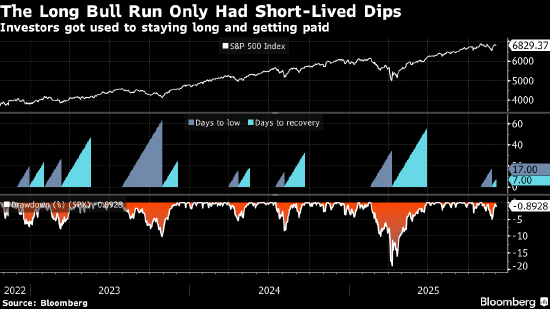
Core Viewpoint - The stock market is likened to a boxing match, with bullish drivers like artificial intelligence and stimulus measures facing off against bearish forces such as high valuations and credit pressures [1][6]. Group 1: Bullish Factors - The S&P 500 index is set to record a double-digit gain for the third consecutive year, with the "seven tech giants" expected to inject approximately $600 billion into the U.S. economy through capital expenditures [1][6]. - Discussions around lowering income taxes and issuing $2,000 stimulus checks are also supportive of the bullish outlook [1][6]. - Additional bullish factors include the end of quantitative tightening, ongoing deficit spending, and $1.2 trillion in buyback authorizations expected by 2026 [1][6]. - Retail investors continue to enter the market and buy on dips, and there are anticipated relaxations in banking regulations and capital requirements by 2026 [1][6]. Group 2: Bearish Factors - Market valuations have been pushed to levels that leave little room for disappointment, with market breadth deteriorating to one of the narrowest levels in the past 20 years, heavily concentrated on the theme of artificial intelligence and its capital expenditures [3][8]. - Concerns about a "K-shaped economy" are rising, leading to increased pressure on certain consumers, higher default rates among low-income households, and new pressures in the private credit sector [3][8]. - The dynamics of the labor market may shift from being a driving force to a hindrance [3][8]. Group 3: Market Sentiment and Future Outlook - Many Wall Street strategists expect the upward trend in the U.S. stock market to continue into 2026, with firms like Deutsche Bank, JPMorgan, Morgan Stanley, UBS, and HSBC predicting double-digit returns supported by solid earnings and Federal Reserve rate cuts [3][8]. - Despite this optimism, there is hesitation among investors regarding bets on artificial intelligence due to ongoing concerns about valuation levels and whether significant investments in computing power will ultimately translate into profits [3][8]. Group 4: Market Behavior and Trader Sentiment - Current traders lack "muscle memory" for sustained pullbacks or corrections, having only experienced an unprecedented bull market over the past 15 years [4][9]. - This has led to a mindset where many participants believe that market bottoms are always present [4][9]. - While nothing can last indefinitely, the current market rally has persisted longer than many anticipated, rewarding those who have held on [4][9]. - If a market correction does occur, the ultimate winners are likely to be those who have previously experienced similar market conditions [4][9].

“大空头”炮轰美联储
Xin Lang Cai Jing· 2025-12-03 03:01
Core Viewpoint - Michael Burry, a well-known short-seller, argues that the Federal Reserve is unnecessary for the U.S. economy, suggesting that its functions could be effectively managed by the Treasury Department [1][2]. Group 1: Burry's Critique of the Federal Reserve - Burry claims that the Federal Reserve's role is "the simplest job in the world" and believes it has caused significant damage over the past century [1][2]. - He expresses a radical view that if former President Trump were to take control of the Federal Reserve, it could lead to the institution's downfall, as public sentiment would turn against it [2]. - Burry questions the rationale behind the Fed's potential interest rate cuts, stating there is no current justification for lowering rates [2]. Group 2: Economic Implications of Fed Policies - The Federal Reserve is expected to lower interest rates in December, despite rising inflation pressures, which Burry warns could harm savers and fixed-income investors [2][3]. - Burry's short positions on high-valuation tech stocks like Nvidia and Palantir could be negatively impacted by Fed rate cuts, as these stocks are sensitive to interest rate changes [3].