云计算

Search documents
AI“恐高症”蔓延:全球投资者正搜寻一切手段,对冲三年的AI狂热
Hua Er Jie Jian Wen· 2026-02-25 11:54
据华尔街日报报道,交易员们正押注科技巨头的巨额AI投资将无法获得对等回报。从做空芯片制造 商、做空科技巨头债务,到针对非上市初创企业进行场外对赌,华尔街正在搜寻一切可能的手段,对冲 AI狂热带来的潜在风险。 沉睡三年的AI空头正在苏醒。随着人工智能狂热将股市推向令人眩晕的高度,持怀疑态度的投资者正 积极寻找获利途径,以应对他们眼中不可避免的市场洗盘。 在直接做空股票方面,甲骨文成为了空头的核心目标之一。据FactSet数据,截至1月30日,甲骨文超过 2%的股份被做空,高于一年前约1.5%的水平。这反映出市场对该公司今年计划筹资多达500亿美元以 建设AI基础设施的担忧。 甲骨文与OpenAI之间价值3000亿美元的算力销售协议,也使其成为做空者的替代标的。"做空甲骨文就 是做空OpenAI,"Michael O'Rourke表示。 与此同时,部分投资者开始针对AI供应链上的衍生企业建立空头头寸。知名做空投资者Jim Chanos近期 做空了可再生能源公司Ormat Technologies。该公司近期与谷歌达成协议,为其在内华达州不断扩张的 业务提供地热发电。Jim Chanos向客户表示,鉴于高昂的成本, ...

高盛警告:AI热潮背后的经济真相与万亿风险!
Sou Hu Cai Jing· 2026-02-25 07:54
Group 1 - Goldman Sachs predicts that AI will have a "negligible" impact on the US economy by 2025, contributing essentially zero to GDP growth, which was 2.2% last year [3][4] - The report indicates that significant capital is flowing towards Asian manufacturing, particularly in semiconductor production, rather than benefiting the US economy directly [3][8] - Major tech companies' capital expenditures are estimated to be around 75% directed towards Asian manufacturing regions, complicating the measurement of AI's net contribution to the US economy [4][11] Group 2 - The S&P 500 index has reached record valuations, with the five major constituents (NVIDIA, Microsoft, Apple, Google, and Amazon) having a price-to-earnings ratio of 28, which is above historical averages but below the 50 times seen during the 2000 dot-com bubble [4][8] - If AI capital expenditures drop back to 2022 levels, AI hardware and service suppliers could face a loss of up to 30% in expected annual sales growth for the S&P 500, equating to a potential $1 trillion impact [4][11] - Analysts expect a significant slowdown in capital expenditures by the end of 2025 or 2026, although tech giants are currently raising their spending guidance [7][11] Group 3 - Some experts argue that the economic contributions of AI are overestimated, with estimates suggesting that chatbots and large language models contributed only about 0.2% to last year's GDP growth [10][11] - Public opinion is divided, with some questioning the short-term practicality of AI-generated content due to time consumption and error rates, while others view the current investment as a defensive strategy in a competitive landscape [10][11] - Long-term concerns include the potential for AI to displace a significant number of jobs, which could challenge government revenue and necessitate tax adjustments [10][11]







AI应用算力双轮驱动行业景气度上行!科创创业人工智能ETF华泰柏瑞(159139)近一月资金净流入领跑同类
Xin Lang Cai Jing· 2026-02-25 06:00
Group 1 - The core viewpoint of the news highlights the increasing interest in AI applications and related ETFs, particularly the Huatai-PB Innovation and Entrepreneurship AI ETF (159139), which has seen a net inflow of 45 million yuan in the past month, reaching a record high fund size of 461 million yuan [1][4] - The Huatai-PB Innovation and Entrepreneurship AI ETF tracks the CSI Innovation and Entrepreneurship AI Index, the first AI theme index that spans both "innovation" and "entrepreneurship" sectors, covering key areas such as chip design, AI hardware, and AI software applications [2][5] - The CSI Innovation and Entrepreneurship AI Index has shown a remarkable annual growth of 96.41%, outperforming other single-market AI theme indices, which recorded growth rates of 38.53% and 88.04% respectively [2][5] Group 2 - Major global cloud computing companies are actively investing in AI capabilities, with Anthropic expected to pay at least 80 billion USD to Amazon, Google, and Microsoft by 2029 for running Claude AI on their cloud servers [1][4] - Microsoft plans to invest 50 billion USD by the end of this decade to promote AI technology in developing countries, while Google has launched the "US-India Connectivity" initiative to enhance international network connectivity [1][4] - The demand for computing power in the AI sector is expected to remain strong in the long term, with a recommendation to focus on new technology penetration in the computing power industry chain and the improvement of domestic industry conditions [1][4]

刘强东创立独立游艇品牌;大疆起诉美国联邦通信委员会;马斯克设想从月球电磁弹射AI卫星
Sou Hu Cai Jing· 2026-02-25 05:37
Group 1 - Liu Qiangdong has established an independent yacht brand named Sea Expandary, with an investment of 5 billion yuan, aiming to cover the entire yacht industry chain from R&D to sales and services. He hopes to produce yachts priced at 100,000 yuan to make them accessible to the general public [4] - Vivo has promoted Hu Bosheng to the position of company president, while CEO Shen Wei will no longer hold the title of president. Other executives have also had their reporting lines adjusted [5] - DJI has filed an appeal against the FCC's decision to list its products on a "regulated list," aiming to protect its rights and the interests of American consumers and agricultural users affected by the ban [6] Group 2 - Panasonic will transfer its television sales business in North America and Europe to China's Skyworth Group starting in April, aiming to cut costs and focus on high-end production in Japan [7] - Apple will begin producing some Mac Mini computers in the U.S., marking a shift in its supply chain strategy, with production set to start later this year at a Foxconn facility [8] - AMD has agreed to sell AI chips worth up to $60 billion to Meta, expanding their strategic partnership and coordinating development roadmaps for AI platforms [9] Group 3 - Elon Musk has proposed launching AI satellites from the Moon using an electromagnetic catapult, aiming to create a satellite network for AI data centers [10] - Oracle's joint venture "Stargate" with OpenAI and SoftBank has encountered difficulties, as OpenAI has not expanded data centers as planned, leading to higher-than-expected computing costs [11] - Anthropic has launched new AI tools for its Claude Cowork software, aimed at automating tasks in various sectors, developed in collaboration with partners [13] Group 4 - Warner Bros. has indicated that Paramount's new acquisition offer of $31 per share may be more favorable than its existing agreement with Netflix, potentially leading to a new bidding round [14] - British autonomous driving company Wayve raised $1.2 billion in a Series D funding round, achieving a valuation of $8.6 billion, with plans to launch self-driving taxi services in collaboration with Uber [15] - HP reported total net revenue of $14.438 billion for the first fiscal quarter, an increase from $13.504 billion in the same period last year [16] Group 5 - The box office for the 2026 Spring Festival reached 5.752 billion yuan, with "Fast Life 3" leading the box office [18] - President Trump announced an agreement with major tech companies to allow them to build power plants for AI data centers, aiming to prevent rising electricity prices for surrounding communities [19]

优刻得股价跌5.11%,广发基金旗下1只基金位居十大流通股东,持有150.08万股浮亏损失315.17万元
Xin Lang Ji Jin· 2026-02-25 02:11
Group 1 - The core point of the article highlights the recent performance of UCloud, which saw a decline of 5.11% in its stock price, reaching 38.97 CNY per share, with a trading volume of 799 million CNY and a turnover rate of 4.96%, resulting in a total market capitalization of 17.782 billion CNY [1] - UCloud, established on March 16, 2012, and listed on January 20, 2020, operates as a neutral third-party cloud computing service provider, focusing on creating a secure and reliable cloud computing service platform for clients [1] - The revenue composition of UCloud includes public cloud at 50.63%, hybrid cloud at 35.41%, cloud communication at 8.26%, private cloud at 2.75%, solutions and others at 1.90%, and edge cloud at 1.05% [1] Group 2 - From the perspective of UCloud's top ten circulating shareholders, it is noted that a fund under GF Fund ranks among the top shareholders, specifically the GF SSE STAR 50 AI ETF (588760), which entered the top ten in the third quarter with 1.5008 million shares, accounting for 0.37% of the circulating shares [2] - The GF SSE STAR 50 AI ETF (588760) was established on January 15, 2025, with a latest scale of 2.581 billion CNY, achieving a year-to-date return of 15.03%, ranking 311 out of 5570 in its category, and a one-year return of 38.98%, ranking 1301 out of 4305 [2] - The fund manager of GF SSE STAR 50 AI ETF is Cao Shiyu, who has been in the position for 2 years and 76 days, managing a total fund size of 40.401 billion CNY, with the best fund return during his tenure being 131.63% and the worst being 13.93% [3]

59页|企业架构实践与创新观察报告(2025年)
Sou Hu Cai Jing· 2026-02-25 01:28
Core Insights - The article discusses the transformation of enterprises from partial digitization to overall intelligence, emphasizing that this shift is not merely a technological update but a reconstruction of the strategic core of businesses, involving the integration of strategy, organization, product services, and digital technologies [1][9]. Group 1: Current State of Digital Transformation - Chinese enterprises are in a critical phase of digital transformation, moving from exploration to tackling challenges, driven by policy support and market demand, but facing deep-rooted issues such as strategic decoding difficulties and insufficient business-technology collaboration [1][9]. - The concept of enterprise architecture is highlighted as a core methodology for digital transformation, serving as a bridge from strategy to execution, enabling the breakdown of strategic goals into actionable value creation segments [1][9]. Group 2: Framework for Enhancing Transformation Efficiency - The report outlines a framework driven by enterprise architecture to enhance the efficiency of digital transformation, focusing on strategic alignment, business-driven approaches, data integration, technological support, and continuous operation [1][10]. - Successful practices from various industries are explored, showcasing how companies like China Tower and Ping An Life have innovatively designed their architecture to support digital capabilities and collaborative systems [2][10]. Group 3: Factors Driving Digital Transformation - Multiple factors are driving the deepening of digital transformation across industries, including the high-quality development of the digital economy, government initiatives emphasizing architecture-driven transformation, and the increasing availability of technological resources [12][24]. - The digital economy's core industries have seen significant growth, with a reported business revenue of 35 trillion yuan, reflecting a year-on-year increase of 11% [21][22]. Group 4: Challenges and Solutions in Transformation - Enterprises face structural challenges in their digital transformation journeys, such as the inability to effectively execute strategic plans and the lag in converting IT potential into business model innovations [28][29]. - To address these systemic issues, the report suggests leveraging enterprise architecture to create standardized, modular business capabilities that can adapt to dynamic business needs and integrate data into decision-making processes [29][30].
美股全线受挫,微软特斯拉暴跌,软件外包云计算领跌,中概股小跌
Sou Hu Cai Jing· 2026-02-24 23:55
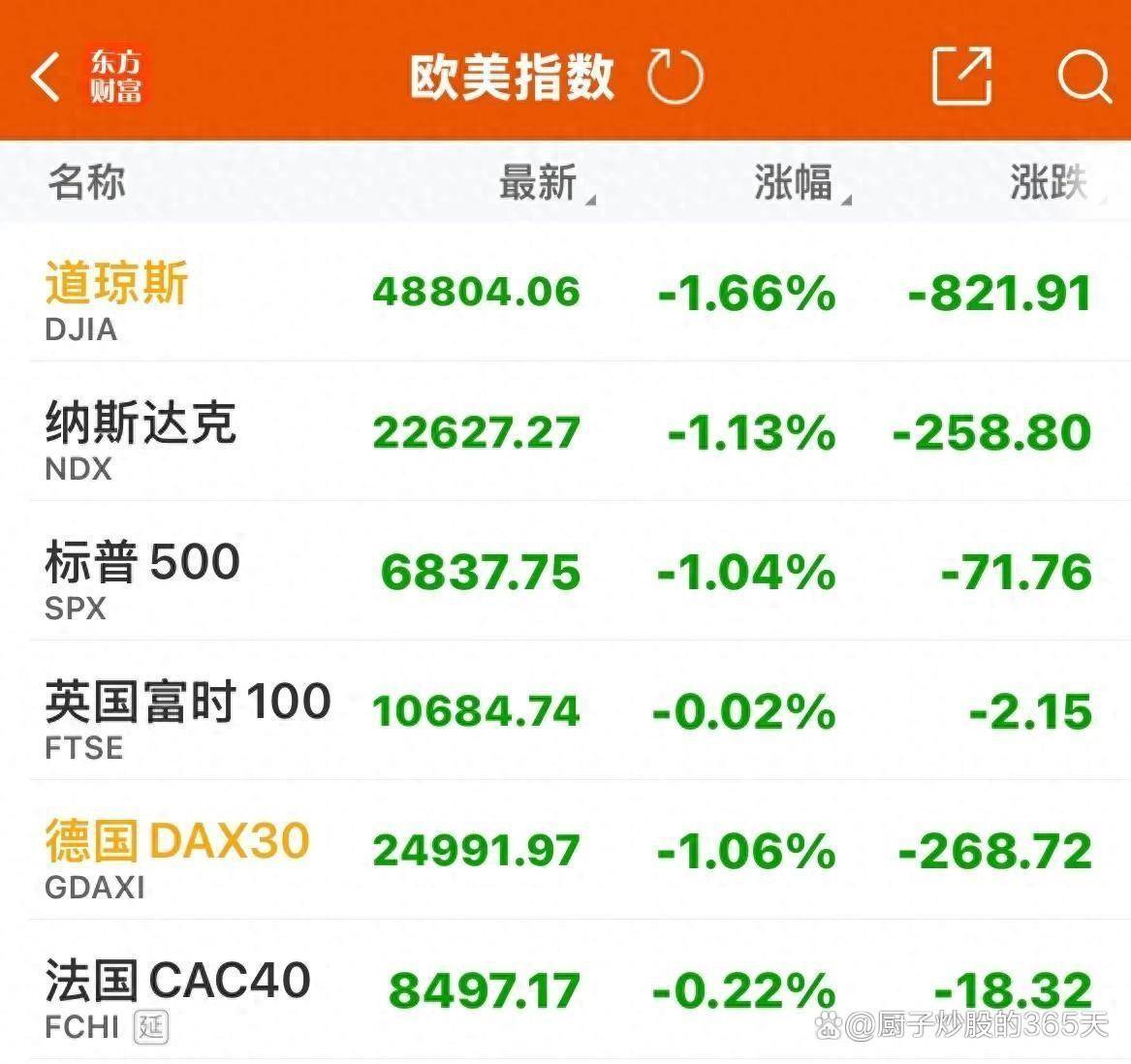
Market Overview - On February 24, 2026, U.S. stock markets experienced a significant drop, with all three major indices falling over 1%. The Dow Jones Industrial Average dropped by 821.91 points, closing at 48,804.06, a decline of 1.66%. The S&P 500 fell by 71.76 points to 6,837.75, down 1.04%. The Nasdaq Composite also declined by 258.80 points, closing at 22,627.27, a drop of 1.13% [1][2]. Sector Performance - The software services, information technology services, and financial sectors were heavily impacted, while precious metals and non-ferrous metals sectors showed resilience, indicating a shift of funds from high-risk assets to traditional safe havens like gold. The price of gold reached a critical level of $5,200 per ounce, with a daily increase of over 2% [2]. Company-Specific Impact - International Business Machines Corporation (IBM) faced a catastrophic decline, with its stock price plummeting by 13.15%, marking its largest single-day drop since March 2020. This decline was attributed to advancements in artificial intelligence, particularly a new capability from the startup Anthropic that modernizes the COBOL programming language, which is crucial for many legacy systems [3][4][5]. AI Disruption - The introduction of AI tools like Claude Code threatens traditional business models reliant on outdated technologies, as they can significantly reduce the time and resources needed for modernizing legacy systems. This has raised concerns about IBM's future, as it is a major provider of COBOL systems [5][6]. Broader Technology Sector Trends - Other major tech companies also saw declines, with Microsoft down 3.21%, Tesla dropping over 3%, and Amazon falling 2.30%. However, Nvidia and Apple managed to stay slightly positive, indicating a selective investment approach within the tech sector [8][9]. Chinese Stocks Performance - The Nasdaq Golden Dragon China Index fell by 0.95%, showing resilience compared to U.S. indices. However, individual stocks exhibited significant volatility, with declines in cloud computing and online travel sectors. Notably, NIO, a Chinese electric vehicle company, surged by 4.34% due to strong operational data [10][22]. Global Market Reaction - European markets followed the U.S. trend, with major indices like the DAX and CAC40 closing lower. The global market exhibited interconnectedness, with panic selling in the U.S. quickly affecting European stocks [13].


布鲁克菲尔德收购Ori Industries押注AI算力,预计全球AI基建需3万亿美元
Xin Lang Cai Jing· 2026-02-24 19:18
摩根士丹利、花旗等华尔街机构指出,AI算力硬件驱动的全球基础设施投资浪潮仍处于早期阶段,预 计至2030年总规模可能达3万亿至4万亿美元。这一趋势支撑布鲁克菲尔德等资产管理公司加码AI基建 布局。 以上内容基于公开资料整理,不构成投资建议。 经济观察网 布鲁克菲尔德资产管理公司近期完成对云计算公司Ori Industries的收购,并将其并入新成立 的公司Radiant。该交易旨在提供全栈AI算力基础设施服务,包括AI芯片租赁、数据中心空间及电力合 同打包,押注全球AI算力需求持续增长。布鲁克菲尔德估算,全球AI繁荣需约7万亿美元资本投入,其 中AI计算基础设施部分占3万亿美元。 机构观点 ...
“AI 颠覆一切” 席卷股票市场 何处是安全避风港?高盛给出关键词:HALO
Zhi Tong Cai Jing· 2026-02-24 15:57
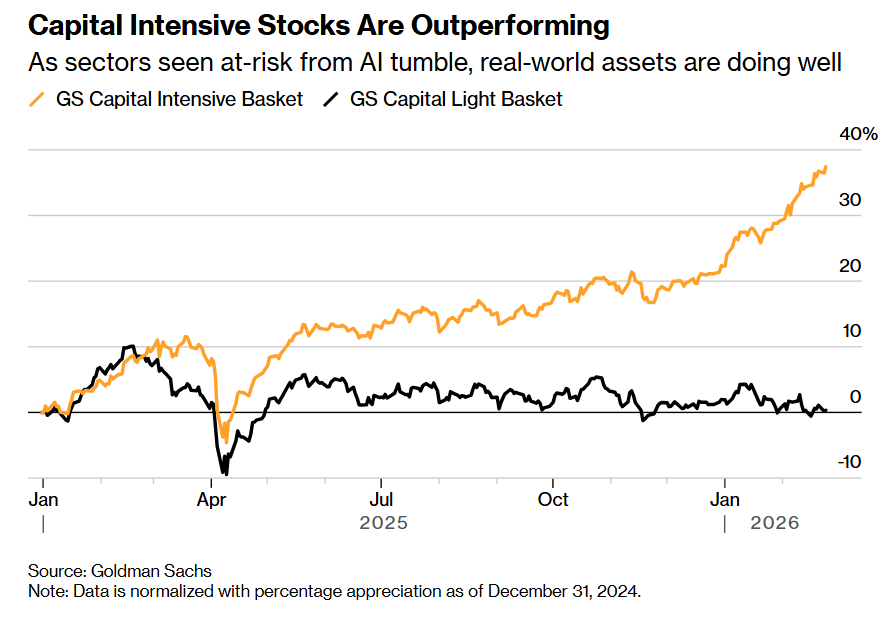
Core Insights - Heavy asset companies are significantly outperforming the global stock market as investors seek safe havens from the "AI disruption" sell-off, focusing on HALO (Heavy Assets, Low Obsolescence) stocks [1][3] - Goldman Sachs reports that its basket of heavy asset stocks has outperformed a lightweight capital stock group by approximately 35% since early 2025 [1][6] Group 1: Characteristics of Heavy Asset Companies - Heavy asset companies are characterized by high barriers to entry in production materials, such as power grids, mining, oil and gas assets, and large utility networks, where AI replication costs are extremely high [2] - These companies also exhibit low technological obsolescence, making it difficult for AI to replace core production capabilities in sectors like semiconductor equipment and advanced packaging [2][3] Group 2: AI Impact on Capital Expenditure - AI is not only disrupting profit structures in lightweight industries but also creating a "super cycle" in capital expenditure, particularly in AI chips and storage [2] - Goldman Sachs estimates that the five largest cloud providers will invest approximately $1.5 trillion in AI infrastructure from 2023 to 2026, shifting them from capital-light to capital-intensive players [2][8] Group 3: Market Trends and Investor Behavior - Investors are increasingly favoring heavy asset stocks due to their perceived stability and lower risk of AI obsolescence, particularly in utilities, basic resources, and semiconductor manufacturing [3][9] - Concerns over AI disrupting traditional business models have led to irrational sell-offs in various sectors, including those not directly impacted by AI, such as logistics [7] Group 4: Performance of Heavy Asset Stocks - Heavy capital-intensive stocks are significantly outperforming the market, especially as light asset sectors face declines due to AI disruption fears [6] - Despite the overall trend, some heavy asset companies are experiencing stock price declines due to skepticism about the returns on massive AI infrastructure investments [8] Group 5: Financial Metrics and Market Shifts - Higher actual yields and geopolitical factors are driving capital towards capital-intensive sectors, with earnings momentum shifting towards heavy asset stocks [9] - Market expectations for stronger earnings per share (EPS) growth and return on equity (ROE) are now significantly higher in capital-intensive companies compared to lightweight capital firms [9]
布鲁克菲尔德(BAM.US)豪赌AI算力需求无止境! 提供从GPU到电力的“AI基建一条龙”
智通财经网· 2026-02-24 14:36
Core Viewpoint - Brookfield Asset Management has successfully acquired cloud computing company Ori Industries, betting on the increasing demand for AI chip infrastructure and power resources as governments and tech companies compete in the AI race [1][3]. Group 1: Acquisition and New Company Formation - The acquisition of Ori has been integrated into a newly established company called Radiant, which aims to provide on-demand access to AI computing infrastructure through token-based or contract-locked services [1]. - Radiant is positioned to offer a full-stack AI training and inference service, capable of serving regulated computing environments such as sovereign clouds [2][3]. Group 2: Business Model and Investment Strategy - Brookfield's model transforms GPU/AI chips from a capital expenditure product into a service that can be leased on demand or through long-term contracts, aiming for higher returns than traditional infrastructure funds [2][3]. - The company is focusing on a comprehensive solution that includes chips, data center space, power supply, and contracts, thereby addressing key bottlenecks in AI data center operations [2]. Group 3: Market Demand and Investment Needs - Brookfield estimates that achieving AI prosperity will require $7 trillion in capital investment, with $3 trillion specifically for AI computing infrastructure [4]. - The global AI arms race is still in its early to mid-stages, with significant growth expected in AI infrastructure investments, potentially reaching $3 to $4 trillion by 2030 [5]. Group 4: Funding and Partnerships - Radiant is one of the first major projects backed by Brookfield's multi-billion dollar AI infrastructure fund, which seeks $10 billion in investor commitments and aims to scale up to $100 billion [6]. - Brookfield is collaborating with major asset management firms to finance AI-driven data center power chains and core hardware, reshaping the industry landscape [6]. Group 5: Strategic Collaborations - Brookfield has business ties with Nvidia, which is a core supplier of AI chips for Radiant, indicating a deepening relationship between the tech giant and financial players [7]. - The AI fund is part of Brookfield's strategy to enhance relationships with high-net-worth investors in the Middle East, with plans to focus initially on Europe while also developing a large AI data center in Qatar [7].