
有机硅

Search documents
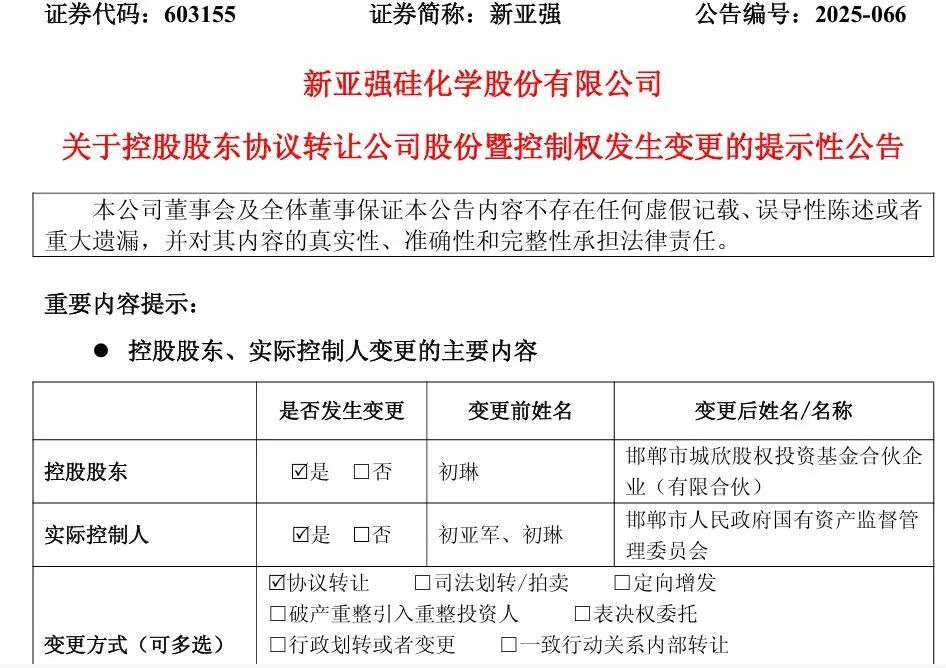
提前涨停!603155,拟易主
中国基金报· 2025-11-25 13:48
Core Viewpoint - The article discusses the proposed transfer of control of Xinyaqiang, a leading organic silicon additive company, to Handan State-owned Assets Supervision and Administration Commission, following a share transfer agreement signed by the current controlling shareholder, Chu Lin [2][8]. Group 1: Share Transfer Details - On November 24, Chu Lin signed a share transfer agreement to sell 94.42 million shares at a price of 20.76 CNY per share, totaling approximately 1.96 billion CNY [8][7]. - After the transfer, the new controlling shareholder, Chengxin Fund, will hold 29.90% of Xinyaqiang's shares, while Chu Lin will retain 16.09% [9][8]. - The share transfer represents a premium of about 26.7% compared to the closing price of 16.38 CNY per share on November 24 [8][7]. Group 2: Company Performance and Financials - Xinyaqiang has experienced significant revenue fluctuations, with a reported revenue of 451 million CNY for the first three quarters of 2025, a year-on-year decrease of 19.05% [17]. - The net profit attributable to shareholders for the same period was approximately 78.85 million CNY, down 20.39% year-on-year, primarily due to declining product margins [17]. - Despite the performance volatility, Xinyaqiang maintains a strong cash position and has a high dividend payout ratio, with a total dividend payment rate of 193% in 2024 [17][10]. Group 3: Strategic Intentions - The share transfer aims to optimize the shareholder structure and enhance the company's credit level and risk resistance, while also expanding brand influence and new business development capabilities [10][12]. - Chengxin Fund has committed not to transfer control for seven years after acquiring it [12]. - Xinyaqiang is actively exploring sustainable investment opportunities in advanced materials, semiconductors, and high-end equipment sectors [17].



控制权变更,603155,邯郸市国资委入主
Zheng Quan Shi Bao· 2025-11-25 12:57
Core Viewpoint - The recent share transfer agreement between Chu Lin and Chengxin Fund marks a significant change in the control structure of Xinyaqiang, with the latter becoming the new controlling shareholder and the actual controller being the Handan State-owned Assets Supervision and Administration Commission [2][3]. Group 1: Share Transfer Details - Chu Lin transferred 94.42 million shares to Chengxin Fund, which now holds 29.90% of Xinyaqiang's total share capital [3]. - After the transfer, Chu Lin and her father, Chu Yajun, hold a combined 17.61% of the company's shares [3]. - The total consideration for the share transfer is 1.96 billion yuan, with a per-share price of 20.76 yuan, representing a 15% premium over the closing price of 18.02 yuan and a 26% premium over the previous day's closing price of 16.38 yuan [3]. Group 2: Company Background and Performance - Xinyaqiang primarily engages in the production of silicone fine chemicals, including functional additives and phenyl chlorosilane, serving strategic emerging industries such as new materials, pharmaceuticals, and renewable energy [5]. - The company reported a year-on-year decline of approximately 20% in both revenue and net profit for the first three quarters of the year, attributed to market demand adjustments and price declines [5]. Group 3: Future Outlook and Commitments - Both Chu Yajun and Chu Lin expressed that the transaction aims to integrate and leverage both parties' strengths to promote higher quality and sustainable development for the listed company [6]. - Chengxin Fund committed to not transferring control for seven years post-acquisition and aims to enhance the company's creditworthiness and risk resistance [3][6].
中国银河证券:化工业供需双底基本确立 2026年或开启“戴维斯双击”
智通财经网· 2025-11-25 09:13
Group 1: Oil and Chemical Industry Outlook - China Galaxy Securities forecasts Brent crude oil prices to range between $60-70 per barrel by 2026, with costs expected to stabilize [1] - The chemical industry is experiencing negative capital expenditure growth since 2024, with supply expected to contract due to the "anti-involution" trend and accelerated elimination of outdated overseas capacity [1] - The "14th Five-Year Plan" draft emphasizes expanding domestic demand, combined with the onset of the US interest rate cut cycle, which is expected to open up demand for chemical products [1] - A dual bottom in supply and demand is anticipated, with strong policy expectations catalyzing a potential cyclical upturn in the chemical industry by 2026, leading to a "Davis Double Play" from valuation recovery to earnings growth [1] Group 2: Specific Chemical Sector Recommendations - PTA industry is operating at low levels, with increasing calls for anti-involution; recommended companies include Hengli Petrochemical, Rongsheng Petrochemical, Xinfon Ming, and Tongkun [1] - Polyester filament capacity is becoming concentrated, with industry self-discipline enhancing cyclical elasticity; recommended companies include Xinfon Ming, Tongkun, and Hengyi Petrochemical [1] - The spandex industry is expected to see increased concentration; recommended companies include Huafeng Chemical and Xinxiang Chemical Fiber [1] - Global demand for pesticides is improving, with bottom-priced varieties likely to rebound; recommended companies include Yangnong Chemical, Runfeng Shares, Jiangshan Shares, Guangxin Shares, and Lier Chemical [1] - Organic silicon capacity expansion is nearing completion, with supply-demand dynamics expected to improve; recommended companies include Hesheng Silicon Industry, Xin'an Shares, and Dongyue Silicon Material [1] - The titanium dioxide industry is facing challenges and opportunities; recommended company is Longbai Group [1] - Refining capacity is being optimized, with a shift from oil to chemicals enhancing effective supply; recommended companies include Sinopec, PetroChina, Rongsheng Petrochemical, and Hengli Petrochemical [1] Group 3: Demand-Supported Chemical Sectors - Strong pricing power from suppliers is expected to sustain high demand for potash fertilizers; recommended companies include Yara International and Dongfang Iron Tower [2] - Phosphate supply and demand remain tight, benefiting resource-based companies; recommended companies include Batian Shares, Yuntianhua, Xingfa Group, and Chuanheng Shares [2] - Strict quota policies are expected to sustain high demand for refrigerants; recommended companies include Juhua Co., Sanmei Co., and Yonghe Co. [2] - Amino acids are expected to maintain their upward trend, with overseas capacity gradually exiting; recommended companies include New Hope Liuhe, Andisu, and Meihua Biological Technology [2] - The chlorinated sugar market is anticipated to see anti-involution, with significant potential for allulose; recommended companies include Jinhui Industrial, Bailong Chuangyuan, and Baolingbao Biology [2] - Vitamins are leading the current round of chemical price increases, entering the second phase; recommended companies include New Hope Liuhe and Zhejiang Medicine [2] - The EU's preliminary anti-dumping ruling is expected to reassess the value of overseas tires; recommended companies include Sailun Tire and Senqilin [2] - The civil explosives industry is developing steadily, with policy guidance likely accelerating industry consolidation; recommended companies include Guangdong Hongda, Yipuli, and Jiangnan Chemical [2] Group 4: New Materials and Technologies - Lightweight humanoid robots may benefit from PEEK as a key solution; recommended companies include Zhongyan Shares, Water Shares, and Guoen Shares [3] - AI is driving global demand for computing power, with electronic-grade PPO expected to grow; recommended companies include Shengquan Group and Dongcai Technology [3] - The domestic substitution of core chip materials, particularly photoresists, is accelerating; recommended companies include Wanrun Shares and Dinglong Shares [3]

东岳硅材股价涨5.94%,广发基金旗下1只基金位居十大流通股东,持有455.66万股浮盈赚取350.86万元
Xin Lang Cai Jing· 2025-11-25 06:46
Group 1 - The core viewpoint of the news is that Dongyue Silicon Materials Co., Ltd. experienced a stock price increase of 5.94%, reaching 13.73 yuan per share, with a trading volume of 822 million yuan and a turnover rate of 5.15%, resulting in a total market capitalization of 16.476 billion yuan [1] - Dongyue Silicon Materials, established on December 28, 2006, and listed on March 12, 2020, specializes in the research, production, and sales of organic silicon materials [1] - The company's main business revenue composition includes: 107 glue 49.40%, silicone oil 13.49%, 110 raw rubber 12.11%, mixed rubber 5.46%, others 5.37%, fumed silica 4.32%, silicone adhesive 4.29%, other (supplement) 2.18%, liquid glue 2.01%, intermediates 1.36% [1] Group 2 - From the perspective of major circulating shareholders, GF Fund's Guangfa Jufeng Mixed A (270005) increased its holdings by 615,000 shares in the third quarter, holding a total of 4.5566 million shares, accounting for 0.38% of circulating shares, with an estimated floating profit of approximately 3.5086 million yuan [2] - Guangfa Jufeng Mixed A (270005) was established on December 23, 2005, with a latest scale of 3.366 billion yuan, achieving a year-to-date return of 30.78%, ranking 1994 out of 8136 in its category; over the past year, it has returned 26.74%, ranking 2653 out of 8058; and since inception, it has achieved a return of 410.83% [2] - The fund manager of Guangfa Jufeng Mixed A is Su Wenjie, who has a cumulative tenure of 7 years and 36 days, with a total asset scale of 9.734 billion yuan, achieving the best fund return of 167.69% and the worst fund return of 5.18% during his tenure [3]
高低切换周期板块机会展望
2025-11-24 01:46
Summary of Conference Call Records Industry Overview - **Coal Industry**: High prices for thermal coal are expected to persist due to increased demand for inventory replenishment in power plants, with national and coastal inventories rising. The anticipated cold winter and increased electricity consumption are likely to support strong coal prices, giving thermal power companies an advantage in year-end long-term contract negotiations [1][2][7]. - **Construction Materials Industry**: Domestic demand for construction materials is declining, prompting companies to pursue overseas expansion as a key strategy. While global cement demand has decreased, excluding China, there has been slight growth. Companies like Huaxin Cement and Western Cement are achieving performance growth through overseas operations [1][3][4]. - **Silicone Industry**: The silicone industry is experiencing a potential turning point with significant price increases following a 30% production cut announced by the industry association. The price of silicone has risen to 13,100 RMB/ton, indicating substantial upward potential as demand from sectors like renewable energy and electronics grows [5][6]. Key Points and Arguments - **Thermal Coal Market**: The price of 5,500 kcal thermal coal remains stable at 827 RMB/ton, with expectations of price increases as demand from power plants rises. The natural gas sector is also expected to see increased production and demand as winter approaches [2][7]. - **Cement and Construction Materials**: The global cement market is projected to see a slight increase in sales in 2025, with significant price differences between domestic and international markets. Companies are focusing on mergers and acquisitions to enhance competitiveness and expand their market presence overseas [3][4]. - **Silicone Industry Dynamics**: The demand for silicone is expected to grow significantly, with a 19.6% year-on-year increase in apparent demand from January to September 2025. The supply side is constrained, with no new capacity additions, which may lead to improved supply-demand balance in 2026 [5][6]. Additional Important Insights - **Real Estate Market**: The real estate sector is under significant downward pressure, with sales and investment growth rates declining sharply. There is an expectation of further policy adjustments to address these challenges, but the effectiveness of such measures remains uncertain [8][10][11]. - **Investment Opportunities**: Despite the challenges in the real estate market, there are perceived investment opportunities in low-priced stocks and defensive sectors. The current low stock prices and rising policy expectations suggest a strong relative return potential [12][13]. - **Impact of Interest Rate Policies**: Adjustments in interest rates are expected to have limited effects on the real estate market, particularly in core cities where supply-demand imbalances persist. The market is currently in a phase of policy negotiation, with high-priced sectors likely facing downward pressure [12][13].
有机硅行业专家会议
2025-11-24 01:46
Summary of the Organic Silicon Industry Conference Industry Overview - The organic silicon industry is responding to weak demand by implementing a production cut of 30% as decided in the November meeting, aiming to raise DMC prices to 13,500-14,000 RMB/ton, although previous unsuccessful cuts may affect execution effectiveness [1][3][9] - The industry is experiencing increased costs due to rising electricity prices during the dry season, impacting the pricing strategy as downstream customers remain cautious about high quotes of 13,200 RMB/ton [1][6] Key Points and Arguments - **Production Cuts and Price Adjustments**: The industry plans to maintain a balance between supply and demand by controlling inventory to within 45 days, with DMC prices expected around 13,200 RMB/ton and profit margins between 1,000-1,200 RMB [2][16] - **Market Participation**: High participation from companies in the recent meetings, particularly led by He Sheng's chairman, has positively influenced the industry, although previous maintenance and restarts may hinder the effectiveness of the production cuts [1][8] - **Demand Dynamics**: Traditional demand from the real estate sector is declining, affecting construction sealant needs, while emerging sectors like electric vehicles and battery sealants are providing growth opportunities [1][12][13] - **Strategic Focus of Companies**: Companies like Luxi Chemical are focusing on downstream extension and high-end product development, indicating a shift towards higher value-added products [1][12] Additional Important Insights - **International Market Expansion**: Domestic demand for organic silicon may decline, prompting companies to explore overseas markets, especially as foreign firms like Dow and Bluestar gradually withdraw from overseas capacities due to EU carbon tariffs [1][14][16] - **Future Capacity Plans**: Several companies plan to increase production capacity, such as Yunnan Energy Investment with a planned 400,000 tons and Xinjiang Qiya aiming for the world's largest organic silicon single unit with 1.5-1.6 million tons [11][19] - **Challenges in Execution**: The effectiveness of the production cut plan is contingent on establishing a robust supervision mechanism, as previous attempts faced challenges due to trade tensions and inventory pressures [4][5] - **Market Price Formation**: Current market prices are influenced by raw material costs, particularly industrial silicon, which has seen price increases due to rising electricity costs [6][18] - **Emerging Product Opportunities**: New products like organic silicon leather show potential in various applications, indicating a diversification strategy within the industry [13] Conclusion The organic silicon industry is navigating a complex landscape of declining traditional demand and rising costs while seeking to capitalize on emerging opportunities. The focus on production cuts, strategic market expansion, and high-value product development will be crucial for maintaining profitability and market stability in the coming years.
【基础化工】行业联合协同,有机硅行业景气有望改善——行业周报(20251117-20251121)(赵乃迪/周家诺/胡星月)
光大证券研究· 2025-11-23 23:05
Core Viewpoint - The organic silicon industry is experiencing price increases and improved profitability due to collaborative efforts and discussions among industry players regarding pricing mechanisms and production reduction strategies [4]. Group 1: Industry Collaboration and Price Trends - Recent meetings in the organic silicon industry have focused on pricing mechanisms and production reduction, leading to significant price increases [4]. - As of November 21, the price of domestic organic silicon intermediates reached 13,000 yuan/ton, an increase of 18.2% compared to early November [4]. - The average gross profit in the organic silicon intermediate industry has risen to 1,209 yuan/ton, up by 2,650 yuan/ton since early November [4]. Group 2: Production Capacity and Inventory Levels - The operating rate of organic silicon plants is currently around 74.4%, showing a slight increase of 4-5 percentage points from previous weeks, but still below historical highs [5]. - Organic silicon factory inventory has decreased from a high of 53,700 tons in April 2025 to 43,800 tons as of November 21, indicating a potential for further inventory reduction [5]. - The industry is expected to maintain relatively low inventory levels, which will support prices and create favorable conditions for profitability recovery [5]. Group 3: Consumption and Demand Growth - The effective production capacity of domestic organic silicon intermediates remains stable at 3.35 million tons per year, reflecting cautious investment in new capacity amid profitability pressures [6]. - The apparent consumption of organic silicon intermediates is projected to reach 1.82 million tons in 2024, representing a year-on-year growth of 20.9% [6]. - For the first ten months of 2025, the apparent consumption was 1.68 million tons, showing a year-on-year increase of 17.0%, indicating steady demand growth in downstream applications [6]. Group 4: Market Dynamics and Company Positioning - The planned new capacity in the organic silicon industry is 2.15 million tons per year, but investment decisions are expected to be more cautious due to increased industry self-discipline and fluctuating profitability [7]. - Major listed companies dominate the organic silicon intermediate market, with six companies holding a combined capacity of 4.28 million tons per year, accounting for 62.0% of total capacity [8]. - This concentrated market structure is likely to promote rational competition and price stability, enhancing the leading role of major enterprises in future industry development [8].

炒作提振工业硅价格,硅片再度下调报价
Dong Zheng Qi Huo· 2025-11-23 14:42
Report Industry Investment Rating - Industrial silicon: Volatile [1] - Polysilicon: Volatile [1] Core Viewpoints of the Report - Industrial silicon has weak fundamental drivers, and its balance sheet may be less optimistic than expected due to lower - than - expected exports and the impact of the silicone "anti - involution" movement. The short - term price may fluctuate between 8,800 - 9,500 yuan/ton [4][11][16]. - The contradiction between the fundamentals and the policy side of polysilicon is increasing. The spot price of leading enterprises is expected to remain stable, while the low - price supply of small and medium - sized factories may decline slightly. The futures main contract may operate between 50,000 - 56,000 yuan/ton [3][4][16]. Summary by Directory 1. Industrial Silicon/Polysilicon Industry Chain Prices - The Si2601 contract of industrial silicon decreased by 60 yuan/ton to 8,960 yuan/ton. The SMM spot price of East China oxygen - blown 553 increased by 50 yuan/ton to 9,550 yuan/ton, and the price of Xinjiang 99 increased by 150 yuan/ton to 9,000 yuan/ton. The PS2601 contract of polysilicon decreased by 685 yuan/ton to 53,360 yuan/ton. The average transaction price of N - type re -投料 of polysilicon remained flat at 53,200 yuan/ton [9]. 2. Speculation Boosts Industrial Silicon Price, and Silicon Wafers Lower Quotes Again - **Industrial silicon**: The futures main contract fluctuated widely. Furnace numbers in Xinjiang decreased by 4, in Yunnan by 2, increased by 2 in Inner Mongolia, and by 1 in Gansu. In December, the number of open furnaces in Sichuan is expected to be within 10, and in Yunnan around 12. Social and factory inventories increased. In October, exports were 45,000 tons, a 35.82% month - on - month decrease [11]. - **Organic silicon**: The price increased significantly under the "anti - involution" movement. A new price mechanism and supply - side dynamic regulation mechanism were established. The overall market is in a wait - and - see state [12]. - **Polysilicon**: The futures main contract fluctuated. Leading manufacturers' prices remained stable, while low - price ranges showed signs of loosening. Production in November is expected to drop to 115,000 tons, and factory inventory reached 271,000 tons as of November 20 [3][13]. - **Silicon wafers**: Prices declined significantly. As of November 20, inventory was 18.72GW. The M10 model has fallen into a cash - loss state [14]. - **Battery cells**: Prices continued to decline. As of November 17, inventory was 10.21GW. Battery cell manufacturers are in a cash - flow loss state [14]. - **Components**: Prices were basically stable. Demand declined, and there are concerns about a significant drop in production in December [15]. 3. Investment Recommendations - **Industrial silicon**: Pay attention to range - trading opportunities between 8,800 - 9,500 yuan/ton [4][16]. - **Polysilicon**: Focus on range - trading opportunities for the futures main contract between 50,000 - 56,000 yuan/ton [4][16]. 4. Hot News Compilation - Two leading silicon wafer companies lowered quotes due to insufficient orders. - In October 2025, industrial silicon exports were 45,073 tons, a 35.82% month - on - month and 30.78% year - on - year decrease. - Anhui's mechanism electricity prices for 2025 - 2026 were announced, with a total scale of 5.8677 billion kWh, using 65% of the planned mechanism electricity [17]. 5. High - Frequency Data Tracking in the Industry Chain - **Industrial silicon**: Data on spot prices, weekly production, and inventory in different regions are presented [19][22][25]. - **Organic silicon**: Information on DMC spot prices, weekly profits, factory inventory, and weekly production is provided [31][33]. - **Polysilicon**: Data on spot prices, weekly gross profits, factory inventory, and weekly production are included [37][38]. - **Silicon wafers**: Information on spot prices, factory inventory, and weekly production is shown [39][41]. - **Battery cells**: Data on spot prices, profit calculations, export factory inventory, and monthly production are presented [46][49][50]. - **Components**: Information on spot prices, profit calculations, finished - product inventory, and monthly production is provided [53][56][58].
《化工周报 25/11/17-25/11/21》:有机硅、己内酰胺协同性确立,或迎景气上行,反内卷加速化工拐点来临-20251123
Shenwan Hongyuan Securities· 2025-11-23 12:58
Investment Rating - The report maintains an "optimistic" rating for the chemical industry [1] Core Views - The chemical sector is expected to experience a turning point with the establishment of synergies between the silicone and caprolactam industries, leading to an upward trend in market conditions and accelerated de-involution [1] - The report highlights the importance of voluntary emission reductions and carbon cuts, with companies planning to maintain a 70% operating rate and adjust production based on market conditions [1] - The report suggests focusing on companies such as Xingfa Group, Luxi Chemical, Dongyue Silicon Materials, and Xin'an Chemical for potential investment opportunities in the silicone sector [1] - In the caprolactam sector, the report recommends monitoring Luxi Chemical, Hualu Hengsheng, and Juhua for their potential to drive profitability recovery [1] Industry Dynamics - Current macroeconomic judgments indicate that oil prices are expected to remain in a relatively loose range, with Brent crude projected between $55-70 per barrel due to delayed OPEC+ production increases and stable demand recovery [2][3] - The report notes that the PPI for all industrial products decreased by 2.1% year-on-year in October, with a slight month-on-month increase of 0.1%, marking the first rise of the year [3] - The manufacturing PMI recorded 49.0 in October, indicating a slowdown in production activities due to various factors, including pre-holiday demand release and a more complex international environment [3] Chemical Sector Configuration - The report suggests a diversified investment strategy across four main chains: textile and apparel, agricultural chemicals, export-related chemicals, and sectors benefiting from de-involution policies [1] - Specific recommendations include focusing on nylon and caprolactam with companies like Luxi Chemical, and on fertilizers with companies like Hualu Hengsheng and Yuntianhua [1] - The report emphasizes the importance of monitoring key materials for growth, particularly in semiconductor materials, OLED panel materials, and lithium battery materials [1]


有机硅、己内酰胺协同性确立,或迎景气上行,反内卷加速化工拐点来临
Shenwan Hongyuan Securities· 2025-11-23 11:46
Investment Rating - The report maintains a "Positive" rating for the chemical industry [3][4]. Core Insights - The synergy between silicone and caprolactam has been established, indicating a potential upturn in the industry, with a shift away from internal competition accelerating the chemical sector's turning point [3]. - The report highlights a stable increase in oil demand due to global economic recovery and tariff adjustments, with Brent crude oil expected to remain in the range of $55-70 per barrel [3][4]. - The report suggests focusing on companies such as Xingfa Group, Luxi Chemical, Dongyue Silicon Materials, and Xin'an Chemical for silicone, and Luxi Chemical, Hualu Hengsheng, and Polyone for caprolactam [3]. Summary by Sections Chemical Industry Dynamics - Current macroeconomic judgment indicates that oil supply growth is slowing due to OPEC+ production delays and peak shale oil output, while demand is stabilizing with a global economic improvement [3][4]. - The report notes that coal prices are expected to stabilize in the long term, and natural gas costs may decrease as the U.S. accelerates its export facility construction [3]. Investment Analysis - The report recommends a diversified investment approach across four chains: textile and apparel, agricultural chemicals, export-related chemicals, and sectors benefiting from anti-involution policies [3]. - Specific companies to watch include: - Textile and Apparel: Luxi Chemical, Tongkun Co., Rongsheng Petrochemical, Hengli Petrochemical - Agricultural Chemicals: Hualu Hengsheng, Baofeng Energy, Yuntianhua - Export-related Chemicals: Juhua Co., Sanmei Co., Wanhu Chemical - Anti-involution sectors: Biyuan Chemical, Xuefeng Technology [3]. Key Material Focus - The report emphasizes the importance of self-sufficiency in key materials, particularly in semiconductor materials, panel materials, and lithium battery materials [3].