锂电材料

Search documents
中国宝安&贝特瑞报名参与杉杉公司重组!已缴纳5000万元尽职调查保证金!
起点锂电· 2025-12-13 11:08
Core Viewpoint - The article discusses the ongoing competition among various companies to acquire control of the Shanshan Group, particularly in the context of its restructuring process, highlighting the strategic interests of different players in the lithium battery supply chain [4][20]. Group 1: Participants in the Restructuring - China Baoan and Bettery have announced their intention to participate in the restructuring of Shanshan Group, with China Baoan submitting a guarantee deposit of 50 million yuan and initiating due diligence [6]. - Hunan Salt Industry Group has also registered as an interested investor, completing a 50 million yuan guarantee deposit [7]. - Fangda Carbon has expressed its interest in the restructuring, with market speculation suggesting a strategic move into negative electrode materials, leading to a significant increase in its stock price [10]. Group 2: Strategic Intentions - Hunan Salt Industry Group aims to integrate capital with its industrial operations to enhance its presence in the new energy materials sector, leveraging its extensive salt resources [9][15]. - Fangda Carbon's participation is seen as a way to stabilize its supply chain in the negative electrode industry, although it faces financial challenges, including high debt levels [17][18]. - The consortium formed by Xinyangzi Trading, TCL Industrial Investment, and Dongfang Asset Management plans to acquire a 23.36% stake in Shanshan but faced legal challenges that have complicated their restructuring efforts [11]. Group 3: Competitive Analysis - Bettery and Shanshan are leading players in the global negative electrode materials market, with Bettery reporting a revenue of 7.838 billion yuan and a net profit of 479 million yuan in the first half of 2025, indicating strong growth [13]. - Hunan Salt Industry Group's acquisition of Shanshan is viewed as a critical step in its strategic transformation, aiming to create a dual-driven growth model by integrating salt and new energy sectors [16]. - Fangda Carbon's business model focuses on carbon-based products, and its success in acquiring Shanshan would depend on overcoming significant operational and financial hurdles [18].


老牌保代突击入股翻车,非法获利410万换10年牢狱
财联社· 2025-12-12 15:08
Core Viewpoint - The case of Du Pengfei, a senior executive at CITIC Securities, marks a significant shift in the legal treatment of violations in the capital market, as the court recognized key personnel in state-owned securities firms as "state workers" under criminal law, leading to a harsher penalty for corruption [1][8]. Group 1: Case Background - Du Pengfei was sentenced to 10 years and 2 months in prison for accepting bribes related to the IPO of Zhenhua New Materials, where he profited 4.1064 million yuan through illegal shareholding practices [1][6]. - The case involved Du's role in the IPO process of Zhenhua New Materials, a supplier of lithium battery cathode materials, which successfully listed on the STAR Market in 2021 [2][3]. Group 2: Legal Implications - The court's ruling established that Du's actions constituted a severe violation of the Securities Law, as he engaged in indirect shareholding through a third party, which is explicitly prohibited [3][9]. - The court determined that Du's position and actions were linked to the management of state-owned assets, thus qualifying him as a "state worker" and subjecting him to stricter criminal liability [6][8]. Group 3: Industry Impact - This case sets a precedent in the capital market, indicating that similar violations by key personnel in state-owned enterprises will face more stringent legal consequences, moving beyond administrative penalties to criminal charges [8][9]. - The ruling is expected to reshape the risk perception among professionals in state-owned securities firms, emphasizing the importance of compliance with legal and regulatory standards [8][9].


磷酸铁锂跑出“新黑马” 已规划125万吨年产能
起点锂电· 2025-12-12 10:25
Core Viewpoint - The article highlights the significant growth and competitive landscape of the lithium iron phosphate (LFP) battery materials market, particularly focusing on the advancements and strategic moves of Wanhua Chemical in this sector [4][5][21]. Group 1: Market Growth and Trends - The demand for lithium iron phosphate materials is surging, with a reported 60.8% year-on-year increase in China's LFP shipments, reaching 2.575 million tons in the first three quarters of 2025 [4]. - The competitive landscape is intensifying, with Hunan Youneng leading in shipments, followed closely by companies like Wanrun New Energy and YouShan Technology [5]. Group 2: Wanhua Chemical's Strategic Developments - Wanhua Chemical has planned a total production capacity of 115,000 tons for lithium iron phosphate, marking 2025 as a transformative year for its battery materials business [6][7]. - The company has made significant investments in multiple LFP projects, including a 650,000-ton project in Laizhou and a 168 billion yuan investment in a new battery materials industrial park in Yantai [8][9]. Group 3: Competitive Positioning and Customer Engagement - Wanhua Chemical's total planned capacity for lithium iron phosphate exceeds 1.25 million tons, positioning it competitively against top players in the market [11]. - The company has secured strategic partnerships, including a memorandum with European LFP battery manufacturer ElevenEs and a collaboration with Haicheng Energy, indicating strong customer recognition and demand for its products [20][21]. Group 4: Integrated Business Model - Wanhua Chemical has established a comprehensive supply chain from upstream phosphate mining to battery production, enhancing its cost control and profit margins [17]. - The company is expanding its footprint in various segments, including negative electrode materials and PVDF production, further solidifying its integrated approach in the lithium battery sector [16].

磷酸铁锂企业集体酝酿涨价,车企“抢货大战”再上演
Mei Ri Jing Ji Xin Wen· 2025-12-11 10:19
Core Viewpoint - The recent price increase of lithium iron phosphate (LFP) materials is driven by multiple factors, including rising upstream raw material costs and the ongoing losses in the industry, prompting several LFP manufacturers to negotiate price hikes with downstream battery manufacturers [1][5]. Group 1: Price Increase Dynamics - Multiple LFP companies have proposed price increases to downstream battery manufacturers, with one company planning to raise processing fees by 3,000 yuan per ton starting January 1, 2026 [3]. - The cost structure of LFP batteries shows that cathode materials account for over 40% of the total cost, indicating that price hikes from LFP manufacturers could significantly impact downstream battery and new energy vehicle sectors [3][5]. - Some battery manufacturers, such as Funeng Technology, have acknowledged the trend of rising battery prices due to increased raw material costs and expanding market demand [3][5]. Group 2: Market Conditions and Trends - The price of LFP materials has seen a significant decline from 173,000 yuan per ton at the end of 2022 to 34,000 yuan per ton in August 2025, a drop of 80.2%, leading to over 36 months of continuous losses in the industry [5]. - As of December 10, 2023, the average market price for LFP batteries has stabilized at 41,000 yuan per ton for power-type, 37,800 yuan per ton for energy storage-type, and 25,400 yuan per ton for repair-type [5]. - The domestic power battery installation volume reached 578.0 GWh from January to October 2023, with LFP batteries accounting for 470.2 GWh, representing 81.3% of the total and a year-on-year growth of 59.7% [6]. Group 3: Industry Sentiment and Future Outlook - The rapid growth of the downstream new energy vehicle and energy storage markets has provided LFP manufacturers with confidence to pursue collective price increases [7]. - Many leading LFP companies have their orders booked through the first half of the next year, operating at near full capacity [7]. - The upcoming reduction in vehicle purchase tax for new energy vehicles is intensifying competition among car manufacturers for battery supply, further complicating the supply chain dynamics [9].


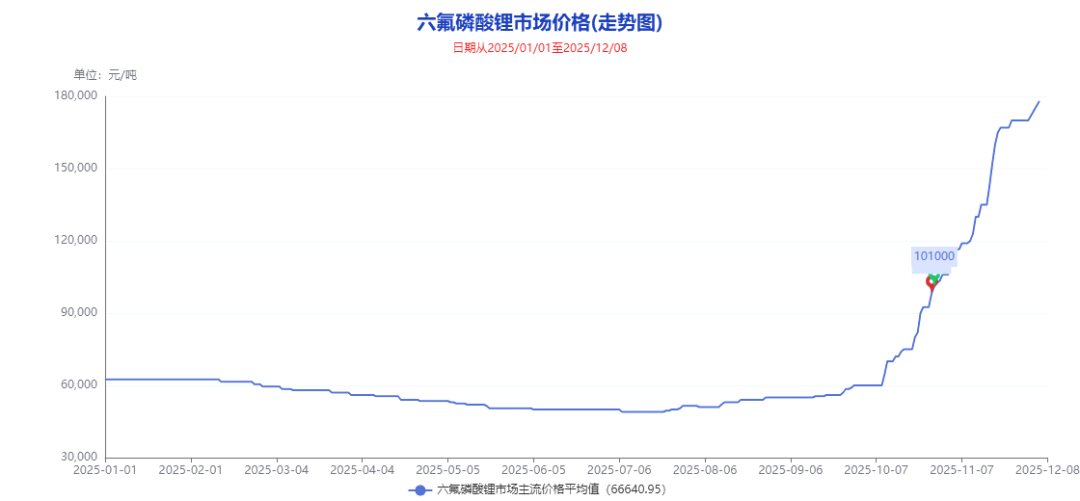
涨破17万!暴涨240%,这一原料还能涨吗?
Xin Lang Cai Jing· 2025-12-11 10:10
Core Insights - The price of lithium hexafluorophosphate has surged past 170,000 yuan/ton, marking an increase of over 240% from the year's low of 47,000 yuan/ton in July [1][7]. Group 1: Price Surge and Market Dynamics - The recent price recovery is driven by a strong resonance between explosive demand and supply contraction [3][10]. - The industry has undergone significant consolidation, with many small producers exiting or ceasing operations, leading to a higher concentration of market power among leading companies [3][10]. - Major companies are currently operating at full capacity, with firms like Tianji Co. and Tinci Materials confirming that their production lines for lithium hexafluorophosphate are fully booked [3][10]. Group 2: Demand Factors - The demand surge is attributed to the end-of-year push in the electric vehicle sector and concentrated installations in energy storage projects [3][10]. - Downstream battery manufacturers are securing long-term contracts to ensure supply, which is further straining current market availability and driving up spot prices [3][10]. Group 3: Future Price Outlook - Industry experts believe that the price of lithium hexafluorophosphate still has room to rise due to the dual pressures of high lithium carbonate costs and tight supply [4][10]. Group 4: Industry Structure and Key Players - The lithium battery materials sector is characterized by a dominance of leading companies, with smaller capacities being phased out [5][11]. - Ganfeng Lithium leads with a planned capacity of 260,000 tons/year LCE by 2025, utilizing a diversified technology route [6][11]. - Tianqi Lithium focuses on spodumene, with a capacity of 146,600 tons/year, while Salt Lake Industry specializes in lithium extraction from salt lakes, planning to increase its capacity from 40,000 tons/year to 60,000 tons/year by 2026 [6][11].



磷酸铁锂企业集体酝酿涨价:已有动力电池厂商上调价格,车企“抢货大战”再上演
Mei Ri Jing Ji Xin Wen· 2025-12-11 10:05
Core Viewpoint - The price of lithium iron phosphate (LFP) is set to increase due to rising costs from upstream raw material suppliers and ongoing discussions between LFP manufacturers and downstream battery producers [1][3]. Group 1: Price Increase Dynamics - Multiple LFP companies have proposed price increases to downstream battery manufacturers, with one company planning to raise processing fees by 3,000 yuan per ton starting January 1, 2026 [3]. - The cost structure of LFP batteries shows that cathode materials account for over 40% of total costs, indicating that price hikes from LFP manufacturers will impact downstream battery and new energy vehicle sectors [3][5]. - Some battery manufacturers, such as Funeng Technology, have already begun to implement price increases due to rising raw material costs and expanding market demand [3][5]. Group 2: Market Trends and Performance - The price of LFP materials has seen a significant decline from 173,000 yuan per ton at the end of 2022 to 34,000 yuan per ton in August 2025, a drop of 80.2%, leading to over 36 months of continuous losses in the industry [5]. - As of December 10, 2023, the average market price for LFP batteries has stabilized at 41,000 yuan per ton for power-type, 37,800 yuan for energy storage-type, and 25,400 yuan for repair-type [5]. - The domestic power battery installation volume reached 578.0 GWh from January to October 2023, a year-on-year increase of 42.4%, with LFP batteries accounting for 470.2 GWh, or 81.3% of the total, marking a 59.7% year-on-year growth [6]. Group 3: Industry Confidence and Challenges - The rapid growth of the downstream new energy vehicle and energy storage markets has provided LFP manufacturers with confidence to pursue collective price increases [7]. - Many leading LFP companies have their orders booked through the first half of the following year, operating at near full capacity [7]. - The upcoming reduction in vehicle purchase tax for new energy vehicles is intensifying competition among car manufacturers for battery supply, leading to challenges in ensuring supply and delivery for battery manufacturers and vehicle producers [9].


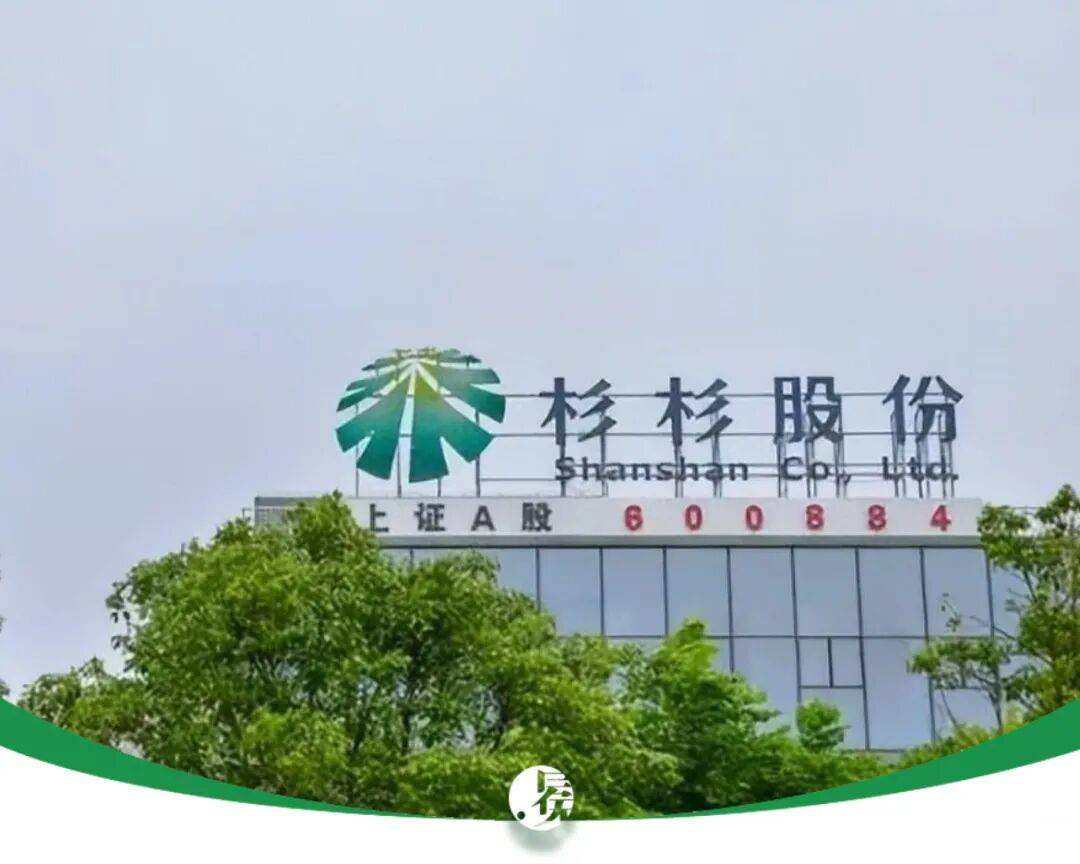
激烈“争夺”300亿杉杉,辽宁首富、国资都来了 || 深度
Sou Hu Cai Jing· 2025-12-11 08:59
Core Viewpoint - The restructuring of Shanshan Group, which has over 40 billion in debt, is attracting significant interest from major investors, including private and state-owned enterprises, amid uncertainties about its future viability [2][3][15]. Group 1: Restructuring Process - Shanshan Group's first restructuring plan was rejected, leading to a second recruitment of potential investors, which attracted notable players like Fang Wei's company and a state-owned enterprise from Hunan [3][6]. - The second recruitment had stricter criteria, emphasizing the need for investors with backgrounds in polarizers and/or anode materials [6][30]. - The deadline for submitting formal restructuring investment proposals is December 8, with a final decision expected by December 20 [27]. Group 2: Financial Situation - Shanshan Group's reported debts exceed 40 billion, yet it possesses valuable assets, including a 23.37% stake in Shanshan Co., valued at approximately 7 billion based on the company's market cap [15][18]. - Shanshan Co. has shown a recovery in performance, with a revenue of 14.81 billion and a net profit of 284 million in the first three quarters of the year, marking a significant year-on-year increase [22][23]. - The company is a leader in lithium battery anode materials and polarizers, with a strong market position that supports its valuation [23][24]. Group 3: Investor Profiles - Fang Wei's company, backed by the "Fangda System," has substantial assets exceeding 400 billion, but its financial performance has been mixed, raising questions about its willingness to invest heavily in Shanshan's restructuring [9][31]. - Hunan Salt Industry Group, with a solid industrial foundation and state backing, is positioned to gain trust from creditors, potentially forming alliances with financial institutions to strengthen its bid [13][30]. - The competition between these investors highlights the strategic importance of Shanshan Group's assets and its operational capabilities [14][26].

继续推荐锂电材料(六氟、隔膜等)
2025-12-11 02:16
Summary of Conference Call Notes Industry Overview - The lithium battery materials industry, particularly lithium hexafluorophosphate and separators, is experiencing strong market demand and low inventory levels, indicating a robust market environment [1][2] - The separator industry has low fixed asset turnover and limited expansion capacity, but demand continues to grow, leading to a favorable supply-demand relationship [1][2] Key Insights and Arguments - **Lithium Hexafluorophosphate**: - Mainstream companies have only two to three days of inventory, reflecting strong demand [2] - Monthly pricing mechanisms for large customers are established, indicating effective price transmission despite some lag [2] - Price increases were noted in mid-October, with expectations for further increases in January due to tight supply-demand conditions [2][17] - **Separator Industry**: - The industry faces skepticism regarding return rates and sustainability due to poor financial performance, with some companies needing over 30 years to recover capital expenditures based on current profitability [4] - If companies can achieve a 20% net profit margin and improve asset turnover, significant growth potential exists [4] - Expansion cycles are lengthy, requiring over 18 months, with equipment primarily imported, limiting expansion willingness [5][6] - **佛塑科技 (Foshan Plastics Technology)**: - Plans to increase production capacity to over 6.5 billion square meters by early next year, leveraging advanced automation technology [7] - Positive operational updates suggest a competitive edge in the separator market [12] - **5-Micron Separator Technology**: - Represents a significant structural iteration with expected penetration rates of 10% in 2024, 20% in 2025, and potentially doubling in 2026 [8] - High technical barriers mean only a few companies can produce this technology, which may widen profitability gaps among firms [8] Market Feedback and Price Trends - Market consensus indicates a 15% increase in separator prices, but actual increases are reported to be much higher, with small battery manufacturers experiencing over 40% price hikes [9][10] - Recent price increases in separators have been noted, with expectations for continued upward trends as production remains robust [16] Future Demand Considerations - Key areas for future demand include: - Automotive sector, influenced by government subsidies and new model releases [11] - Energy storage sector, driven by national capacity pricing policies and emerging storage needs [11] - Overseas market demand for large-scale energy storage [11] Financial Performance and Valuation - The company reported a net profit of approximately 0.049 yuan per square meter, with financial costs impacting profitability [15] - Current market valuation estimates suggest a conservative approach, with potential for higher actual production capacity [15] Investor Focus Areas - Investors should monitor price transmission dynamics and the impact of 5-micron separator technology on profitability [18] - Attention should also be given to strategic moves by major companies, such as acquisitions and product development initiatives, which will shape future market dynamics [18]
天华新能:12月9日召开董事会会议
Mei Ri Jing Ji Xin Wen· 2025-12-09 12:15
Group 1 - Tianhua New Energy (SZ 300390) announced on December 9, 2025, that its 29th meeting of the sixth board of directors was held, where the proposal to amend the company's articles of association was reviewed [1] - For the first half of 2025, Tianhua New Energy's revenue composition was 88.08% from the lithium battery materials industry and 11.92% from other businesses [1] - As of the report date, Tianhua New Energy's market capitalization was 41.6 billion yuan [1]

电解液一哥股价年内涨150%,高管频繁减持,最新套现近3600万
21世纪经济报道· 2025-12-08 12:43
Core Viewpoint - The article discusses the recent stock price surge of Tianci Materials, leading to a wave of insider selling by executives, while the controlling shareholder has committed to not selling shares in the near term, indicating a mixed sentiment about the company's future prospects [1][12]. Group 1: Executive Selling and Shareholder Commitments - Executives of Tianci Materials, including Vice Chairman Xu Sanshan and Vice General Manager Gu Bin, plan to sell a total of 924,000 shares within three months after a 15-day notice period [1]. - In response to the executive selling plans, controlling shareholder Xu Jinfeng announced a commitment to not sell shares for the next six months, which may help stabilize the stock price [1][12]. - Historically, Tianci Materials has seen frequent insider selling, particularly before 2022, with a pause in such activities due to a downturn in the industry [1][12]. Group 2: Industry and Market Conditions - The electrolyte and its upstream materials, particularly lithium hexafluorophosphate, have seen significant price increases, with prices rising from 61,000 yuan/ton in September to 180,000 yuan/ton by December, marking a 195% increase in the fourth quarter [2]. - Tianci Materials holds the largest production capacity for lithium hexafluorophosphate in China and is the leading company in electrolyte sales, which has led to improved profit expectations [4]. - Analysts predict that Tianci Materials' net profit for the fourth quarter could rise to 520 million yuan, with some forecasts for 2026 net profit reaching 5.1 billion yuan, comparable to the peak of the previous cycle in 2022 [4]. Group 3: Stock Performance and Market Reactions - Tianci Materials' stock price has increased by over 153% this year, peaking at 49.78 yuan in mid-November, but has since retreated to around 39.8 yuan by December 8 [4][7]. - The stock price fluctuations are influenced not only by fundamental improvements but also by market dynamics such as investor sentiment and sector rotation [4]. - Following the announcement of executive selling, the stock price experienced a slight increase, possibly due to the commitment from the controlling shareholder [13].