石化

Search documents
增速5.8%!甘肃经济稳中向好韧性凸显质效双升——2025年甘肃省经济运行成绩单透视
Xin Lang Cai Jing· 2026-01-21 01:00
Core Viewpoint - Gansu Province's economy demonstrated resilience and positive growth in 2025, with a GDP of 1.36975 trillion yuan, reflecting a year-on-year increase of 5.8%, surpassing the national average by 0.8 percentage points [1]. Economic Growth Indicators - Gansu's economic performance in 2025 showed "five positive trends": stable growth outpacing the national average, improved supply across all three industries, resilient investment and consumption, strong foreign trade growth, and enhanced quality and efficiency [2]. - Key indicators included industrial added value growth exceeding the national average by 3.6 percentage points, import and export growth surpassing the national average by 12.4 percentage points, and per capita disposable income growth exceeding the national average by 0.6 and 0.5 percentage points respectively [2]. Industry Performance - The agricultural sector achieved a record grain output of over 13 million tons, with significant growth in specialty products like vegetables and medicinal herbs, establishing Gansu as a major seed production base [3]. - The industrial sector saw a 0.5 percentage point acceleration in industrial added value growth, with key industries like non-ferrous metals and electricity contributing significantly to economic stability [3]. - The service sector emerged as a primary growth driver, contributing 51.4% to GDP growth, with tourism seeing over 500 million visitors and generating 403.6 billion yuan in spending [3]. Domestic and Foreign Trade - Gansu implemented measures to boost domestic demand and stabilize foreign trade, resulting in a 2.7% increase in project investment despite a downturn in the real estate market [4]. - The province's total import and export value exceeded 70 billion yuan, with a growth rate 12.4 percentage points higher than the national average, and a notable increase in high-tech product exports [4]. Development Momentum and Quality Improvement - New industries and private sector growth contributed to Gansu's economic transformation, with significant increases in strategic emerging industries and private enterprise performance [5][6]. - In 2025, Gansu added 16.05 million kilowatts of new power generation capacity, with a total capacity exceeding 80 million kilowatts and a year-on-year increase in power generation of 11.4% [6]. - The province saw a 22.6% increase in funds for newly established and ongoing investment projects, with a notable rise in the contribution of private enterprises to both industrial output and foreign trade [6].
丙烯期货首月交割平稳落地
Qi Huo Ri Bao· 2026-01-20 16:10
Core Viewpoint - The successful completion of the first contract for propylene futures (PL2601) marks a significant step for China's propylene industry, transitioning from "scale advantage" to "pricing advantage" through effective risk management and pricing reference tools [1] Group 1: Delivery Process and Participation - The delivery process showcased high industry participation and efficiency, with a total registered warehouse receipt volume of 28,800 tons from three production warehouses in Shandong [1] - A total of 1,500 tons were delivered, involving two production companies and one trading company, highlighting the practical value of futures tools for real business operations [1][2] - The delivery process was smooth and exceeded expectations, aided by detailed guidance from the exchange, ensuring seamless connections in registration, matching, and payment processes [2][3] Group 2: Price Discovery Mechanism - The effective functioning of the price discovery mechanism was a highlight, with the basis narrowing from -148 yuan/ton on November 4 to -22 yuan/ton by December 31, indicating a good convergence of futures and spot prices [1] - This convergence provides a reliable basis for enterprises to engage in hedging and basis trading, validating the scientific design and practicality of the propylene futures delivery rules [1] Group 3: Industry Insights and Future Plans - Companies involved in the delivery, such as Shandong Binhua New Materials and Jinneng Chemical, emphasized the importance of futures for stabilizing operations and managing risks, with futures prices being a more authoritative benchmark than spot prices [2][3] - The experience gained from the first delivery will be utilized to optimize inventory management and stabilize production operations in the future [3][4] - The propylene futures market is expected to further assist the industry in converting "scale advantages" into "pricing advantages" as participation increases and services are optimized [4][5] Group 4: Market Context and Future Developments - Propylene is a core product in the chemical industry, widely used across various sectors, and China's propylene production capacity ranks first globally [5] - The futures and options for propylene are set to enhance the derivative product system in the energy and chemical sector, addressing the urgent risk management needs of industry chain enterprises [5] - The exchange plans to optimize delivery warehouse layouts and enhance training for industry participants to improve their engagement with the futures market [5]
从份额向回报,行业预期正迎来重构化工行业的心动时刻
Orient Securities· 2026-01-20 14:42
Core Insights - The chemical industry is undergoing a strategic shift from a focus on market share to profitability, driven by internal policy adjustments and external pressures such as anti-dumping investigations [4][7][11] - The report identifies five key sectors with investment potential: MDI, petrochemicals, phosphate chemicals, PVC, and polyester bottle flakes, emphasizing the importance of leading companies with significant market share and competitive advantages [4][12][55] Group 1: Industry Trends - The chemical industry has historically prioritized market share, but recent policies and market conditions are prompting a shift towards profitability [7][13] - The supply-side reforms and dual carbon goals have raised entry barriers, leading to increased industry concentration without curbing expansion ambitions [7][13] - The trend of sacrificing market share for improved returns is becoming more prevalent, as companies recognize the need to adapt to changing market dynamics [31][11] Group 2: Investment Recommendations - MDI: The leading company, Wanhua Chemical, is expected to benefit significantly from its strategic shift towards profitability, with potential for substantial earnings growth in 2026 [56] - Petrochemicals: Major players like Sinopec and Rongsheng Petrochemical are undergoing operational adjustments that could reshape industry trends [57] - Phosphate Chemicals: The sector is poised for revaluation due to a tight supply-demand balance and increasing recognition of phosphate's value in energy security [59][60] - PVC: The industry faces strong supply constraints, with emerging markets driving demand growth despite domestic challenges [60] - Polyester Bottle Flakes: The sector is experiencing a recovery in profitability due to high industry concentration and strategic production limitations by leading firms [61]




化工:近期行业变化和历次周期牛市中龙头表现复盘
2026-01-20 03:54
Summary of Conference Call on Chemical Industry and Petrochemical Sector Industry Overview - The conference call focused on the chemical and petrochemical sectors, discussing recent investment opportunities and market dynamics [1][2]. Key Points from Petrochemical Sector - **Oil Price Outlook**: Current geopolitical issues have caused some disturbances in oil prices, with expectations of prices stabilizing around $65 during the off-season. However, there is a bullish outlook for oil prices in 2023 and 2024, with potential peaks between $70 and $80 [2][3]. - **Market Sentiment**: The market sentiment is currently bearish, but the analysis suggests a more optimistic view on oil prices, contradicting the majority opinion [2]. - **Midstream Developments**: There have been minor changes in the midstream sector, with some production cuts due to seasonal factors. The price differentials in certain products have improved, indicating a recovery in margins [3][4]. Key Points from Chemical Sector - **Market Trends**: The chemical industry is expected to experience a sustained uptrend in 2026 and 2027, potentially surpassing previous cycles. The valuation of chemical companies may exceed historical highs due to lower interest rates and improved market conditions [5][6]. - **Inventory Dynamics**: There is an expectation of a price increase post-Chinese New Year due to inventory replenishment, which has been absent in previous years due to trade tensions [6][7]. - **Supply Chain Constraints**: The expansion phase for many sub-industries has peaked, with capacity growth expected to slow down significantly by 2027. This will likely lead to tighter supply conditions [6][7]. - **Government Policies**: Recent government initiatives aimed at upgrading traditional industries for greener practices are expected to impact supply dynamics positively [6][7]. Investment Recommendations - **Focus on Cyclical Stocks**: The analysis emphasizes investing in cyclical stocks, particularly those with strong fundamentals and cost advantages. Companies like Wanhua Chemical and Longbai Group are highlighted for their potential to outperform the market [8][9]. - **Performance of Leading Companies**: Historical data shows that leading companies in the chemical sector have significantly outperformed the broader market during previous bull cycles, with returns of up to 5 times for some stocks [9][10]. - **Cost Advantages**: Leading firms maintain strong cost advantages, allowing them to remain profitable even during downturns. This positions them well for future price recoveries [10][11]. Sector-Specific Insights - **Urea and Acetic Acid**: The urea market is under observation for export policies, while acetic acid prices are expected to stabilize due to limited capacity expansion [12][13]. - **Titanium Dioxide**: The titanium dioxide market is facing challenges with profitability, and any new environmental regulations could further impact pricing [13][14]. - **Polyester and PTA**: The polyester chain is currently experiencing price adjustments due to seasonal demand fluctuations, with expectations of price increases as the market enters a recovery phase [16][17]. - **Refrigerants**: Prices for refrigerants are expected to rise as demand increases during the peak season, with current prices around 60,000 to 162,000 [20]. Conclusion - The overall sentiment in the chemical and petrochemical sectors is cautiously optimistic, with expectations of price increases and improved market conditions in the coming years. Investors are encouraged to focus on leading companies with strong fundamentals and cost advantages to capitalize on the anticipated market recovery [21].
机构看好十五五开局阶段化工“破晓时分”,石化ETF(159731)连续9天净流入
Sou Hu Cai Jing· 2026-01-20 03:01
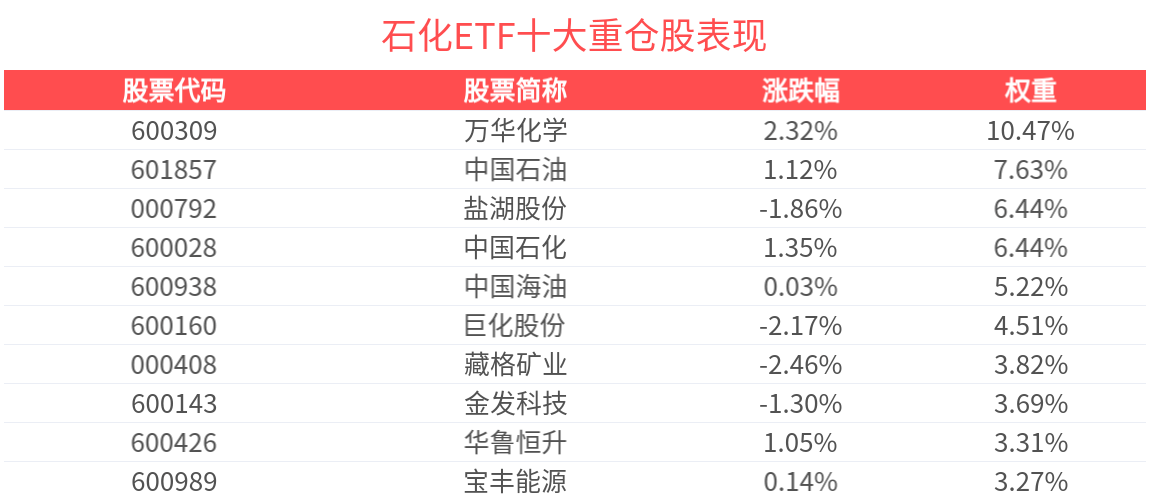
截至2026年1月20日10:33,中证石化产业指数下跌0.26%。成分股方面涨跌互现,三棵树领涨5.59%,卫星化学上涨3.80%,华峰化学上涨2.37%;中复神鹰 领跌5.35%,光威复材下跌4.34%,杭氧股份下跌3.52%。石化ETF(159731)下跌0.31%,从资金净流入方面来看,石化ETF近9天获得连续资金净流入,合 计"吸金"2.8亿元,最新份额达5.61亿份,最新规模达5.49亿元,创新高。 广发证券指出,化工作为典型周期性行业,通常5年一轮周期,经历"盈利上行-产能扩张-盈利触底-产能出清/需求预期改善"四个阶段。伴随资本开支增速转 负、反内卷、海外降息、扩内需,看好十五五开局阶段化工"破晓时分"。此外,全球技术革命持续提速,材料变革迎新机遇。 | 股票代码 | 股票简称 | 涨跌幅 | 权重 | | --- | --- | --- | --- | | 600309 | 万华化学 | 2.32% | 10.47% | | 601857 | 中国石油 | 1.12% | 7.63% | | 000792 | 盐湖股份 | -1.86% | 6.44% | | 600028 | 中国石化 | ...

政协委员沈谊:用好政府投资基金 赋能新质生产力发展
Qi Lu Wan Bao· 2026-01-19 13:45
Core Viewpoint - The focus of the current economic strategy in Zibo is on effectively utilizing government investment funds to empower the growth of new productive forces, which has become a hot topic during the Zibo "Two Sessions" [1] Group 1: Government Investment Fund Utilization - Zibo has been seizing policy opportunities to advance the construction of its fund system, with gradual success in linking funds to key projects like Jinshi Investment, aiding several companies in going public or entering the IPO guidance stage [1] - By 2025, the investment proportion of the "four new" economy in Zibo is expected to rise to 64% [1] - There is a noted tendency for substantial funds to favor relatively mature, lower-risk mid-to-late stage projects, resulting in insufficient support for early-stage hard technology projects that require urgent assistance [1] Group 2: Recommendations for Fund Improvement - It is suggested to establish a hundred billion-level "chain master fund" focused on advantageous industries such as petrochemicals, new materials, and intelligent equipment, in collaboration with leading enterprises to support key technological breakthroughs and high-end capacity expansion [1] - The proposal includes creating a specialized early-stage investment guiding fund to cultivate hidden champion enterprises and accelerate the development of new productive forces, fostering a more tolerant investment ecosystem [1] Group 3: Financial Innovation and Risk Management - The establishment of a regional fund share transfer platform is recommended, alongside the pursuit of more financial innovation tool pilots to broaden market-oriented and diversified exit paths [2] - A core aspect of the proposal is to create an assessment and error-tolerance mechanism that aligns with the investment rules of innovation, allowing for a "5-year + 3-year" long-cycle assessment for funds focused on hard technology [2] - It is emphasized that under the premise of thorough due diligence and compliant decision-making processes, early investment losses should be exempt from accountability to foster an ecosystem of "bold capital and patient capital" [2] Group 4: Systematic Improvement and Quality Transformation - To address potential issues of homogenized competition and low management professionalism among district and county funds, a systematic enhancement is recommended to build an optimal development ecosystem [2] - The aim is to transform Zibo's government investment funds from "scale expansion" to "quality efficiency," enabling them to effectively identify future industries, cultivate core enterprises, and strengthen new productive forces, thereby injecting robust capital momentum into Zibo's transformation and high-quality development [2]
氟化工引爆行情,龙头股涨停!化工ETF(516020)单日狂飙3%,收盘价续创近3年新高!
Xin Lang Cai Jing· 2026-01-19 11:19
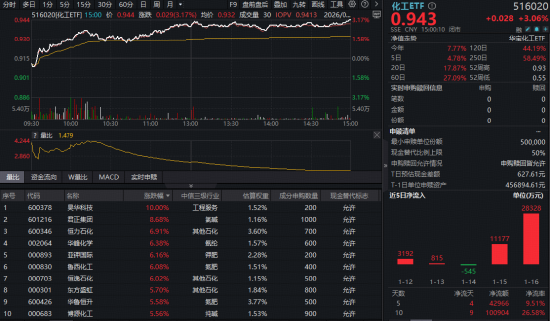
Group 1 - The chemical sector continues to perform strongly, with the Chemical ETF (516020) rising by 3.06% and reaching a new high since August 2022 [1][8] - Key stocks in the sector include Haohua Technology, which hit the daily limit, and Junzheng Group, which surged over 8%, along with several others rising more than 6% [1][8] - Since 2025, the Chemical ETF has shown a cumulative increase of 52.03%, significantly outperforming major indices like the Shanghai Composite Index (22.74%) and the CSI 300 Index (20.32%) [1][10] Group 2 - Prices of refrigerants have surged, with R507 and R404 reaching 46,000-49,000 yuan/ton and 43,000-45,000 yuan/ton respectively, reflecting a 3,000 yuan/ton increase [4][11] - The price increase is attributed to a combination of strong overseas demand and tightening domestic supply, which is expected to enhance the revenue and profit margins of refrigerant producers [4][11] - The chemical industry is anticipated to experience a recovery in profitability in 2026, following a period of adjustment and rebalancing in supply and demand [4][11] Group 3 - The Chemical ETF (516020) tracks the CSI Sub-Industry Chemical Theme Index, with nearly 50% of its holdings in large-cap leading stocks, including Wanhua Chemical and Salt Lake Industry [12] - The ETF provides an efficient way to invest in the chemical sector, covering various themes such as AI computing, anti-involution, and new energy [12] - Investors can also access the Chemical ETF through linked funds, which offer different fee structures for subscriptions and redemptions [12]
大庆石化聚烯烃部全密度二装置安稳运行破纪录
Xin Lang Cai Jing· 2026-01-19 06:51
全密度二装置于2012年开工建设,年设计产能为30万吨,是聚烯烃部六套生产装置中产能最大的装置。 此装置充分发挥生产负荷高、消化乙烯能力强的优势,常年保持稳定的高负荷生产状态,为聚烯烃部全 年生产任务的完成提供了有力保障。在保障常规牌号产品生产的基础上,该装置主动加压,积极应对困 难,开展技术攻关活动,实现了高附加值长链支化聚乙烯产品的规模化生产。通过工艺优化与技术改 造,装置成功达成高负荷安稳生产的目标,实现了产量与效益的双提升。此外,该装置还加强精益化生 产管理,精细核算成本,深入挖掘装置潜能,通过精心操作与优化生产流程,实现了提质增效。 通讯员 张瑞 转自:大庆网 截至2026年1月12日,大庆石化聚烯烃部全密度二装置已连续安稳运行712天,打破了自身469天的长周 期运行纪录。该装置全年产量为35.9万吨,占聚烯烃部总产量的27.8%,超出计划产量3800多吨。 (来源:大庆网) ...
涨超2.0%,石化ETF(159731)连续8天净流入
Sou Hu Cai Jing· 2026-01-19 02:41
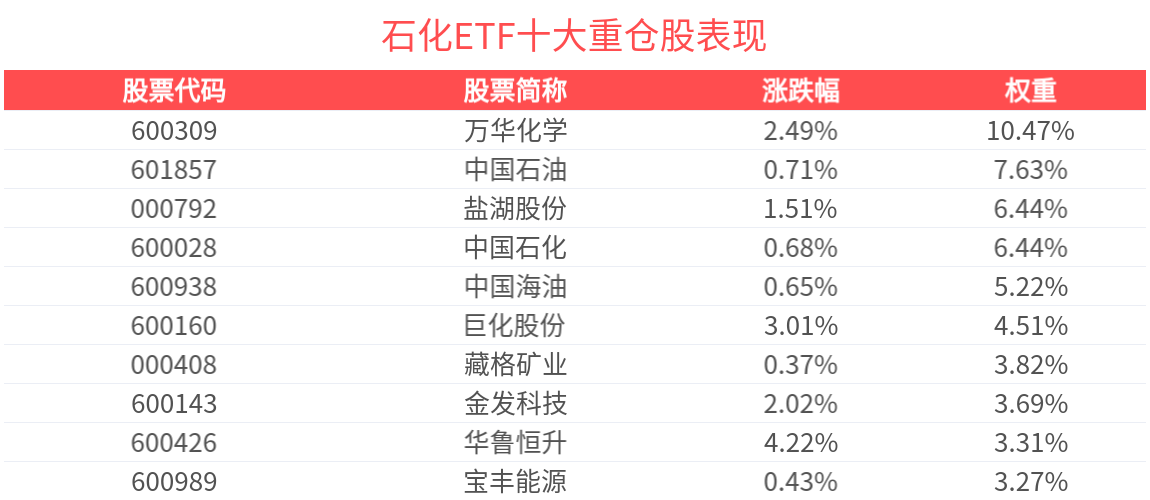
Core Insights - The petrochemical industry index has shown a strong increase of 1.88%, with significant gains in constituent stocks such as Yara International (up 4.93%) and Haohua Technology (up 4.58%) [1] - The Petrochemical ETF (159731) has experienced continuous net inflows over the past 8 days, totaling 269 million yuan, reaching a record high in both shares and scale [2] - The Petrochemical ETF has achieved a net value increase of 53.13% over the past two years, with a maximum single-month return of 15.86% since its inception [2] Fund Performance - The Petrochemical ETF's latest share count is 549 million, with a total scale of 522 million yuan [2] - The ETF has recorded an average monthly return of 5.25% during its rising months, with the longest consecutive rising streak lasting 8 months and a total increase of 41.60% [2] - The top ten weighted stocks in the index account for 56.73% of the total, including major companies like Wanhua Chemical and China Petroleum [2] Stock Performance - Notable stock performances include Wanhua Chemical (up 2.49%, weight 10.47%), China Petroleum (up 0.71%, weight 7.63%), and Salt Lake Potash (up 1.51%, weight 6.44%) [4] - Other significant stocks include China Petrochemical (up 0.68%, weight 6.44%) and Haohua Technology (up 4.22%, weight 3.31%) [4]
东营今年将统筹安排2亿元政府投资基金,支持新兴产业
Sou Hu Cai Jing· 2026-01-17 12:38
支持工业转型升级,统筹安排2亿元政府投资基金,支持"石化、橡胶轮胎、石油装备、有色金属等优势 产业,新材料、新能源、生物医药等新兴产业,人工智能、低空经济、新型储能等未来产业"加快实施 技术改造和设备更新、人工智能赋能、产业链延伸,推动传统产业焕新升级、新兴产业扩量提质、未来 产业加速布局。加快实施总投资4211亿元的158个重点工业项目,滚动实施投资500万元以上技改项目 260个,打造绿色工厂、绿色园区等30个以上。 工业经济是全市经济的"主引擎""压舱石"。在1月16日的发布会上,东营市工业和信息化局副局长、新 闻发言人王清海详细阐述了2026年将工业经济作为"头号工程"来抓的四项重点任务,明确提出了规上工 业企业数字化转型覆盖率目标。 突出抓好稳增长行动,聚焦产业高端化、智能化、绿色化发展方向,围绕石化、有色金属等重点行业制 定稳增长行动方案,突出稳增长和优结构并重,大力培育新的增长点,推动产业发展量质齐升。实施稳 产增产激励政策,支持工业企业稳定经营。积极帮助有需求的炼化企业争取更多国内原油供应。指导轮 胎企业更好应对贸易摩擦。推动铜冶炼企业尽快签订铜精矿国际贸易长单,争取进口铜精矿"口岸+目 的地 ...