
粮食种植

Search documents
粮食稳产高产靠什么丨生产体系稳健性持续增强
Jing Ji Ri Bao· 2025-11-11 01:49
Core Viewpoint - China's grain production capacity has strengthened, with a record output of over 1.4 trillion jin in 2024, ensuring food security and stable supply of key agricultural products [1] Group 1: Grain Production System - The grain production system in China has shown resilience, with improved production capacity and risk resistance [1] - High-standard farmland construction has been steadily advanced, enhancing agricultural production conditions and reducing risks from drought and flooding [1][2] - The application of digital and intelligent technologies in farming practices has accelerated, providing technical support for stable grain production [1][2] Group 2: Infrastructure and Coordination - There is still room for improvement in regional coordination and system completeness within the grain production framework [2] - Some areas face challenges such as uneven construction levels of high-standard farmland and aging infrastructure [2] - Strengthening infrastructure is essential for maintaining stable production, with a focus on modernizing irrigation systems and enhancing digital monitoring [2] Group 3: Climate Resilience and Long-term Strategies - Building climate-resilient agriculture is a long-term strategy, requiring optimization of production layouts and promotion of drought-resistant crops [3] - A comprehensive approach to agricultural emission reduction and carbon sequestration technologies is necessary to enhance soil stability and ecosystem adaptability [3] - Establishing a sustainable support system involving government guidance, market participation, and social collaboration is crucial for food security [3] Group 4: Regional Developments in Shandong - Shandong has made significant progress in high-standard farmland construction, with 77.59 million mu completed by the end of 2024, leading to an average yield increase of 100 jin per mu [4][8] - The transformation of fragmented farmland into standardized units has improved efficiency and reduced costs for farmers [5][6] - Financial support for high-standard farmland construction has been increased, with new investment standards set to enhance infrastructure [8] Group 5: Technological Integration and Financial Support - The integration of technology in agriculture, such as smart irrigation systems and remote monitoring, has improved production efficiency and reduced costs [10][15] - Financial institutions have introduced specialized loan products to support agricultural development, enhancing the capacity of new farming entities [15][16] - The establishment of a comprehensive agricultural insurance system provides a safety net for grain production, mitigating risks [15][16]
稻浪田间观新种,清远农投助力打造清远百亿丝苗米产业
Nan Fang Nong Cun Bao· 2025-11-10 15:03
Core Viewpoint - The article highlights the efforts of Qingyuan Agricultural Investment Group in promoting the high-quality development of the Qingyuan silk rice industry, aiming to establish it as a key agricultural sector worth billions in the region [2][5][10]. Group 1: Industry Development - Qingyuan silk rice is positioned as one of the five key agricultural industries in the region, with a projected planting area exceeding 1.56 million acres and a comprehensive output value surpassing 6.4 billion yuan in 2024 [11][15]. - The region's favorable ecological conditions, including fertile sandy loam and suitable temperature variations, contribute to the production of high-quality silk rice characterized by long grains, bright color, and rich aroma [8][9]. Group 2: Company Initiatives - Qingyuan Agricultural Investment Group plays a crucial role in the agricultural industry chain, focusing on modern agricultural practices and technology integration, such as the use of drones and mechanized planting [12][20]. - The company is responsible for the promotion of the new rice variety "Li Liang You Xiang You Zhan," which has shown promising growth and high yield potential, with expected production reaching 800 to 900 pounds per acre [24][28]. Group 3: Future Plans - The company plans to implement a unified model for seed supply, technical guidance, and order recovery to support farmers, with a goal to expand the new rice variety's planting area to 20,000 to 50,000 acres by 2026 and over 200,000 acres by 2028 [35][36][41]. - Qingyuan Agricultural Investment Group aims to enhance the entire industry chain from breeding research to processing and brand promotion, aligning with government goals for food security and the establishment of a billion-yuan silk rice industry [39][40].


全省秋粮收割进度超八成,多方共促“优质优价、稳产稳收”全链条保障让粮农吃下“定心丸”
Xin Hua Ri Bao· 2025-11-09 23:38
Core Insights - The article discusses the impact of weather conditions on the autumn grain harvest in Jiangsu province, highlighting the challenges faced by farmers and the measures taken to ensure their income [1][10]. Harvest Progress - As of November 6, 2023, Jiangsu province has harvested 37.3 million acres of autumn grain, achieving an 83% completion rate, which is an increase of 5.2 million acres compared to the previous year [3][12]. - The rice harvest reached 26.1 million acres, with a completion rate of 78% [3][12]. - The average yield for rice is expected to remain stable at approximately 1,110 pounds per acre, similar to last year [2][11]. Weather Impact - Continuous rain and typhoon conditions from September to October have affected the growth and harvesting of autumn grain, particularly rice [1][10]. - High temperatures in summer and subsequent rainy weather in October have posed challenges, but timely harvesting has mitigated some negative effects [2][3]. Price Trends and Agricultural Policies - The price of rice has decreased compared to last year, with farmers receiving approximately 1.4 to 1.5 yuan per pound, down from 1.6 to 1.7 yuan [4][13]. - Order agriculture has emerged as a key strategy for farmers to secure stable income, with contracts guaranteeing prices around 2.45 yuan per pound [14][5]. - The "优粮优价" (Quality Grain, Quality Price) policy has been implemented to encourage the cultivation of high-quality grains, providing additional financial support to farmers [16][17]. Support Measures - Zhangjiagang city has established a comprehensive post-harvest service system, ensuring effective grain drying and storage capabilities, with a drying capacity of 5,800 tons per batch [17]. - The government is prepared to activate minimum purchase price policies to protect farmers' interests if market prices fall below acceptable levels [18][9].
付伟:夯实粮食安全数智基础
Jing Ji Ri Bao· 2025-11-07 00:31
Group 1 - The core viewpoint of the articles emphasizes the transformation of China's agricultural sector towards a modernized, technology-driven model, with a comprehensive mechanization rate exceeding 75% by the end of 2024 [1] - The integration of IoT, AI, and big data in various agricultural processes such as planting, storage, and processing is enhancing the technical level of food production, leading to a shift from traditional labor-intensive methods to high-tech, market-oriented, and eco-friendly agriculture [1][2] - Mechanization and automation are effectively addressing the challenges posed by urbanization and labor shortages in agriculture, particularly the aging workforce, thereby improving production efficiency and reducing reliance on human labor [1][2] Group 2 - Intelligent agricultural technologies, such as smart sowing, water-saving techniques, and AI-based fertilization, are enhancing the value of existing agricultural resources and mitigating ecological risks like extreme weather and pest outbreaks [2] - The demand for diversified and quality food consumption is driving the need for a market-oriented agricultural supply system, which is being met through the optimization of the entire production, circulation, and consumption chain using digital technologies [2] - To ensure food security, it is crucial to establish a supportive agricultural technology application system that aligns with China's regional differences and operational realities, addressing the specific needs for small-scale mechanization in certain areas [3]
地理标志赋能乡村振兴 “粤字号”品牌擦亮大湾区名片(人民网)
Ren Min Wang· 2025-11-06 09:12
Core Insights - The article highlights the significance of geographical indications in promoting rural revitalization and high-quality development in the Guangdong-Hong Kong-Macao Greater Bay Area, showcasing local specialties as a "golden business card" for the region [1] Group 1: Geographical Indications and Regulations - Guangdong has placed a strong emphasis on geographical indication work, with the implementation of the "Guangdong Provincial Geographical Indication Regulations" since January 1, 2023, providing robust legal support for industrial development [1] - As of June 30, 2025, Guangdong has approved 229 geographical indication protected products, ranking among the top in the country, with notable products like Phoenix Dan Cong tea and Xinhui dried tangerine peel included in the "China-EU Geographical Indication Product Mutual Recognition and Protection List" [1] Group 2: Economic Impact and Employment - The Zengcheng area has seen the Zengcheng Silmiao rice brand, known as "the jade of rice," achieve a brand value exceeding 5.15 billion yuan, marking a transition from traditional agricultural products to a geographical indication star product [1][2] - The Silmiao rice industry has created employment for 34,000 farmers, with an annual production of 44,000 tons and a core area output value of nearly 1.9 billion yuan, significantly increasing farmers' income [2] Group 3: Quality Control and Brand Development - A comprehensive quality control system has been established to ensure product quality, with over 20 inspections conducted from farm to table, and traceability codes on packaging to provide full process information [3] - The Zengcheng Silmiao rice brand value is 5.15 billion yuan, while the Zengcheng lychee brand value is 2.48 billion yuan, reflecting ongoing efforts in brand building and promotion [4] Group 4: Marketing and Promotion Strategies - The integration of agriculture and tourism has been innovated through events like harvest festivals and lychee festivals, successfully transitioning geographical indication products from agricultural goods to cultural and tourism gifts [4] - Online and offline marketing strategies have been implemented, including designated areas for geographical indication products in high-traffic locations and the development of online platforms for authorized enterprises [4] Group 5: Support Systems for Development - The International Geographical Indication Product Service Base in Guangzhou Knowledge City serves as an "accelerator" for the development of geographical indication industries, focusing on research, data centers, and product trading operations [5] - The article outlines a comprehensive rural revitalization framework that connects products, industries, brands, markets, protection, and wealth generation through geographical indications in the Greater Bay Area [5]

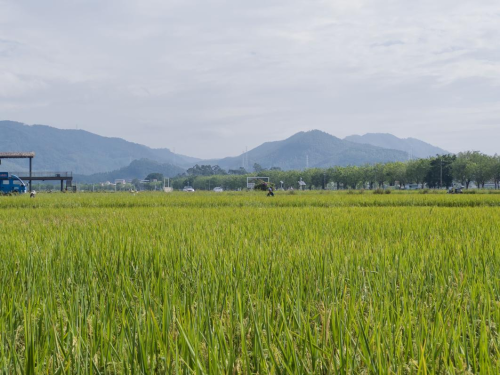
粮食稳产高产靠什么丨稳健机制筑牢粮安根基
Jing Ji Ri Bao· 2025-11-06 02:31
Core Viewpoint - The article emphasizes the importance of enhancing farmers' motivation in grain production to ensure national food security, highlighting the role of market mechanisms, price stability, and digital empowerment in achieving this goal [1][6]. Group 1: Market Mechanisms and Price Stability - The continuous optimization of the price formation mechanism is fundamental to stimulating farmers' willingness to plant grains, with a stable grain price being a prerequisite for farmers to engage in production [2]. - The minimum purchase price for wheat in 2025 is set at 119 yuan per 50 kg, reflecting a year-on-year increase, which signals predictable returns for farmers and encourages them to optimize their planting decisions [2][3]. - A scientific and fair pricing system can convert farmers' efforts into tangible income, thereby reinforcing the foundation for stable grain production [2]. Group 2: Efficient Market Circulation - The improvement of the grain circulation system is crucial for enhancing farmers' income and expanding agricultural development space, ensuring that grain is not only produced well but also sold effectively [3]. - The launch of the first multimodal transport "single document" train for grain in 2025 reduced transportation time from 18 days to 13 days, significantly improving efficiency [3]. - A smooth circulation system facilitates the integration of small farmers into larger markets, creating a virtuous cycle of quality production, efficient circulation, and increased income [3]. Group 3: Supply and Demand Regulation - Effective regulation of supply and demand is essential for guiding farmers' decisions and maintaining market stability, which directly impacts their interests [4]. - A clear and stable supply-demand structure aids farmers in making informed decisions regarding land use and investment [4]. - The establishment of a "surplus grain storage and deficit grain release" model helps stabilize market fluctuations and provides farmers with confidence in their planting decisions [4]. Group 4: Digital Empowerment in Agriculture - Digitalization is becoming a key driver of modern agricultural development, transforming production methods and market participation for farmers [5]. - The growth of live-streaming and e-commerce has opened new market opportunities for farmers, with the national agricultural live-streaming e-commerce transaction scale exceeding 3.1 trillion yuan in the first half of 2025, a 28% year-on-year increase [5]. - The integration of digital technology with market mechanisms is creating a sustainable agricultural ecosystem, providing farmers with stable income and broader prospects [5]. Group 5: Local Initiatives and Community Support - In Sichuan, local initiatives such as live-streaming e-commerce are helping farmers increase their income, with some farmers reporting an average income increase of 2,000 yuan per mu from live-streaming activities [7][8]. - The establishment of clear pricing mechanisms and direct sales models in communities is reducing costs and increasing profits for farmers [8]. - The integration of community support in e-commerce initiatives is fostering rural economic development and ensuring that benefits are shared among local residents [8]. Group 6: Agricultural Socialization and Modernization - The establishment of an agricultural socialization service system is enhancing the connection between small farmers and modern agricultural practices, promoting efficiency and productivity [12][13]. - The dual-track operation model combining public service and market value-added services is being implemented to support farmers effectively [12]. - The focus on technology and standardized management is leading to significant increases in crop yields and overall agricultural productivity [12][13].
稳健机制筑牢粮安根基
Jing Ji Ri Bao· 2025-11-06 00:08
Core Insights - The core argument emphasizes the importance of farmers' enthusiasm for grain production, which directly impacts national food security and the livelihoods of over 1.4 billion people. In 2024, China's total grain output is expected to exceed 1.4 trillion jin, supported by robust national policies and effective market mechanisms [1] Group 1: Price Mechanism - Continuous optimization of the price formation mechanism is fundamental to stimulating farmers' willingness to plant grains and is essential for the healthy operation of market mechanisms. A reasonable and stable grain price mechanism is a prerequisite for farmers to "dare to plant, want to plant, and can plant" [2] - The minimum purchase price for third-grade wheat in 2025 is set at 119 yuan per 50 kilograms, reflecting a year-on-year increase of 1 fen, marking five consecutive years of price increases. This stable adjustment signals predictable returns, guiding farmers in their investment and output decisions [2] Group 2: Market Circulation - The continuous improvement of the market circulation system is crucial for enhancing farmers' income from grain production and expanding agricultural development space. Efficient circulation ensures that grain is not only produced well but also sold effectively [3] - The launch of the first national multimodal transport "single document" train for grain in 2025 reduced transportation time from 18 days to 13 days, significantly improving grain transport efficiency [3] Group 3: Supply and Demand Regulation - Effective regulation of supply and demand is vital for guiding farmers' decision-making and is an intrinsic support for stimulating sustained grain production motivation. A clear and stable supply-demand structure aids farmers in making informed judgments regarding land use, capital investment, and labor allocation [4] - The establishment of a "surplus grain storage and deficit grain release" adjustment model has been gradually formed, which helps stabilize production and sales fluctuations [4] Group 4: Digital Empowerment - Digitalization is becoming a key driver of modern agricultural development, fundamentally changing farmers' production methods and market participation. Farmers can access real-time market information, accurately meet consumer demands, and enhance sales efficiency [5] - In the first half of 2025, the national live-streaming e-commerce transaction scale for agricultural products surpassed 3.1 trillion yuan, representing a year-on-year growth of 28% [5] Group 5: Future Outlook - During the "14th Five-Year Plan" period, China's agriculture has progressed steadily, with market mechanisms improving and farmers' enthusiasm increasing, significantly enhancing national food security capabilities. Moving into the "15th Five-Year Plan," there is a need to further leverage market mechanisms to optimize price formation, stabilize farmers' income expectations, and enhance circulation efficiency [6]
粮食稳产高产靠什么丨科技强农粮满仓
Jing Ji Ri Bao· 2025-11-04 02:57
Core Insights - The article emphasizes the rapid development of an agricultural technology innovation system centered on high-quality farmland, seeds, opportunities, and methods, which is crucial for ensuring food supply and promoting high-quality agricultural development [1][2][3][4]. Group 1: Agricultural Technology Innovation - The construction of high-standard farmland is a solid foundation supported by technological innovation, significantly enhancing disaster resistance and overall productivity [1]. - The national coverage rate of quality seeds has exceeded 96%, with over 95% being independently bred, ensuring a stable supply of major grain crops [2]. - The integration of modern information technology with agricultural machinery has led to a comprehensive mechanization rate of over 75% for major crops, improving operational efficiency [3]. Group 2: Technological Integration and Efficiency - The establishment of replicable and promotable technology integration models has upgraded agricultural production towards standardization, scale, and sustainability, benefiting small farmers [4]. - The article highlights the importance of transforming laboratory results into practical agricultural productivity, with significant advancements in breeding technologies and the establishment of innovation platforms [8][9]. Group 3: Regional Agricultural Developments - In Yangling, significant breakthroughs in breeding technology have been achieved, with a focus on developing drought-resistant varieties and enhancing breeding efficiency [9]. - In Pinggu, the area has seen a continuous increase in grain harvest area and total production, with grain harvest area expanding from 88,700 acres to 138,500 acres and production rising from 42,500 tons to 57,100 tons over four years [12][13]. - In Pucheng, the promotion of "one variety, two harvests" for regenerating rice has led to substantial increases in planting area and yield, with the average yield reaching 770.5 kg per acre [14][15].
新疆,中国新粮仓
3 6 Ke· 2025-11-03 23:19
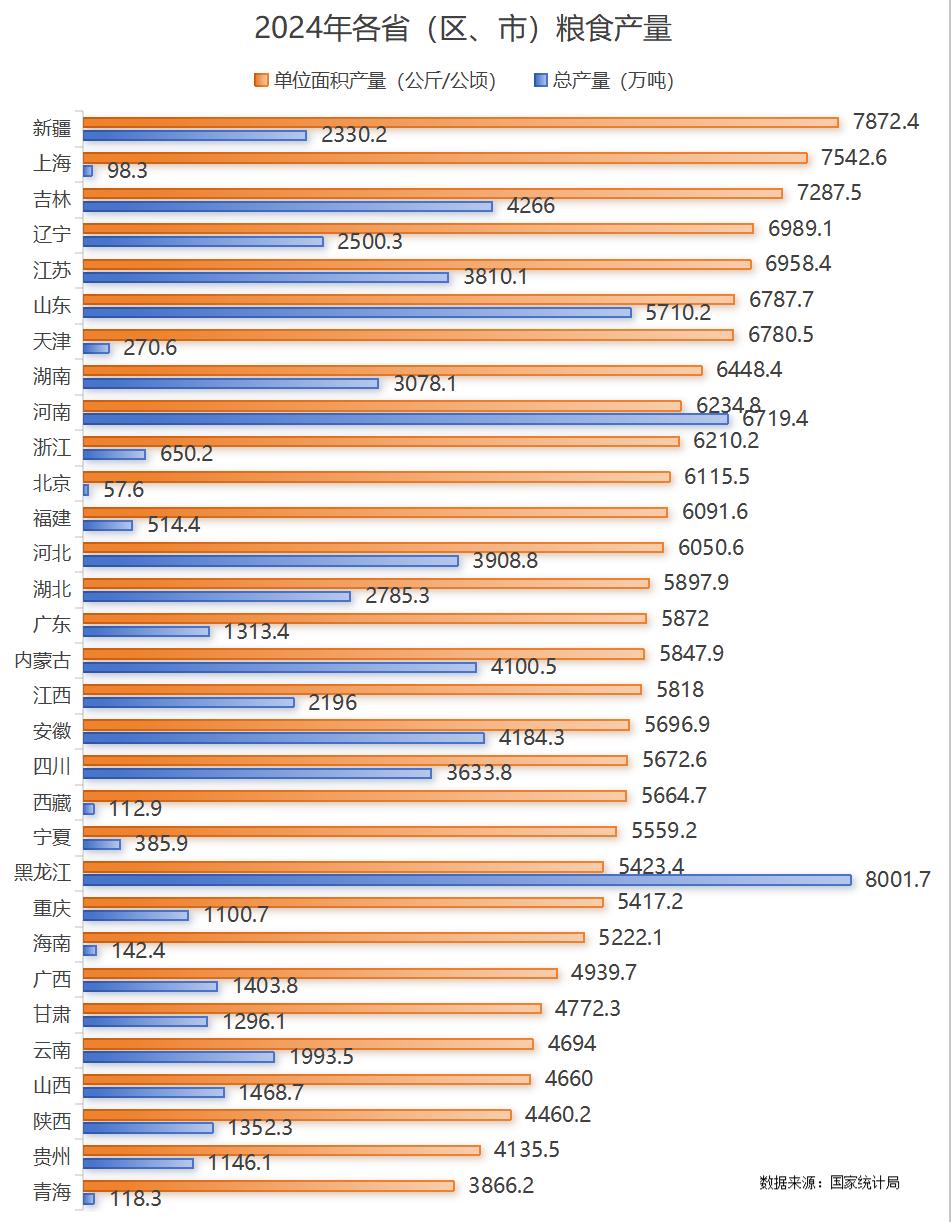
Core Viewpoint - Xinjiang has emerged as a leading grain-producing region in China, achieving the highest grain yield per unit area in 2024, surpassing Shanghai, with a yield of 524.8 kg per mu, which is 33% higher than the national average [6][7][10]. Group 1: Grain Production Achievements - Xinjiang's total grain production exceeded 21.19 million tons in 2023 and reached 23.30 million tons in 2024, marking an increase of 2.11 million tons from the previous year, equivalent to an additional 3 kg of grain per person nationwide [10][11]. - The province has set records for high yields in major crops, with wheat and corn achieving significant milestones in large-scale production [9][10]. - Xinjiang's grain production has increased by 746.8 million tons from 2020 to 2024, accounting for 20.2% of the national increase, the highest in the country [11]. Group 2: Technological Advancements in Agriculture - Modern agricultural practices, including high-standard farmland construction, have transformed Xinjiang's agricultural landscape, with 59.89 million mu of high-standard farmland established, representing 72.8% of the permanent basic farmland [19][21]. - The use of technology, such as satellite navigation for automated planting and smart irrigation systems, has significantly improved efficiency and productivity in farming [30][31]. - The introduction of precision agriculture techniques has led to substantial increases in crop yields, with wheat yields rising from 300 kg to 700 kg per mu in some areas [26][27]. Group 3: Strategic Adjustments in Crop Planting - Xinjiang's agricultural strategy focuses on increasing planting area and yield while optimizing crop structure, with grain planting area reaching 44.4 million mu in 2024, an increase of 2.03 million mu from the previous year [38]. - The province has reduced the planting area for economically beneficial crops like cotton and fruit trees to prioritize grain production, reflecting a commitment to national food security [39][40]. - The adjustments in planting strategies have been guided by the principle of "two increases and one adjustment," emphasizing the importance of food production in the context of global food security challenges [38][40].
多元融合强链条
Jing Ji Ri Bao· 2025-11-03 22:37
Core Insights - The average yield of the regenerated rice in Wuxi Village, Pucheng County, reached 770.5 kg per mu, indicating a significant increase in productivity due to the promotion of "one variety, two harvests" regenerated rice [1] - Pucheng County plans to plant 85,000 mu of regenerated rice in 2024, with demonstration plots achieving a maximum combined yield of 1,382.7 kg per mu, showcasing the potential for high-yield farming in the mechanization era [1][2] - The county has established five major scientific innovation platforms to promote agricultural technology, including the "Pucheng Regenerated Rice Technology Small Courtyard," which has facilitated the transformation of research results into practical applications [1][2] Agricultural Development - Pucheng County's grain planting area is projected to reach 482,800 mu in 2024, with regenerated rice occupying 85,000 mu, leading the province in both areas [2] - The county's agricultural budget allocates over 20 million yuan annually to support grain production, alongside an additional 100 million yuan for modern agricultural projects [2] - The implementation of the "Further Strengthening Grain Production Fifteen Measures" aims to encourage farmers and stabilize grain production [2] Technological Advancements - The county has achieved a rice seed coverage rate of 98.5% through the selection and promotion of high-quality varieties, with a total seed production area of 63,700 mu [3] - A comprehensive mechanization service system has been established, with over 70,000 agricultural machines and a mechanization rate of 83.35% for major crops [3] - The brand value of "Pucheng Rice" has increased to 42.117 billion yuan, reflecting the success of the county's branding and marketing efforts [3] Future Plans - Pucheng County aims to explore efficient planting models combining seasonal rice, regenerated rice, and rapeseed to enhance land resource utilization and increase per-unit income [3] - Plans are in place to develop a comprehensive rice industry chain, from seed production to deep processing and sales, while integrating tourism and education into agricultural practices [3]