
机电

Search documents
上海市单月出口规模首超1800亿元 民营企业进出口占比首次突破四成
Xin Hua Cai Jing· 2025-09-19 13:49
Group 1 - In August, Shanghai's total import and export value reached 387.43 billion RMB, marking an 11.7% year-on-year increase, continuing a growth streak for seven consecutive months since February [1] - Exports amounted to 183.08 billion RMB, surpassing 180 billion RMB for the first time in a single month, with a year-on-year growth of 17.1%; imports were 204.35 billion RMB, up 7.3% [1] - For the first eight months of the year, Shanghai's cumulative import and export value reached 2.94 trillion RMB, reflecting a 4.5% year-on-year increase, with growth rate improving by 1 percentage point compared to the previous seven months [1] Group 2 - Private enterprises in Shanghai achieved an import and export value of 166.85 billion RMB in August, a significant year-on-year increase of 31.5%, contributing 11.5 percentage points to the city's overall trade growth [1] - Exports to emerging markets saw substantial growth, with a total of 53.74 billion RMB in August, representing a 45% year-on-year increase, which boosted the overall export growth rate by 10.7 percentage points [1] - Key export categories included ships and marine engineering equipment, and engineering machinery, with export values increasing by 10.6 times and 72.8% respectively [1][2] Group 3 - In August, Shanghai's export of electromechanical products reached 125.39 billion RMB, a 19% year-on-year increase, accounting for nearly 70% of total exports [2] - Notable growth was observed in the export of high-end machinery, electric vehicles, lithium batteries, and photovoltaic products, with year-on-year increases of 45.1%, 37.1%, 112.1%, and 39% respectively [2] - Import trends indicated stability and recovery in industrial and consumer demand, with significant increases in imports of metal ores, semiconductor manufacturing equipment, and various consumer goods [2]
8月份上海市进出口额同比实现两位数增长
Zhong Guo Xin Wen Wang· 2025-09-19 08:38
Core Insights - In August, Shanghai's import and export value reached 387.43 billion yuan, marking a year-on-year growth of 11.7%, continuing a growth streak for seven consecutive months since February [1] - Exports amounted to 183.08 billion yuan, surpassing 180 billion yuan for the first time in a single month, with a growth rate of 17.1%, while imports were 204.35 billion yuan, growing by 7.3% [1] - For the first eight months of the year, the total import and export value was 2.94 trillion yuan, reflecting a growth of 4.5%, with an acceleration of 1 percentage point compared to the previous seven months [1] Export Performance - In August, the export of mechanical and electrical products reached 125.39 billion yuan, growing by 19%, accounting for nearly 70% of the total exports [2] - Notable growth was observed in the exports of ships and high-end machine tools, which increased by 45.1% and 43.7% respectively [2] - The demand for green products surged, with exports of electric vehicles, lithium batteries, and photovoltaic products growing by 37.1%, 112.1%, and 39% respectively [2] Import Dynamics - The import of metal ores, unrefined copper, and copper products increased by 15% and 21% respectively, reflecting a recovery in raw material manufacturing [2] - The development of the semiconductor and artificial intelligence industries drove significant growth in imports of semiconductor manufacturing equipment and computer accessories, which surged by 105.5% and 55.2% respectively [2] - Consumer goods imports also saw growth, with beef, milk powder, perfume, and sports equipment increasing by 10.5%, 43.2%, 29.4%, and 35.8% respectively [2] Market Opportunities - The strong performance in August was significantly driven by private enterprises, which accounted for 166.85 billion yuan in imports and exports, growing by 31.5% and contributing 11.5 percentage points to the overall growth [1] - Emerging markets such as Africa, ASEAN, the Middle East, and India saw exports totaling 53.74 billion yuan, a year-on-year increase of 45%, contributing 10.7 percentage points to the overall export growth [1] - The export of shipbuilding and marine engineering equipment, along with engineering machinery, showed remarkable performance, with increases of 10.6 times and 72.8% respectively, contributing 16.5 percentage points to the growth in emerging markets [1]
上海外贸8月两位数强势增长,民企首次突破4成
Di Yi Cai Jing· 2025-09-19 08:38
Core Insights - Private enterprises are increasingly becoming a key force in stabilizing foreign trade due to their flexibility and market sensitivity [1] Group 1: Trade Performance - In August, Shanghai's total imports and exports grew by 11.7% year-on-year, marking the seventh consecutive month of growth since February [1] - Exports exceeded 180 billion yuan for the first time, with a growth rate of 17.1%, while imports reached 204.35 billion yuan, growing by 7.3% [1] - For the first eight months, Shanghai's total imports and exports increased by 4.5%, with the growth rate improving by 1 percentage point compared to the first seven months [1] Group 2: Role of Private Enterprises - In August, the import and export volume of private enterprises in Shanghai surged by 31.5%, maintaining a growth rate above 30% for three consecutive months [1] - The share of private enterprises in Shanghai's total foreign trade rose to 43.1%, surpassing 40% for the first time, contributing 11.5 percentage points to the city's overall trade growth [1] Group 3: Market Diversification - Exports to emerging markets such as Africa, ASEAN, the Middle East, and India grew by 45% in August, contributing 10.7 percentage points to the overall export growth [1] - Notable export performance was observed in shipbuilding and marine engineering equipment, which grew by 10.6 times, and engineering machinery, which increased by 72.8%, together driving a 16.5 percentage point increase in exports to these emerging markets [1] Group 4: High-End Manufacturing and Imports - In August, the export of electromechanical products grew by 19%, accounting for nearly 70% of the total export value, with significant growth in shipbuilding and high-end machine tools at 45.1% and 43.7% respectively [2] - The export of "new three samples" including electric vehicles, lithium batteries, and photovoltaic products saw growth rates of 37.1%, 112.1%, and 39% respectively [2] - Imports of raw materials such as metal ores and copper products increased by 15% and 21% respectively, driven by stable industrial and consumer demand [2] - The import of semiconductor manufacturing equipment and computer accessories surged by 105.5% and 55.2% respectively, supported by the development of the integrated circuit and artificial intelligence industries [2] - Consumption-related policies have led to significant growth in imports of consumer goods, with beef, milk powder, perfume, and sports equipment increasing by 10.5%, 43.2%, 29.4%, and 35.8% respectively [2]
抢抓“3.0版”新机遇 中国—东盟为世界经贸注入更多确定性
Yang Shi Wang· 2025-09-19 04:37
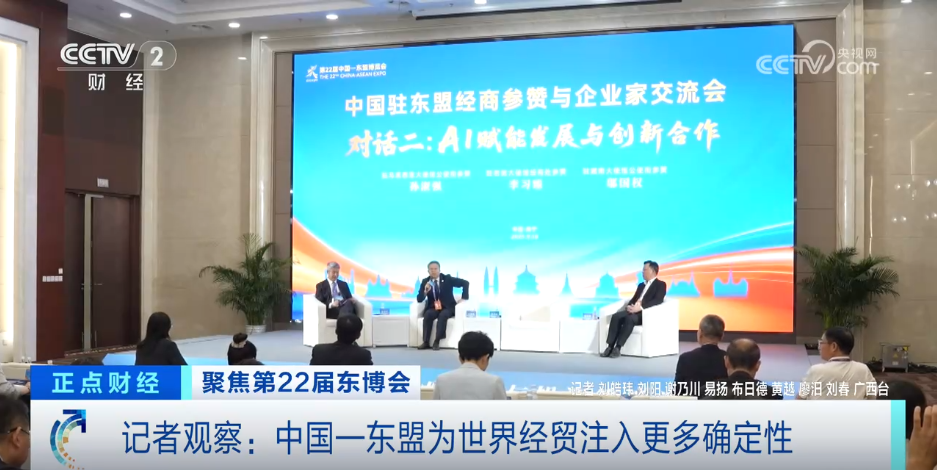
Group 1 - In the first eight months of this year, China's import and export with ASEAN reached 4.93 trillion yuan, an increase of 9.7%, which is 6.2 percentage points higher than the overall foreign trade growth rate of China, accounting for 16.7% of China's total import and export value [1] - The China-ASEAN Free Trade Area 3.0 protocol was signed during the East Expo, leading to increased interest from Chinese enterprises in exploring the ASEAN market [3] - There is a noticeable shift in trade structure between China and ASEAN, with a focus on digital economy, machinery and electronics, and traditional industries continuing to grow [10] Group 2 - The trade facilitation measures have significantly contributed to the increase in trade volume, with specific examples such as the approval of durian exports from Malaysia, Thailand, Vietnam, and the Philippines to China [7] - Companies are looking to extend from traditional bulk commodities to digital trade, indicating a trend towards digitalization in trade practices [5] - The total value of durian imports to China is projected to reach 6.99 billion yuan in 2024, highlighting the potential for explosive growth in certain product categories [7] Group 3 - Malaysian representatives at the East Expo expressed a desire to promote not only traditional industries but also sectors like technology, green economy, chemical products, and education services [11] - There is a strong confidence among Chinese entrepreneurs in tapping into the potential of the East Asian integrated market [3] - A company reported a signing amount of approximately 10 billion yuan in agreements with Vietnam, Thailand, and other Belt and Road countries, indicating robust investment activity [5]

烟台市外贸进出口由2020年3243.1亿元增至2024年4723.4亿元
Da Zhong Ri Bao· 2025-09-19 04:16
Core Insights - Yantai's foreign trade import and export increased from 324.31 billion yuan in 2020 to 472.34 billion yuan in 2024, with actual foreign investment exceeding 9.5 billion USD [1] - The city has implemented various policies to enhance its open economy, including measures for foreign trade stability and integrated investment [2] - Yantai has focused on attracting major projects and enhancing its global investment network, resulting in significant foreign investment and project approvals [3] - The development of industrial parks has been prioritized, with several parks recognized for their unique characteristics and contributions to the local economy [4] Group 1: Foreign Trade and Investment - Yantai's total foreign trade import and export is projected to reach 472.34 billion yuan by 2024, up from 324.31 billion yuan in 2020, with a growth of 18.2% in the first seven months of this year [1] - Actual foreign investment in Yantai reached 6.86 million USD in the first seven months of this year, ranking third in the province [1] - The city has cumulatively attracted 72.7 million USD in foreign investment and 13.7 million USD in outbound investment, reflecting a growth of 6.7% [1] Group 2: Policy and Structural Reforms - Yantai has established a comprehensive open economy framework, integrating internal and external trade, investment, and resource sharing [2] - The city has introduced seven policy measures aimed at stabilizing foreign trade and optimizing its structure, with over 200 policy trials and 2.25 billion yuan in funding secured during the "14th Five-Year Plan" period [2] - The implementation of the "Double Hundred Project" has supported the growth of key enterprises, with an average of over 1,000 new foreign trade companies established annually [2] Group 3: Investment Attraction - Yantai has focused on 16 key industrial chains to attract significant projects, hosting over 30 major investment activities annually [3] - The city has signed agreements with 132 business associations globally, enhancing its international investment network [3] - A total of 366 foreign enterprises have expanded their investments in Yantai, with a contractual foreign investment of 4.93 billion USD during the "14th Five-Year Plan" [3] Group 4: Industrial Park Development - Yantai has prioritized the development of industrial parks, with five parks recognized for their unique characteristics, leading the province in this regard [4] - The Yantai Development Zone ranked eighth nationally in comprehensive development performance evaluation for 2024 [4] - The establishment of the "Blue Granary" marine economic development zone has set a precedent for national marine construction [4]
秦安股份终止发行股份购买资产,拟以现金方式收购亦高光电股权
Ju Chao Zi Xun· 2025-09-19 02:35
Group 1 - The company, Qin'an Co., has decided to terminate the original plan to acquire 99% equity of Anhui Yigao Optoelectronics Technology Co., Ltd. through issuing shares and cash payment, opting instead for a cash acquisition [2] - The initial plan involved purchasing the equity from 12 shareholders, but due to the inability to complete the share issuance before year-end and the need for efficient acquisition to maintain the target company's core team stability, a cash acquisition was deemed more suitable [2] - Since the stock suspension on June 30, 2025, the company has been actively working on the acquisition, including audits, evaluations, and negotiations with the transaction parties [2] Group 2 - Qin'an Co. has signed a cash acquisition intention agreement with 11 major shareholders of Yigao Optoelectronics, planning to establish a wholly-owned subsidiary to facilitate the cash purchase [3] - The transaction price will be paid in installments based on current payment conditions, and performance commitments will be made by the shareholders regarding the operational performance of Yigao Optoelectronics during the commitment period [3] - Shareholder Rao Yiran is required to purchase a certain number of Qin'an Co. shares to guarantee the fulfillment of obligations by all performance commitment parties under the transaction documents [3]

前八个月我省经济运行总体平稳
Liao Ning Ri Bao· 2025-09-19 01:33
Economic Overview - The overall economic operation of the province remains stable in the first eight months of the year, with a year-on-year industrial added value growth of 3.5% [1] - High-tech manufacturing industry added value increased by 6.4% [1] Industrial Performance - Mining industry added value grew by 10.1%, manufacturing by 2.9%, and electricity, heat, gas, and water production and supply by 0.1% [1] - Among 40 major industrial categories, 23 experienced year-on-year growth, resulting in a growth coverage of 57.5% [1] - Notable product performance includes transformer production up by 63%, chemical reagents by 35.9%, civil steel ships by 32.1%, and new energy vehicles by 19.7% [1] Investment Trends - Fixed asset investment in the manufacturing sector grew rapidly, with a year-on-year increase of 14.3%, and high-tech manufacturing investment up by 16.7% [1] - Investment in the primary industry increased by 20.4%, while the secondary industry saw a growth of 4.1% [1] - Investment in construction projects exceeding one billion yuan grew by 2.8% [1] Consumer Market - The total retail sales of social consumer goods reached 687.48 billion yuan, with a year-on-year growth of 4.6% [2] - Basic living goods sales showed stable growth, with food and oil retail sales up by 16% and daily necessities by 11.4% [2] - Upgraded consumer goods saw significant sales growth, including smartphones up by 120%, wearable smart devices by 77.8%, and energy-efficient home appliances by 44.7% [2] Trade Performance - The total import and export value reached 501.94 billion yuan, with a slight year-on-year increase of 0.1% [2] - Exports totaled 267.67 billion yuan, growing by 11.6%, with notable increases in agricultural products by 9.6% and steel by 5.7% [2] - Electrical equipment exports increased by 14.6%, while ship exports rose by 23.1% [2] Price Trends - Consumer prices decreased by 0.2% year-on-year, while industrial producer prices fell by 4.8% [2] - The purchase prices for industrial producers declined by 5.2% [2]
东盟跃居浙江出口第一大市场
Mei Ri Shang Bao· 2025-09-18 22:19
Group 1 - Zhejiang's total import and export value to ASEAN reached 559.96 billion yuan in the first eight months of the year, a year-on-year increase of 16.1%, contributing 40.4% to the province's foreign trade growth [1][2] - Exports to ASEAN amounted to 390.04 billion yuan, growing by 16.7%, while imports were 169.92 billion yuan, increasing by 14.9%, making ASEAN the second-largest trade market for Zhejiang [2][3] - The proportion of ASEAN's import and export value in Zhejiang's total trade rose from 13.1% in 2020 to 15.2% in the first eight months of this year [2] Group 2 - The import of consumer goods from ASEAN reached 24.86 billion yuan, a significant increase of 36.6%, accounting for 14.6% of total imports from ASEAN [2] - The import of dried and fresh fruits and nuts surged to 8.02 billion yuan, with a growth rate of 50.8%, while agricultural product imports also saw a 37.4% increase [2] Group 3 - Zhejiang's export of electromechanical products to ASEAN grew by 20.3%, making up 42.8% of total exports to the region [3] - Notable exports included auto parts at 5.81 billion yuan, solar batteries at 3.15 billion yuan, and automobiles at 2 billion yuan, with growth rates of 27.2%, 38.7%, and 107.9% respectively [3] Group 4 - Cross-border e-commerce exports to ASEAN reached 45.61 billion yuan, a remarkable increase of 62.2%, making ASEAN the largest market for Zhejiang's cross-border e-commerce exports [4] - Yiwu, as a global hub for small commodity trade and cross-border e-commerce, provides diverse logistics support, enhancing the efficiency of cross-border trade [4]
江苏南京:机电“压舱”,“智”造破浪前行
Nan Jing Ri Bao· 2025-09-17 01:43
Group 1: Industry Overview - In the first half of 2025, Nanjing's electromechanical product exports reached 95.44 billion yuan, a year-on-year increase of 7.8%, accounting for 52.2% of the city's total exports [1] - Electromechanical products are crucial high-tech components that stabilize foreign trade and illustrate Nanjing's innovative manufacturing capabilities [1] Group 2: Company Highlights - Hansan Technology, which recently went public, exported smart speakers worth several million yuan, achieving over 97% of its sales from exports [3][5] - Despite global tariff changes, Hansan Technology experienced growth due to its comprehensive core technology capabilities and strong partnerships with overseas clients [5][6] - Nanjing Lijin Panda Electric Co. saw an 8% increase in exports from January to August, with European and South American markets growing by 14% [6] - Skyworth Group's overseas market revenue reached 8.053 billion yuan in the first half of the year, a 7.1% increase, as it aims for a revenue target of 100 billion yuan within two years [8] - Sumida Energy's export revenue reached 2.93 billion USD in the first half of the year, a 14% increase, as it transitions from product export to integrated energy solutions [9] Group 3: Market Trends - The global consumer electronics market is witnessing innovative products like AI glasses and compact TV sticks, showcasing the technological strength of Chinese brands [6][8] - The demand for automotive transport ships is rising due to the expansion of the global automotive market and the rapid growth of new energy vehicles [12] - The Nanjing electromechanical industry benefits from a complete industrial system and strong cluster advantages, enhancing its competitiveness in international markets [12][13]

重庆秦安机电股份有限公司关于2023年员工持股计划首次受让部分第二个解锁期符合解锁条件的部分股份非交易过户完成的公告
Shang Hai Zheng Quan Bao· 2025-09-16 19:19
Summary of Key Points Core Viewpoint - The announcement details the completion of the non-trading transfer of shares related to the 2023 employee stock ownership plan of Chongqing Qin'an Electromechanical Co., Ltd, highlighting the successful unlocking of shares and the establishment of a management committee for the plan [1][2][5]. Group 1: Employee Stock Ownership Plan - The company approved the 2023 employee stock ownership plan on August 7, 2023, during a shareholders' meeting, which included the management methods and related resolutions [1]. - A total of 16.35 million shares were transferred to the employee stock ownership plan account on September 8, 2023, through a non-trading transfer [2]. - The first unlocking period for the initial portion of the employee stock ownership plan was confirmed on September 5, 2024, with 4.854 million shares unlocked, of which 2.934 million shares were transferred to individual accounts on September 27, 2024 [2][3]. Group 2: Unlocking and Distribution of Shares - The second unlocking period for the initial portion of the employee stock ownership plan was confirmed on September 8, 2025, with 3.884 million shares unlocked [3]. - Out of the unlocked shares, 2.631599 million shares were transferred to individual accounts on September 15, 2025, involving 97 employees, representing 0.60% of the company's total share capital [5]. Group 3: Future Arrangements - The company will continue to monitor the implementation of the employee stock ownership plan and fulfill its information disclosure obligations as required by relevant laws and regulations [5].