酒店

Search documents
36氪研究院 | 2026全国连锁商家抖音经营报告
3 6 Ke· 2026-02-11 08:32
当前,我国连锁行业正整体步入以效率为核心的稳态高效发展阶段。以连锁餐饮、连锁零售为代表的主要业态增速逐步趋稳,行业发展重心由开店速度转 向单店坪效、整体增长与经营确定性。如何精准触达用户并实现高效转化,成为连锁商家普遍面临的核心命题。以抖音生活服务为代表的内容驱动型平 台,正凭借独特的内容场域优势,推动全域流量的高效协同与转化,助力实体连锁商家探索线上线下深度融合的增长新路径。 生活服务正成为连锁商家增长发力的"新主场" 抖音生活服务生态升级扩容,全域协同经营助力连锁商家释放增长潜能 近年来,抖音生活服务生态持续升级,交易规模、用户规模与连锁商家数量稳步提升,逐步形成了消费活跃、增长有力、供给多元的生活服务新生态。抖 音生活服务正围绕商品供给、内容传播与线下经营三大核心场域展开,依托"一个心智爆品、两个营销一致性、三个流量循环、四步区域经营"四大增长引 擎,打通"商品供给-内容种草-流量获客-交易转化-线下履约 "线上线下全链路闭环,为线下连锁商家提供从流量获取到业绩增长的全流程支持,最 终助力商家完成全域流量协同、经营效能跃升,开拓全新经营增长空间。 具体而言,在餐饮、游玩、综合、零售等核心垂类中,抖音生活 ...


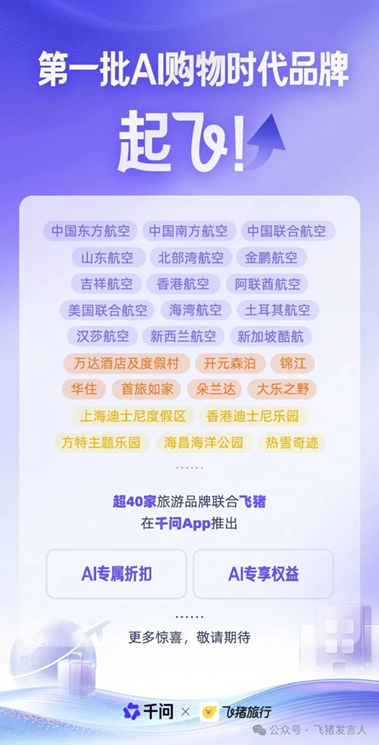
超40家旅行大牌率先与阿里千问、飞猪合作 AI预订机票酒店至高减300元
Zheng Quan Ri Bao· 2026-02-11 08:09
Group 1 - Alibaba's Qianwen and Fliggy have partnered with over 40 global travel brands to provide exclusive subsidies and value-added benefits for AI users [1] - Initial partners include major airlines such as China Eastern Airlines, China Southern Airlines, and Emirates, as well as hotel brands like Wanda Hotels and Shanghai Disneyland [1] - The AI collaboration aims to enhance the travel experience by enabling users to easily identify their needs and match them with travel services through natural language interactions [1][2] Group 2 - The integration of AI is expected to transform consumer behavior in the travel industry, with 2026 being highlighted as a pivotal year for AI-driven consumption [3] - Airlines are encouraged to leverage platforms like Qianwen and Fliggy to optimize supply-side offerings and capture AI-driven traffic opportunities [3] - The rapid development of AI is anticipated to significantly impact the entire cultural and tourism industry, potentially serving as a critical turning point for hotel and travel enterprises [3]



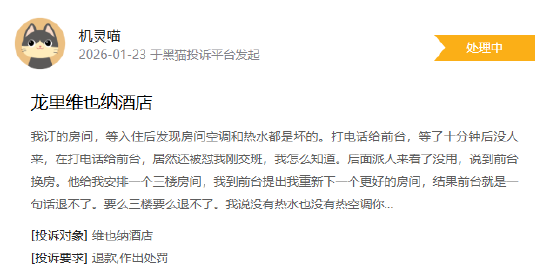
1月黑猫投诉企业红黑榜:维也纳酒店空调热水全坏 前台态度恶劣拒不解决
Xin Lang Cai Jing· 2026-02-11 07:55
黑猫投诉 【下载黑猫投诉客户端】发布1月企业投诉处理红黑榜单,数据均来源于黑猫投诉平台,反映 了企业在黑猫投诉平台的投诉处理解决情况。 截至2026年1月底,黑猫投诉平台累计收到消费者有效投诉近3274万件,1月有效投诉近79万件。 为了更加精准、及时地展现不同细分消费领域企业在黑猫平台的客诉处理情况,红黑榜单除了按行业划 分,还会根据近期热点消费事件设置"最受关注领域榜单",为消费者提供更有价值的消费参考。 关键词:维也纳酒店空调热水全坏 前台态度恶劣拒不解决 本月,多位消费者在黑猫投诉平台反映维也纳酒店存在服务质量问题。有消费者称,入住后发现房间空 调与热水器均无法使用,多次联系前台处理,但前台人员以"刚交班不知情"为由推脱,消费者提出更换 房间,但酒店仅提供条件更差的选项,并明确拒绝退款要求。另有消费者在深夜遭遇无热水问题,酒店 承诺换房后却长时间无人处理,导致其等待超1小时仍无法正常休息,消费者要求酒店方退款并作出解 释。 红榜:心悦汇商城、千山集、迪瓜租机、闪超科技、爱租机、杭州载道、天猫超市、东方福利网、海淘 免税店、臻心购 黑猫投诉1月行业红黑榜单 共享服务 黑榜:光宇科斯特换电、智慧笑联、云马 ...
1月黑猫投诉企业红黑榜:Agoda暴力取消订单差价损失无人赔
Xin Lang Cai Jing· 2026-02-11 07:06
Core Insights - The article discusses the January complaint handling red and black list published by the Black Cat Complaint platform, highlighting the performance of various companies in addressing consumer complaints [1][13]. Group 1: Complaint Statistics - As of the end of January 2026, the Black Cat Complaint platform has received nearly 32.74 million valid consumer complaints, with approximately 790,000 complaints recorded in January alone [1][13]. - The red and black lists categorize companies based on their complaint handling performance across different consumer sectors, aiming to provide valuable consumer references [1][13]. Group 2: Notable Complaints - Agoda faced multiple complaints for unilaterally canceling orders without compensation, leading to significant price differences for consumers when rebooking hotels, with a complaint response rate of 0% [2][14]. - Capital Airlines received complaints regarding flight cancellations without compensation, with a total of 7,779 complaints and a response rate of only 54%, dropping to 4.5% in the last 30 days [3][15]. - Vienna Hotels was criticized for poor service quality, including non-functional air conditioning and hot water, with staff refusing to resolve issues or provide refunds [4][16]. - The precious metals trading market saw complaints about delayed shipments and issues with product authenticity, with consumers facing difficulties in obtaining refunds [5][18]. - Consumers reported issues with Han Shu cosmetics, which were found to have a low production cost and alleged illegal additives, resulting in a high volume of complaints and a 0% response rate [6][19]. - Old Temple Gold faced complaints for not disclosing the weight of gold jewelry, leading to discrepancies in value and refusal to process refunds, with a response rate of 0% in the last 30 days [7][20]. Group 3: Industry Red and Black Lists - In the shared services sector, companies like Guangyu Koste and Hello were placed on the black list, while Monster Charging and Street Electric made it to the red list [8][21]. - In the shopping platform category, major platforms like Taobao and JD.com were listed on the black list, while Heart Joy Mall and Tmall Supermarket were recognized on the red list [8][21]. - The travel and accommodation sector saw Capital Airlines and several others on the black list, while companies like Fly Easy and Jinjiang Star were highlighted on the red list [8][21]. - In the entertainment and lifestyle sector, platforms like WeChat and Tencent were blacklisted, while companies like iQIYI and Cloud Technology were recognized positively [8][21]. - The education and training sector included companies like Zhonggong Education on the black list, while brands like Yuantong Education were acknowledged on the red list [22].
大行评级丨花旗:预期农历新年休闲旅游需求将持续强劲,利好中国中免、亚朵及华住
Ge Long Hui· 2026-02-11 06:04
Group 1 - The core viewpoint of the report is that Citi remains optimistic about the structural growth of experiential consumption in China, particularly during the Lunar New Year holiday [1] - The demand for leisure travel is expected to remain strong, positively impacting Hainan duty-free sales by China Duty Free Group, as well as room revenue for Atour and Huazhu Group [1] - The trend of outbound tourism in China is anticipated to diversify, with demand for travel to Japan shifting to other Asian regions and domestic travel [1] - The domestic travel momentum is viewed positively, with expectations for it to continue during the Lunar New Year holiday period [1] - Citi reiterates Atour as one of the preferred stocks in the Chinese consumer sector [1]


周期与成长共振:酒店产业投资范式解读与龙头Alpha捕捉
Changjiang Securities· 2026-02-11 06:02
Investment Rating - The report maintains a "Positive" investment rating for the hotel industry [15] Core Insights - The cyclical nature of the hotel industry is primarily due to the lag in supply-side adjustments, and a low chain rate tends to exacerbate industry volatility. The current cycle of the hotel industry in China is still unfolding, with the industry expected to enter a recovery phase [5][10] - The demand in the hotel industry can be divided into business travel and leisure travel, with key indicators such as domestic tourist numbers and per capita tourism spending reflecting market scale and consumption intensity. The PMI index serves as a critical forward-looking indicator for business travel demand [9][26] - The report emphasizes the importance of precise positioning of leading companies when industry data shows reversal signals, as this is key to capturing cyclical opportunities and realizing returns [5][11] Summary by Sections Supply and Demand Dynamics - The hotel industry's demand can be split into business travel and leisure travel, with business travel being influenced by the PMI index, which reflects macroeconomic conditions and corporate activity levels. Leisure travel demand is measured by domestic tourist numbers and per capita spending, both of which show an upward trend [9][26] - Supply-side indicators include the total number of hotels, the structure of different hotel grades, and the chain rate, with forward-looking indicators such as fixed asset investment in the accommodation and catering sectors indicating trends in supply adjustments [9][33] Industry Cycles and Current Stage - The cyclical nature of the hotel industry is characterized by supply-side adjustments lagging behind demand changes, leading to periods of oversupply or undersupply. The report identifies the current phase as a recovery period, with expectations of a gradual improvement in demand and supply dynamics [10][52] - Historical analysis shows that the hotel industry in China has experienced cycles of approximately 5-7 years, with the current cycle still in progress and expected to transition into a recovery phase [10][52] Investment Strategy - The report outlines a core investment strategy focused on left-side positioning within the cyclical context of the hotel industry. Key indicators for investment timing include occupancy rates (OCC), average daily rates (ADR), and revenue per available room (RevPAR), with buy signals occurring when these indicators show signs of improvement [73][75] - The correlation between PMI and RevPAR is highlighted, indicating that hotel groups with strong operational control can effectively capture trends and shorten lag periods, thus enhancing investment opportunities [11][66] Differentiation Among Hotel Companies - The report notes significant differences among listed hotel companies in terms of development stages and structural characteristics, with some companies in mature operational phases while others are still expanding or optimizing their structures. This differentiation leads to varied growth trajectories and profitability characteristics across the industry [13][116]


中国旅游:乐山乐水,业畅其流
2026-02-11 05:57
Summary of Key Points from the Conference Call Industry Overview - **Industry**: Chinese Tourism - **Context**: The tourism sector is rapidly becoming a key focus for enhancing the quality of life in China, aligning with government policies aimed at boosting service consumption, expanding employment, and further opening up to the outside world [1][4] Core Insights and Arguments - **Projected Revenue Growth**: - Total tourism revenue in China is expected to reach approximately RMB 12 trillion by 2030, with a compound annual growth rate (CAGR) of 11% [1][13] - Domestic tourism spending is projected to account for 18% of per capita consumption by 2030, up from 13% in 2023 [1][14] - The contribution of tourism to GDP is anticipated to rise from 4.8% in 2024 to 6.7% by 2030 [1][11] - **Domestic Tourism Growth**: - Domestic tourism is expected to grow at a CAGR of 9.7% over the next five years [1][14] - In 2025, domestic travel volume is projected to reach 6.5 billion trips, a 16% increase year-on-year [1][17] - **Inbound and Outbound Tourism**: - Inbound tourism is expected to contribute 16% to total tourism revenue by 2030, up from 12% in 2025 [1][15] - The appreciation of the RMB is expected to boost outbound tourism, which is crucial for the revenue of Chinese airlines [1][31] Driving Forces Behind Tourism Demand - **Macroeconomic Rebalancing**: Emphasis on service consumption and enhancing quality of life [1][25] - **Global Engagement**: Continued openness to international visitors [1][25] - **Currency Strength**: The appreciation of the RMB is favorable for outbound tourism [1][29] - **Policy Support**: Initiatives aimed at stimulating travel demand among younger and older demographics [1][25] - **Technological Innovation**: Enhanced travel experiences through technology [1][38] Structural Improvements and Monetization - **Visitor Demographics**: Improvement in visitor structure, with an increase in the proportion of non-domestic and business travelers [2][9] - **Supply Constraints**: Airlines are facing low capacity growth due to global supply chain issues, while hotel supply growth has slowed significantly [2][9] Key Investment Opportunities - **Recommended Stocks**: - Air China H-shares, Spring Airlines, Huazhu, Atour, and Trip.com are highlighted as key investment opportunities to capitalize on the strong growth in tourism demand [2][41] - **Airlines**: - Airlines are expected to see improved pricing power and valuation as they recover from deflationary pressures [9][41] - **Hotels**: - The hotel sector is witnessing a positive trend in revenue per available room (RevPAR), with expectations of continued growth [9][42] - **Online Travel Agencies (OTAs)**: - OTAs are expected to benefit from strong tourism demand, but regulatory uncertainties should be monitored [9][43] Additional Important Insights - **Entertainment and Events**: The rise in large-scale entertainment events is significantly contributing to tourism growth, with a notable increase in attendance [1][21] - **Visa Policies**: The introduction of new visa-free policies is driving inbound tourism growth, with a 50% increase in visa-free visitors [1][23][22] This summary encapsulates the key points from the conference call regarding the Chinese tourism industry, highlighting growth projections, driving factors, investment opportunities, and additional insights that may be overlooked.



中国休闲与住宿行业-上调行业观点⸺多年转机
2026-02-11 05:57
February 10, 2026 10:18 AM GMT 中国内地/香港休闲与住宿行业 上调行业观点⸺多年转机 中国酒店 RevPAR 增长趋势正在改善。休闲需求依然具备韧 性,商务需求正在复苏,而供给增速正在放缓。需求与供给 增速趋于平衡状态,酒店价格压力因此缓解⸺这支持 RevPAR 转正,并支撑我们将行业观点上调至乐观。 我们将对中国酒店行业的观点从中性(In-line)上调至乐观(Attractive):我们 认为 RevPAR 增长趋势已出现明确拐点。过去数年中,需求复苏一直被激进的供给 扩张所抵消;需求与供给增速正趋于平衡转好状态,这将支撑 RevPAR 转为正增 长,并推动更可持续的上行周期。 • 过去两年,RevPAR 累计下滑约 9%,目前正以约每年2% 的速度增长。 RevPAR 的三大核心驱动因素均已转为正向: 我们预计在多元化休闲需求、入境游复苏以及商务需求回暖的带动下,需求增速 将稳步增长,并有望达到或超过放缓中的供给增速轨迹。随着酒店价格压力逐步 缓解,RevPAR 增长有望延续至 2026 年以后。考虑到酒店行业较高的经营杠 杆,RevPAR 的回升预计将推动盈利增速由过去的 ...
阿里千问、飞猪宣布与全球超40家旅行品牌达成AI合作
Xin Lang Cai Jing· 2026-02-11 04:16
格隆汇2月11日|据全天候科技,阿里千问、飞猪宣布与全球超40家旅行品牌达成AI合作,为千问APP 和飞猪的AI用户提供专属补贴和增值权益。华尔街见闻从飞猪方面了解到,此次率先启动AI合作的品 牌包括中国东方航空、中国南方航空、中国联合航空、山东航空、北部湾航空、金鹏航空、吉祥航空、 香港航空、阿联酋航空、美国联合航空、海湾航空、土耳其航空、汉莎航空、新西兰航空、新加坡酷航 等头部航空公司,万达酒店及度假村、开元森泊、锦江、华住、首旅如家、朵兰达、大乐之野等酒旅大 牌,以及上海迪士尼度假区、香港迪士尼乐园、方特主题乐园、海昌海洋公园、热雪奇迹等超级主题乐 园。 ...
2026年拥抱“AI购物” 40多个飞猪商家率先推出“千问价”
Xin Lang Cai Jing· 2026-02-11 03:27
Core Insights - Alibaba's Qianwen app has launched a significant AI shopping initiative, achieving over 10 million orders within 9 hours of its "Spring Festival 30 Billion Free Order" promotion [1][7] - The app has consistently ranked first in the Apple App Store's free app category, surpassing competitors [1][7] - A partnership has been established with over 40 global travel brands, including major airlines and hotel chains, to provide exclusive subsidies and value-added benefits to users of Qianwen and Fliggy [2][8] Group 1: AI Shopping Experience - The Qianwen app will utilize AI capabilities to offer a seamless travel service experience, allowing users to consult, plan, and book travel in one step without switching platforms [4][9] - Users can receive discounts and benefits, with single orders eligible for discounts up to 300 yuan [4][9] - The AI system can accurately identify user intentions through natural language processing, matching them with relevant travel services from a vast array of dynamic product information [3][8] Group 2: Industry Impact - The integration of AI in the travel industry is expected to transform the supply and demand dynamics, particularly in sectors with complex decision-making processes like travel [3][6] - Experts suggest that airlines should leverage platforms like Qianwen and Fliggy to implement advantageous policies and enhance product development, thus capturing the early AI traffic opportunities [5][13] - The rapid advancement of AI technology is anticipated to significantly impact the entire tourism ecosystem, potentially marking a pivotal shift in the supply side of the hospitality industry [6][14]