数智营销

Search documents
泸州老窖(000568) - 000568泸州老窖投资者关系管理信息20260327
2026-03-27 09:03
Group 1: Low-Alcohol Product Strategy - The company emphasizes the growing preference for low-alcohol beverages among young consumers, positioning itself as a leader in this market segment [1] - Key advantages include a strong technical foundation, adherence to traditional brewing methods, and proven market acceptance in regions like North China, East China, and Southwest China [1][2] Group 2: Brand Strategy for Guojiao 1573 - The brand's pricing strategy is based on historical experience, ensuring stability against market fluctuations, particularly for high-end products [3] - The brand's value and user demand dictate pricing, with Guojiao 1573 maintaining a stable price during industry adjustments due to its quality and scarcity [3] - The company aims to enhance service quality and consumer experience to create additional value, rather than merely maintaining prices [3] Group 3: Marketing and Consumer Engagement - The company is enhancing its digital marketing system to improve the precision and effectiveness of its marketing expenditures, aiming to keep the expense ratio at a reasonable level [4] - It is focusing on building marketing service centers across provincial regions to improve consumer relations and service capabilities [7][8] - Initiatives to elevate brand and cultural significance include the establishment of projects like the China Baijiu Museum, aimed at deepening consumer engagement [8] Group 4: Operational Goals and Shareholder Returns - The company is committed to high-quality development, ensuring channel health and price stability to achieve sustainable growth and long-term value [5] - Dividend plans will be executed according to shareholder resolutions to enhance shareholder returns [6]

中国东方航空与阿里千问、飞猪达成合作,为AI用户提供专属补贴
Zhong Guo Min Hang Wang· 2026-02-11 06:25
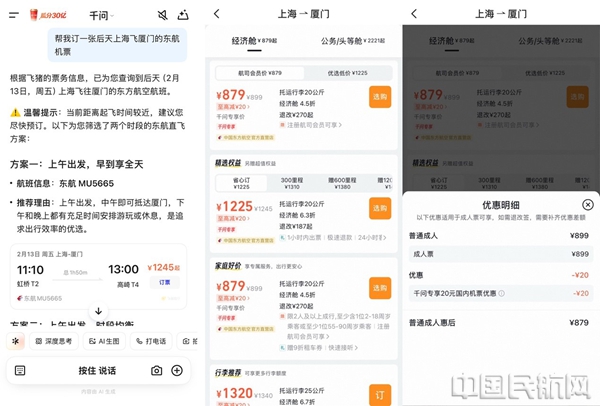
Group 1 - Alibaba's Qianwen app launched a "Spring Festival 30 Billion Big Free Order" campaign, achieving over 10 million orders within 9 hours [1] - Qianwen app has surpassed Doubao and Yuanbao, ranking first on the Apple App Store free chart [1] - China Eastern Airlines is the first domestic airline to engage in consumer-level AI collaboration with Alibaba's Qianwen and Fliggy, providing exclusive subsidies for AI users [1][2] Group 2 - The Qianwen app integrates with Alibaba's ecosystem, including Taobao, Alipay, and Fliggy, to offer AI shopping capabilities [1] - Users can book flights by simply stating their request, receiving tailored flight options with exclusive discounts [3] - Future collaborations between China Eastern Airlines and Alibaba's Qianwen and Fliggy aim to expand "flight+" products and enhance service interactions [3] Group 3 - Experts predict that 2026 will mark the beginning of the AI consumption era, driven by applications like Alibaba's Qianwen [3] - Airlines are encouraged to leverage AI platforms like Qianwen and Fliggy to optimize supply-side offerings and capture AI traffic opportunities [3] - The introduction of AI technology is expected to usher the aviation industry into a new era of "AI+" intelligent marketing [3]



2026年拥抱“AI购物” 40多个飞猪商家率先推出“千问价”
Xin Lang Cai Jing· 2026-02-11 03:27
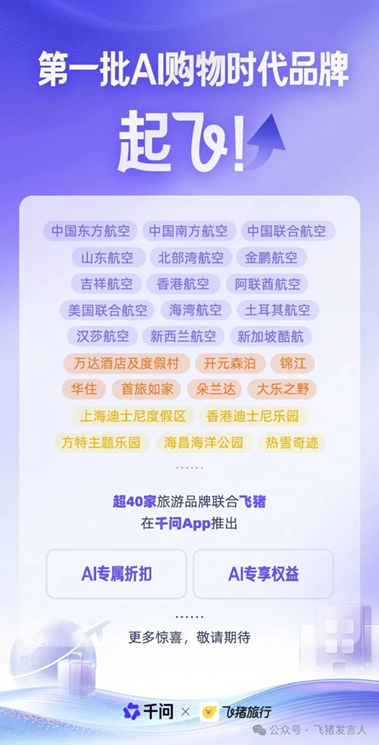
Core Insights - Alibaba's Qianwen app has launched a significant AI shopping initiative, achieving over 10 million orders within 9 hours of its "Spring Festival 30 Billion Free Order" promotion [1][7] - The app has consistently ranked first in the Apple App Store's free app category, surpassing competitors [1][7] - A partnership has been established with over 40 global travel brands, including major airlines and hotel chains, to provide exclusive subsidies and value-added benefits to users of Qianwen and Fliggy [2][8] Group 1: AI Shopping Experience - The Qianwen app will utilize AI capabilities to offer a seamless travel service experience, allowing users to consult, plan, and book travel in one step without switching platforms [4][9] - Users can receive discounts and benefits, with single orders eligible for discounts up to 300 yuan [4][9] - The AI system can accurately identify user intentions through natural language processing, matching them with relevant travel services from a vast array of dynamic product information [3][8] Group 2: Industry Impact - The integration of AI in the travel industry is expected to transform the supply and demand dynamics, particularly in sectors with complex decision-making processes like travel [3][6] - Experts suggest that airlines should leverage platforms like Qianwen and Fliggy to implement advantageous policies and enhance product development, thus capturing the early AI traffic opportunities [5][13] - The rapid advancement of AI technology is anticipated to significantly impact the entire tourism ecosystem, potentially marking a pivotal shift in the supply side of the hospitality industry [6][14]
户外宝:IP场景化定制+全周期运营,重构户外营销长效价值
Sou Hu Cai Jing· 2026-02-02 12:26
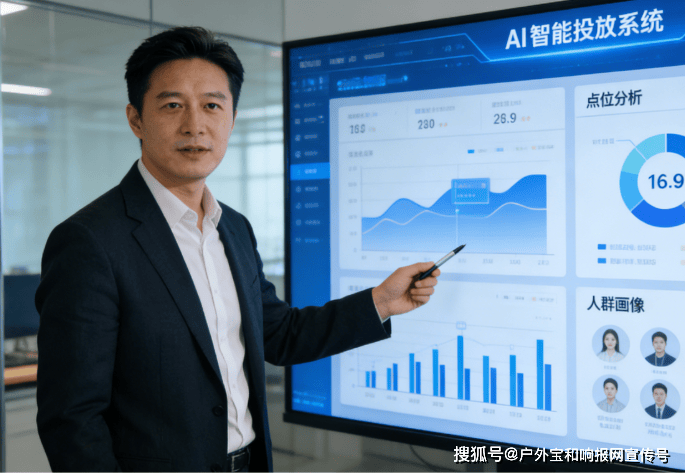
Core Insights - The outdoor marketing industry is facing challenges such as "homogenized customization" and "heavy investment with light operation," leading to shallow IP and location binding, which hinders the sustainable release of IP value and long-term brand empowerment [1][5] Group 1: IP Scene Customization - The core of IP scene customization is "tone adaptation and precise targeting," which allows IP content to effectively reach users and resonate with them [3] - Outdoor Bao has established a comprehensive network covering over 220 cities and more than 240,000 quality locations, enabling precise segmentation based on "lifecycle, consumption scenarios, and demand scenarios" for IP scene customization [3][5] - The platform has created five major scene matrices: "trendy youth, family convenience, high-end business, cultural tourism, and campus youth," with over 80% of core golden locations and deep strategic partnerships with 95% of core resource providers [3][5] Group 2: Full-Cycle Operation - Outdoor Bao focuses on deep integration of IP and scenes, as well as two-way interaction between deployment and operation, creating a specialized, full-cycle IP operation system [5][6] - The platform provides "one-to-one" IP customization services based on a scene-person database, allowing for tailored content creation that aligns with specific brand tones and scenarios [5][6] - The full-cycle operation includes planning, real-time monitoring, and post-campaign analysis to ensure continuous value release from IP marketing [6][8] Group 3: Data-Driven Optimization - Outdoor Bao utilizes intelligent IP operation systems and big data analysis to recommend optimal IP customization directions and scene combinations, reducing costs and risks [8] - The platform tracks the effectiveness of IP content in various scenarios through real-time data monitoring, enabling quick adjustments to deployment strategies [8] - A case study showed that a cultural brand achieved a 90% increase in exposure and a 45% increase in conversion rates after two rounds of content iteration, demonstrating the long-term value of this model [8] Group 4: Ecosystem Development - Outdoor Bao aims to create an open outdoor IP marketing ecosystem that connects brands, IP providers, scene providers, and content creators for mutual benefits [9] - The company plans to deepen its IP scene customization and full-cycle operation model while expanding into more niche scene collaborations and integrating emerging formats like short videos and AR interactions [9] - Future efforts will focus on optimizing the scene-person matching model to transition outdoor marketing from "traffic exposure" to "long-term value accumulation" [9]
2026年中国营销趋势报告
Sou Hu Cai Jing· 2026-01-07 15:01
Core Insights - The 2026 China Marketing Trends Report emphasizes four key themes: "Digital Intelligence, Trust, Engagement, and Community" as pivotal for shaping marketing strategies in the coming year [1][4][6] Group 1: Digital Intelligence - AI Agents are evolving into agent-based AI, driving automation across the marketing chain and promoting "marketing equality" [1][6] - Companies are focusing on building marketing knowledge bases to enable precise and personalized marketing through frameworks like MAGIC [1][20] - AI applications have led to efficiency gains for companies such as Lenovo and Douyin, with significant improvements in content production and operational efficiency [20][21] Group 2: Trust - Trust is identified as a core competitive advantage for brands, necessitating transparent communication and value resonance to build consumer trust [1][6] - Brands like Small Can Tea and Ping An Good Doctor are enhancing user trust through public welfare marketing and cross-industry collaborations [1][6] Group 3: Engagement - "Human-centric marketing" is gaining importance, requiring brands to exhibit personality and social attributes to penetrate attention barriers [1][6] - Companies like JD.com and Little Swan are leveraging trending topics and engaging personas to achieve breakthrough communication [1][6] Group 4: Community - Brands must immerse themselves in community cultures to become social currency, empowering stakeholders for co-creation and mutual benefits [1][6] - Companies such as Stone Technology and Godiva are integrating into communities through cross-industry collaborations, while platforms like Bilibili are enhancing value through channel empowerment [1][6] Group 5: Methodology and Practical Framework - The report not only presents trend predictions but also offers actionable methodologies and practical references to help marketing decision-makers navigate changes and seize opportunities [7][6] - The MAGIC framework is highlighted as a systematic approach to enhance marketing strategies, focusing on user journey orchestration and personalized content generation [20][31]

基于创意传播管理(CCM)的数智时代创意传播实践课程教学探索
Jing Ji Guan Cha Wang· 2025-12-06 04:59
Core Insights - The core objective of the Creative Communication Practice course is to cultivate students' ability to solve real communication problems, adapting to the demands of the digital intelligence era [2][3][4] - The course integrates digital platforms and public welfare projects, emphasizing hands-on experience through five teaching stages and eight tasks, significantly enhancing students' professional skills [6][10][29] Course Design - The course is designed around the Creative Communication Management (CCM) theory, focusing on the integration of human intelligence and digital technology to complete marketing communication tasks [7][10] - It emphasizes the development of students' creative communication management abilities, encouraging them to analyze information environments and effectively integrate communication resources [7][10] - The curriculum includes 32 class hours divided into five stages: group formation, theory learning, content creation, practical placement, and effect evaluation, with a focus on student-led initiatives [10][11] Teaching Process - The teaching process is structured into five stages, starting with group formation and selection of public welfare topics, followed by theory learning and content creation [11][12] - Students engage in practical tasks such as creating videos and conducting market research, with guidance from industry experts and mentors [12][13] - The course incorporates real public welfare projects, allowing students to apply their skills in a practical context, enhancing their understanding of social issues [13][14] Practical Application - The course collaborates with digital platforms like ByteDance to provide students with real-world marketing scenarios, utilizing tools such as Douyin and other digital marketing systems [9][10] - Students are tasked with creating and optimizing content for public welfare projects, which helps them develop data analysis and marketing skills [27][28] - The average return on investment for the projects is reported at 3.6, indicating successful fundraising efforts beyond expectations [27] Educational Outcomes - The course aims to improve students' analytical, creative, and practical skills, fostering a comprehensive understanding of the creative communication industry [27][28] - It also emphasizes the importance of social responsibility, encouraging students to engage with real-world issues and develop a sense of empathy through their projects [28][29] - The integration of digital platforms and public welfare projects enhances the relevance and effectiveness of the educational experience, preparing students for future industry demands [29]

AI原生 与生态共舞 让价值绽放|2025数智科技生态大会倒计时2天!
Xin Lang Cai Jing· 2025-12-03 06:14
Core Insights - The article emphasizes the importance of innovative business operation models and smart marketing in driving digital transformation [3][6]. Group 1 - The 2025 Digital Intelligence Technology Ecological Conference is highlighted as a significant event for discussing advancements in digital transformation [2][5]. - The focus on smart marketing is presented as a key strategy for companies to enhance their operational efficiency and customer engagement [3][6]. Group 2 - The article suggests that the integration of digital technologies into business operations is essential for maintaining competitiveness in the market [3][6]. - Companies are encouraged to adopt new operational models that leverage data analytics and digital tools to optimize their marketing strategies [3][6].

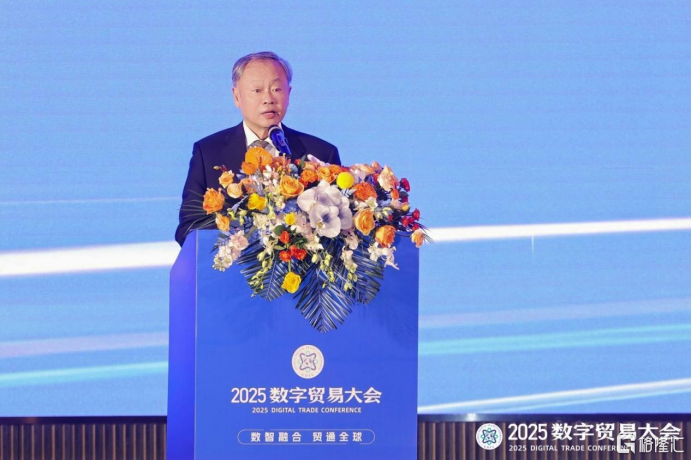
武汉集结全球智慧 2025数字贸易大会共话数字贸易新趋势
Ge Long Hui· 2025-11-21 02:31
Core Insights - The 2025 Digital Trade Conference, hosted by Zall Intelligent Logistics, focused on themes such as digital trade, artificial intelligence, smart marketing, and green supply chains, attracting hundreds of participants including government officials, diplomats, and industry experts [1][2] - Wuhan's strategic position as a national central city and international transportation hub facilitates active trade with 225 countries, with cross-border e-commerce imports and exports growing at an annual rate of 48.3% during the 14th Five-Year Plan period [1] - The Chinese Commercial Federation aims to position Wuhan as a digital economy benchmark in Central China, leveraging its geographical advantages and promoting cooperation with Latin America in digital trade and smart logistics [2] Digital Trade Trends - Digital trade has become a national strategy in China, with significant growth in scale and a positive outlook, driven by the integration of products and digital services, with AI identified as a key driver [3][7] - The conference highlighted the importance of balancing security and development in digital trade governance and the need for participation in international rule-making [3] AI and Industry Upgrades - Experts discussed the advancements in multimodal AI applications across various sectors, emphasizing the need for ethical standards and technical optimization to address challenges such as privacy and misinformation [5] - AI is viewed as a tool for leveling the playing field, with trends in logical capability enhancement and multi-expert model efficiency optimization being noted [5] Marketing and Supply Chain Innovations - The conference featured discussions on smart marketing and green supply chains, with emphasis on AI's role in improving operational efficiency and brand engagement through precise traffic acquisition and intelligent content generation [6][9] - Companies are encouraged to transition from customer acquisition to brand resonance, focusing on emerging markets in Latin America and Central Asia through product innovation and diverse content dissemination [6] Green Transformation - The importance of green supply chain construction was highlighted, with companies urged to adopt digital tools for carbon footprint management in response to international compliance requirements and market demands [9] - The conference also announced the release of the "2025 Wuhan Digital Trade Development Innovation Practice Case," showcasing successful digital innovation solutions from various companies [9]
营销改革,让老字号走近年轻人
Xin Jing Bao· 2025-11-18 01:50
Core Viewpoint - The company Tong Ren Tang, with a history of over 350 years, is actively reforming its marketing strategies to remain competitive in the market, focusing on innovative approaches to engage younger consumers and enhance brand recognition [1][2][3]. Group 1: Marketing Strategies - Tong Ren Tang has implemented a "saturation-free" marketing strategy, which has been recognized with an award for innovation in state-owned enterprise reform [1]. - The company is focusing on a "big variety" strategy for its well-known products, enhancing its marketing system and channel construction to adapt to new market conditions [2]. - The brand has successfully created IP images such as "Yuan Zong" and "Bai Feng," which resonate with consumers, leading to significant exposure and increased product awareness [3]. Group 2: Product Development and Cultural Integration - The "Royal Medicine Legend" product series has been launched, featuring upgrades in raw materials, packaging, and adherence to traditional manufacturing standards, aiming to provide higher quality and healthier options [3]. - A cultural exhibition titled "Royal Medicine Legend" has been organized to showcase the history of Tong Ren Tang's royal medicine, promoting traditional Chinese medicine culture [3]. Group 3: Digital Transformation and Consumer Engagement - The company has developed a data visualization platform that utilizes big data and AI to enhance marketing management and decision-making processes [4]. - An AI-driven health service platform, in collaboration with Xiaomi, has been introduced to provide personalized health advice and medication safety recommendations through mobile devices [4]. Group 4: Cultural Promotion and Heritage - Tong Ren Tang is committed to promoting traditional Chinese medicine culture through participation in various exhibitions and the establishment of a cultural display center [7]. - The company has initiated programs to preserve traditional manufacturing techniques and knowledge, including the establishment of a national-level workshop for traditional medicine artisans [8].

京东携手兰蔻重构梯媒场景,打造美妆行业即时互动营销新标杆
Jin Tou Wang· 2025-09-16 09:41
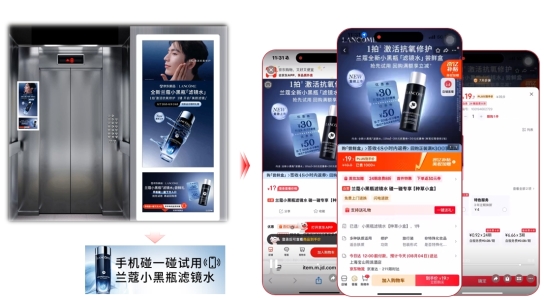
Core Insights - The current trend shows a slowdown in online traffic growth, prompting brands to turn to offline advertising as a strategic choice to overcome growth bottlenecks and reshape user perception [1] - The challenge lies in enhancing traditional advertising methods, particularly in creating interactive experiences that bridge the gap between one-way communication and consumer engagement [1] Group 1: Marketing Strategy - JD.com partnered with Lancôme to launch the new "Filter Water" product using an innovative community elevator media interaction format, addressing key pain points in the beauty industry related to new product launches and user trial costs [1] - JD's comprehensive data capabilities enable precise targeting of high-value consumer segments, focusing on beauty enthusiasts, brand fans, and high purchasing power groups, thereby improving the return on marketing investment [2] Group 2: Technological Innovation - The introduction of the industry-first NFC "tap to receive" feature allows consumers to interact with Lancôme's advertisements in elevators, significantly lowering the barrier to participation [5] - This seamless integration of logistics ensures that samples are delivered directly to consumers' homes after they engage with the advertisement [5] Group 3: Campaign Results - The marketing campaign successfully reached over 3 million people, with more than 2 million new customers engaged, achieving a new customer conversion rate exceeding 30% [5] - The collaboration between JD.com and Lancôme exemplifies the unique marketing value of offline advertising enhanced by digital capabilities, setting a benchmark for efficient growth in the offline advertising sector [5]