咖啡连锁

Search documents
韩国星巴克禁止携带台式电脑打印机等大型设备
3 6 Ke· 2025-08-15 03:49
Core Viewpoint - Starbucks Korea has implemented a policy prohibiting customers from bringing large work equipment into stores to enhance the in-store experience for all customers [1] Group 1: Policy Changes - The new policy specifically bans desktop computers, printers, and other bulky items that may limit seating and affect shared space [1] - The company continues to promote the concept of a "popular third space" for customers [1] Group 2: Customer Behavior - A professor from Curtin University noted that working remotely at Starbucks has become an economical option, as customers only need to purchase a coffee to work there, but this has led to overuse [1] - Currently, Starbucks in China is promoting the idea of office/study spaces, showcasing examples of stores being used as study rooms [1]


【省钱】0.99元起购36元立减金,省钱秘籍来啦
中国建设银行· 2025-08-13 08:15
Group 1 - The article discusses a promotional event by a bank, offering discounts and cash rebates for users of its app during August 2025 [1][8]. - The promotion includes various thresholds for cash rebates, such as a 10 yuan rebate for purchases over 10.01 yuan and a 5 yuan rebate for purchases over 5.01 yuan [8]. - The participating merchants include popular brands like Luckin Coffee and Tmall Supermarket, indicating a broad range of options for consumers [9].

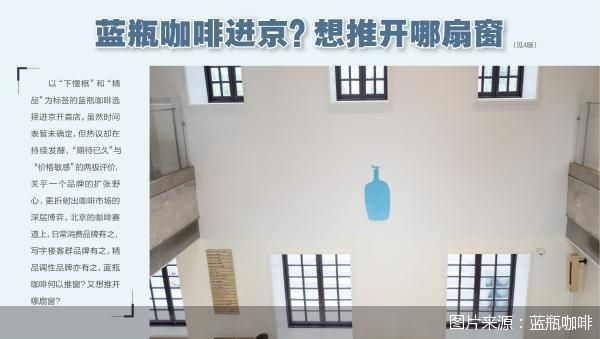
进京姗姗来迟 蓝瓶咖啡能否以慢制快
Bei Jing Shang Bao· 2025-08-12 16:12
Core Insights - Blue Bottle Coffee is planning to enter the Beijing market, sparking discussions about its potential success against established competitors like Luckin Coffee and Starbucks [3][5] - The brand's cautious approach to expansion contrasts with its previous rapid growth in Shanghai, where it opened its first store in 2022 [4][6] - The coffee market in Beijing is characterized by diverse competition, with various brands targeting different consumer segments, making Blue Bottle's entry challenging [7][8] Company Expansion Plans - Blue Bottle Coffee's potential opening of three stores in Beijing is under consideration, with locations being evaluated in popular areas like Sanlitun and Guomao [3][5] - The company has been slow in expanding its presence in China, averaging fewer than five new stores per year since its first opening in Shanghai [5][6] - Despite its slow growth, Blue Bottle Coffee's expansion in China is relatively faster compared to its global pace, indicating a strategic focus on the Chinese market [6] Market Dynamics - The coffee market in Beijing is competitive, with brands like Luckin and Starbucks dominating the low-price segment, while others focus on high-end consumers [7] - Blue Bottle Coffee's brand positioning as a premium coffee provider may attract quality-seeking consumers, but it must adapt to local preferences to succeed [7][8] - The company faces challenges in maintaining its brand identity while appealing to a broader audience in a market with high rental costs and intense competition [8]
在商场蹭空调,去麦当劳打牌:城市空间向谁开放?
Hu Xiu· 2025-08-12 09:45
Group 1 - The article discusses the increasing presence of elderly individuals in urban spaces such as cafes and fast-food restaurants, highlighting their need for social interaction and cooling spaces during summer [1][3][8] - It points out the lack of suitable urban spaces that cater to diverse demographic needs, leading to conflicts over space usage between different age groups [2][11][12] - The article references sociologist William H. Whyte's findings that people are drawn to crowded spaces despite claiming to prefer solitude, indicating a fundamental human need for connection [4][5] Group 2 - The article emphasizes the active role of elderly individuals in claiming urban spaces, often competing with younger demographics for access to recreational areas [10][13] - It discusses the transformation of urban spaces due to commercial interests, where businesses like Starbucks serve as informal public spaces, fulfilling social needs [16][18][20] - The article highlights the tension between standardized commercial spaces and the unique needs of different consumer groups, particularly the elderly [20][21][23] Group 3 - The article notes that urban planning often overlooks the needs of the elderly, leading to a lack of appropriate recreational facilities [11][13][14] - It discusses the concept of "public space" in the context of Chinese urban environments, where government and commercial interests often intersect, complicating the notion of accessibility [28][32] - The article concludes that the evolving nature of urban spaces requires a balance between commercial viability and the genuine public need for inclusive environments [25][26][32]
出售中国区业务,星巴克布下“死局”
虎嗅APP· 2025-08-11 00:14
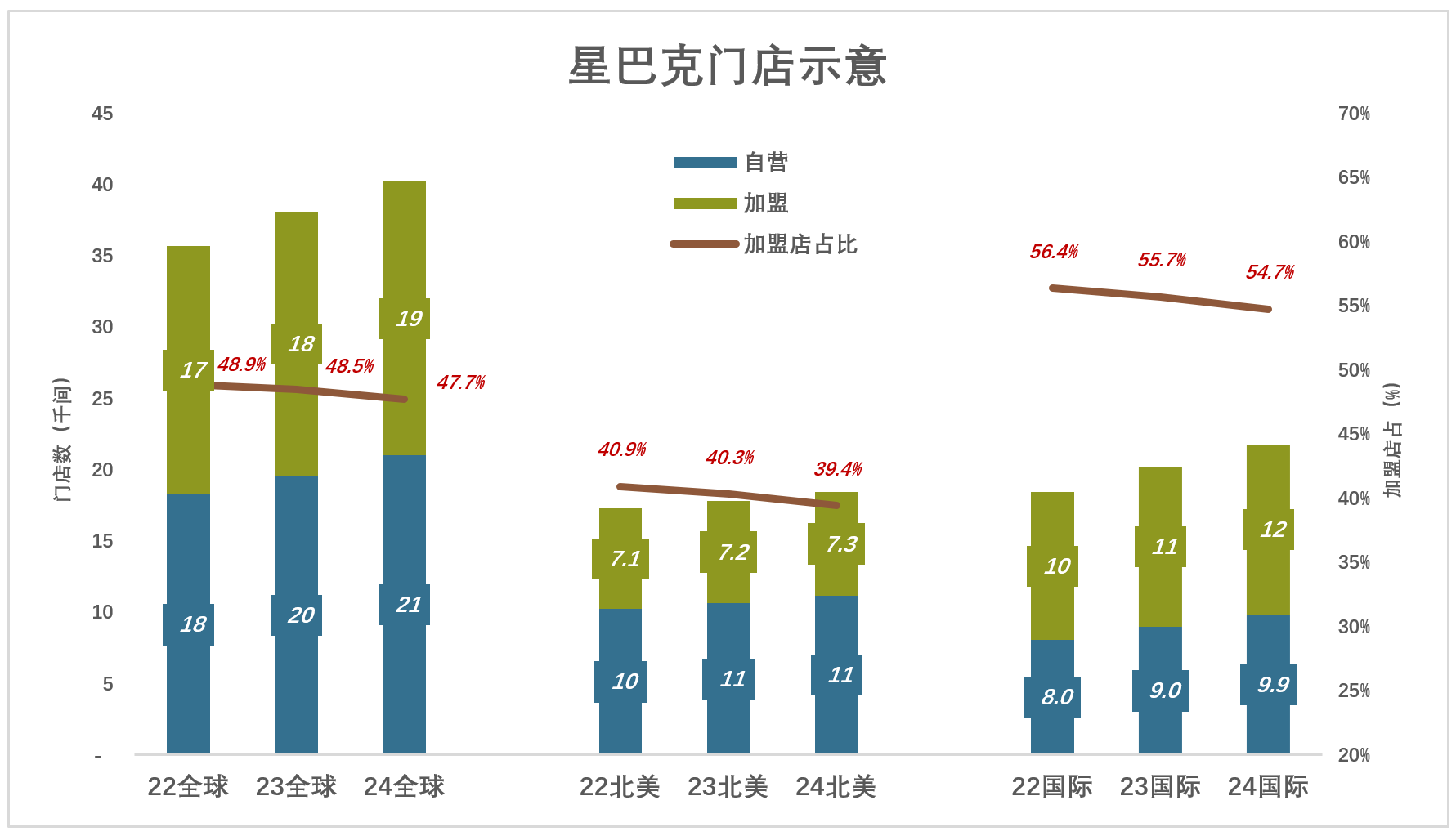
Core Viewpoint - Starbucks is considering selling 70% of its Chinese business while retaining 30%, which raises concerns about the feasibility and implications of such a strategy in the competitive market [5][30][34]. Group 1: Business Strategy and Market Position - Starbucks CEO expressed confidence in the Chinese market, stating the company is evaluating over 20 interested institutions for potential partnerships [5]. - The valuation of Starbucks' Chinese business is reported to be as high as $10 billion [5]. - The company has maintained a fully self-operated model in China, contrasting with its North American strategy, which has a mix of self-operated and franchised stores [8][12]. Group 2: Store Expansion and Performance - As of the end of fiscal year 2024, Starbucks had 40,200 stores globally, with 21,000 being self-operated, representing 47.7% of the total [10]. - The number of self-operated stores in China reached 7,594, significantly surpassing Japan's 1,809 stores [14]. - The company has seen a decline in market share in China, dropping to 14% by 2024, amid rising competition from local brands [16]. Group 3: Financial Performance and Profitability - In North America, self-operated stores contribute 90% of revenue but less than 50% of operating profit, highlighting the cost structure challenges [18]. - For fiscal year 2024, North American self-operated business reported an operating profit of $2.6 billion, with a profit margin of 10.7% [19]. - The international division, particularly in China, has shown promising growth, but the self-operated business has faced significant operating losses, with a loss rate of 14.3% [25][26]. Group 4: Strategic Challenges and Considerations - The proposed sale structure of retaining 30% equity while selling 70% to multiple buyers is viewed as problematic, potentially leading to governance issues and lack of control [30][34]. - The comparison with Uber's exit from the Chinese market illustrates the complexities and potential pitfalls of maintaining partial ownership in a competitive landscape [34]. - Starbucks' strategy of retaining a minority stake may hinder the ability to fully capitalize on the growth potential of its Chinese operations [34][35].
出售中国区业务,星巴克布下“死局”
Hu Xiu· 2025-08-11 00:04
Core Viewpoint - Starbucks is evaluating over 20 institutions with a strong interest in its China business, aiming to retain a significant equity stake while potentially selling 70% to multiple buyers, each holding no more than 30% [1][2]. Group 1: Business Strategy - Starbucks has adopted a fully self-operated model in China, contrasting with its North American strategy of a 60:40 self-operated to franchised ratio, which has been stable for years [3][6]. - The company has been gradually transitioning from a franchise model to a self-operated model in China since 2003, with the number of self-operated stores increasing significantly [6][20]. - The self-operated model allows for better service quality and brand image, while the eventual goal is to replicate the North American model of 60% self-operated and 40% franchised stores in China [8][19]. Group 2: Financial Performance - As of the end of fiscal year 2024, Starbucks had 7,594 self-operated stores in China, significantly outpacing its second-largest market, Japan [6][20]. - The international division's self-operated revenue for fiscal year 2024 was $5.51 billion, but the operating loss rate reached 14.3%, highlighting the challenges faced in international markets [16][17]. - The North American division's operating profit for fiscal year 2024 was $2.6 billion, with a profit margin of 10.7%, but faced a 30.6% year-over-year decline in operating profit for the first three quarters of fiscal year 2025 [12][17]. Group 3: Market Dynamics - Starbucks' market share in China has declined to 14% by 2024, facing strong competition from local brands like Luckin Coffee [9][20]. - The company’s strategy to retain 30% equity in its China business while selling the majority stake raises concerns about potential conflicts and operational challenges, similar to the Uber and Didi case [21][22]. - The proposed sale structure may lead to a "deadlock" situation, where the retained stake complicates the integration and operational independence of the new buyers [22][23].
存取5万元以上现金,或无需再登记;男子发布12字评论被拘,当地启动调查程序;俄方:扎波罗热核电站周边局势“变得危急”丨每经早参
Mei Ri Jing Ji Xin Wen· 2025-08-10 23:01
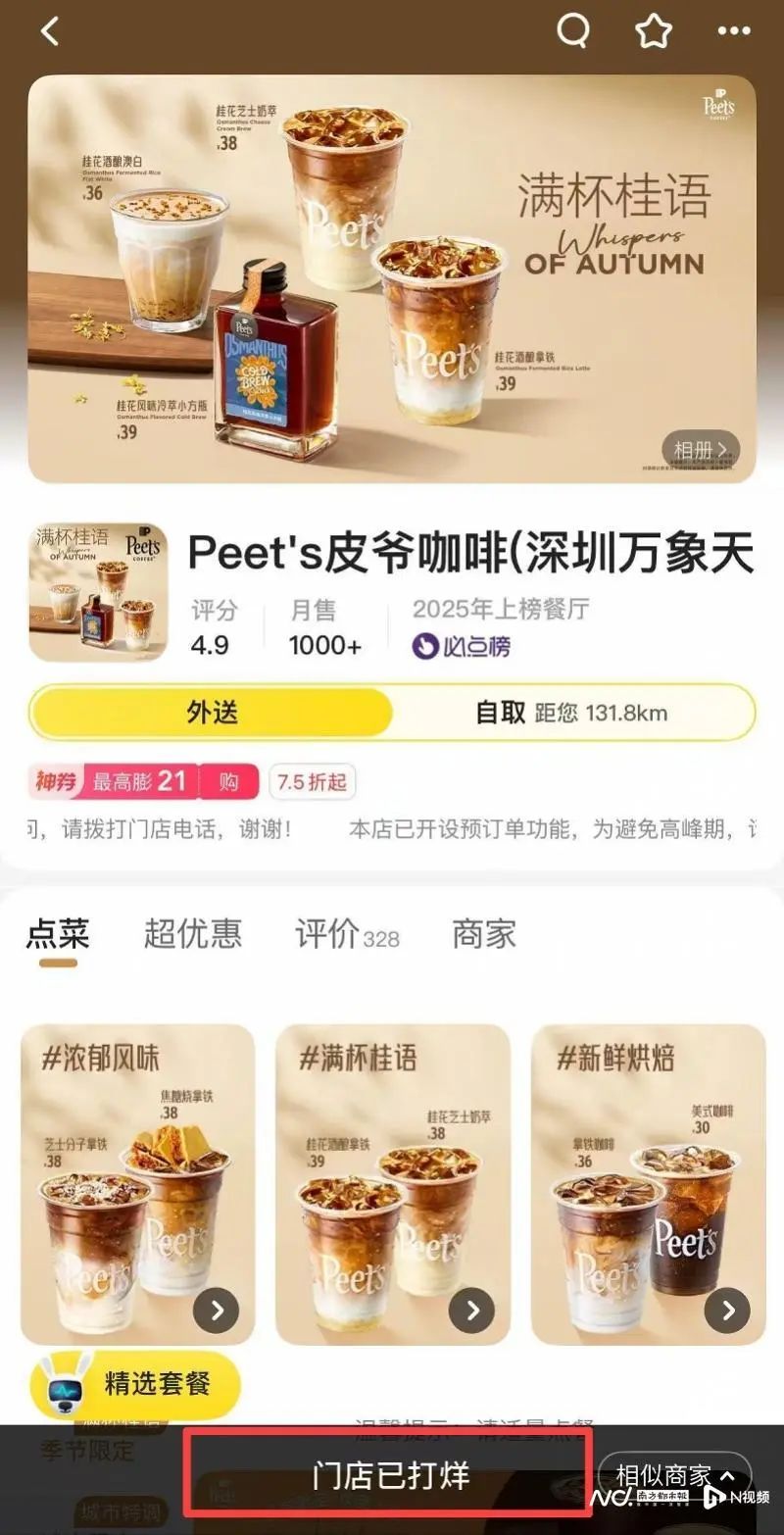
Group 1 - The People's Bank of China, the National Financial Regulatory Administration, and the China Securities Regulatory Commission jointly released a draft regulation on customer due diligence and transaction record management, which notably removes the requirement for individuals to declare the source or purpose of cash transactions over 50,000 yuan [4][1][2] - The draft regulation is open for public comments from August 4 to September 3, 2025 [4][1][2] Group 2 - Henan Province has introduced policies to support the development of specialized and innovative enterprises in the artificial intelligence sector, offering subsidies up to 500,000 yuan for national-level "little giant" companies [4][1][2] - The policies aim to enhance the ecosystem for artificial intelligence and promote the development of various AI terminal products [4][1][2] Group 3 - Yanjing Beer reported a revenue of approximately 8.558 billion yuan for the first half of 2025, a year-on-year increase of 6.37%, with a net profit of 1.103 billion yuan, up 45.45% from the previous year [15][1][2] - The company is actively expanding into the beverage market, with beverage product revenue reaching approximately 83.015 million yuan, a year-on-year growth of 98.69% [15][1][2] Group 4 - Southern Fund announced an investment of at least 230 million yuan into its equity funds, demonstrating confidence in its internal products [17][1][2] - This investment is expected to positively impact the performance of the funds involved [17][1][2] Group 5 - Peet's Coffee, known as the "ancestor of Starbucks," has closed several stores in China, including its first store in South China, citing regular operational strategy adjustments rather than a simple exit from the market [19][1][2] - The closures reflect the intense competition and adjustment pressures within the restaurant industry [19][1][2]



被誉为“星巴克祖师爷”,这一知名连锁品牌大量关店?公司最新回应
Mei Ri Jing Ji Xin Wen· 2025-08-10 09:42
Core Viewpoint - Peet's Coffee, a well-known global coffee chain, has closed its first store in South China, located in Shenzhen, due to the expiration of its lease, reflecting a strategic adjustment in its operations amid a competitive market [1][4][6]. Company Summary - Peet's Coffee opened its first store in South China in September 2021 and has operated for nearly four years before closing [4]. - The company has been closing several stores in China, including locations in Guangzhou, Hangzhou, and Beijing, primarily due to lease expirations [4][6]. - Peet's Coffee has approximately 270 stores across 20 provinces and 35 core cities in China, with plans to continue expanding its store count in the second half of the year [4][6]. - The parent company, JDE Peet's, reported a strong organic sales growth of 23.8% for Peet's Coffee in China, contributing to a global sales increase of 7.9% to €8.837 billion [4]. Industry Summary - The coffee market in China is experiencing intense competition, with various brands engaging in price wars, leading to a dilution of the premium coffee image [7][9]. - Analysts suggest that the restaurant industry is entering a phase of consolidation, where companies are closing underperforming stores while opening new ones in more strategic locations [7]. - Peet's Coffee is adapting to market changes by testing a more affordable product line with its Ora Coffee brand, offering products priced between 15 to 25 yuan, and implementing a "small and refined" store model to enhance operational efficiency [9].
9块9喝咖啡的风,还是吹到了美利坚?
3 6 Ke· 2025-08-07 00:34
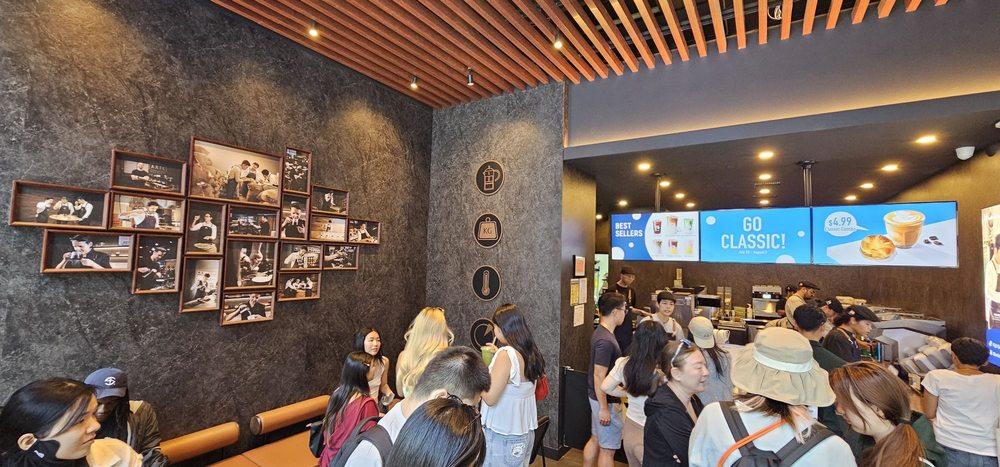
瑞幸"杀"回美国了。 2025年6月30日,瑞幸咖啡在美国的两家店同时开业,分别位于纽约曼哈顿百老汇大道和第六大道。 开业时间的选择很值得玩味。五年前,瑞幸因为财务造假事件遭遇成立以来的最大危机,最终从美国纳斯达克退市,正式停牌时间,是2020年6月29日。 第五年零一天,瑞幸带着咖啡重返美国。 临街的店铺上方仍然挂着熟悉的蓝白色小鹿logo,进门后直面柜台,六七个咖啡师正在忙碌地制作咖啡。墙上挂着一幅幅咖啡制作的照片,店里几把简单 的椅子和小桌子,提供短暂歇脚的地方。Lucy专门挑了傍晚的时间来到店里,排队的人不多。她打开手机,花费1.99美元下单一杯咖啡。点单五分钟后她 就拿到了饮品——在国内最喜欢的生椰拿铁。 图源Yelp 自国内外卖平台竞争加剧以来,瑞幸咖啡顺势加快了扩张步伐。 财报数据显示,在刚刚过去的2025年第二季度里,瑞幸实现营收123.6亿元,同比增长47.1%,新增2109家门店,同时创下近四个季度以来的最 高增速和最高开店数。 "九条命的猫",华尔街日报用这个词形容瑞幸咖啡,这家公司曾经被股市驱逐、被人认定失败,但成功卷土重来。如今它带着在中国赢过的打法,再一次 走上熟悉的擂台,对瑞幸而 ...
后悔,可口可乐对Costa表现不满,350亿元收购案为何令人失望?
3 6 Ke· 2025-08-05 03:43
Core Viewpoint - Coca-Cola is reassessing its investment in Costa Coffee, reflecting on past experiences and exploring new growth avenues in the coffee category after the acquisition did not meet expectations [1][3]. Group 1: Acquisition and Initial Expectations - Coca-Cola acquired Costa Coffee for $5.1 billion in 2018, aiming to enter the hot beverage market, which lacked a global brand presence [1][3]. - At the time of acquisition, Costa was the second-largest coffee chain globally, with nearly 4,000 stores and a robust supply chain [3]. - The acquisition was seen as a strategic move to compete with Starbucks and Nestlé in the rapidly growing beverage category [3]. Group 2: Performance Issues - Costa's revenue declined from approximately £1.3 billion in the 2018 fiscal year to £1.22 billion in the 2023 fiscal year, indicating underperformance post-acquisition [3]. - Analysts noted that while new products launched in the UK received positive feedback, Costa struggled in the competitive U.S. market, primarily focusing on B2B channels due to challenges in retail [6]. - Coca-Cola's lack of experience in operating coffee shops contributed to the difficulties in integrating Costa into its business model [6][7]. Group 3: Market Challenges in China - Costa entered the Chinese market in 2006 but has seen stagnation, with only about 400 stores compared to Starbucks' 7,596 stores as of 2024 [8][10]. - The brand has been overshadowed by local competitors like Luckin Coffee, which has rapidly expanded to over 21,000 stores [8][10]. - Despite plans to open 1,000 stores by 2025, Costa's store count has remained stagnant since 2020, with reports of closures in various cities [10][11]. Group 4: Strategic Adjustments - Coca-Cola has restructured Costa's operations in China, transferring management of coffee shop operations to its European division, which may slow decision-making [11]. - The focus for Costa in China is shifting towards ready-to-drink coffee products, an area where Coca-Cola has more expertise [13]. - Despite speculation about selling Costa, Coca-Cola has integrated the brand into its regular operations, indicating a commitment to the coffee segment for the time being [13].