保险业

Search documents
广东:加快提升金融业规模能级
Zhong Guo Zheng Quan Bao· 2026-01-26 20:54
Group 1 - The Guangdong provincial government aims for a GDP growth target of 4.5%-5% for the year, emphasizing the importance of a strong start to the 14th Five-Year Plan [1] - The report highlights the need to enhance the scale and capability of the financial sector, support insurance product innovation, and facilitate corporate financing and mergers [1] - By 2025, Guangdong's GDP is projected to grow by 3.9%, maintaining its position as the top province in China for 37 consecutive years, with public budget revenue increasing by 3% and goods import-export growth at 4.4% [1] Group 2 - The report emphasizes the acceleration of emerging industries such as new energy, new materials, and smart vehicles, aiming to cultivate more pillar industries [2] - It calls for strengthening original innovation and tackling key core technologies, particularly in quantum technology, artificial intelligence, and integrated circuits [2] - In the real estate sector, the focus is on stabilizing the market through targeted policies, promoting the utilization of idle commercial properties, and enhancing the quality of housing and property services [2]
健康险解决创新药支付三部曲
2 1 Shi Ji Jing Ji Bao Dao· 2026-01-26 13:01
Core Viewpoint - The commercial health insurance sector is increasingly positioned as a crucial component of China's multi-tiered medical security system, especially in the context of high prices for innovative drugs and tightening medical insurance payment spaces [1][4]. Group 1: Growth of Commercial Health Insurance - The compensation scale for innovative drugs and medical devices by commercial health insurance has been growing rapidly, with a projected total compensation amount of approximately 14.7 billion yuan by 2025, reflecting a compound annual growth rate of 70% over four consecutive years [3][4]. - The demand for high-quality health insurance is rising due to limited accessibility to high-quality medical services under the current medical insurance system, making commercial health insurance an important supplement [3][4]. Group 2: Challenges Faced by the Industry - The lack of reliable incidence and cost data presents a significant challenge for commercial health insurance in assessing risks associated with innovative drugs, leading to potential profit erosion and losses for insurance companies [5][6][7]. - The industry is working on creating a unified net cost table for commercial medical insurance to improve risk assessment and pricing accuracy, which has historically relied on limited internal data [8][9]. Group 3: Industry Collaboration and Investment - Insurance companies are transitioning from being mere financial payers to becoming collaborative partners within the medical industry, leveraging their capital to support healthcare and elderly care sectors [10][12]. - By 2025, insurance funds are expected to invest over 150 billion yuan in medical-related projects, with direct equity investments in the healthcare sector nearing 30 billion yuan [11][12]. Group 4: Regulatory Environment and Future Directions - The China Insurance Industry Association emphasizes the need to adhere to fundamental insurance principles while expanding product offerings, reflecting a shift towards sustainable commercial practices [14][17]. - The relationship between the National Medical Insurance Administration and the National Financial Regulatory Bureau is characterized by both cooperation and competition, with the former pushing for commercial health insurance to take on more responsibilities [15][16][17].


1.26犀牛财经晚报:全球首次人形机器人直连低轨高通量卫星试验成功
Xi Niu Cai Jing· 2026-01-26 10:28
Group 1 - Multiple heavyweight stocks experienced significant sell orders at the close, with Zijin Mining's sell order amount exceeding 4 billion yuan [1] - The head of broad-based ETFs has seen a continuous reduction in shares, with the average share reduction of 27.24% for six large-scale ETFs over the past seven trading days [1] - The CSI 1000 ETFs have seen a dramatic decline, with an average share reduction of 47.9% over the same period, and two products experiencing a drop of over 50% [1] Group 2 - The Dalian Commodity Exchange announced the listing parameters for soybean meal and corn options, set to begin trading on February 2 [2] - The international gold price has reached a new high, with spot gold surpassing 5,100 USD per ounce, leading to a rise in gold jewelry prices in Shenzhen [3] - The global laptop shipment is expected to decrease by 14.8% in Q1 2026 due to rising prices of CPUs and memory [4] Group 3 - The global production of lithium iron phosphate is projected to reach 70,000 tons by 2026, up from 28,500 tons in 2025, driven by demand in electric vehicles and consumer electronics [4] - SoftBank has terminated negotiations to acquire data center operator Switch, impacting its AI infrastructure ambitions [5] - Porsche plans to reduce its dealer network by 30% this year, with no current plans for local production in China [5] Group 4 - Hunan Gold plans to integrate gold mines, expecting to add approximately 4 tons of gold reserves upon reaching production capacity [7] - The stock of *ST Tianshan may face delisting due to projected losses of 16 million to 23 million yuan for 2025 [9] - Jiangzhong Pharmaceutical will change its stock name to "China Resources Jiangzhong" to enhance brand recognition [10] Group 5 - Changyuan Donggu received a notice of being selected as a supplier for a well-known domestic passenger car project, with an estimated sales amount of 2.2 billion to 3 billion yuan [11] - Shankai Intelligent won a project for developing a smart water service platform, with a bid amount of 12.11 million yuan [12] - Several companies, including Koli Yuan and Shenling Environment, forecast significant profit increases for 2025, with expected growth rates ranging from 49.69% to 420% [13][14][15][17][19]

小摩:偏好中国人寿(02628)及中国平安(02318)增长前景胜地区同业
智通财经网· 2026-01-26 06:33
报告同时指出,美元保单需求保持稳健,第三季度同比增长48%,反映在内地保证利率下调后,香港寿 险市场在产品多元性及回报竞争力方面的优势。展望第四季度,小摩预期在销售佣金率调整前,代理及 经纪渠道将共同推动新单业务保持强劲。此外,内地保险公司自2025年9月起下调非分红险保证利率, 可能进一步刺激内地访客对香港保险产品的需求。 智通财经APP获悉,摩根大通发布研报称,香港寿险业在2025年第三季度再次创下新单销售纪录,首年 保费达910亿元,同比大幅增长69%。然而,该行认为虽然销售量创新高,但整体产品结构及业务发展 的健康度不及近期季度,并预期在监管趋紧的背景下,管理增长动能将成为2026年关键。小摩表示, 2026年更偏好中国人寿(02628)及中国平安(02318),认为其业务增长前景优于其他地区同业。 小摩表示,香港保险业监管局计划自2026年1月起下调前端销售佣金,促使经纪渠道销售贡献显著提 升,第三季度占新单保费比例达35%,同比增加8个百分点。 ...


国债周报:债期超长端温和修复-20260126
Guo Mao Qi Huo· 2026-01-26 05:09
1. Report Industry Investment Rating - No relevant information provided in the content 2. Core Viewpoints - Last week, the Treasury bond futures market showed an oscillating upward trend, with ultra - long - term varieties performing particularly prominently. The main drivers for the bond market's strength this week were allocation demand and foreign capital inflows. The central bank's large - scale liquidity injection and the indication of a moderately loose monetary policy also provided support [4]. - In the short term, the Treasury bond futures market is expected to continue the oscillating pattern, and it is difficult to form a unilateral trend. In the long term, the bond market's trend will depend on the sustainability of economic recovery, the actual strength of fiscal policy, and the future direction of monetary policy [6]. 3. Summary by Relevant Catalogs 3.1 Part One: Main Viewpoints - **Market Performance**: The Treasury bond futures market showed an oscillating upward trend last week, with ultra - long - term varieties standing out. At the beginning of the week, there was obvious market differentiation, but the 30 - year Treasury bond futures gradually strengthened in the following three trading days, and all contracts closed up on Friday [4]. - **Driving Factors**: The main reasons for the bond market's strength were the continuous allocation demand for long - term interest - rate bonds from institutions such as banks and insurance companies, and the inflow of overseas hedging funds. The central bank's indication of a moderately loose monetary policy and a large - scale liquidity injection also played a role [4]. - **Market Outlook**: In the short term, the market is expected to oscillate, with multiple long and short factors at play. In the long term, the bond market's trend will be affected by economic recovery, fiscal policy, and monetary policy [6]. 3.2 Part Two: Liquidity Tracking - The content includes a large number of charts related to liquidity, such as open - market operations (including currency投放, currency回笼, and net投放), medium - term lending facilities (in terms of quantity and price), various interest rates (reverse repurchase rate, deposit - based pledge - style repurchase rate, SHIBOR, etc.), LPR, deposit reserve ratio, Treasury bond yields, and US Treasury bond yields [10][11][13] 3.3 Part Three: Treasury Bond Futures Arbitrage Indicator Tracking - The report tracks various arbitrage indicators of Treasury bond futures, including basis, net basis, IRR, and implied interest rate for 2 - year, 5 - year, 10 - year, and 30 - year Treasury bond futures [41][42][44]
邯郸金融监管分局同意中汇人寿邯郸市峰峰支公司变更营业场所
Jin Tou Wang· 2026-01-26 03:32
Group 1 - The financial regulatory bureau of Handan approved the request from Zhonghui Life Insurance Co., Ltd. Hebei Branch for the relocation of its Fengfeng sub-branch [1] - The new business location for the Fengfeng sub-branch is specified as Room 301, 3rd Floor, Leyi Building, No. 1 Baowei Road, Fengfeng Mining District, Handan City, Hebei Province [1] - Zhonghui Life Insurance Co., Ltd. is required to timely handle the change and obtain the necessary permits as per relevant regulations [1]
东吴证券:政策引导+行协牵头,保险业布局康养领域进程再加速
Zhi Tong Cai Jing· 2026-01-26 02:57
Group 1: Industry Insights - The insurance industry is experiencing continuous improvement on both the liability and asset sides, with significant upward valuation potential remaining [1] - The China Insurance Industry Association held a seminar focusing on the high-quality development of commercial health insurance, highlighting a compound annual growth rate of over 20% in the past decade for commercial health insurance [2] - The Shanghai Financial Regulatory Bureau released an action plan for the high-quality development of pension finance, proposing 20 measures to enhance the pension system and support the pension industry [3] Group 2: Company Developments - Major insurance companies, including China Life and PICC, have established specialized health management subsidiaries to create a comprehensive health and wellness service ecosystem [4] - The establishment of health management companies is expected to accelerate the pace of insurance institutions' layout in the health and wellness sector, leveraging policy guidance to develop a second growth curve through the "insurance products + health services" model [4]

中国改革现场丨可以抵押的猪牛羊
Yang Guang Wang· 2026-01-26 01:57
Core Viewpoint - The recent policy by the People's Bank of China and other authorities to allow livestock and agricultural facilities as collateral for loans aims to unlock the financial potential of rural assets, addressing long-standing financing challenges in agriculture [1][8]. Group 1: Policy Changes - The People's Bank of China, Ministry of Agriculture and Rural Affairs, and National Financial Regulatory Administration issued a notice to promote the use of agricultural facilities and livestock as legal collateral for loans [1][8]. - The policy aims to resolve issues related to the difficulty of asset valuation and the lack of liquidity in rural financing [8][16]. Group 2: Case Study - Livestock Financing - In Mengcheng County, Anhui Province, a cattle farm successfully obtained a loan of 2 million yuan by using livestock as collateral, a process previously deemed impossible [1][5]. - The local bank introduced an "insurance + credit" model, allowing farmers to use livestock insurance as collateral, thus reducing financing difficulties [5][7]. - The bank provided loans totaling 35 million yuan to approximately 35 livestock farmers in Mengcheng County, demonstrating the effectiveness of the new financing model [7][12]. Group 3: Challenges in Agricultural Financing - Traditional financing methods for agriculture have been limited, relying on credit loans and government guarantees, which are not sustainable for new agricultural entities [4][8]. - The risk associated with livestock financing, such as disease outbreaks, has made banks hesitant to accept live animals as collateral [4][8]. Group 4: Technological Innovations - The new policy encourages the use of digital technologies like electronic ear tags and biometric identification to establish ownership and value for livestock, addressing the challenges of asset identification and valuation [8][16]. - A comprehensive system combining technology and regulation is proposed to facilitate the identification, tracking, and risk management of agricultural assets [13][16]. Group 5: Case Study - Flower Farming Financing - In Kunming, Yunnan Province, flower farmers face high costs for greenhouse construction, which cannot be used as collateral due to lack of ownership documentation [9][10]. - Local financial institutions have begun to accept land use rights and attached structures as collateral, enabling flower farmers to secure loans [14][15]. - By 2025, the Kunming Rural Credit Cooperative provided 717 million yuan in loans to flower farmers, showcasing the potential of the new financing model [14][16].
一齐发声,精准发力:多方共促商保医保协同发展!
Sou Hu Cai Jing· 2026-01-26 01:28
Core Viewpoint - The high-quality development of commercial health insurance is both an internal requirement for the industry's transformation and an essential responsibility to support national strategies and ensure public welfare [1][10]. Group 1: Policy and Regulatory Framework - Nine government departments, including the Ministry of Commerce and the National Health Commission, jointly issued opinions to promote the high-quality development of the drug retail industry, emphasizing the construction of a commercial insurance payment guarantee system [1]. - The opinions encourage insurance institutions to develop commercial health insurance products that meet diverse public needs and support the establishment of risk-sharing mechanisms between drug retail enterprises and insurance institutions [1][10]. Group 2: Industry Collaboration and Development - The China Insurance Industry Association is actively promoting cross-industry communication and developing model clauses for commercial medical insurance, aiming to enhance public awareness of health insurance [2]. - The insurance industry will focus on responding to market demands and supporting national priorities, such as addressing population aging and promoting innovative drugs [2]. Group 3: Actuarial Insights and Cost Management - The Actuarial Association is focusing on cost measurement, experience analysis, and pricing optimization to ensure sustainable development in commercial health insurance [3]. - Key initiatives include compiling a net cost table for commercial medical insurance and conducting cost analysis for innovative drugs to align insurance rates with underwriting risks [3][4]. Group 4: Investment and Financial Support - Insurance funds are a significant source of long-term capital for the healthcare and elderly care industries, with over 150 billion yuan invested in medical-related fields by 2025 [6][7]. - Direct investments in healthcare and elderly care sectors have reached nearly 30 billion yuan, supporting various sub-sectors, including biotechnology and medical devices [6]. Group 5: Data Infrastructure and Information Sharing - The China Silver Insurance Company is building a data infrastructure to support the development of commercial health insurance, focusing on information sharing between medical insurance and commercial insurance [8][9]. - Efforts include creating intelligent product verification systems and enhancing data research to support decision-making in the industry [8]. Group 6: Market Growth and Future Outlook - The commercial health insurance sector has experienced explosive growth over the past decade, with an average annual growth rate exceeding 20% and over 11,000 medical insurance products available [10]. - By 2025, the total compensation for innovative drugs and devices is estimated to reach 14.7 billion yuan, reflecting a compound annual growth rate of 70% [11]. - The strategic positioning of commercial health insurance is becoming clearer, with a roadmap established for its role in the national health security system by 2030 [11][12].
农险扩面提质结硕果
Jing Ji Ri Bao· 2026-01-25 22:17
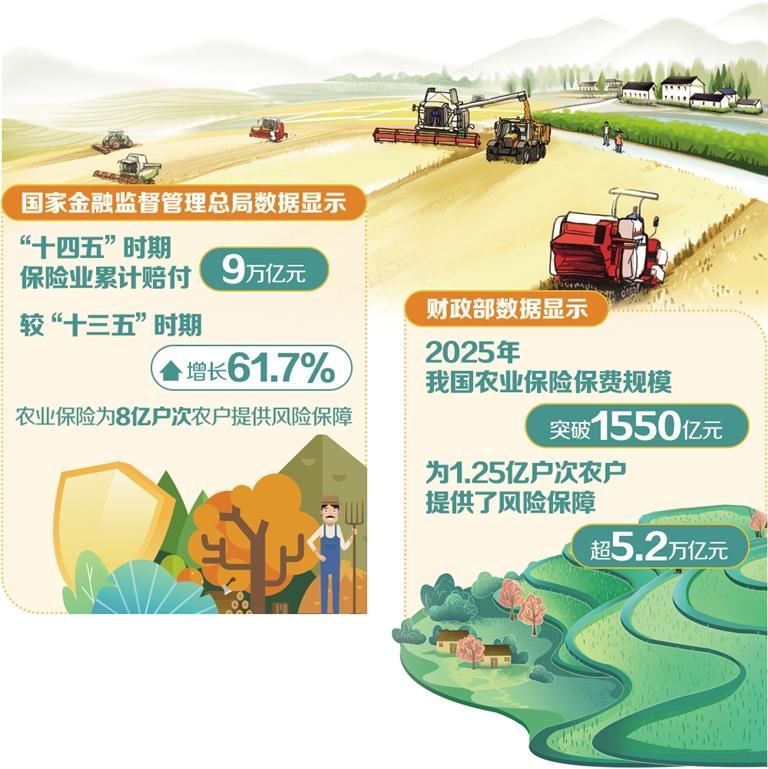
Core Insights - The central economic and rural work meetings in 2025 have systematically deployed strategies for "three rural issues," emphasizing the importance of agricultural insurance in supporting rural revitalization and food security [2] - Agricultural insurance premiums in China have steadily increased, with a total payout of 9 trillion yuan during the 14th Five-Year Plan, marking a 61.7% increase compared to the previous plan [2] - The agricultural insurance sector is evolving from cost coverage to income protection, addressing significant disaster risks associated with agricultural production [4] Agricultural Insurance Development - The planting areas of rice, wheat, and corn account for over 80% of China's total grain area, with these crops being the main focus of agricultural insurance policies [3] - The development of agricultural insurance has progressed in stages every 5 to 6 years, with the introduction of basic insurance in 2007 and the expansion of comprehensive cost and income insurance starting in 2018 [3] - In 2023, agricultural insurance payouts exceeded 2.6 billion yuan due to adverse weather conditions affecting wheat crops, demonstrating the critical role of insurance in mitigating farmers' losses [3] Expansion of Coverage - The scope of comprehensive cost and income insurance is expanding, with new policies for sugarcane and soybeans set to cover more regions by 2026 [4] - The establishment of a disaster model for major crops aims to assess risks from various natural disasters, enhancing the insurance framework [4] Specialized Agricultural Products - Agricultural insurance in China is categorized into central government-subsidized products and local specialty products, with a focus on expanding coverage and improving product offerings [5] - Insurance products tailored for geographical indication agricultural products have been developed, providing significant risk coverage for specific crops [5] Technological Integration - The insurance sector is increasingly adopting digital transformation to enhance efficiency in underwriting and claims processing, with a focus on a comprehensive risk management service model [7] - The use of advanced technologies such as drones and AI is being encouraged to improve the accuracy and timeliness of insurance services [10] Future Outlook - By 2025, agricultural insurance premiums are projected to exceed 155 billion yuan, providing risk coverage for over 1.25 billion farmers [11] - The Ministry of Finance plans to continue enhancing the quality and efficiency of agricultural insurance, with a guiding document expected in 2026 to support high-quality development [11]