生物医药

Search documents
ST未名2026年2月27日涨停分析:药品许可+股权收回+亏损收窄
Xin Lang Cai Jing· 2026-02-27 06:42
Core Viewpoint - ST Unimed (SZ002581) experienced a trading halt with a price of 8.4 yuan, reflecting a 5% increase, and a total market capitalization of 5.542 billion yuan, driven by positive developments in its business operations and market conditions [1][2]. Group 1: Company Developments - The subsidiary of the company obtained a pharmaceutical operating license, which is expected to enhance its pharmaceutical industry chain layout and positively impact long-term business development [2]. - The company won a legal case to recover 34% of its equity in Xiamen Unimed and received compensation, strengthening its control over related business operations [2]. - The company's losses for 2025 narrowed by 34.46% to 59.95% year-on-year, indicating an improvement in operational conditions and effectiveness in strategic adjustments or cost control [2]. Group 2: Market and Technical Analysis - The biopharmaceutical sector showed active performance on February 27, 2026, contributing to a sector-wide momentum that benefited the company, which specializes in interferon, nerve growth factors, and vaccines [2]. - Technical indicators such as the MACD may form a golden cross, and short-term moving averages are in a bullish arrangement, suggesting potential upward momentum [2]. - There was a net inflow of large orders on that day, indicating that major funds are paying attention to and participating in the stock, which contributed to the price increase [2].

国都港股操作导航:每日投资策略:港股高开低收,恒指收跌 384 点-20260227
Guodu Securities Hongkong· 2026-02-27 05:52
Group 1: Market Overview - The Hang Seng Index opened high but closed down 384 points, or 1.44%, at 26,381 points, with significant selling pressure observed throughout the day [3][4] - The market saw a total turnover of 25.93 billion HKD, with net outflow from northbound trading amounting to 736.6 million HKD [3] Group 2: Company Performance - NIO's subsidiary GeniTech secured over 2.257 billion RMB in investment from Chinese investors, maintaining a 62.7% controlling stake post-transaction [12] - New World Department Store China reported a 3.93 times increase in interim profit to 15.327 million HKD, despite a 12.44% decrease in revenue to 536 million HKD [13] - Chow Tai Fook Jewelry Group announced a 15.26% increase in interim profit to 1.334 billion HKD, with revenue rising 5.9% to 12.827 billion HKD [14] - Baidu reported a 65.68% decrease in net profit to 1.782 billion RMB for the fourth quarter, with total revenue declining 4.06% to 32.74 billion RMB [15] Group 3: Industry Developments - Hong Kong Exchanges and Clearing is exploring the development of a multi-asset tokenization platform, contingent on technological capabilities and market demand [7] - The People's Bank of China issued a notice to enhance the management of RMB cross-border interbank financing, aiming to improve transparency and stability in offshore RMB liquidity [10] - The Hong Kong government plans to inject 10 billion HKD into the Hong Kong-Shenzhen Innovation and Technology Park and the New Territories Science Park to bolster public-private partnerships [9]





新引进500万以上项目314个!2025年清远工业干了这些大事
Xin Lang Cai Jing· 2026-02-27 04:57
Group 1 - The manufacturing value-added growth rate is 6.7%, which is 3.5 percentage points higher than the provincial growth rate of 3.2% [2] - The city ranks third in the province for manufacturing investment growth, indicating stable growth in the manufacturing sector [2][3] - The city has successfully introduced 314 projects with investments below 5 million and 175 projects for orderly industrial transfer, completing 253.6% of the provincial task [3] Group 2 - The main platforms in Qingyuan, including Qingcheng, Qingxin, and Fogang industrial parks, have been rated as the best in the province, showcasing a focus on clustered and specialized development [4] - The city has implemented the "High-Quality Development Action Plan for Industrial Parks," which includes reforms in approval services and the establishment of a service mechanism for parks [6] Group 3 - The city is focusing on building a modern industrial system, categorizing and nurturing emerging, traditional, and future industries [8] - A total of 172 small enterprises have been upgraded to standardized industrial enterprises, contributing to the industrial base [26] Group 4 - The city has created 3 provincial-level characteristic industrial clusters, ranking first in northern Guangdong [11] - The food industry in Qingcheng has been selected as a pilot county for provincial food industry cultivation, with two pilot counties in total [12] Group 5 - The city has established 31 provincial-level enterprise technology centers and has one enterprise listed in the Ministry of Industry and Information Technology's key cultivation list for pilot platforms [32] - A total of 13 new provincial-level green factories have been added, bringing the cumulative total to 39, leading in both new and cumulative numbers in northern Guangdong [32] Group 6 - The electronic information manufacturing industry has achieved an output value of 362.9 billion, with a year-on-year growth of 14.8% [44] - The city has built 11,462 5G base stations, achieving full coverage in key areas, with a broadband user base of 1.398 million and a 5G user base of 2.864 million, resulting in a penetration rate of 71.8% [43]


海南产经新观察:稳步扩开放引外资
Zhong Guo Xin Wen Wang· 2026-02-27 03:31
Core Viewpoint - Hainan Free Trade Port is striving to become a strategic hub for global capital to access the Chinese market by implementing a series of supportive policies for foreign enterprises and investors [1] Group 1: Policy Implementation - By 2025, Hainan aims to ensure the smooth implementation of core policies, establishing a tax system characterized by "zero tariffs, low tax rates, and simplified tax regulations," which will provide foreign enterprises with direct and long-term competitive advantages [2] - Hainan is expanding its openness and promoting investment liberalization and facilitation, utilizing the shortest negative list for foreign investment in the country and implementing measures to fully remove restrictions on foreign investment in the manufacturing sector [2] - A financial system is being developed to facilitate cross-border capital flow, including the establishment of a multi-functional free trade account system and simplified processes for foreign debt and listing [2] Group 2: Foreign Investment Attraction - In 2025, Hainan is expected to establish 2,549 new foreign-funded enterprises, a year-on-year increase of 23.2%, with actual foreign investment reaching 25.103 billion yuan, up 19.9% [4] - Major foreign enterprises are actively investing in various sectors, including Siemens Energy establishing a green energy innovation research center and hydrogen equipment manufacturing base in Hainan [4] - The establishment of Hainan Lausanne Tourism University by the Swiss Lausanne Hotel Management School and the opening of the first wholly foreign-owned hospital project by Singapore's Parkway Group highlight the growing foreign investment in education and healthcare [4] Group 3: Future Strategies - Hainan plans to continue attracting international enterprises and investors by steadily expanding openness in key sectors such as value-added telecommunications and biotechnology [5] - The province will focus on targeted recruitment from specific countries, such as the UAE, and prioritize high-end tourism, healthcare, information technology, and marine economy sectors [6] - A comprehensive service and management system for foreign enterprises throughout their lifecycle will be enhanced to improve investment facilitation [6]
资讯日报:美伊日内瓦会谈取得进展
Guoxin Securities· 2026-02-27 03:15
Market Overview - The Hang Seng Index closed at 26,381, down 1.44% for the day and up 2.93% year-to-date[3] - The Hang Seng Tech Index fell 2.87%, reaching a new low since July of the previous year[9] - The Shanghai Composite Index remained stable, closing at 4,147, with a slight decrease of 0.01% for the day and a year-to-date increase of 4.48%[3] Sector Performance - Major tech stocks in Hong Kong saw significant declines, with Bilibili and Baidu dropping over 4%, and Alibaba falling more than 3%[9] - The biopharmaceutical sector faced heavy losses, with BeiGene down over 9% and WuXi Biologics down over 7%[9] - Conversely, the power equipment sector experienced gains, with Dongfang Electric rising over 15%[9] Investment Insights - Storage concept stocks surged, with Southern Double Long Samsung Electronics up over 15% and Southern Double Long SK Hynix up over 14%[9] - Cryptocurrency stocks collectively rose, with Jin Yong Investment increasing by 29.28%[9] - Nvidia's earnings report did not alleviate market concerns, leading to a decline in tech stocks, with the Nasdaq dropping over 1%[9] Economic Indicators - The U.S. jobless claims increased less than expected, indicating relatively low layoffs[12] - The Federal Reserve's officials suggested potential interest rate cuts if inflation decreases[12] - Ongoing discussions between the U.S. and Iran in Geneva showed positive progress, with further negotiations scheduled[12]
机构称AI长期产业趋势依然存在,港股通互联网ETF基金(520910)近5个交易日累计“吸金”达3250万元
Mei Ri Jing Ji Xin Wen· 2026-02-27 02:27
Core Viewpoint - The Hong Kong stock market showed a mixed performance with the Hang Seng Index rising by 0.25%, driven by a rebound in large-cap technology stocks and a collective rise in the biopharmaceutical sector, while the market is shifting focus towards tangible assets amid AI uncertainties [1][2] Group 1: Market Performance - The three major indices of the Hong Kong stock market opened higher but closed lower, with the Hang Seng Index up 0.25%, the Hang Seng China Enterprises Index up 0.04%, and the Hang Seng Tech Index up 0.15% [1] - Major technology stocks experienced varied performance, with SenseTime rising over 4% and Tencent Holdings increasing nearly 1.5%, while other key tech stocks like SMIC and Alibaba also saw gains [1] - The Hong Kong Stock Connect Internet ETF (520910) saw a slight increase, with a total scale of 664 million yuan and a net inflow of 32.5 million yuan over the past five trading days [1] Group 2: Market Analysis - Analysts attribute the recent market pullback to a "HALO trading" strategy, indicating a shift from chasing light-asset narratives to focusing on tangible assets with high entry barriers that are less susceptible to technological obsolescence [1] - According to Ping An International, external market disturbances have led to a retreat in optimistic sentiment, with some trading indicators showing weakened momentum [2] - The Hang Seng Index remains above one standard deviation from the past five years, while the Hang Seng Tech Index is closer to its five-year average, suggesting potential for upward movement if companies adjust their earnings guidance positively [2] Group 3: AI and Investment Trends - The long-term trend in AI remains strong, with a necessary focus on continued investment, although the structure of investments is expected to become more differentiated [2] - Companies in the Hong Kong stock market, particularly leading tech firms, are encouraged to plan their AI investments strategically to enhance their upward potential and certainty [2] - The Hong Kong Stock Connect Internet ETF (520910) tracks the CSI Hong Kong Stock Connect Internet Index, covering key internet sectors with a high proportion of AI applications, including major players like Alibaba, Tencent, Meituan, and Kuaishou [2]
港股异动 再涨超5% 预计去年归母净利同比增长416.37% 海外市场持续拓展
Zhi Tong Cai Jing· 2026-02-27 02:04
Core Viewpoint - The company Bai Aosaitu-B (02315) has experienced a significant stock price increase of over 5%, attributed to strong financial performance and ongoing expansion in overseas markets [1] Financial Performance - For the fiscal year 2025, the company expects to achieve a revenue of approximately 1.379 billion RMB, representing a year-on-year growth of 40.63% [1] - The net profit attributable to the owners of the company is projected to be 173 million RMB, reflecting a remarkable year-on-year increase of 416.37% [1] - The net profit after deducting non-recurring gains and losses is anticipated to be 116 million RMB, with a year-on-year growth of 405.39% [1] Asset and Equity Growth - The total assets of the company are expected to reach 3.724 billion RMB, an increase of 54.20% compared to the beginning of the period [1] - The equity attributable to the owners of the company is projected to be 2.175 billion RMB, showing a substantial increase of 160.76% from the start of the period [1] Strategic Drivers - The growth in operating performance is primarily driven by the continuous expansion into overseas markets, alongside a recovery in the domestic biopharmaceutical industry [1] - The company emphasizes an innovation-driven strategy, maintaining high levels of research and development investment to build core technological barriers and ensure stable high gross margins [1] - Lean management practices are being implemented to continuously enhance operational efficiency, contributing to rapid improvements in profitability [1]
百奥赛图-B再涨超5% 预计去年归母净利同比增长416.37% 海外市场持续拓展
Zhi Tong Cai Jing· 2026-02-27 01:57
Core Viewpoint - The company BaiO Saite-B (02315) has reported significant growth in its 2025 performance forecast, with a notable increase in revenue and net profit, driven by overseas market expansion and recovery in the domestic biopharmaceutical industry [1] Financial Performance - The expected revenue for 2025 is approximately 1.379 billion RMB, representing a year-on-year growth of 40.63% [1] - The net profit attributable to the company's owners is projected to be 173 million RMB, showing a substantial year-on-year increase of 416.37% [1] - The net profit attributable to the company's owners, excluding non-recurring gains and losses, is expected to be 116 million RMB, reflecting a year-on-year growth of 405.39% [1] Asset and Equity Growth - Total assets are anticipated to reach 3.724 billion RMB, an increase of 54.20% compared to the beginning of the period [1] - Equity attributable to the company's owners is projected to be 2.175 billion RMB, marking a significant increase of 160.76% from the beginning of the period [1] Strategic Drivers - The growth in operating performance is primarily attributed to the continuous expansion in overseas markets and the recovery of the domestic biopharmaceutical sector [1] - The company emphasizes an innovation-driven strategy, with sustained high-intensity R&D investment to build core technological barriers, ensuring stable high gross margins [1] - Lean management practices are being implemented to continuously enhance operational efficiency, contributing to rapid improvements in profitability [1]
港股异动 | 百奥赛图-B(02315)再涨超5% 预计去年归母净利同比增长416.37% 海外市场持续拓展
智通财经网· 2026-02-27 01:54
Core Viewpoint - Baosai Technology-B (02315) has seen a stock price increase of over 5%, currently trading at 55.75 HKD, with a transaction volume of 6.6351 million HKD [1] Financial Performance - For the fiscal year 2025, the company expects a revenue of approximately 1.379 billion RMB, representing a year-on-year growth of 40.63% [1] - The net profit attributable to the owners of the company is projected to be 173 million RMB, showing a significant year-on-year increase of 416.37% [1] - The net profit attributable to the owners of the company, excluding non-recurring gains and losses, is expected to be 116 million RMB, reflecting a year-on-year growth of 405.39% [1] - Total assets of the company are estimated to be 3.724 billion RMB, an increase of 54.20% compared to the beginning of the period [1] - Equity attributable to the owners of the company is projected to be 2.175 billion RMB, which is a substantial increase of 160.76% from the beginning of the period [1] Growth Drivers - The growth in operating performance is primarily attributed to the continuous expansion in overseas markets, coupled with the recovery of the domestic biopharmaceutical industry [1] - The company maintains a strategy of driving performance growth through innovation, supported by sustained high-intensity R&D investments to build core technological barriers [1] - Lean management practices are being implemented to continuously enhance operational efficiency, thereby rapidly improving the company's profitability [1]
港股医药股反弹
Di Yi Cai Jing Zi Xun· 2026-02-27 01:44
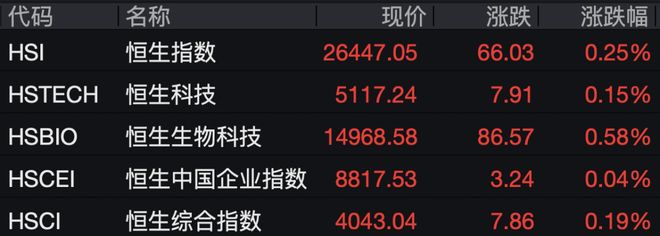
Market Overview - On February 27, the Hang Seng Index opened up by 0.25%, reaching 26,447.05, with an increase of 66.03 points [2] - The Hang Seng Tech Index rose by 0.15%, reaching 5,117.24 [2] Sector Performance Biotechnology Sector - The biotechnology stocks experienced a rebound, with notable gains from: - Zai Lab, up by 4.90% to 15.19 [3] - WuXi Biologics, up by 4.86% to 40.14 [3] - Kelun Pharmaceutical, up by 1.94% to 79.00 [3] Technology Sector - Mixed performance in tech stocks, with: - SenseTime rising over 4% to 2.54 [4] - Tencent Music increasing over 3% to 57.40 [4] - Baidu Group declining over 1% to 122.10 [4]