
油气

Search documents
新闻发布︱国家能源局举行季度例行新闻发布会
国家能源局· 2026-01-30 06:43
Core Viewpoint - The National Energy Administration (NEA) has outlined the energy situation for 2025, emphasizing energy security, green low-carbon transformation, and orderly industry development as key areas of focus for the upcoming years [9][10][12]. Group 1: Energy Supply and Security - By 2025, China's energy supply security will be significantly enhanced, with coal production stable and oil and gas output reaching historical highs, including a 1.5% increase in crude oil production and a 6.2% increase in natural gas production [9][10]. - The electricity supply will remain stable, supported by the commissioning of several ultra-high voltage direct current transmission projects, improving the interconnectivity of the power system [9][10]. Group 2: Green Low-Carbon Transformation - The development of renewable energy will accelerate, with new wind and solar installations exceeding 430 million kilowatts, bringing the total installed capacity to over 1.8 billion kilowatts, and renewable energy generation accounting for over 60% of total power generation [9][10]. - Renewable energy generation is projected to reach approximately 4 trillion kilowatt-hours, surpassing the combined electricity consumption of the 27 EU countries [9][10]. Group 3: Industry Development - The photovoltaic industry will undergo comprehensive regulation, with polysilicon and wafer prices expected to rise by 52% and 35.6%, respectively, by the end of 2025 [10]. - The price of thermal coal at the port is projected to reach 690 yuan per ton, reflecting a 75 yuan increase from the lowest point of the year [10]. Group 4: Winter Energy Supply Assurance - The overall temperature this winter is expected to be close to or slightly warmer than the historical average, but with frequent cold spells, leading to record-breaking electricity loads, including a peak load of 1.433 billion kilowatts on January 21 [12][13]. - The NEA is ensuring stable energy supply through robust monitoring and coordination, with sufficient fuel reserves and optimized electricity supply strategies [13][14]. Group 5: New Energy Storage Development - By the end of 2025, the installed capacity of new energy storage is expected to reach 136 million kilowatts, a growth of 84% compared to the end of 2024, with an average storage duration of 2.58 hours [19][22]. - The North China region will account for the largest share of new energy storage installations, with significant contributions from provinces like Xinjiang and Inner Mongolia [20][21]. Group 6: Electricity Market Development - The total electricity trading volume in 2025 is projected to reach 6.64 trillion kilowatt-hours, a year-on-year increase of 7.4%, with market-based transactions accounting for 64% of total electricity consumption [26][27]. - Cross-regional electricity trading is expected to grow significantly, reaching 1.59 trillion kilowatt-hours, marking an 11.6% increase from the previous year [26][27]. Group 7: Green Certificate Market - The green certificate market is anticipated to see a substantial increase, with a total of 930 million certificates traded in 2025, representing a 120% year-on-year growth [40][41]. - The average trading price of green certificates is expected to stabilize and rise, with a projected average price of approximately 4.14 yuan per certificate in the second half of 2025, a 90% increase from the first half [40][41].


油气投资热度攀升!地缘风险溢价、供给冲击、需求回暖三重利好共振,借道油气ETF华泰柏瑞(561570)一键布局油气产业链
Sou Hu Cai Jing· 2026-01-30 06:19
Group 1 - The oil and gas investment heat is rapidly rising due to multiple favorable factors in the market, including geopolitical tensions and extreme weather in the US affecting supply capacity, alongside OPEC+'s decision to maintain supply restrictions [1] - Demand-side factors include the gradual construction of reserve inventories globally and the expected boost in refined oil consumption due to the Federal Reserve's interest rate cuts, with demand in Asia, Africa, and Latin America anticipated to rise [1] - The US dollar index has reached a near four-year low, further supporting the rise in oil prices denominated in dollars, as historical trends show an inverse relationship between oil prices and the dollar index [1] Group 2 - Huatai Securities indicates that geopolitical premiums have led to a rebound in oil prices during the off-season, with expectations for oil prices to rise in Q2 to Q3 of 2026 due to demand recovery and global reserve accumulation [1] - The Huatai Baichuan Oil and Gas ETF tracks the CSI Oil and Gas Industry Index, which includes 60 fundamentally strong A-share oil and gas companies, providing investors with a convenient tool to access the overall opportunities in the A-share oil and gas sector [1]





宏观固收周报(20260119-20260125):国际避险情绪提升与国内投资风险偏好高企-20260130
Shanghai Securities· 2026-01-30 06:12
1. Report Industry Investment Rating - No relevant content provided 2. Core Views of the Report - The bond market has long - term allocation value, and there is still room for reserve requirement ratio cuts in 2026. The 10 - year Treasury bond yield of 1.83% has long - term investment value, though it may fluctuate in the short term due to high investor risk preference [12] - For A - shares, investors can follow the trend and focus on opportunities in four directions: satellite, commercial aerospace, and military industries; technology sectors like artificial intelligence, chips, etc.; bulk resource products such as non - ferrous metals, gold, and rare earths; and oil, gas, chemical, and petrochemical industries [13] - The US dollar may face continued depreciation pressure during the Fed's interest - rate cut cycle. The euro, pound, and yen will appreciate against the US dollar, while the RMB's appreciation against the US dollar may be relatively lower. Bulk commodities like gold, silver, copper, and oil may continue to rise in price [14] 3. Summary by Related Contents Stock Market Performance - US stock market: The three major US stock indexes declined. From 20260119 - 20260125, the Nasdaq, S&P 500, and Dow Jones Industrial Average changed by - 0.06%, - 0.35%, and - 0.53% respectively. The Hang Seng Index also declined by 0.36% during the same period [4] - A - share market: The large - cap stocks in A - shares declined while small - cap stocks rose, and most growth sectors increased. From 20260119 - 20260125, the Wind All - A Index changed by 1.81%. The CSI A100, CSI 300, CSI 500, CSI 1000, CSI 2000, and Wind Micro - cap stocks changed by - 0.69%, - 0.62%, 4.34%, 2.89%, 4.04%, and 5.16% respectively. In terms of sector styles, blue - chip stocks in the Shanghai Stock Exchange declined while growth stocks rose; in the Shenzhen Stock Exchange, both blue - chip and growth stocks declined; the Beixin 50 Index increased by 2.60%. Among the 30 CITIC industries, 24 industries rose and 6 declined. Leading industries with a weekly increase of more than 5.0% included building materials, petroleum and petrochemicals, steel, non - ferrous metals, basic chemicals, and real estate. Gold, photovoltaic, building materials, satellite, petrochemical, and aerospace ETFs led with a weekly increase of over 5% [5][6] Bond Market Performance - Chinese bonds: The yields of medium - and long - term Treasury bonds in China declined in the past week. From 20260119 - 20260125, the 10 - year Treasury bond futures main contract rose by 0.12% compared to January 16, 2026. The yield of the 10 - year active Treasury bond declined by 1.26 BP to 1.8298% compared to January 16, 2026. Yields of bonds with a maturity of 3 years and above declined [7] - US bonds: US bond yields showed mixed performance. As of January 23, 2026, the 10 - year US bond yield remained unchanged at 4.24% compared to January 16, 2026. Yields of various maturities showed mixed performance from 20260119 - 20260125 [8] Exchange Rate and Commodity Performance - Exchange rates: The US dollar depreciated. From 20260119 - 20260125, the US dollar index declined by 1.88%. The US dollar against the euro, pound, and yen changed by - 1.87%, - 1.89%, and - 1.43% respectively. The US dollar against the offshore RMB exchange rate declined by 0.27% to 6.9487 as of January 23, 2026, and the US dollar against the on - shore RMB exchange rate declined by 0.07% to 6.9642 [9][10] - Commodities: Gold prices rose. From 20260119 - 20260125, the London gold spot price rose by 7.27% to $4946.25 per ounce; the COMEX gold futures price rose by 7.00% to $4936.00 per ounce. The domestic Shanghai gold spot price rose by 7.52% to 1110.3 yuan per gram, and the futures price rose by 7.71% to 1111.88 yuan per gram [11]
国家能源局:新型储能累计装机351GWh,平均储能时长2.58小时
中关村储能产业技术联盟· 2026-01-30 05:40
Core Viewpoint - The article discusses the 2025 energy outlook in China, highlighting significant advancements in energy supply security, green low-carbon transformation, and the development of new energy storage systems, which are crucial for supporting economic recovery and ensuring energy supply stability. Energy Supply Security - By 2025, China's energy supply security is expected to improve significantly, with stable coal production and record-high oil and gas outputs. The industrial crude oil production is projected to increase by 1.5% year-on-year, while natural gas production is expected to rise by 6.2% [5][6] - The power supply is anticipated to remain stable, supported by the commissioning of several ultra-high voltage direct current transmission projects, enhancing the interconnectivity of the power system [6] Green Low-Carbon Transformation - The pace of green low-carbon transformation is accelerating, with new policies aimed at integrating and promoting renewable energy consumption. Wind and solar power installations are expected to exceed 430 million kilowatts, with total installed capacity surpassing 1.8 billion kilowatts, accounting for over 60% of renewable energy generation [6][7] - Renewable energy generation is projected to reach approximately 4 trillion kilowatt-hours, exceeding the combined electricity consumption of the 27 EU countries [6] New Energy Storage Development - New energy storage installations are expected to grow by 84% compared to the end of 2024, reaching a total capacity of 136 million kilowatts (351 million kilowatt-hours) by the end of 2025, marking a more than 40-fold increase compared to the end of the 13th Five-Year Plan [12][14] - The average storage duration is projected to increase to 2.58 hours, an increase of 0.30 hours from the end of 2024 [12] Electricity Market Transactions - The total electricity market transaction volume is expected to reach a record high of 664 billion kilowatt-hours in 2025, with a year-on-year growth of 7.4%. Market-based transactions are projected to account for 64% of total electricity consumption, an increase of 1.3 percentage points [15][16] - Cross-regional electricity transactions are anticipated to grow to 1.59 trillion kilowatt-hours, a historical high, with a year-on-year increase of 11.6% [16] Investment Trends - National energy investment is expected to maintain rapid growth, with key project investments exceeding 3.5 trillion yuan, a year-on-year increase of nearly 11% [21] - Investment in green transition new business formats is accelerating, with significant growth in wind and solar power installations and new energy storage projects [21][27] Regulatory Developments - The article highlights the ongoing reforms in the electricity retail market, with a focus on enhancing the regulatory framework for electricity sales companies to ensure market stability and fair competition [22][23] - The introduction of new rules for long-term electricity market transactions aims to adapt to the evolving energy landscape and support the construction of a unified national electricity market [19][20]

国家能源局:2025年我国可再生能源发电量约4.0万亿千瓦时
Xin Hua Cai Jing· 2026-01-30 05:13
新华财经北京1月30日电(记者安娜) 记者30日从国家能源局获悉,2025年,我国可再生能源发电量约 4.0万亿千瓦时,超过欧盟27国用电量之和。 当日,国家能源局在北京举行新闻发布会。国家能源局发展规划司副司长邢翼腾在会上提供了上述数 据。 "2025年,我国能源供应保障能力有效提升,供需总体宽松,多项重要政策举措密集出台,行业健康有 序发展,新型能源体系建设基础持续夯实,助力我国经济持续回升向好。"邢翼腾在会上说。 据他介绍,2025年是"十四五"以来我国能源保供成效最好的一年,原煤生产保持稳定,规上工业原煤产 量同比增长1.2%;油、气产量双创历史新高,规上工业原油产量同比增长1.5%,规上工业天然气产量 同比增长6.2%;电力供应平稳有序,一批特高压直流输电工程投产送电,电力系统互补互济水平持续 提升。 2025年,我国绿色低碳转型步伐加快,有关部门制定出台新能源集成融合发展、促进新能源消纳和调控 等一系列政策措施,助力新能源发展提质增效。邢翼腾在会上提供的数据显示,2025年,我国风电光伏 新增装机超过4.3亿千瓦、累计装机规模突破18亿千瓦,可再生能源发电装机占比超过六成。 与此同时,我国深入推进 ...
近年来油气行业最大合并倒计时? 传二叠纪巨头Coterra(CTRA.US)与戴文能源(DVN.US)酝酿并购
智通财经网· 2026-01-30 04:22
智通财经APP获悉,媒体援引知情人士透露的消息报道称,美国二叠纪油气巨头Coterra Energy Inc. (CTRA.US)与戴文能源公司(DVN.US)正在就合并进行深入谈判;若达成,这将成为近年来全球规模最大 的油气领域并购交易之一。知情人士表示,两家油气巨头可能在未来几天内宣布并购交易。知情人士补 充称,双方尚未作出任何最终决定,时间安排可能变化,谈判也可能破裂。该交易将加强他们在西得克 萨斯州和新墨西哥州二叠纪盆地的市场领先地位,使他们拥有更大的规模,更好地与埃克森美孚等竞争 对手们进行竞争。 周四在纽约股票市场,并购利好消息催化之下Coterra股价一度上涨4.6%,使该公司市值一度高达约220 亿美元。戴文能源公司股价一度上涨3.7%,市值一度高达260亿美元。 双方关于并购的最新讨论表明,在2025年相对低迷之后,美国大型油气钻探商们正迫切希望通过整合实 现油气资源集中化。该交易将强化它们在得克萨斯州西部与新墨西哥州二叠纪盆地(Permian Basin)的能 源主导地位——这是美国规模最大且产量最高的油气田,并购成功之后的实体将获得更庞大油气市场规 模,以便更好地与埃克森美孚公司(XOM ...


油价景气度持续上升,标普油气ETF嘉实(159518)交投活跃
Jin Rong Jie· 2026-01-30 03:11
标普油气ETF嘉实(159518)管理费+托管费为0.60%/年,既适合普通投资者作为长期配置工具,也能 满足专业投资者的灵活交易需求。 声明:市场有风险,投资需谨慎。本文为AI基于第三方数据生成,仅供参考,不构成个人投资建议。 东方证券研报表示,由于市场担忧产油国地缘冲突或导致油气供给减少,因此近期油价出现持续回升。 若油价继续上升并保持更高水平,预计行业资本开支将边际提升,油服的景气度有望边际上升。 同花顺数据显示,截至10:13,标普油气ETF嘉实(159518)涨3.07%,盘中最高涨超5%,成交额达15 亿元,换手率达101%。 ...
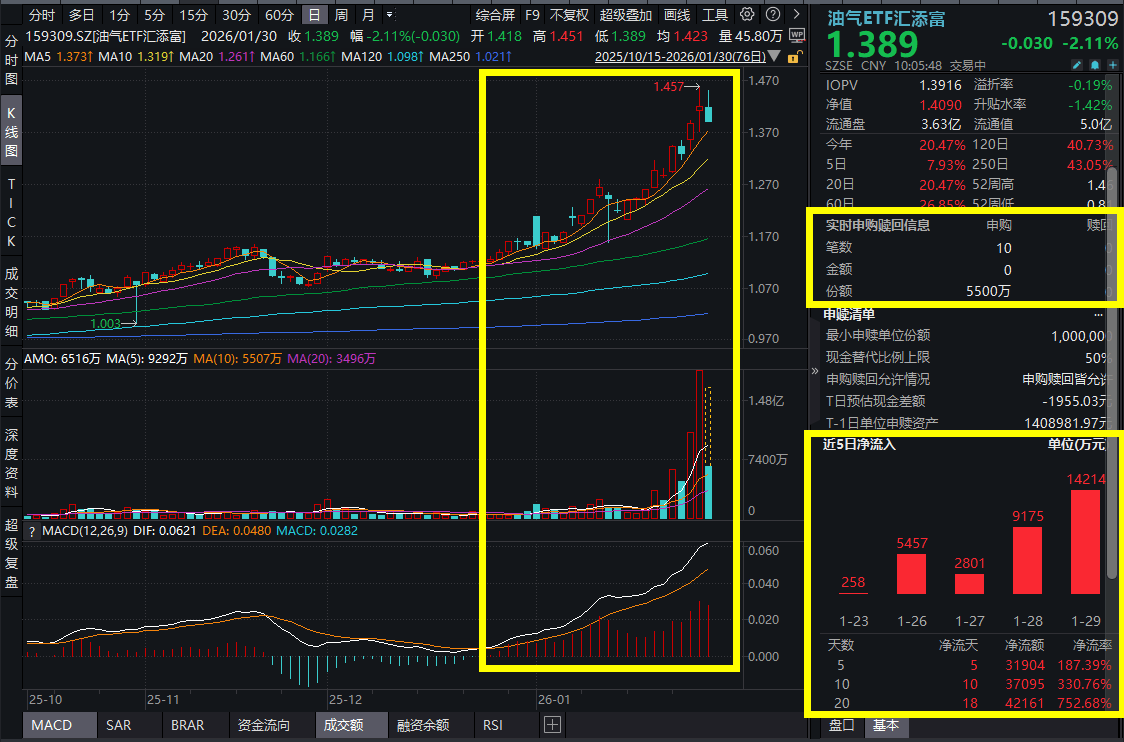
油气板块大幅异动!油气ETF汇添富(159309)跌超2%,盘中强势吸金超7800万元,已连续14日吸金!IEA上调26年原油需求预期!
Sou Hu Cai Jing· 2026-01-30 02:31
消息面上,昨夜,美油主力合约收涨3.64%,报65.51美元/桶;布油主力合约涨3.43%,报69.68美元/桶。市场对美国可能对伊朗发起攻击的担忧加剧,地缘 政治风险升温推升原油供应中断预期,支撑布油价格上涨。 分析人士指出,地缘政治紧张与宏观情绪升温,正推动原油、黄金、白银等大宗商品走强,也意外点燃了国内相关主题LOF基金的交易热度。然而,火爆的 二级市场交易价格已大幅脱离基金净值,形成巨大溢价"泡沫"。不少石油类基金LOF今日停牌1小时,同时也开启了限购措施。 在此背景下,油气ETF汇添富(159309)或更具性价比,凭借ETF的交易优势,跟踪中证油气资源指数的油气ETF汇添富(159309)不仅聚焦国内油气产业 链优质企业,全面把握油气机遇,其溢价水平还相对较低,能更真实地反映价值,其次产品的流动性充沛,交易便捷! 1月30日,A股市场震荡走弱,资源行业跌幅居前,油气ETF汇添富(159309)冲高后回落,开盘一度涨超2%,当前跌超2%,盘中振幅超4%!资金持续涌 入油气板块,油气ETF汇添富(159309)强势吸金超7800万元,加上今日已经连续14日强势吸金超4.7亿元! 油气ETF汇添富(159 ...
万和财富早班车-20260130
Vanho Securities· 2026-01-30 02:23
Domestic Financial Market - The National Development and Reform Commission is coordinating the development of charging infrastructure for new energy vehicles [5] - The Ministry of Civil Affairs is promoting the application of advanced technologies such as humanoid robots and brain-computer interfaces in the development of high-performance intelligent elderly care service robots [5] - The Ministry of Commerce is utilizing the China-US economic and trade consultation mechanism to manage differences and promote cooperation [5] Industry Latest Developments - Shenzhen is encouraging smart home systems to adapt to domestic systems and fully integrate AI, with related stocks including Ying Shi Innovation and Ruixin Microelectronics [7] - New gene therapy strategies are addressing the challenges of efficient delivery of long genes, with related stocks including Meibang Technology and Kaineng Health [7] - The surge in raw material prices and strong demand is leading to a price increase in electronic components, with related stocks including Jiang Hai Co. and Junwei Electronics [7] Focus on Listed Companies - Xinzhou Bang has submitted an application for listing on the Hong Kong Stock Exchange to strengthen its global supply layout for electronic chemicals [9] - Yunji Group plans to raise no more than 788 million yuan through a private placement to expand into intelligent manufacturing and overseas operations [9] - Lixing Co. intends to raise no more than 560 million yuan through a private placement to increase production capacity for high-end bearing rolling elements [9] - Bojie Co. is supplying liquid cooling testing equipment to N clients, with significant supply arrangements expected this year [9] Market Review and Outlook - On January 29, the three major indices showed mixed results, with the Shanghai Composite Index experiencing slight fluctuations and the Shanghai 50 Index rising over 1% [11] - The market saw rapid rotation of hotspots, with over 3,500 stocks declining, while the liquor sector surged in the afternoon [11] - The non-ferrous metals sector remained active, with copper and precious metals leading the gains, and the oil and gas sector continued its strong performance [11] - The real estate sector showed signs of rebound, while the chip industry faced declines [11] - Looking ahead, the market is expected to continue focusing on undervalued and high-certainty sectors, as the growth stocks are undergoing consolidation [11]
委代总统签署并颁布油气法改革法案:欢迎国内外投资参与委油气和石化领域发展
Xin Lang Cai Jing· 2026-01-30 02:04
委内瑞拉代总统罗德里格斯当地时间1月29日签署并颁布油气法改革法案。她发表讲话称,委内瑞拉将 持续推进油气产业改革,欢迎国内外投资参与石油、天然气和石化领域发展,同时通过设立主权基金, 将能源发展成果更多用于改善民生和完善基础设施。(央视新闻) ...