
半导体芯片

Search documents
港股午评:恒指跌0.1%,油价下挫三桶油齐跌,半导体芯片股继续强势,中芯国际再创新高
Ge Long Hui A P P· 2025-09-30 04:12
Market Overview - The Hong Kong stock market showed mixed performance with the Hang Seng Index and the Hang Seng China Enterprises Index declining by 0.1% and 0.13% respectively, while the Hang Seng Tech Index rose by 0.55% [1] - Large tech stocks exhibited varied performance, with Alibaba, NetEase, Kuaishou, and Tencent rising by less than 1%, while Baidu fell by over 1% [1] Semiconductor Sector - Semiconductor stocks continued to perform strongly, with Hua Hong Semiconductor's share price increasing by over 11%, reaching a new historical high, and accumulating a monthly gain of over 48% and an annual gain of approximately 270% [1] - Leading company SMIC also saw its stock rise by over 3%, hitting a new historical price [1] Gold and Commodities - Spot gold prices surpassed $3,860, with an annual increase of over 47%, leading to a rise in most gold stocks [1] - Copper stocks showed relatively strong gains [1] Other Sectors - The biopharmaceutical, aviation, high-speed rail infrastructure, Apple concept, and lithium battery sectors were notably active [1] - Conversely, OPEC+ plans to increase oil production in November led to a decline in international oil prices, causing major oil companies to drop, with China Petroleum shares falling by over 3% [1] - Other sectors such as gambling, home appliances, domestic banks, coal, telecommunications, and paper industries also experienced declines [1] New Listings - Three new stocks saw significant increases, with Xipuni soaring nearly 184%, Zijin Gold International rising nearly 56%, and Botai Che Lian increasing by over 32% [1]

港股午评:恒指跌0.1%,三桶油走低,半导体股强势,3只新股集体大涨
Ge Long Hui· 2025-09-30 04:09
Core Viewpoint - The Hong Kong stock market showed mixed performance in the morning session, with the Hang Seng Index and the Hang Seng China Enterprises Index turning slightly negative, while the Hang Seng Tech Index maintained a gain of 0.55% [1] Group 1: Market Performance - The three major indices experienced divergence, with the Hang Seng Index and the China Enterprises Index down by 0.1% and 0.13% respectively, while the Hang Seng Tech Index rose by 0.55% [1] - Large technology stocks exhibited varied performance, with Alibaba, NetEase, Kuaishou, and Tencent showing gains of less than 1%, while Baidu, Meituan, Xiaomi, and JD.com saw slight declines [1] - Semiconductor stocks continued to perform strongly, with Hua Hong Semiconductor's share price increasing by nearly 12%, reaching a new historical high, and leading company SMIC rising over 3% to also set a new high [1] Group 2: Commodity and Sector Performance - Spot gold prices surpassed $3,860, marking a year-to-date increase of over 47%, leading to a rise in gold stocks, while copper stocks also showed strong gains [1] - Biopharmaceutical, aviation, high-speed rail infrastructure, Apple concept, and lithium battery stocks were notably active [1] - Conversely, OPEC+ plans to increase oil production in November led to a decline in international oil prices, causing major oil companies to drop collectively, with China Petroleum shares falling nearly 3% [1] - Other sectors such as gambling, home appliances, domestic banks, coal, telecommunications, and paper industries also experienced declines [1] Group 3: New Stock Performance - Three new stocks saw significant gains, with Xipuni soaring by 248.31%, Zijin Gold International rising by 60.78%, and Botai Che Lian increasing by 36.69% [1]


港股收评:尾盘加速跳水!恒科指大跌2.89%,科技股退潮,内银股逆势上涨
Ge Long Hui· 2025-09-26 08:31
Market Overview - The Hong Kong stock market indices accelerated declines near midday, with the Hang Seng Tech Index dropping as much as 3.2% and closing down 2.89% at 6195 points [1] - The Hang Seng Index fell 1.35%, returning to around the 26000 mark, while the State-Owned Enterprises Index decreased by 1.49%, narrowly holding above 9300 points [1] Sector Performance - Technology stocks faced significant pressure, with notable declines including Xiaomi down 8%, JD.com down 3.7%, and Alibaba, Kuaishou, Baidu, NetEase, and Meituan all falling by over 2% [1] - Biopharmaceutical stocks collectively dropped following Trump's announcement of a 100% tariff on any brand or patented pharmaceutical products starting October 1 [1] - Semiconductor stocks also experienced declines due to potential U.S. restrictions on overseas chip imports, with leading company SMIC falling by 5% [1] Positive Trends - Wind power generation in China saw a cumulative increase of 10.4% from January to July 2025, leading to strong performance in wind energy stocks, with Goldwind Technology rising over 4% [1] - Small and medium-sized banks have been actively lowering deposit rates, which may alleviate pressure on the banks' liabilities, resulting in a counter-trend rise in domestic bank stocks, with Agricultural Bank and Construction Bank both increasing by over 1% [1] - Other sectors such as military, dairy products, and heavy machinery stocks showed relative activity [1]
美媒:美对华鹰派为何热衷谈AI
Huan Qiu Wang Zi Xun· 2025-09-24 23:14
Group 1 - The article argues that while the U.S. is focused on artificial intelligence (AI) as a key area in the tech competition with China, this perspective is flawed as AI is not the most critical sector in the U.S.-China tech rivalry [1][2] - China has made significant advancements in various technology sectors, including solar energy, batteries, and electric vehicles, where it currently leads the U.S. [1] - China's overseas investment in clean energy has exceeded $220 billion since 2022, and its new solar capacity in the first half of this year was more than 12 times that of the U.S. [1] Group 2 - Critics argue that AI has not lived up to expectations and has been overhyped, similar to previous technologies like blockchain and the metaverse [2] - The focus on AI by U.S. hawks is partly due to it being one of the few tech areas where the White House has not actively engaged in conflict, despite potential changes in this stance [2][3] - The clean energy sector poses greater challenges for the U.S. to regain competitiveness, requiring substantial investment and political consensus, making AI a more convenient topic for discussion [3]
完成10亿融资!碳化硅破解先进封装散热难题,英伟达也要用
DT新材料· 2025-09-24 16:04
Group 1 - The core viewpoint of the article highlights the successful completion of a C round financing by Shanghai Zhanchip Electronics Technology Co., Ltd., raising over 1 billion RMB, which strengthens its position in the silicon carbide (SiC) industry [2][11] - The financing was led by the National Development Fund for Manufacturing Transformation and Upgrading, with participation from multiple investment institutions, bringing the total financing since its establishment in 2017 to nearly 3 billion RMB [2][11] - Zhanchip Electronics focuses on developing SiC power devices and has achieved significant milestones in product commercialization, supplying to well-known clients in the electric vehicle and renewable energy sectors [10][11] Group 2 - The semiconductor industry is facing significant thermal challenges due to the evolution of advanced packaging technologies, which are leading to increased heat density that exceeds traditional cooling methods [3] - Advanced packaging techniques such as 2.5D/3D packaging and Chiplet integration are contributing to higher thermal flow densities, necessitating innovative cooling solutions [3] - Silicon carbide (SiC) is emerging as a key material for addressing these thermal challenges due to its superior thermal conductivity and compatibility with silicon [5][8] Group 3 - SiC is utilized in advanced packaging not as a chip material but as a thermal substrate or intermediary layer, enhancing heat dissipation in stacked configurations [6][7] - The high thermal conductivity of SiC (approximately 270-490 W/m·K) significantly outperforms traditional materials, allowing for efficient heat spreading and reducing the risk of hotspots [8] - SiC's thermal expansion coefficient closely matches that of silicon, which minimizes stress during temperature fluctuations, thereby improving reliability and lifespan of the packaging [8]

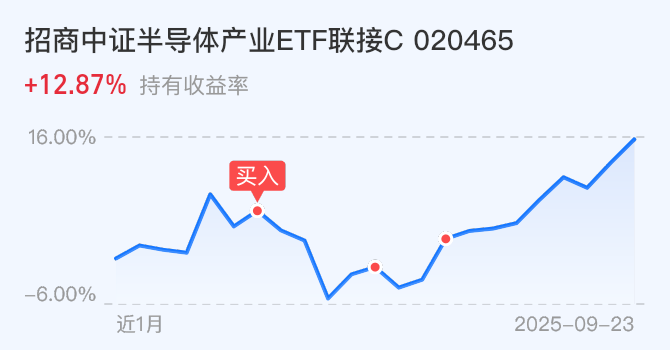
操作:注意了!撤退,紧急撤退一个基金!同时追击4个方向
Ge Long Hui· 2025-09-24 11:43
Group 1 - The semiconductor sector is experiencing a surge, driven by positive developments in technology, indicating a strong market outlook for this industry [1][9] - The AI infrastructure investment by Alibaba, amounting to 380 billion, highlights the increasing demand for AI computing power, suggesting a bright future for AI-related companies [1][2] - The "Artificial Intelligence +" policy is set to enhance applications across various industries, including gaming, healthcare, education, and automotive, which could lead to significant growth opportunities [2] Group 2 - The fund focusing on AI infrastructure and hard technology has shown a strong performance with a year-to-date increase of 127.91%, reflecting the explosive growth in AI computing demand [2] - The robotics sector is poised for growth, supported by favorable policies and technological advancements, with a target for mass production of humanoid robots by 2025 [3][4] - The Hong Kong technology sector is recovering from previous declines, with valuations at historical lows, providing a solid foundation for potential upside as the economy stabilizes [4] Group 3 - The market is seeing a shift towards diversified investments, with a focus on both fixed income and equities to balance risk and return [1] - The performance of the semiconductor and robotics sectors indicates strong investor interest and potential for further gains in the near term [3][9] - The overall sentiment in the technology sector remains optimistic, with expectations of continued recovery and growth driven by AI advancements and economic stabilization [4]
港股收评:单边上行!恒科指大涨2.5%,阿里巴巴劲升超9%
Ge Long Hui· 2025-09-24 08:45
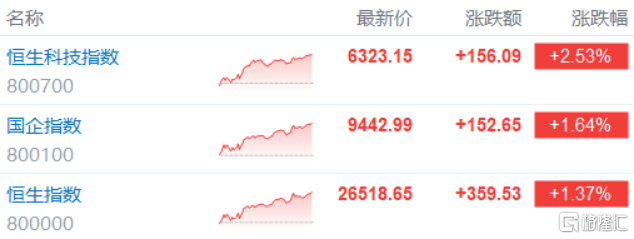
Market Overview - The Hong Kong stock market experienced a significant upward trend on September 24, with the Hang Seng Technology Index rising by 2.53%, the Hang Seng Index increasing by 1.37% to reclaim the 26,500-point mark, and the Hang Seng China Enterprises Index gaining 1.64% [1][2]. Leading Stocks - Major technology stocks led the market rally, with Alibaba surging over 9%, Kuaishou and JD.com rising nearly 4%, Xiaomi increasing by 2.6%, and Tencent up by 2% [3][5]. - Alibaba's stock price reached HKD 174.00, reflecting a gain of HKD 14.60 or 9.16% [6][8]. Sector Performance - The semiconductor sector continued to show strength, with leading company SMIC reaching a historical high during the trading session [3][9]. - AI concept stocks and application software stocks also performed actively, while sectors such as military, home appliances, solar energy, gaming, and lithium battery stocks saw widespread gains [2][3]. Industry Developments - Alibaba announced a collaboration with NVIDIA at the 2025 Alibaba Cloud Summit, focusing on various aspects of Physical AI, including data synthesis, model training, and environment simulation [5][7]. - The semiconductor industry is experiencing a price increase, with TSMC reportedly raising prices for its 2nm chips by at least 50%, benefiting companies like SMIC [9][10]. Renewable Energy Sector - Solar energy stocks saw an increase, with companies like Kamda Solar rising over 5% following a statement from the National Energy Administration emphasizing the need for high-quality development in the renewable energy sector [11][12]. Regulatory Environment - The Ministry of Industry and Information Technology and other departments issued a plan to stabilize growth in the building materials industry, imposing strict controls on cement and glass production capacity [15][16]. Investment Trends - Southbound funds recorded a net inflow of HKD 13.705 billion, indicating strong investor interest in the Hong Kong market [20].

港股收评:单边上行!恒科指大涨2.5%,恒指重回26500点关口,阿里巴巴升超9%
Ge Long Hui A P P· 2025-09-24 08:37
Core Viewpoint - The Hong Kong stock market experienced a significant rebound with major indices showing strong upward trends, indicating a revival in market sentiment after a period of adjustment [1] Market Performance - The Hang Seng Technology Index rose by 2.53%, leading the gains, while the Hang Seng Index increased by 1.37%, reclaiming the 26,500-point mark, and the National Enterprises Index climbed by 1.64% [1] Sector Highlights - Major technology stocks drove the market higher, with Alibaba surging over 9% following the announcement of a collaboration with Nvidia on Physical AI [1] - Other notable gainers included Kuaishou and JD.com, both rising nearly 4%, Xiaomi up 2.6%, Tencent increasing by 2%, and Meituan gaining over 1% [1] - Semiconductor stocks remained strong due to price increases and domestic production drives, with SMIC reaching a new historical high during the trading session [1] - AI concept stocks and application software stocks also showed active performance, alongside gains in military, home appliance, photovoltaic, gaming, and lithium battery sectors [1] Underperforming Sectors - Conversely, cryptocurrency-related stocks and biopharmaceutical stocks experienced notable declines, with paper, heavy machinery, gold, building materials, and coal sectors also showing collective weakness [1] - Additionally, over 20 stocks in the market recorded declines of more than 10% [1]
港股收评:单边上行!恒科指大涨2.5%,恒指重回26500点关口,阿里巴巴劲升超9%
Ge Long Hui· 2025-09-24 08:28
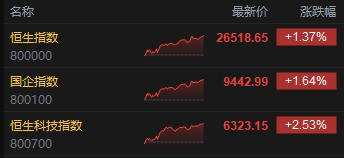
Market Performance - The Hong Kong stock market indices experienced a strong upward trend, with the Hang Seng Technology Index leading the gains at 2.53%, while the Hang Seng Index rose by 1.37% to reclaim the 26,500-point mark, and the National Enterprises Index increased by 1.64% [1] Sector Performance - Major technology stocks drove the market higher, with Alibaba surging over 9% following the announcement of a Physical AI collaboration with NVIDIA. Other notable gainers included Kuaishou and JD.com, both rising nearly 4%, Xiaomi up 2.6%, Tencent increasing by 2%, and Meituan gaining over 1% [1] - Semiconductor stocks remained strong due to price increases and domestic production drives, with leading company SMIC reaching a new historical high during trading [1] - AI concept stocks and application software stocks showed active performance, alongside gains in military, home appliance, photovoltaic, gaming, and lithium battery sectors [1] Declining Sectors - Conversely, cryptocurrency concept stocks and biopharmaceutical stocks faced significant declines, with paper, heavy machinery, gold, building materials, and coal stocks also showing collective weakness. Additionally, over 20 stocks in the market recorded declines of more than 10% [1]
光大期货金融期货日报-20250924
Guang Da Qi Huo· 2025-09-24 04:10
Report Industry Investment Rating - The investment rating for stock index futures is "Relatively Strong", and for treasury bond futures is "Oscillating" [1] Core Viewpoints - The market fluctuated throughout the day with the three major indexes showing mixed results. Over 4,200 stocks in the Shanghai, Shenzhen, and Beijing markets closed lower, and the trading volume exceeded 2.51 trillion yuan. The Fed cut interest rates by 25BP, but its stance was cautious, and there was internal divergence on the path of interest rate cuts this year. The domestic economic data in August showed a slight decline in demand - side indicators, indicating that the economy is still on the way to bottom - out and stabilize. The implementation of the parenting subsidy system is expected to boost inflation through more inclusive fiscal policies. As the important meeting in October approaches, the long - short game intensifies, and it is advisable to reduce long positions appropriately [1] - Treasury bond futures closed lower across the board. The central bank conducted 276.1 billion yuan of 7 - day reverse repurchase operations, with a net withdrawal of 10.9 billion yuan. The short - term central bank's signal to support the capital market is obvious. With the current fundamental factors being mixed, the bond market shows no obvious turning point signal and will continue the oscillating trend [1][2] Summary by Directory 1. Daily Price Changes - **Stock Index Futures**: On September 23, 2025, IH was at 2,925.0 (up 2.0, 0.07% from the previous day), IF was at 4,483.8 (down 0.2, 0.00%), IC was at 6,940.6 (down 72.6, - 1.04%), and IM was at 7,127.0 (down 103.2, - 1.43%) [3] - **Stock Indexes**: The Shanghai Composite 50 was at 2,919.5 (down 2.7, - 0.09%), the CSI 300 was at 4,519.8 (down 2.8, - 0.06%), the CSI 500 was at 7,180.7 (down 44.4, - 0.61%), and the CSI 1000 was at 7,408.1 (down 81.4, - 1.09%) [3] - **Treasury Bond Futures**: On September 23, 2025, TS was at 102.35 (down 0.052, - 0.05%), TF was at 105.63 (down 0.145, - 0.14%), T was at 107.72 (down 0.26, - 0.24%), and TL was at 114.32 (down 0.81, - 0.70%) [3] 2. Market News - **Diplomatic Response**: The Ministry of Foreign Affairs stated that the tariff war and trade war are not in the interests of any party, and both sides should resolve issues through negotiation on the basis of equality, respect, and reciprocity [5] - **Stock Market Performance**: The market fluctuated throughout the day. The shipping sector was strong, with Nanjing Port and Ningbo Shipping hitting the daily limit. Bank stocks rebounded, with Nanjing Bank and Xiamen Bank rising more than 3%. The tourism sector adjusted, with Yunnan Tourism and Tibet Tourism hitting the daily limit down. Semiconductor chip stocks strengthened in the afternoon, with many stocks such as Demingli and Leon Micro hitting the daily limit [5][6] 3. Chart Analysis - **Stock Index Futures**: The report presents the trends and basis trends of IH, IF, IC, and IM contracts, as well as the trends of the Shanghai Composite 50, CSI 300, CSI 500, and CSI 1000 indexes [8][10][12] - **Treasury Bond Futures**: The report shows the trends of treasury bond futures contracts, treasury bond spot yields, basis, inter - period spreads, cross - variety spreads, and capital interest rates [15][18][20] - **Exchange Rates**: The report includes the trends of the US dollar against the RMB, the euro against the RMB, forward exchange rates, the US dollar index, and cross - currency exchange rates [24][25][28] 4. Member Introduction - Zhu Jintao, a master of economics from Jilin University, is the director of macro - financial research at Everbright Futures Research Institute [32] - Wang Dongying, an index analyst with a master's degree from Columbia University, mainly tracks stock index futures, focusing on macro - fundamental quantification, key industry sector research, index earnings report analysis, and market capital tracking [32]